By using this website, you agree to our use of cookies (needed to provide our website’s features) and our Terms of Use.
By: Andrew Forrest - May 2026
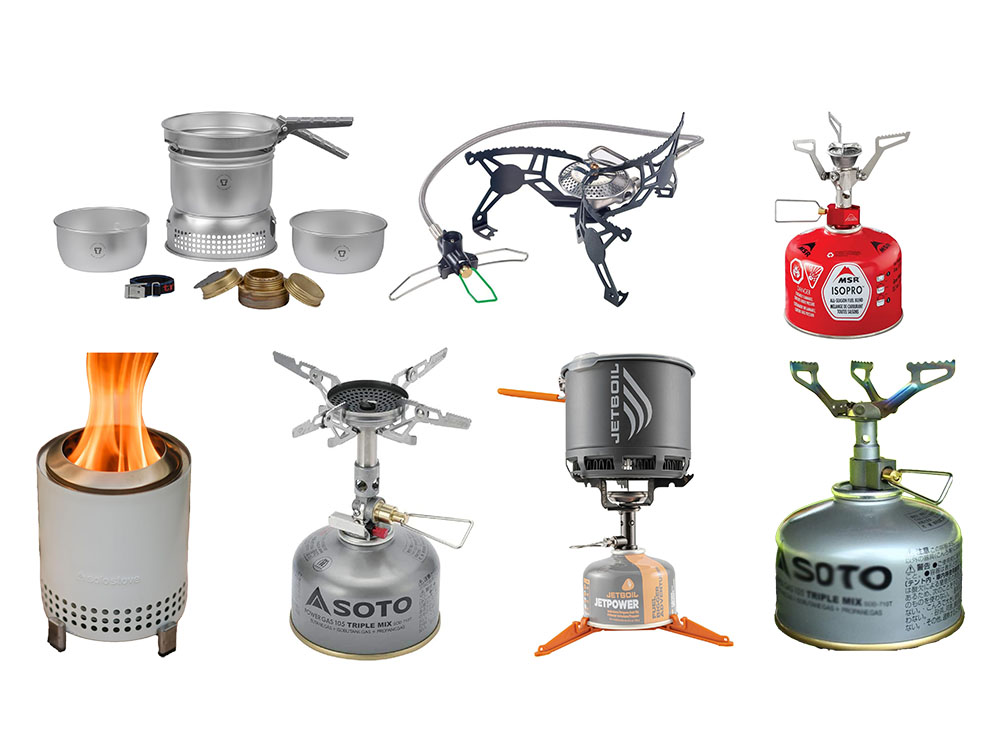
Compare the best lightweight camping stoves for walkers and campers, including gas, integrated, spirit, liquid-fuel and wood-burning options, plus a detailed UK buyer's guide and safety tips.
A lightweight camping stove is one of those bits of kit you only truly appreciate when you are tired, cold, hungry, or desperate for a proper brew. Whether you are spending a night on the hills, camping at a family campsite, bikepacking, fishing, travelling in a campervan, or simply making a hot drink after a long walk, the right stove can make camp feel much more comfortable.
The best camping stove for you depends on how you actually cook outdoors. Some walkers only need to boil water quickly for dehydrated meals and coffee. Others want a stable stove for pasta, porridge, sausages, noodles or a small frying pan. Some people prioritise the lowest possible weight, while others care more about fuel efficiency, wind performance, simplicity or safety.
In this Walks4all guide, we have selected seven lightweight camping stoves for different use cases, suitable for UK walkers, wild campers, backpackers and weekend campers.
This page contains affiliate links. As an Amazon Associate, we earn from qualifying Amazon purchases at no additional cost to you. We may also earn commissions from other retailers, again at no additional cost to you.
| Category | Our choice | Best for | Approx. weight |
| Best overall lightweight camping stove | SOTO WindMaster with 4Flex | Walkers, backpackers and campers who want one small stove that can boil quickly, simmer properly and cope with breezy UK campsites. | 87 g with 4Flex pot support, around 60 g stove body only |
| Best simple all-round stove for walkers | MSR PocketRocket 2 | Walkers who want a simple, proven stove for tea, coffee, dehydrated meals and straightforward campsite cooking. | 73 g |
| Best budget ultralight camping stove | BRS-3000T | Ultralight walkers, backup stove users and budget campers who mainly boil water in a small pot. | 25-26 g |
| Best lightweight all-in-one stove system | Jetboil Stash | Campers and walkers who mainly want fast hot water for coffee, tea and freeze-dried meals. | around 200-232 g depending on accessories included |
| Best stable lightweight stove for proper cooking | Optimus Vega | Campers who want a lightweight stove that is better with pans, simmering and exposed conditions than a top-mounted burner and has 4-season capability. | around 178-185 g |
| Best spirit stove system | Trangia 27-1 UL | Campers who value simplicity, durability and an all-in-one cook set more than the lightest possible stove weight. | around 684 g for the 27-1 UL cook set, depending on exact version |
| Best compact wood-burning camping stove | Solo Stove Mesa | Campers who want a compact, contained tabletop wood-burning fire pit for permitted campsites, garden camping and relaxed outdoor cooking. | around 635 g |
Note: Fuel is not included with any of these stoves - it must be purchased separately.
 |
 |
A compact, regulated gas canister stove that balances low weight, wind performance and proper simmer control better than most tiny burners.
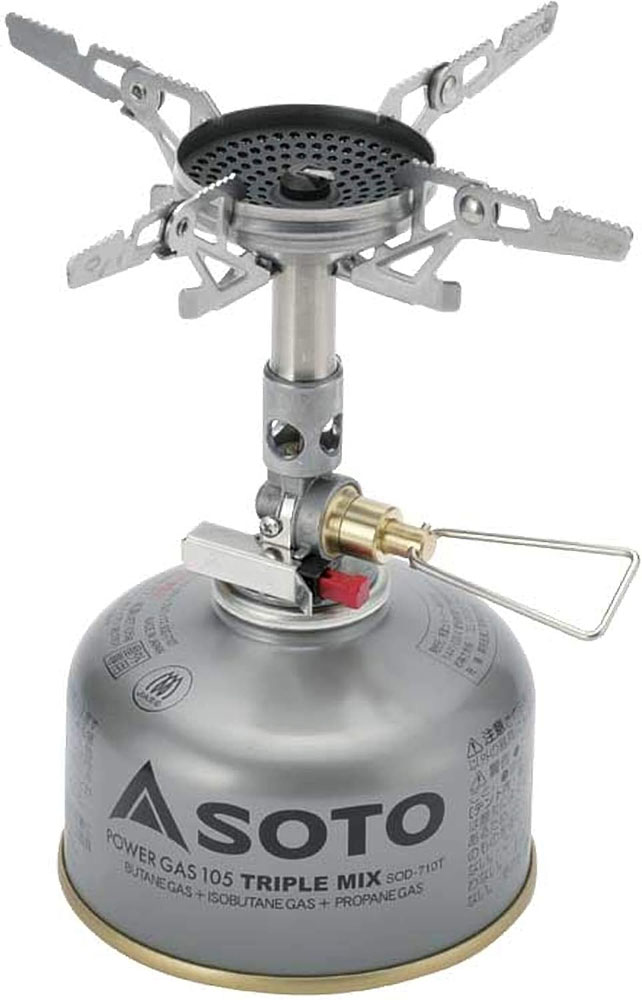
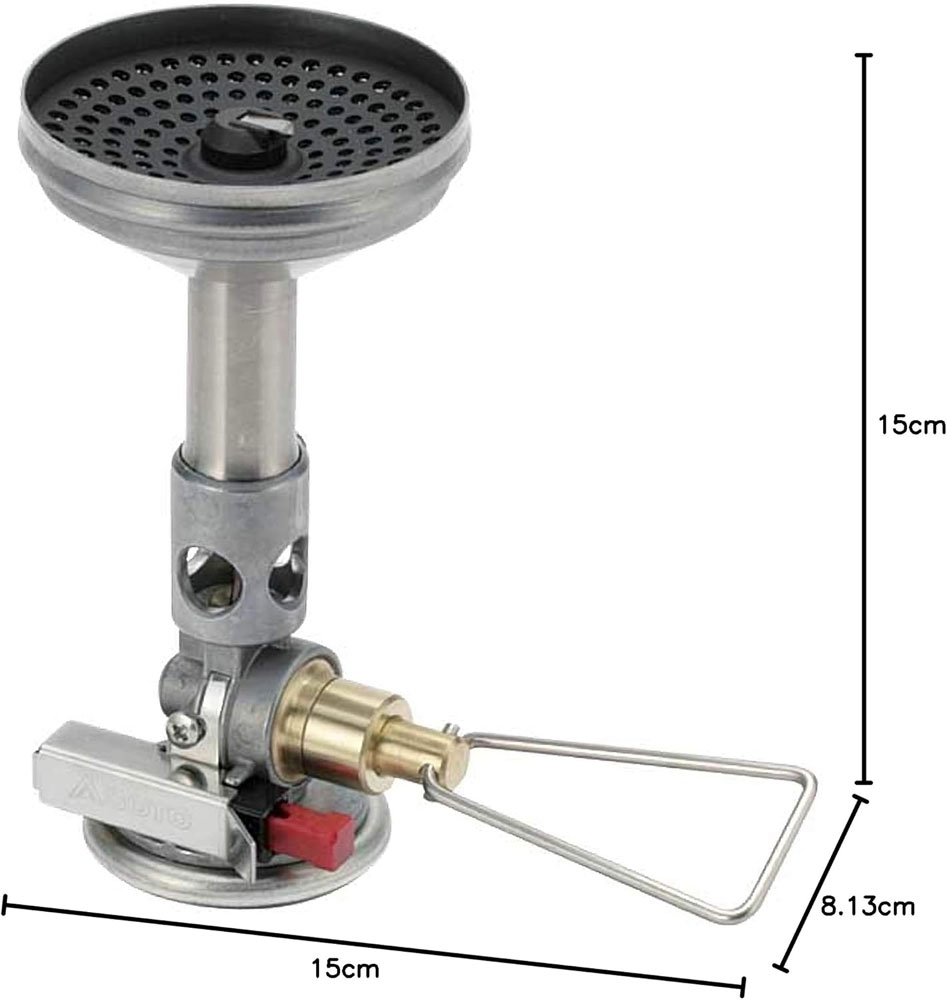
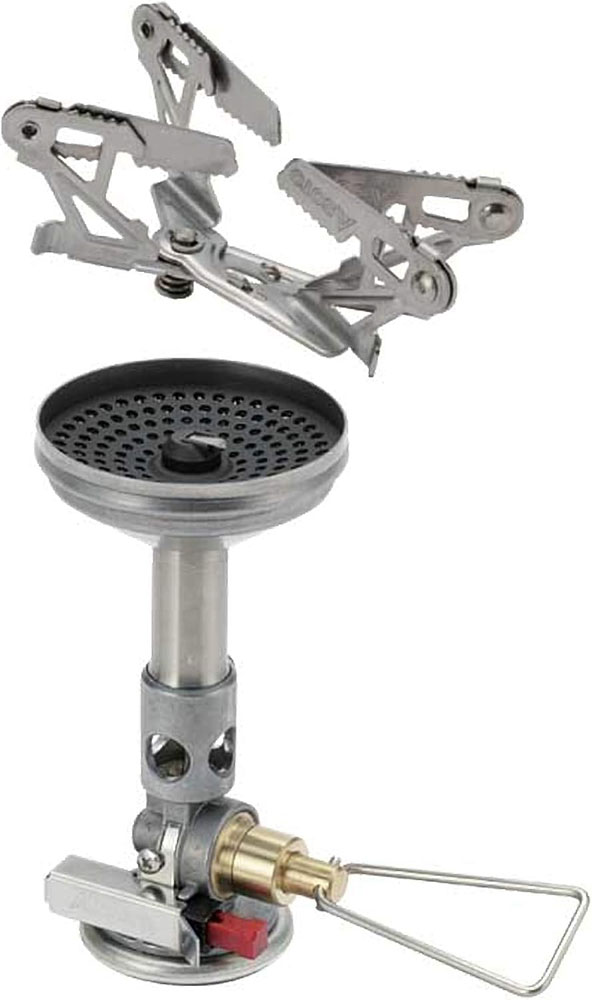
Best for: Walkers, backpackers and campers who want a compact stove that boils quickly, simmers properly and copes with breezy UK campsites.
Specs
Key features
Why buy the SOTO WindMaster with 4Flex?
If we were choosing one small stove for most UK walking and camping trips, the SOTO WindMaster with 4Flex would be near the top of the list. It is light enough for backpacking, powerful enough for quick brews, and far better at real cooking than many tiny gas burners. It is not just a 'boil water and hope for the best' stove; the flame control is good enough for porridge, rice, noodles and simple one-pan meals.
Soto's Windmaster stove features a micro-regulator that stabilises output in cold weather and an internal piezo igniter designed to resist damage. Additionally, it has a specialised burner head to prevent performance issues in windy conditions.
The main reason it stands out is its balance of stability, wind resistance and simmering. Many ultralight stoves are impressively compact until you put a pot on them in a breeze. The WindMaster feels more composed. The 4Flex pot support spreads the load better than narrow fold-out arms, and the burner design handles exposed spots better than many basic canister stoves.
It is still a small upright gas stove, so you need to use it sensibly. Large family pans, frying pans and tall pots can still feel top-heavy on a gas canister. For one or two people, though, it is a superb lightweight all-rounder and a strong Walks4all top choice for walkers who want one dependable stove rather than a cupboard full of niche burners - that said, I do have a boxful of them!
Pros:
Cons:
|
|
A classic lightweight gas stove that is compact, reliable, easy to use and widely recommended for solo and two-person backpacking. It's an improvement on the pocket rocket that was my main camping stove for many mountain marathons.
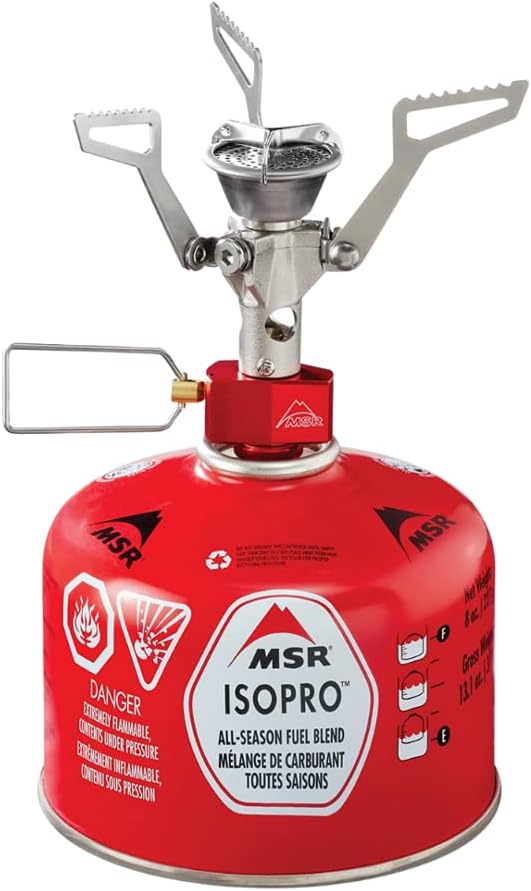
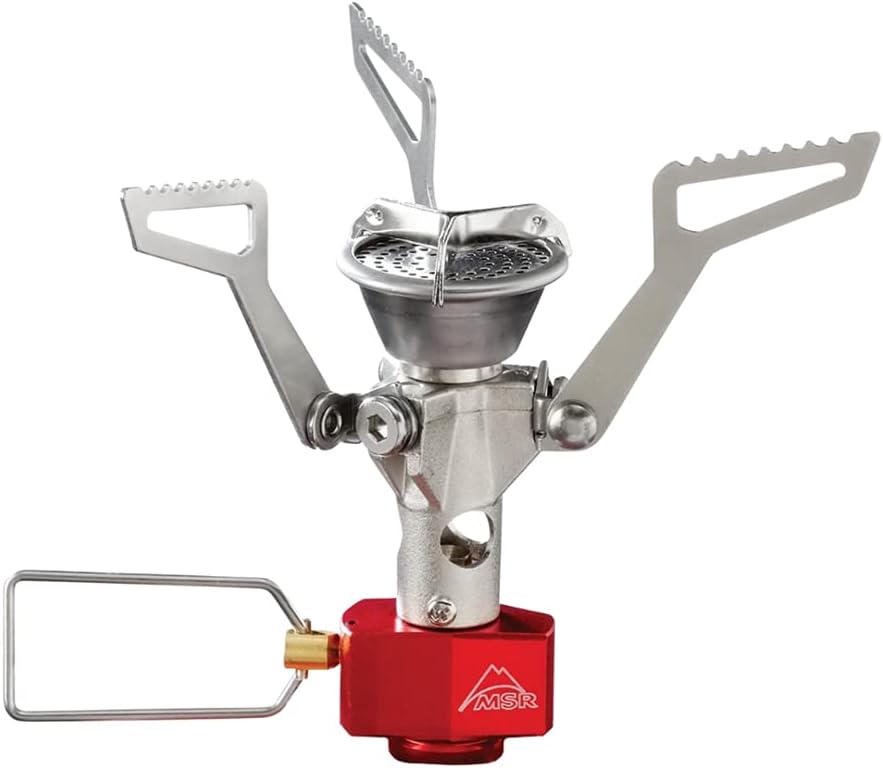
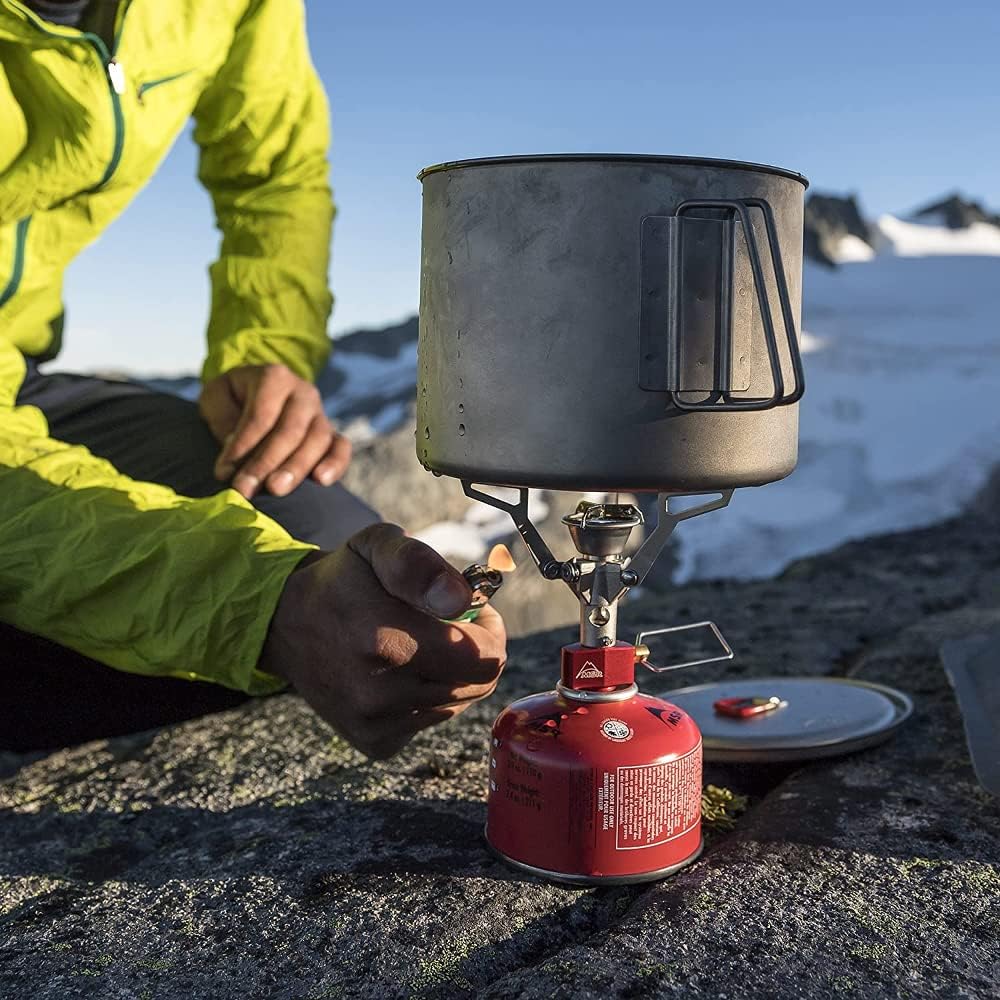
Best for: Walkers and campers who want a simple, proven stove for tea, coffee, dehydrated meals and straightforward campsite cooking.
Specs
Key features
Why buy the MSR Pocket Rocket 2?
The MSR Pocket Rocket 2 is the sort of stove many walkers should buy first. It is not the most exotic stove here, and it does not have an integrated cooking pot, but that is part of its appeal. It is small, reliable, simple to use, and light enough that you will actually pack it. For me, it provided many a meal over the years during the mountain marathons I took part in - it was a step up (or down in weight) from the Trangia I initially used.
The Pocket Rocket 2 is now lighter due to redesigned pot supports. These supports offer a broad surface ideal for larger pans and feature serrated edges to secure your pot. The cross-section above the burner head offers additional wind protection, preventing sudden gusts from extinguishing the flame, and it functions effectively.
For most weekend camps, it does exactly what you need: boil water for hot drinks, heat boil-in-the-bag meals, cook noodles, make porridge, and handle basic one-pot dishes. The flame adjustment is sufficient for simple simmering if you use sensible cookware and keep it out of strong winds. It also includes an ultralight hard-shell protective carry case.
Its biggest weakness is also what makes it easy to live with: it is a standard upright canister stove. It is less stable than a remote canister stove and less fuel-efficient than a heat-exchanger system in rough conditions. But if you want a fuss-free stove that can live in a rucksack for years, the Pocket Rocket 2 remains a safe recommendation.
Pros:
Cons:
|
|
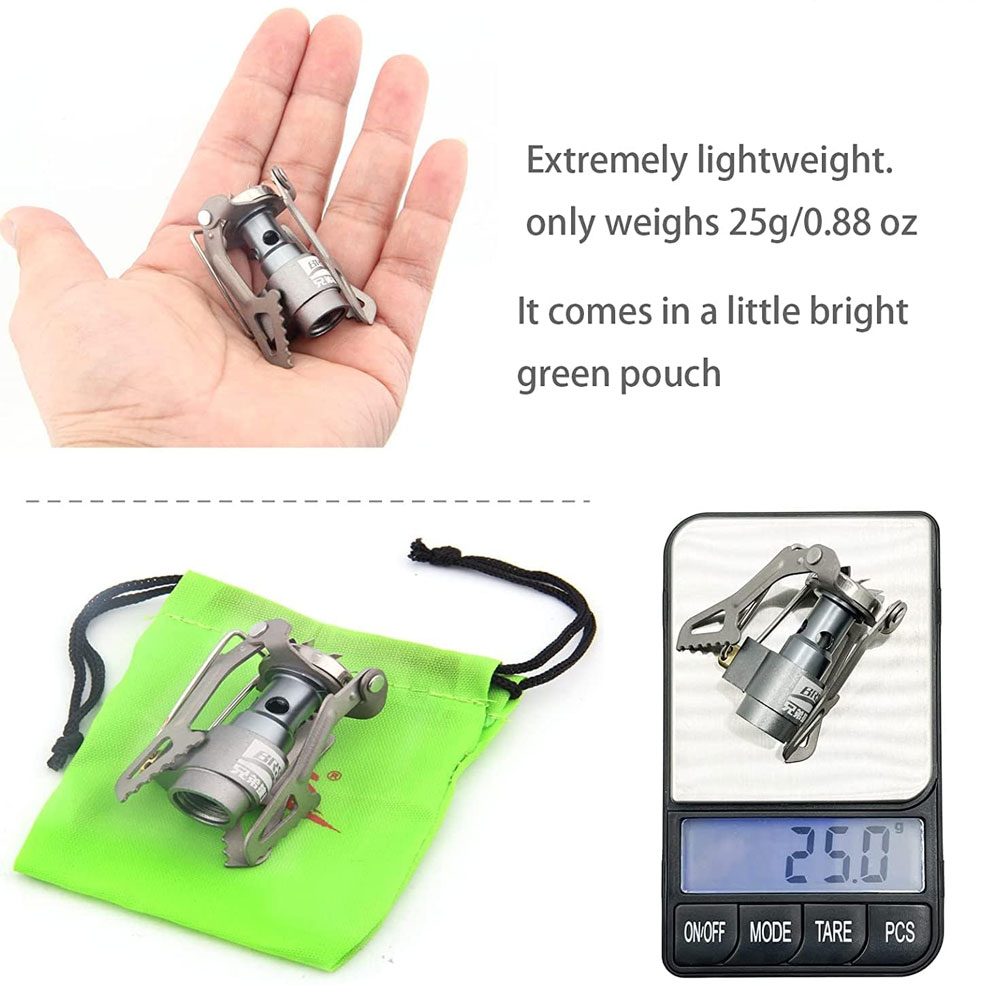
A tiny titanium gas stove that weighs around 26 g and costs far less than premium burners, but requires you to accept compromises in stability and wind resistance.
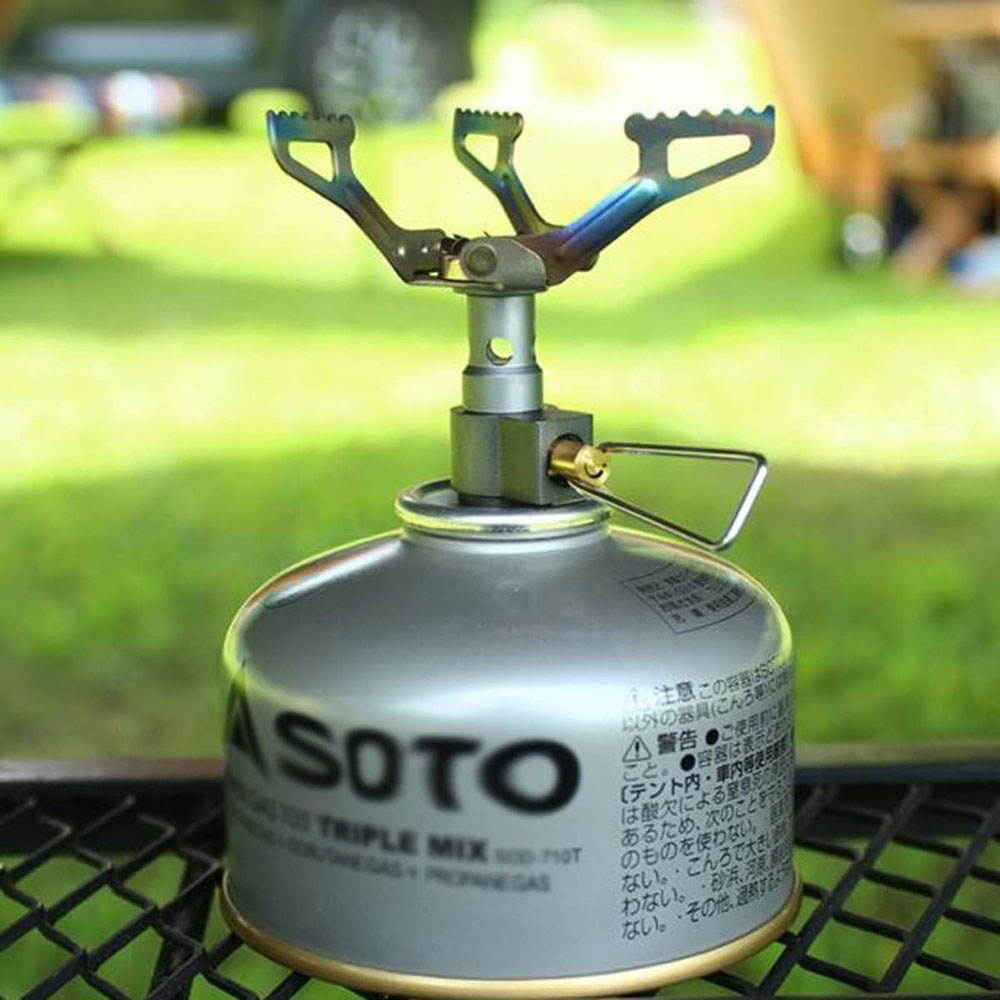
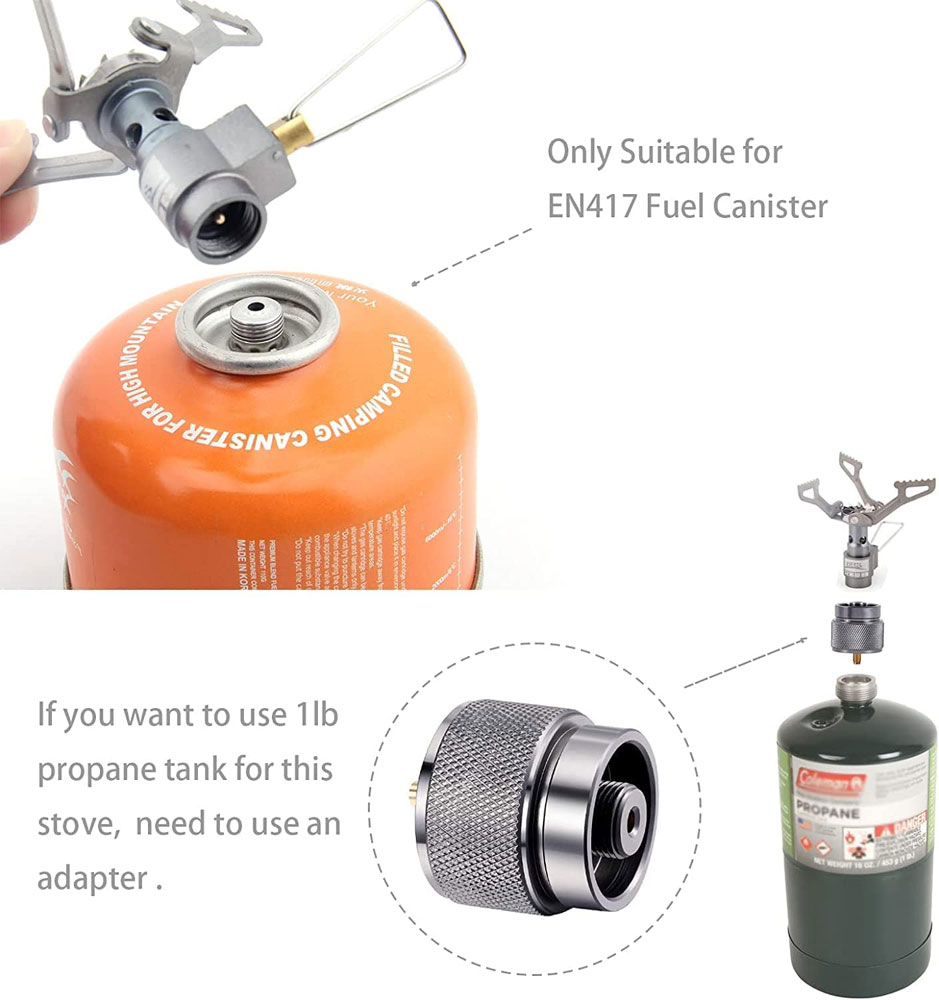
Best for: Ultralight walkers and campers, backup-stove users and budget campers who mainly boil water in a small pot.
Specs
Key features
Why buy the BRS-3000T?
The BRS-3000T is famous for being almost absurdly light. At around 26 g, it is lighter than many multi-tools and can disappear into a small cook pot. For walkers counting every gram, that is a real advantage, especially on short trips when all you need is hot water for drinks and dehydrated meals.
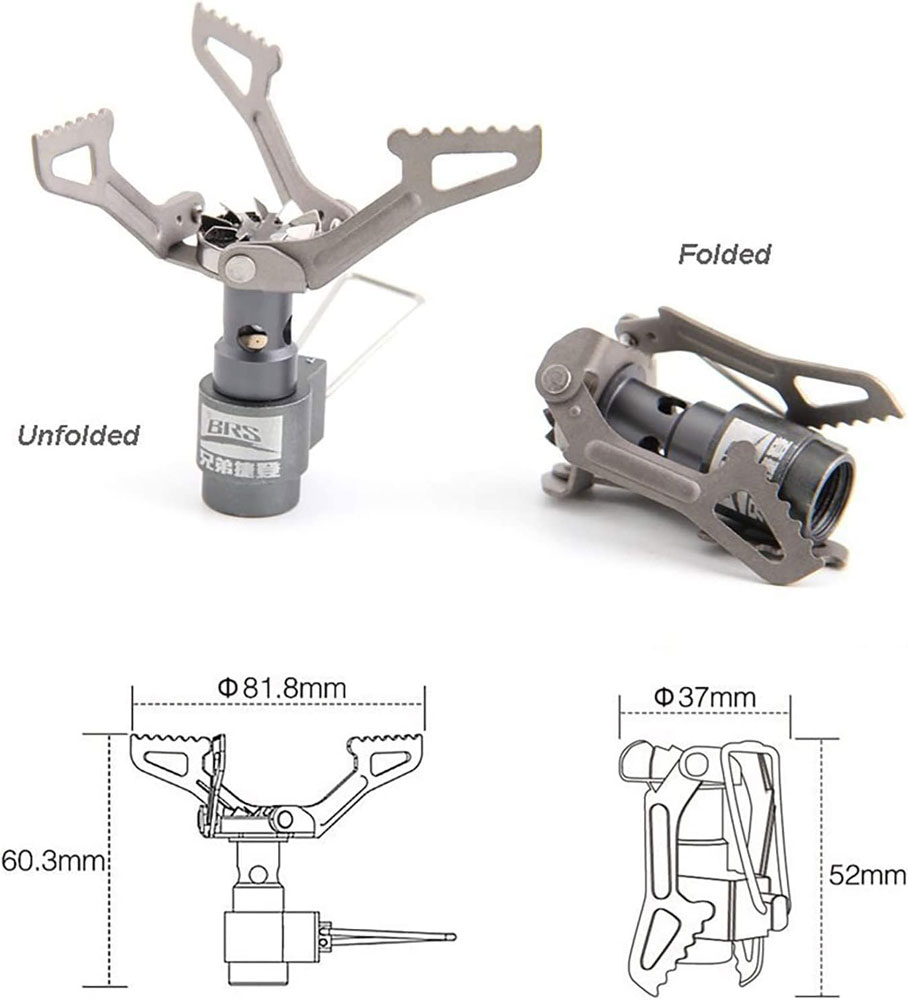
The BRS 3000-T stove is renowned as an iconic ultralight choice for thru-hikers, fastpackers and anyone who prioritises minimal weight and dependable performance. Crafted from titanium, this stove is extremely lightweight, making it perfect for those aiming to reduce pack weight without sacrificing functionality. It folds down to a very compact 37mm x 52mm, taking up minimal space in your pack and fitting easily into most pots.
It is also very affordable, making it attractive for beginners or anyone building a budget wild-camping setup. The key point is to understand what you are giving up. The pot supports are small, the burner head is exposed, and wind can quickly degrade performance. It is not the stove we would choose for a big frying pan, an exposed mountain camp, or a winter meal where reliability matters more than grams.
Used within its limits, it offers excellent value. Pair it with a small pot, a canister stabiliser, a lighter and a sheltered cooking spot. Treat it as a tiny water-boiling stove rather than a full camp kitchen, and it makes far more sense. These will really suit those who count every gram or are on a tight budget, but for me, given the extra 50 g or so and the additional cost, the MSR Pocket Rocket 2 is much more stable.
Pros:
Cons:
|
|
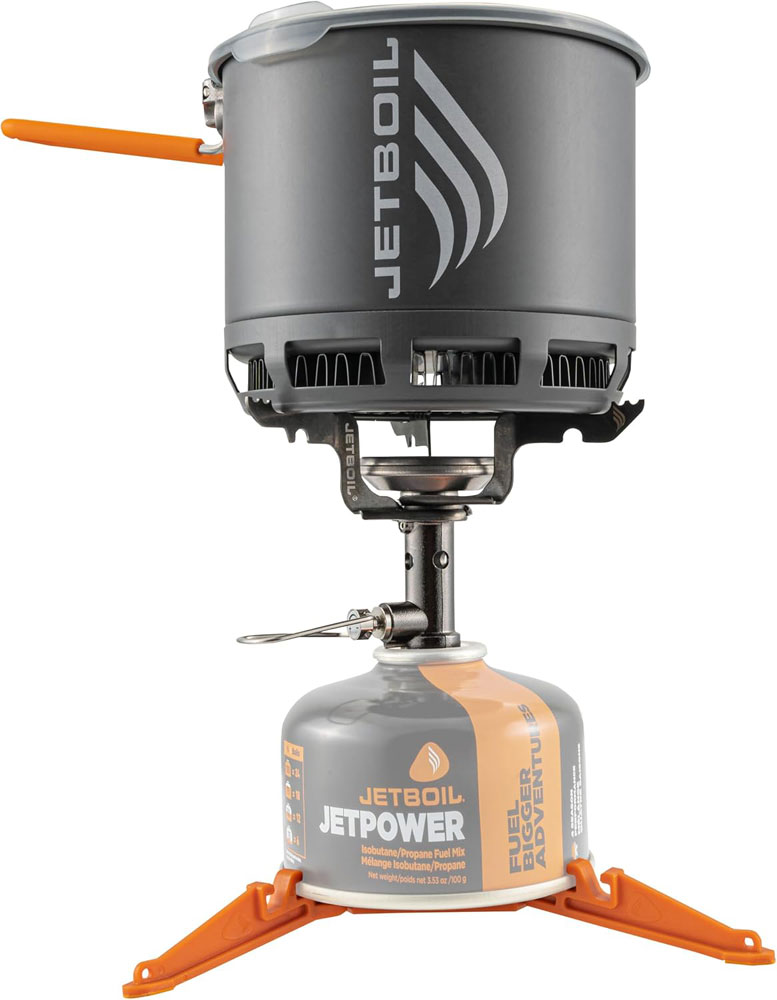
A lightweight, integrated gas stove and a 0.8-litre heat-exchanger pot designed for fast, efficient boiling without the bulk of heavier Jetboil systems.
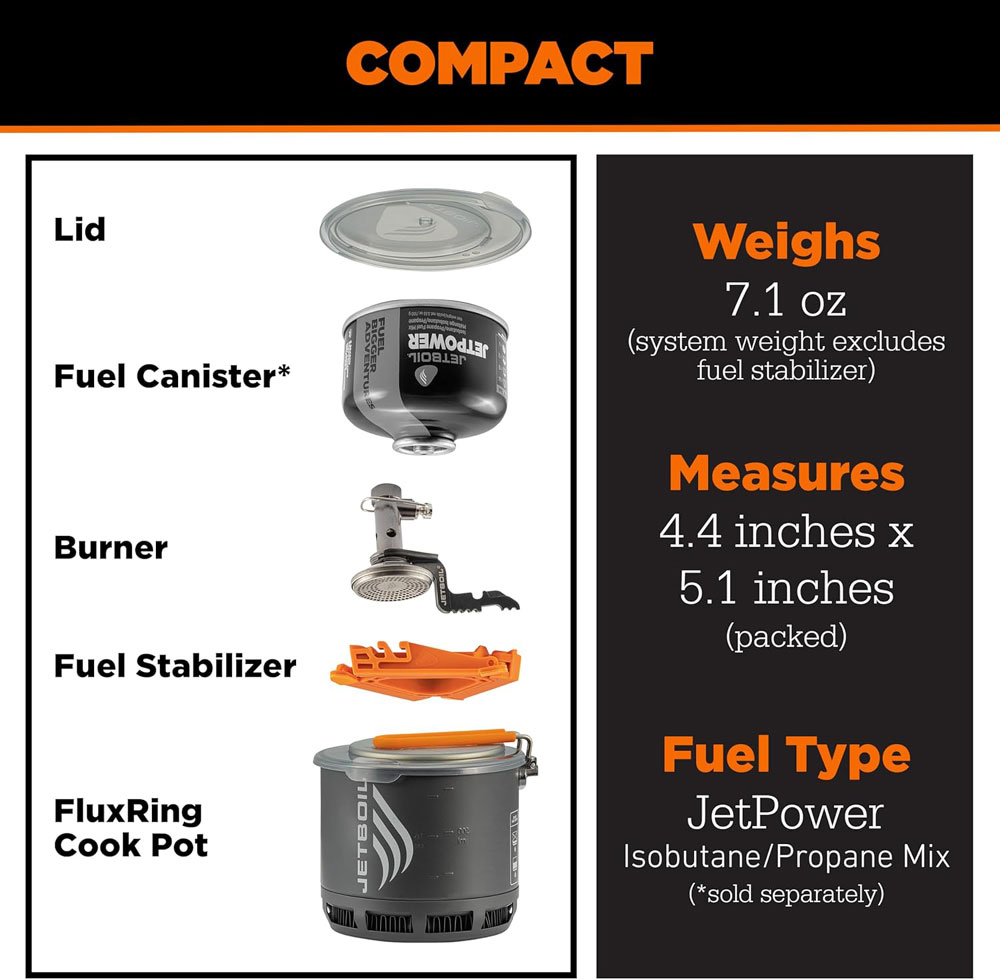
Best for: Campers and walkers who primarily want fast, hot water for coffee, tea, and freeze-dried meals.
Specs
Key features
Why buy the Jetboil Stash?
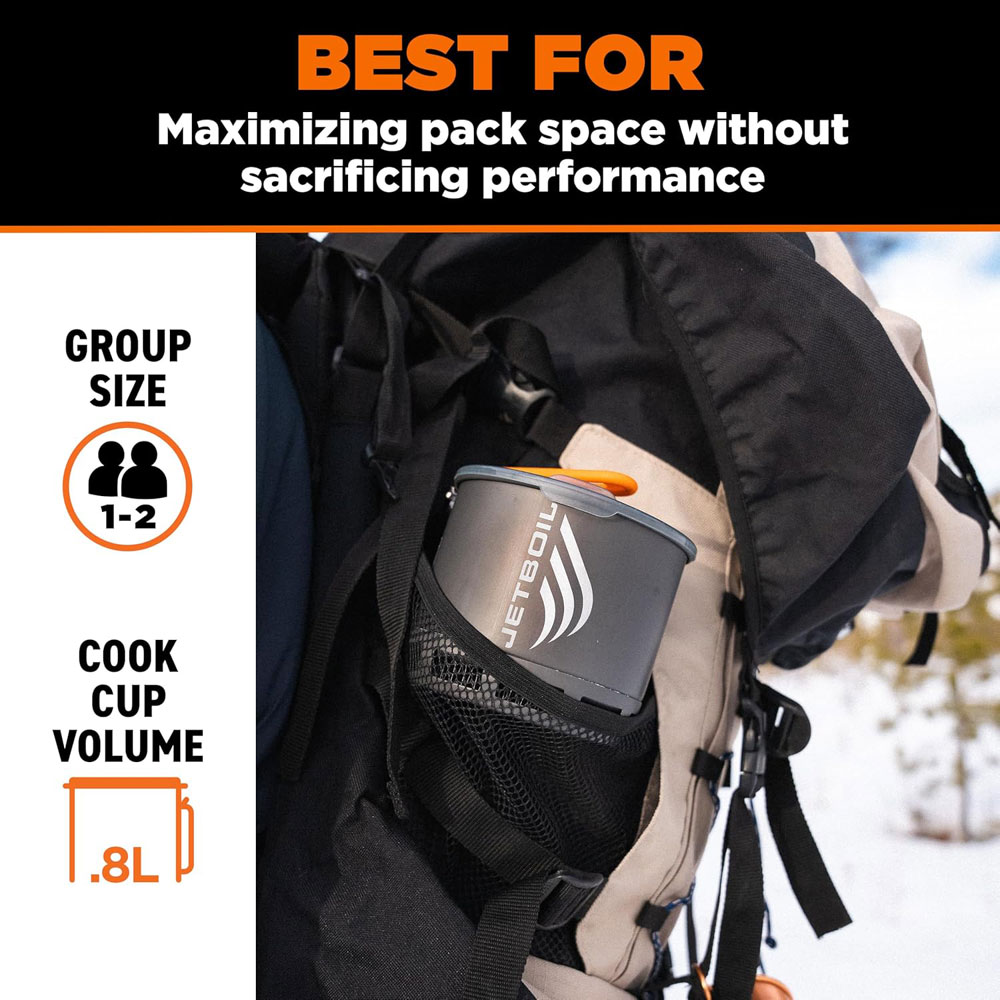
The Jetboil Stash is ideal if your camp cooking is mostly for hot water. That might sound limited, but it reflects how many walkers actually eat on overnight trips: coffee in the morning, a dehydrated meal at night, and maybe instant porridge or noodles in between. For this type of use, speed and fuel efficiency are more important than a wide simmering range. Its compact design enables you to store everything, including a gas canister, inside the pot, making it highly packable.
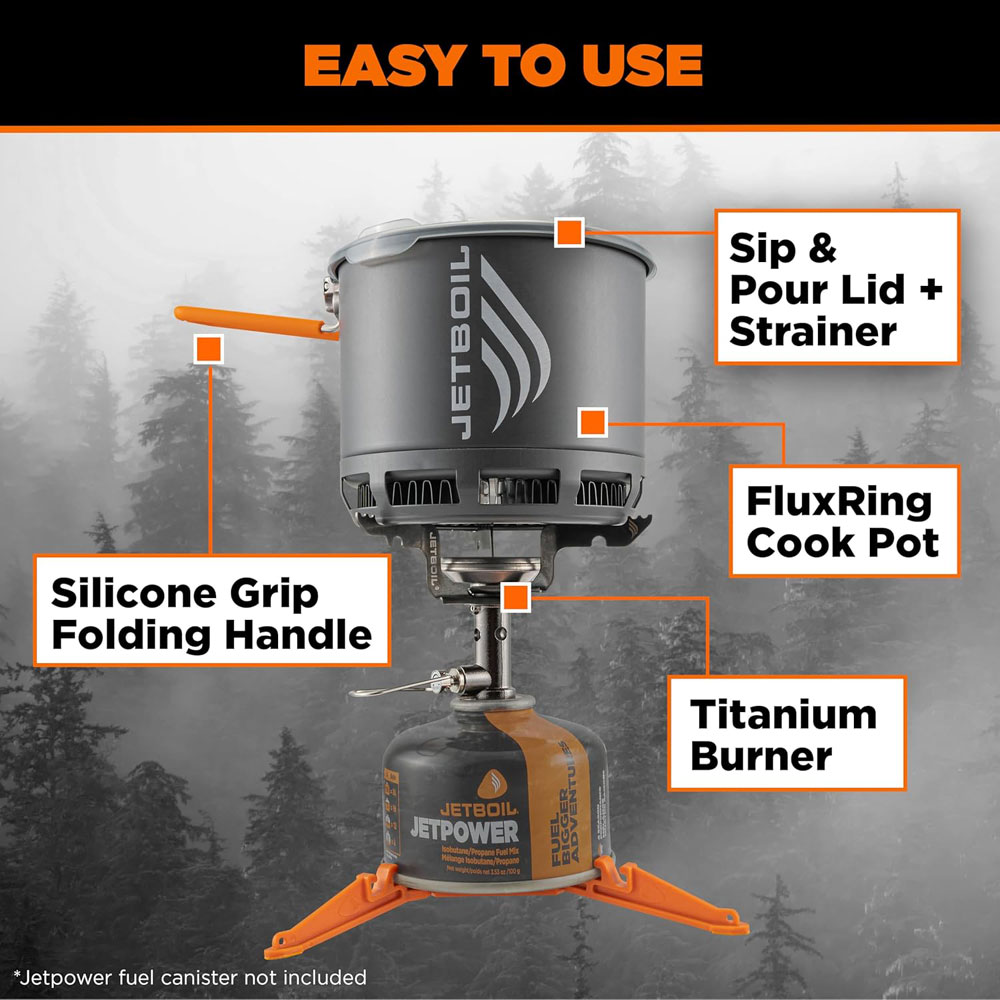
The Jetboil Stash Cooking System features a titanium canister stove, a lightweight FluxRing pot with an innovative lid, and a pot support. This allows you to carry the entire system or just individual components, like the burner, depending on your adventure. Designed for weight savings, each part is lightweight and easy to carry.
The Stash is interesting because it offers much of the efficiency of a Jetboil-style system without the weight of larger all-in-one stoves, and makes it the lightest offering in the Jetboil series. The 0.8-litre pot is big enough for solo meals and drinks, and the FluxRing heat exchanger helps more heat reach the pot rather than being lost around the sides. That can mean carrying less spare fuel on longer trips.
It is not the best choice if you want to fry bacon, cook pasta slowly, or use your favourite wide pan. It is designed around its own pot and excels at boiling rather than flexible cooking. For lightweight walkers who value quick drinks and simple meals, though, it is a very tidy system.
Jetboils do come in various sizes.
Pros:
Cons:
|
|
A remote canister stove with a low, stable stance and four-season capability, making it a strong choice for cooking real meals, rather than just boiling water, in changeable conditions.
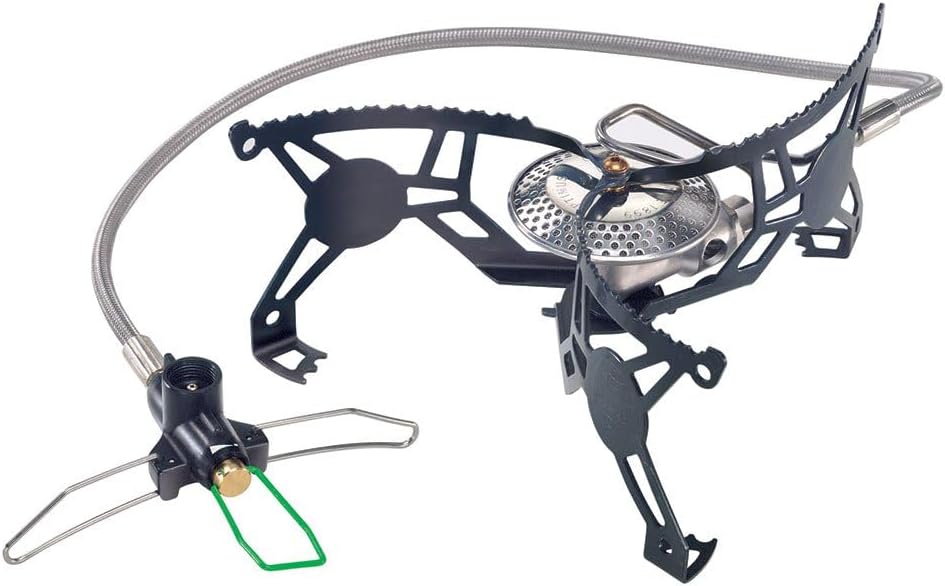
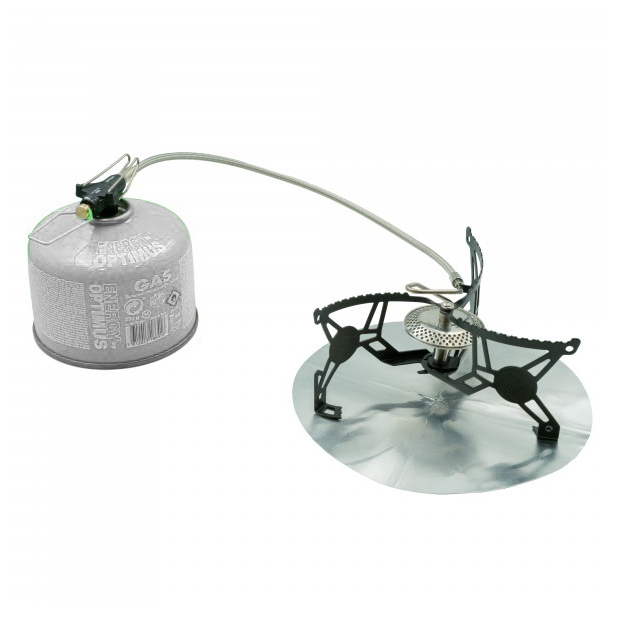
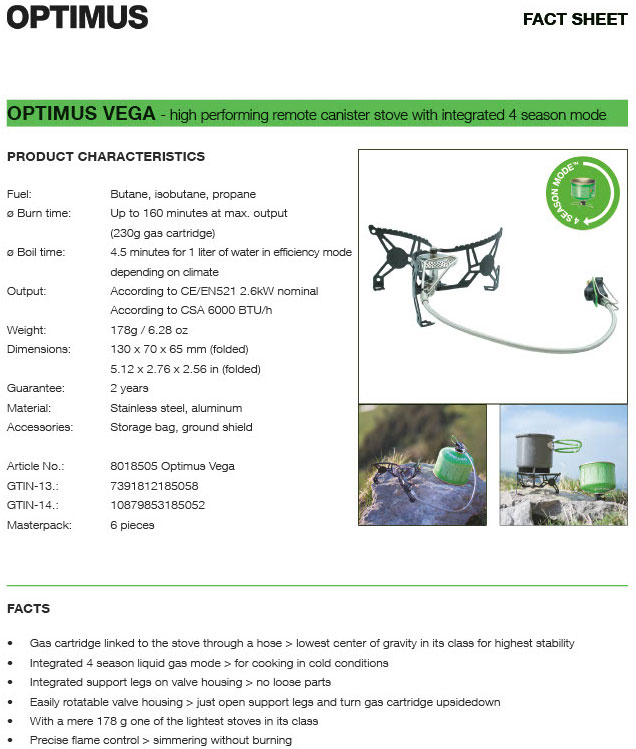
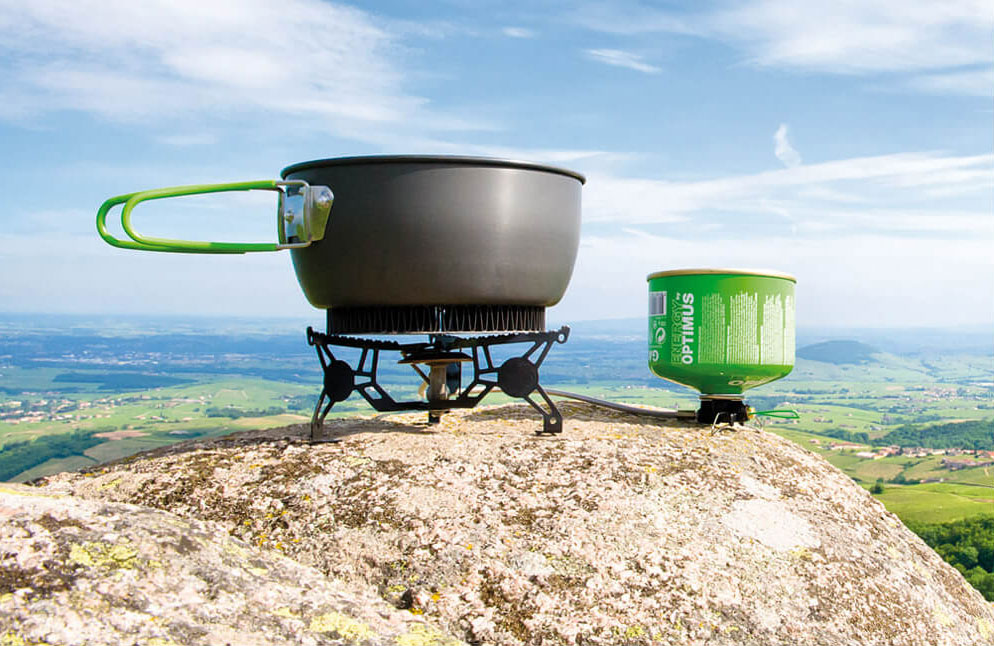
Best for: Hikers and campers who want a lightweight stove that performs better with pans, for simmering, and in exposed conditions than a top-mounted burner.
Specs
Key features
Why buy the Optimus Vega?
The Optimus Vega is the stove to consider if you want to cook, not just boil. Its remote canister design places the burner low to the ground, making it much more stable with wider pots and small frying pans. That matters on uneven ground, in the wind, or when you are cooking something that needs stirring rather than simply pouring boiling water into a pouch.
It is heavier than the tiny upright burners, but that extra weight buys you control, stability and better all-season performance. In colder conditions, inverting the canister can help maintain performance, as the stove can run on liquid-feed gas once the burner is properly heated. For UK spring, autumn and shoulder-season camping, that is a useful advantage.
This is probably overkill for a minimalist solo walker making a single cup of coffee. But for campers who enjoy proper meals, pairs sharing a pot, or walkers heading out in less predictable conditions, the Vega offers a level of confidence that basic burners cannot match.
Pros:
Cons:
|
|
A classic alcohol-fuelled cook set with excellent wind protection and very simple operation, best suited to unhurried camping rather than fast boil times.
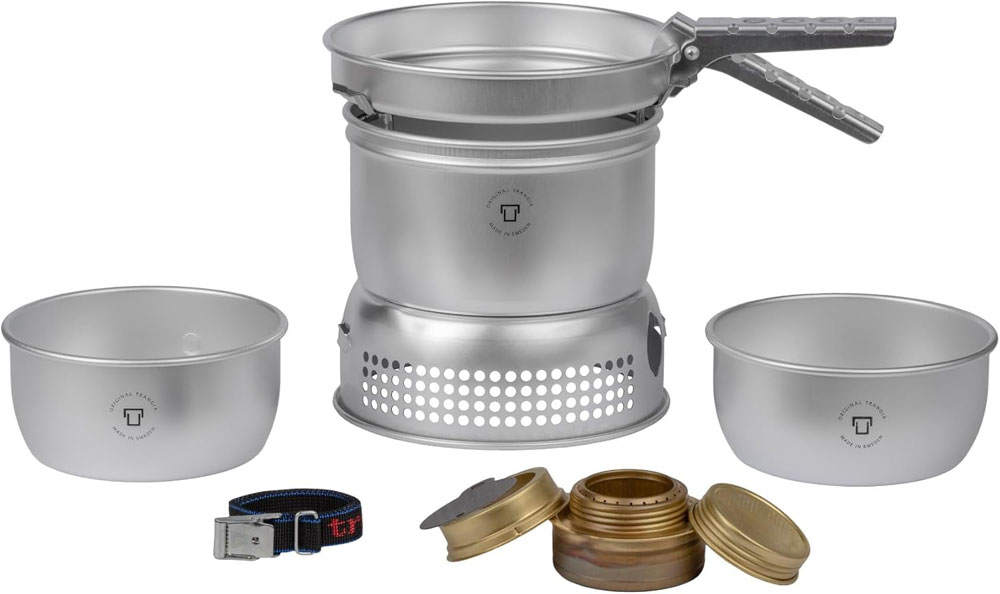
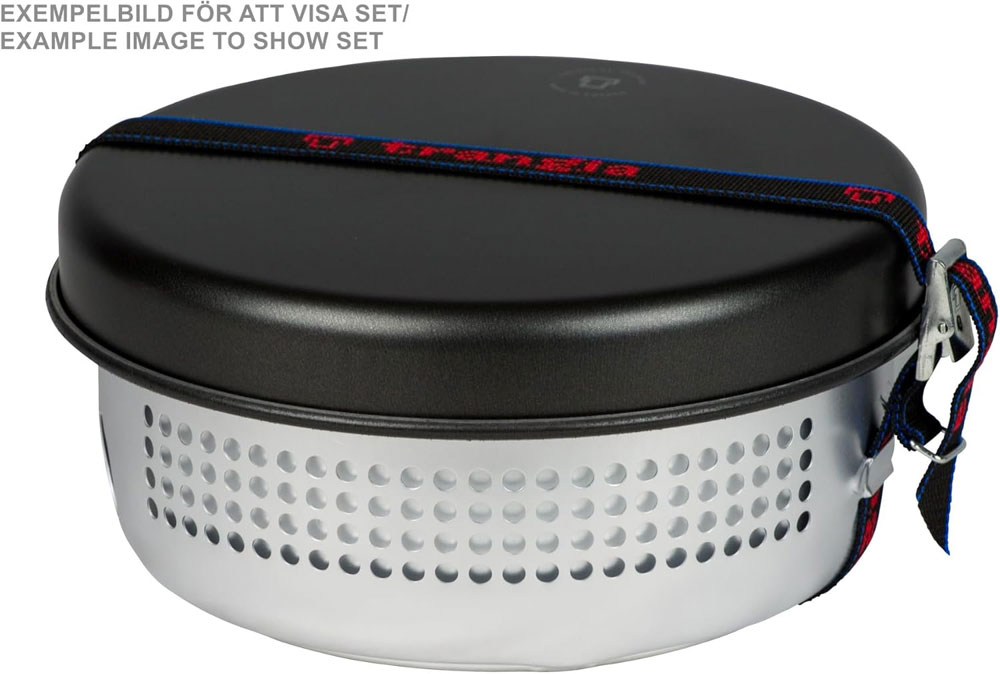
Best for: Campers who value simplicity, durability and an all-in-one cook set more than the lightest possible stove weight.
Specs
Key features
Why buy the Trangia 27-1 UL?
The Trangia 27-1 UL is not the lightest option if you consider only burner weight, but that misses the point. It is a complete, stable cooking system: stove, wind protection, pans, a lid/frying pan and a pot handle. For many campers, especially those who prefer relaxed evenings to ultralight speed, it makes for wonderfully practical camping.
Spirit stoves are slower than gas stoves and require more patience. You are not buying a Trangia to win boil-time tests. You are buying it because it is simple, reliable, easy to maintain and forgiving. There are no gas threads to cross, no piezo igniter to fail and no tiny jet to block, as with some liquid-fuel stoves.
For walkers, the weight makes it better suited to short backpacking trips, car camping, Duke of Edinburgh-style setups (it is included on their official list), and campsites, as well as to anyone who prefers a stable cooking system to a tiny burner. It is also a good choice for people who want a stove that feels calm and controlled rather than powerful and fierce, and for those who just do not like gas as a fuel.
I'll always have a soft spot for Trangia. For me, the Trangia, albeit in an earlier incarnation than this one, was the first cook set I took on walks, and I used it for my first few mountain marathons. It was very reliable, but it is heavier and slower than the newer lightweight gas stoves. It sits in my camping box in the garage and still gets used from time to time, especially when I've run out of gas!
There is a wide range of Trangia sets available, and this 27-1 UL set is now also available to use gas as the fuel rather than alcohol-based fuels.
Pros:
Cons:
|
|
A stainless-steel tabletop wood-burning fire pit for campers seeking a contained, low-smoke flame for permitted campsites, garden camping and relaxed outdoor cooking. Really more of a fire-pit than something you can cook on.
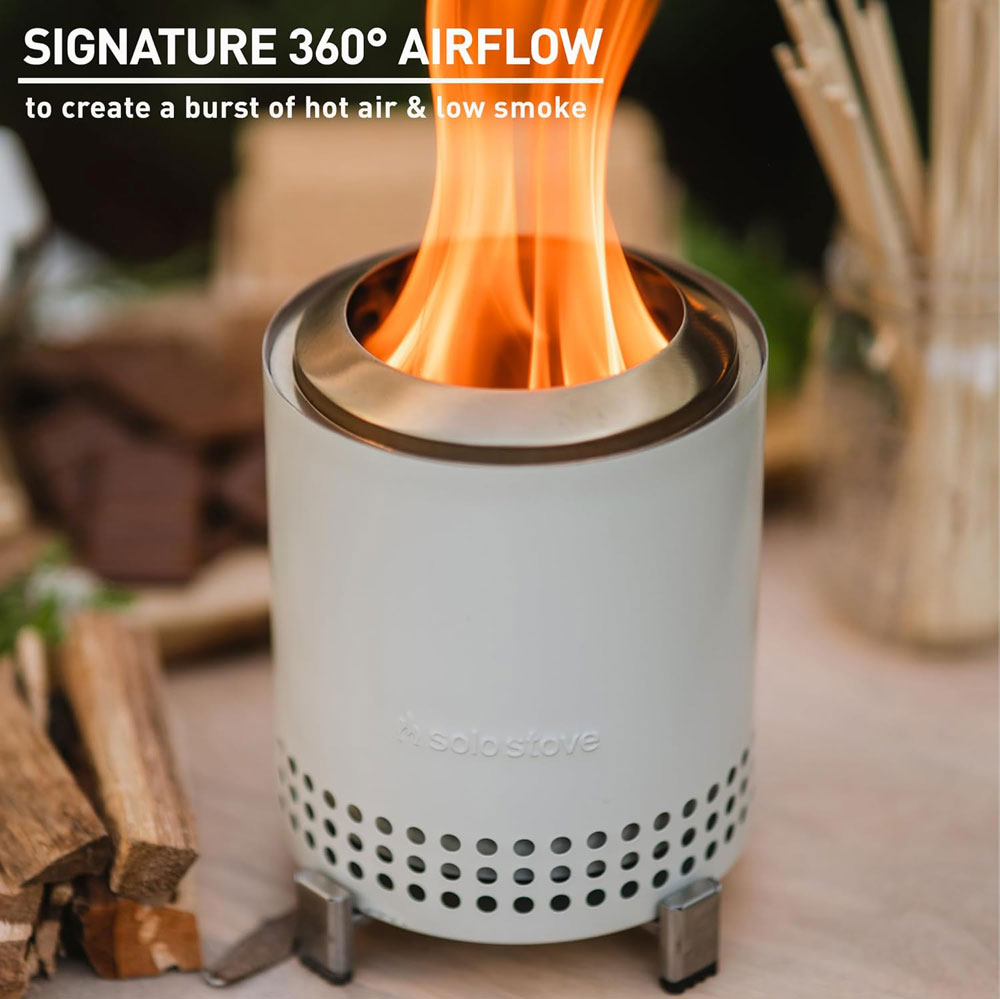
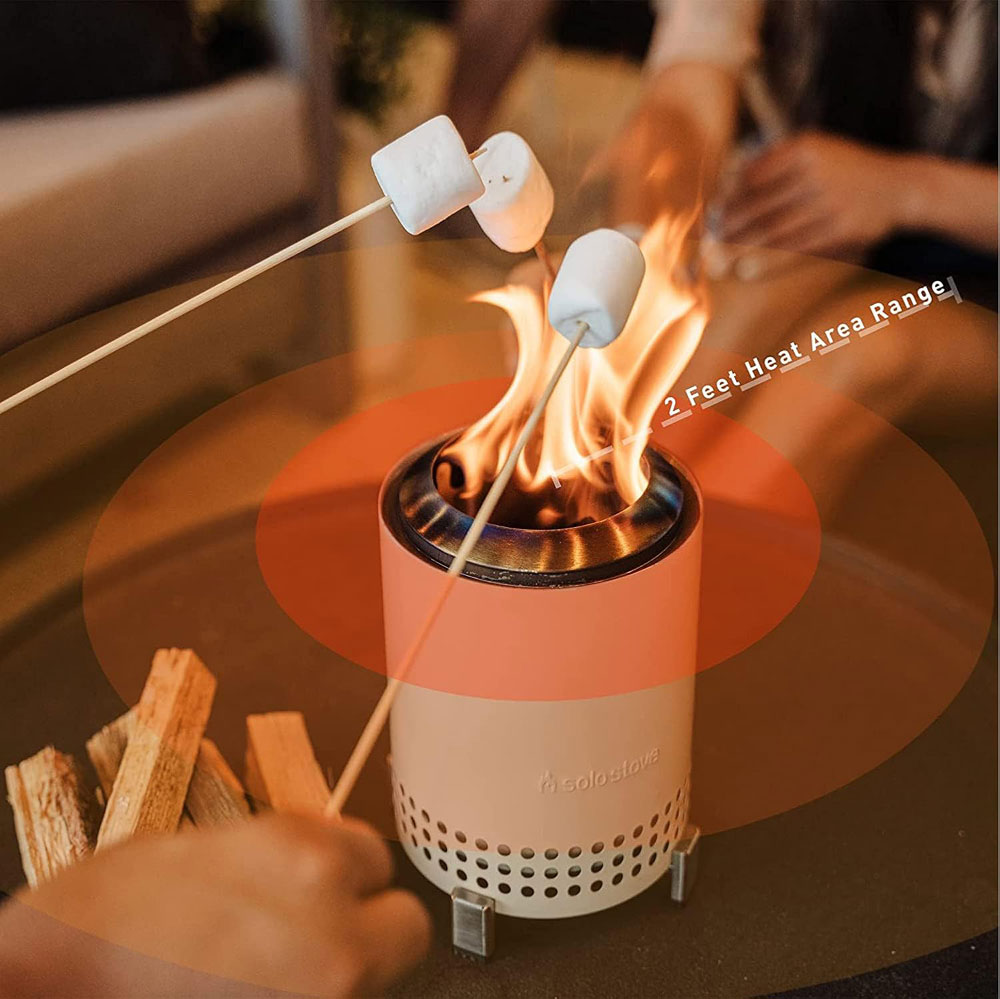
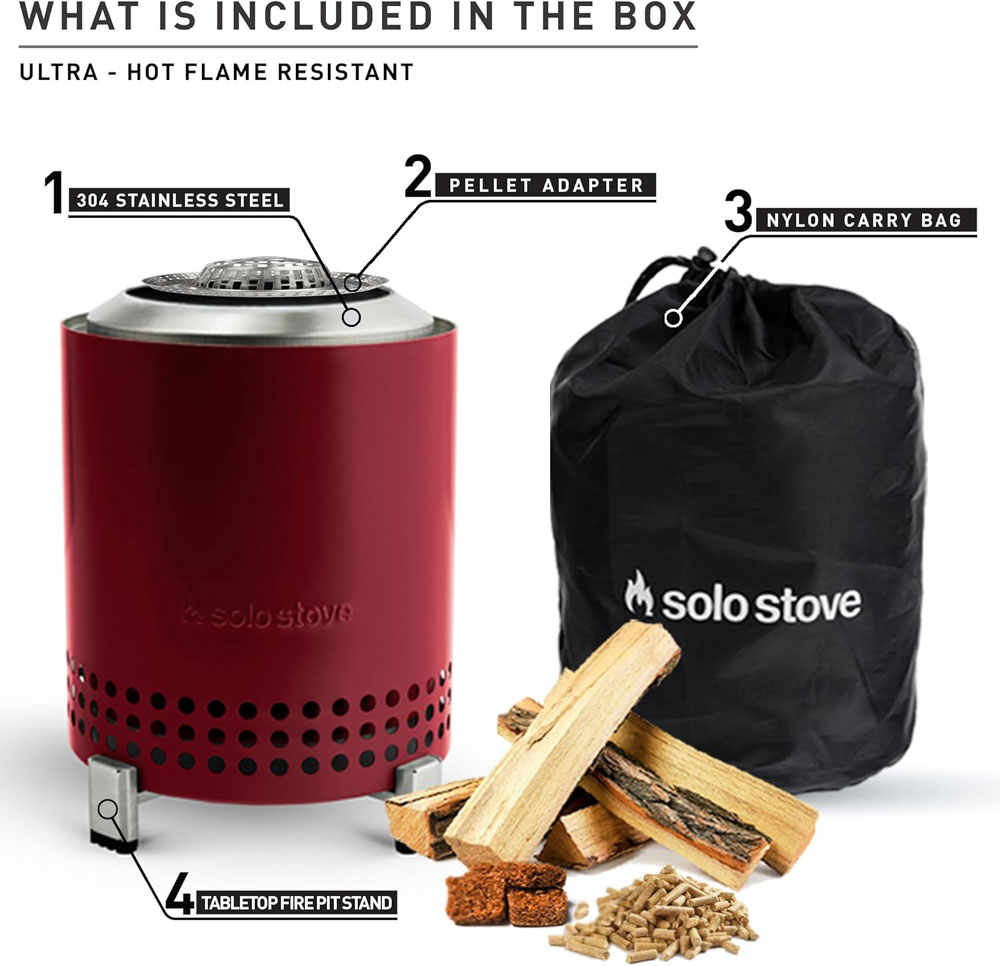
Best for: Campers who want a compact wood- or pellet-burning tabletop fire pit for permitted campsites, garden camping, caravanning and slow outdoor evenings, rather than fast backpacking boil times.
Specs
Key features
Why buy the Solo Stove Mesa?
The Solo Stove Mesa is not a direct replacement for a tiny backpacking burner. It is more of a compact tabletop fire pit that can double as a contained wood-burning camp stove if you want to hold food above it. That makes it best suited to campsites, garden camping, caravanning and relaxed evenings where the flame itself is part of the experience.
The big advantage is that it feels much more controlled than lighting a loose fire. The stainless-steel body, stand and low-smoke airflow design make it a neater option for those who want the atmosphere of wood burning without relying on gas canisters. It is also small enough to pack for car camping or campsite use without taking up much space in your kit bag.
For walkers, the main caveat is that it is a specialist choice rather than an everyday hillwalking stove. At around 635 g, it is much heavier than the gas burners in this guide, and you still need suitable fuel, permission, and time for the unit to cool. However, where wood burning is allowed and you want a slower, more atmospheric camp setup, it offers a contained and satisfying way to enjoy a small flame outdoors.
Pros:
Cons:
These stoves were close runners-up to the stoves chosen.
| Stove | Type | Why it was not one of the main seven |
| MSR PocketRocket Deluxe | Premium upright gas stove | Excellent igniter, regulator and performance, but the SOTO WindMaster just edges it for this version of the list. |
| SOTO Amicus | Budget/value gas stove | A good affordable alternative to the Pocket Rocket 2, often praised for easy use and value. |
| Fire-Maple FMS-300T | Value ultralight titanium stove | Very light at around 45 g and available on Amazon UK; a useful alternative if the BRS feels too minimal. |
| Jetboil Flash 1.0L | Fast-boil integrated stove | Excellent for fast hot water, but heavier and bulkier than the Jetboil Stash, but at one point was my go-to for taking out on overnight camps. |
| MSR WindBurner | Wind-resistant integrated stove | Very strong in poor weather, but heavier and more expensive than most walkers need. |
| Campingaz Camp Bistro 3 | Affordable campsite stove | Good and cheap for car camping, but too heavy and bulky for a lightweight walking-focused guide. |
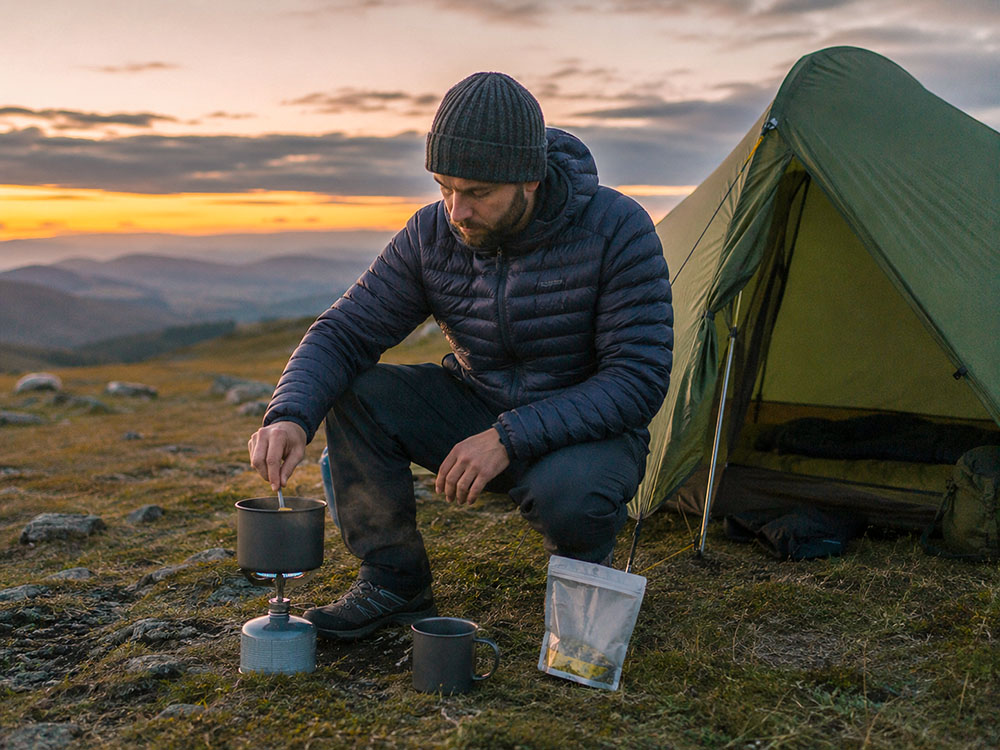
Before looking at grams, boiling times or BTUs, the most useful question is: what are you actually going to cook? A stove that is perfect for boiling water quickly can be frustrating if you want to simmer pasta. A stable campsite stove may be wonderful at a picnic table, but annoying to carry five miles up a hill. We have therefore separated the choices by real use rather than pretending there is one perfect stove for everyone.
| How you camp or cook | Best starting point |
| Solo overnight walk, hot drinks and dehydrated meals | SOTO WindMaster, MSR PocketRocket 2 or BRS-3000T |
| Fast water boiling and low fuel use | Jetboil Stash |
| Proper cooking with a small frying pan or wider pot | Optimus Vega or SOTO WindMaster with 4Flex |
| Very tight budget or emergency backup | BRS-3000T |
| Relaxed campsite cooking with built-in cookware | Trangia 27-1 UL |
| Woodland campsite, garden table or contained wood-burning setup where fires are allowed | Those wanting a mini 'fire-pit' rather than a stove |
| Cold, windy or spring/autumn trips | Optimus Vega, or a specialist liquid/multi-fuel stove if conditions are severe |
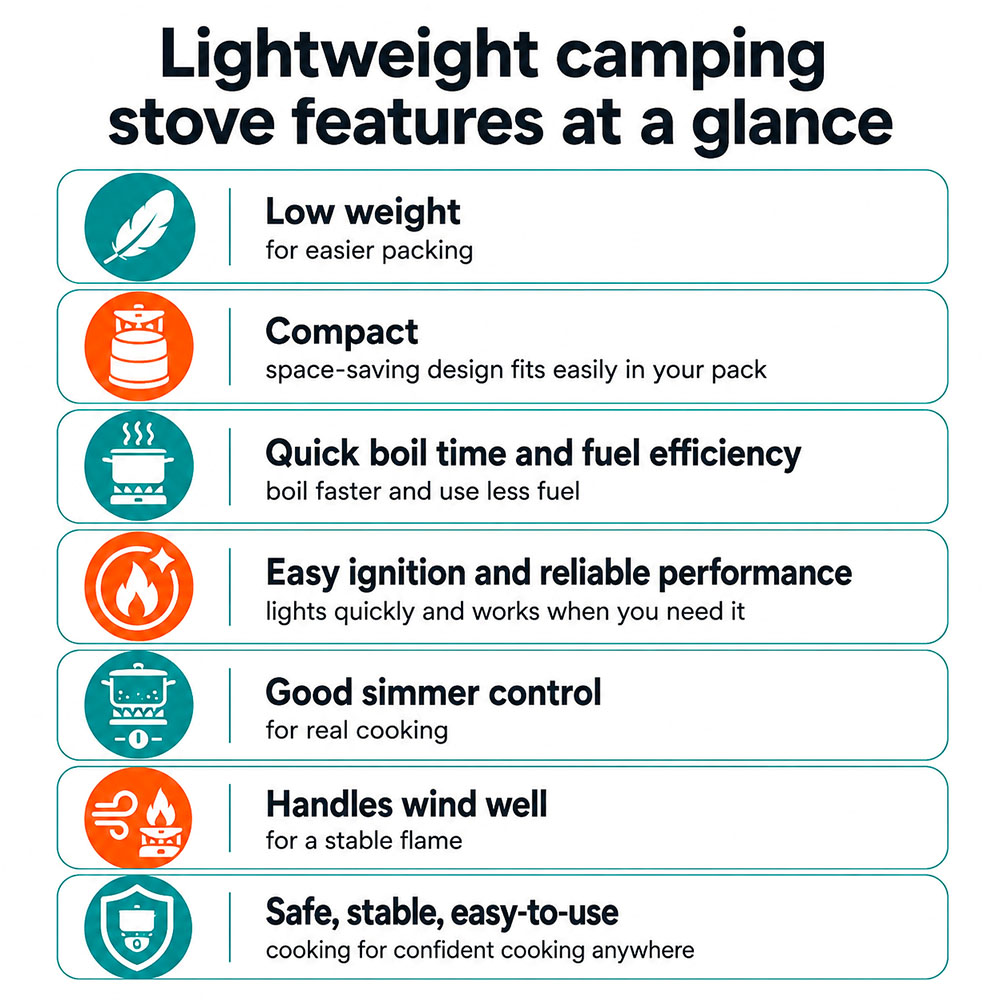
A lightweight camping stove is a portable stove designed to be carried in a rucksack, pannier or compact camping kit. For walkers, the stove itself might weigh anywhere from 25 g to around 250 g, although complete cooking systems can weigh more once you include a pot, windscreen, fuel, lighter and stabiliser.
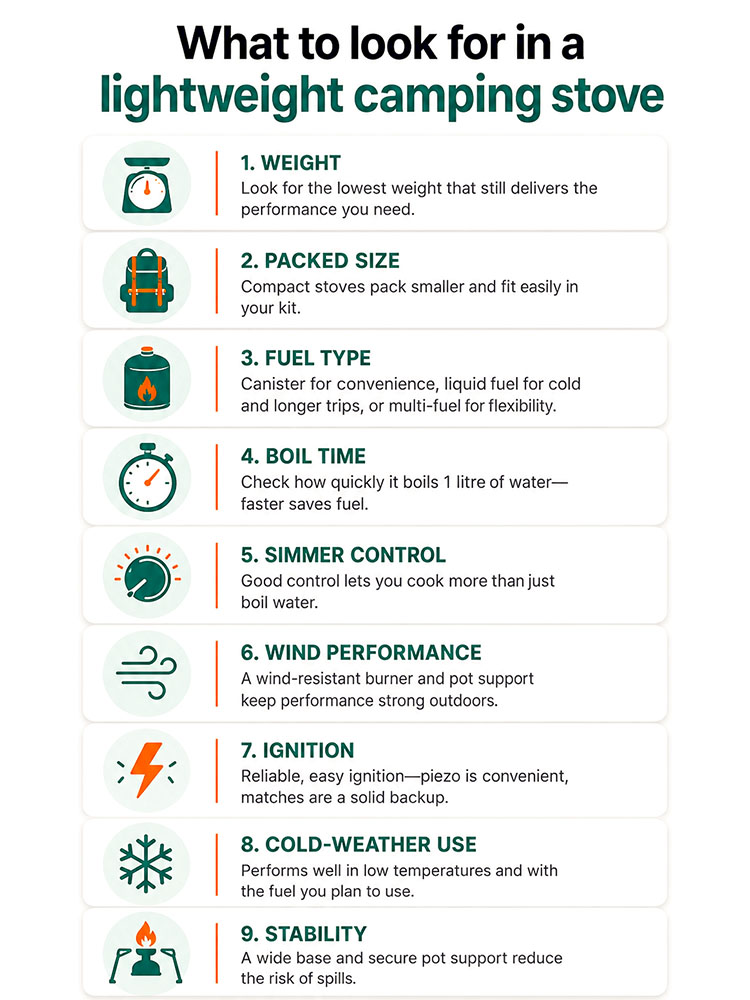
This is why it helps to think in terms of 'cooking system weight', not just stove weight. A 25 g burner sounds unbelievably light, but you still need a pot, fuel canister, lighter and possibly a stabiliser. A heavier integrated stove may save fuel by transferring heat more efficiently to the pot. The best choice depends on the whole setup, not the headline stove weight alone.
For most walkers, a lightweight stove should be compact, reliable, easy to light, stable with your chosen pot, and powerful enough to boil water without wasting fuel. For campers travelling by car, weight matters less, but compact stoves are still useful because they take up less space and are easier to store.
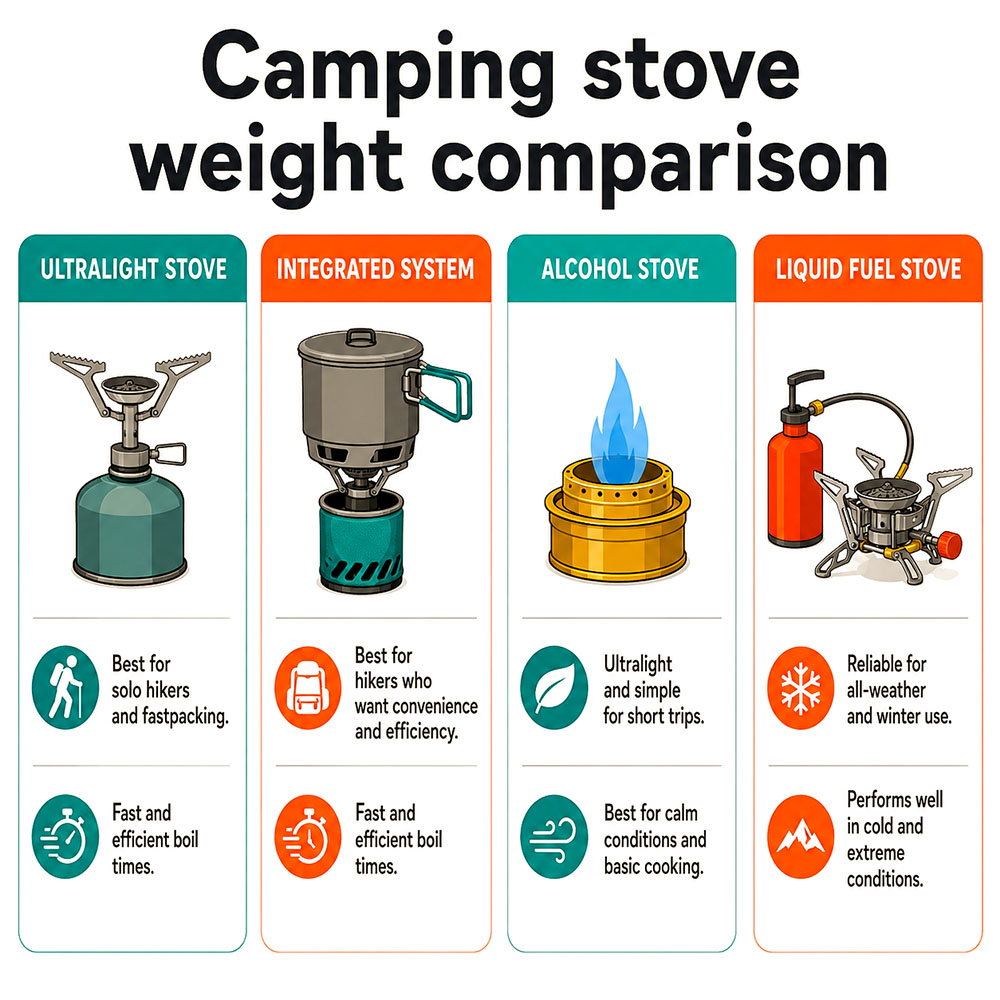
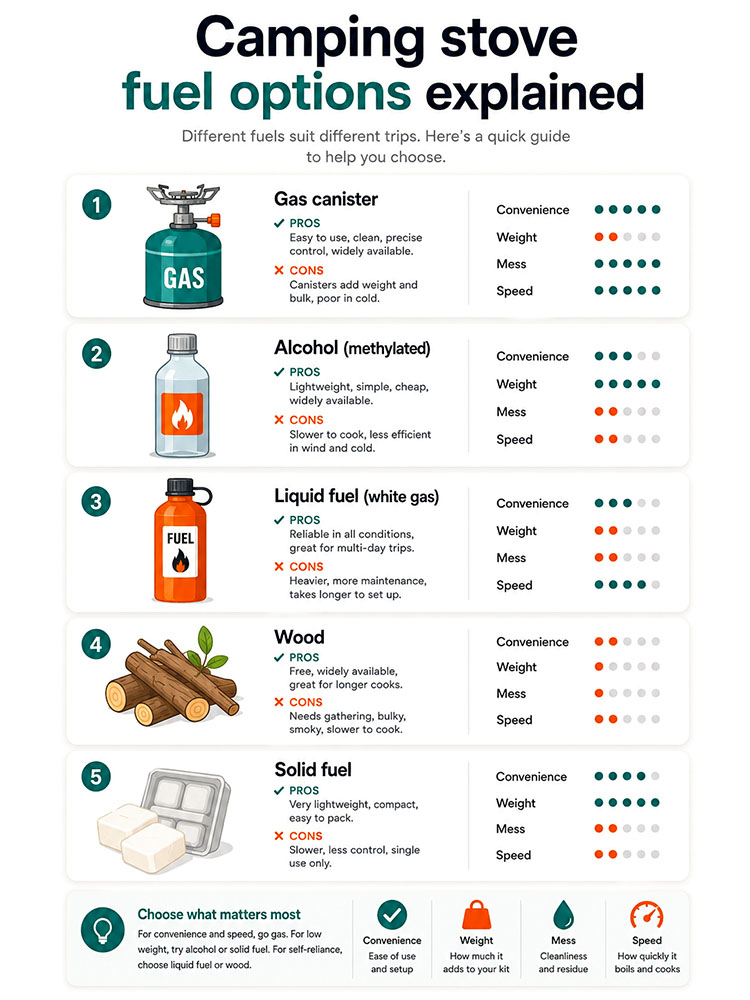
The primary types of lightweight stoves include upright gas canister stoves, integrated gas stove systems, remote canister stoves, spirit/alcohol stoves, liquid or multi-fuel stoves, and wood-burning stoves. Each type offers a different mix of weight, speed, stability, fuel accessibility, and safety.
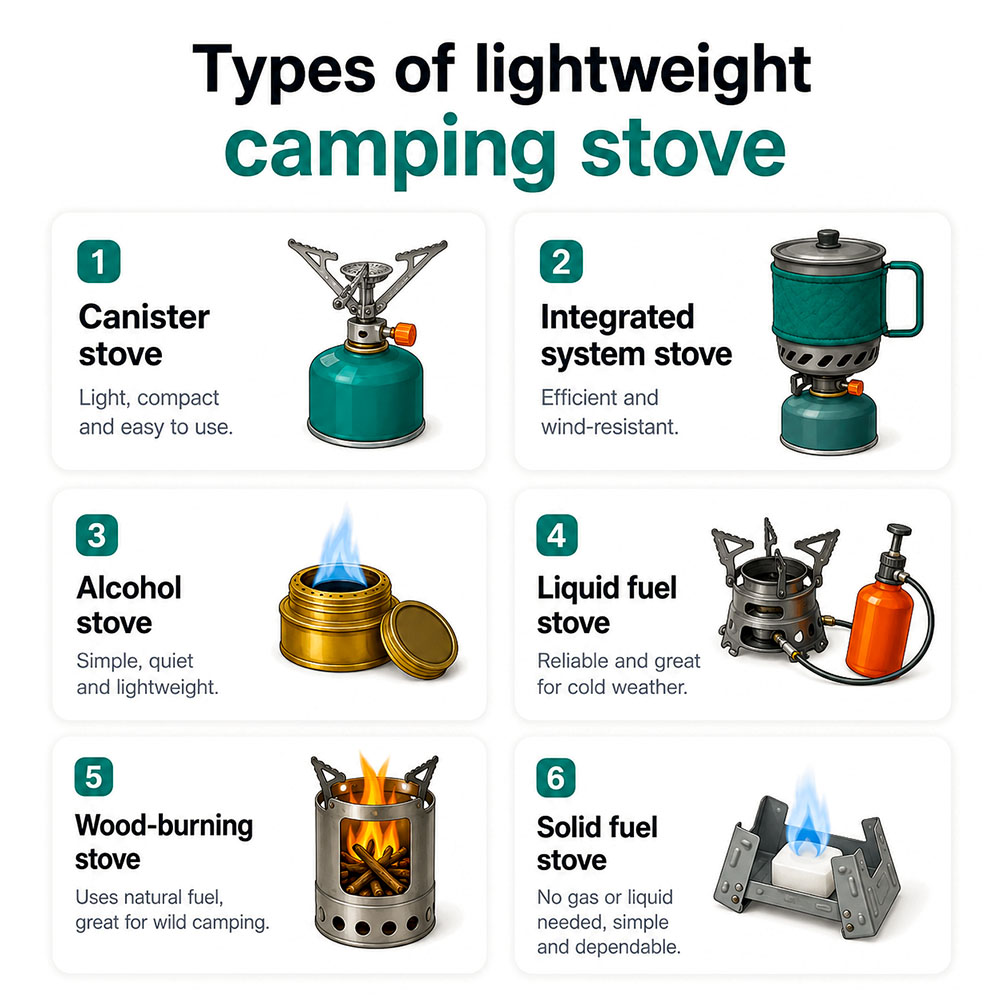
Upright gas stoves screw directly onto a gas canister. They are lightweight, compact and convenient, making them the default choice for many walkers. Integrated systems combine the burner with a matched pot and a heat exchanger for fast, efficient boiling of water. Remote canister stoves place the burner away from the canister, improving stability and making wind protection easier.
Spirit stoves use alcohol fuel, making them simple, quiet, and durable, though they are slower than gas stoves. Liquid fuel stoves are more complex but are effective in very cold weather or remote locations where gas canisters are scarce. Wood-burning stoves eliminate the need for gas canisters, but they require permissions, dry fuel, and careful fire management.
Camping stoves often list their heat output in watts (W) or British Thermal Units per hour (BTU/h). These figures indicate how much heat energy the stove can produce, similar to the power rating on a hob at home.
A higher output can boil water faster, but it does not automatically mean the stove is better. Burner design, pot shape, wind, fuel type, altitude, and how much heat actually reaches the water all matter. A high-output stove with poor wind resistance can waste fuel quickly, while a lower-output integrated system can be surprisingly efficient because more heat goes into the pot.
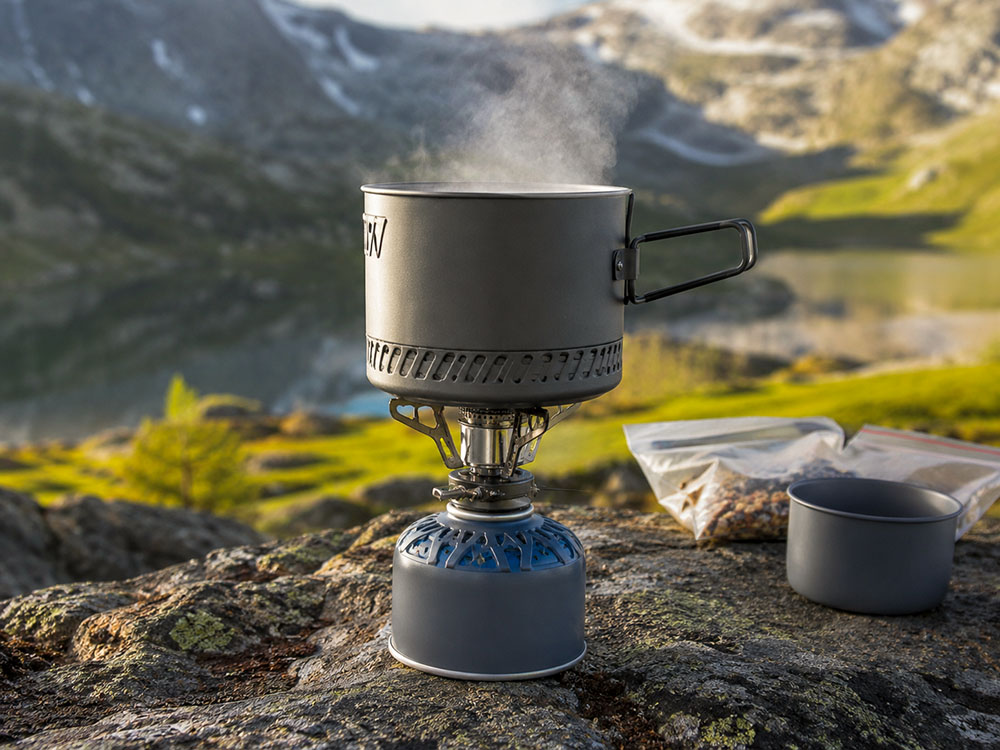
As a rough guide, small gas stoves typically operate around 2,500-3,500 W. That is plenty for solo and two-person cooking. For lightweight walking, control and efficiency are often more useful than chasing the highest possible power output.
Boil time tells you how long a stove takes to boil a stated amount of water, usually 500 ml or 1 litre. It is one of the easiest figures to compare, but it can also be misleading because test conditions vary. One brand may test indoors, another in calm outdoor conditions, and a reviewer may test in windy conditions with cold water.
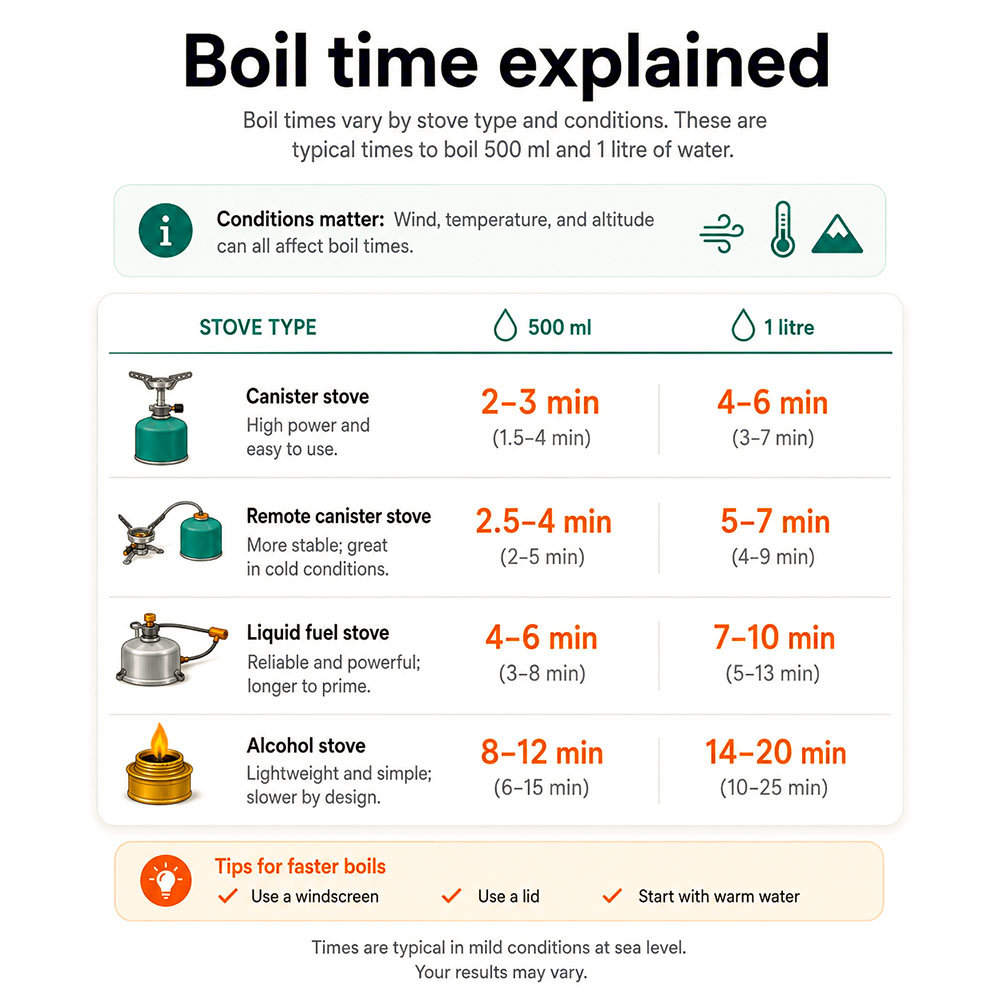
For walkers, boil time matters most when you mainly make drinks and dehydrated meals. A fast stove is welcome at the end of a long day, but shaving 30 seconds off a brew is less important than stability, fuel efficiency and safe operation in the weather you actually encounter.
A practical target is that a lightweight gas stove should boil 500 ml of water in a few minutes under calm conditions. If you often camp in windy conditions, look beyond boil time and pay close attention to burner design, windscreens and heat exchangers.
Fuel efficiency is the amount of fuel used to boil water or cook a meal. Some reviews measure it in grams of gas per boil, while some manufacturers state how many litres of water a 100 g or 230 g canister can boil. This matters because fuel is part of your carried weight.
A very light burner can become less appealing on a longer trip if it wastes gas and forces you to carry a larger canister. An integrated stove system may weigh more at the start, but if it saves enough fuel over several days, the real-world difference narrows. This is particularly relevant for multi-day walks, cold mornings and windy camps.
For a single overnight, simplicity often outweighs optimisation. For a week-long trip, fuel use becomes more important. Always include the stove, pot, fuel, lighter, wind protection and any stabiliser when comparing total cooking weight.
Most modern backpacking stoves use screw-thread gas canisters containing a blend of butane, isobutane and/or propane. The common threaded cartridge type is often described as EN417/Lindal valve-compatible. These canisters are widely sold by outdoor shops, campsites and some larger retailers, but they are not interchangeable with every stove on the market, so always check your stove's instructions.
Small 100 g canisters are popular for solo walking because they fit inside many pots. Larger 230 g canisters are better for multiple nights or for two people. Larger canisters can be more stable, but they take up more space and add weight.
Aerosol-style butane cartridges are cheap and common for tabletop stoves, but they are not what most lightweight backpacking stoves use. Pierceable cartridges and brand-specific fittings also exist, so do not assume that any gas canister will fit any stove.
Please note that when buying stoves, fuel is rarely included. You need to purchase that separately.
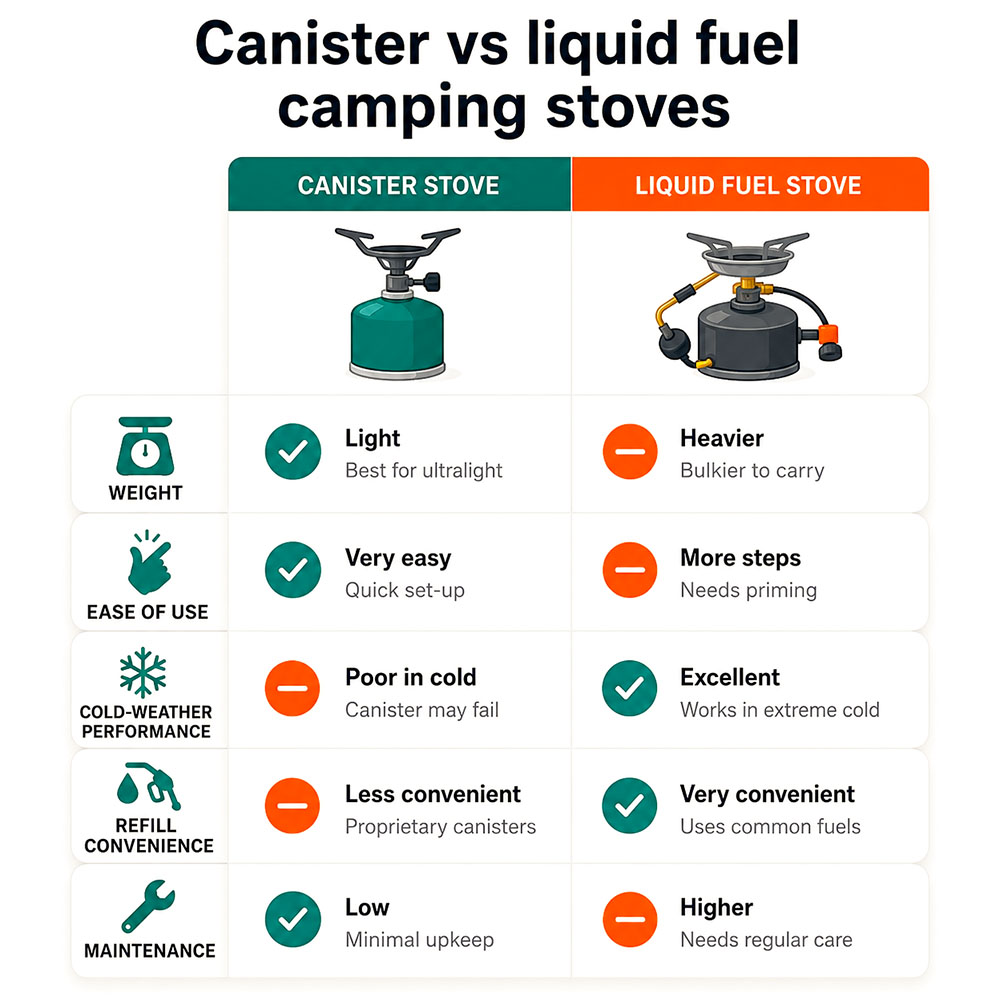
Cold affects gas stoves because the fuel must vaporise inside the canister before it reaches the burner. Butane performs poorly near freezing, whereas isobutane and propane mixtures are better suited to cooler conditions. This is why winter gas blends usually contain more isobutane and propane.
Upright canister stoves can struggle as the canister cools or empties. Regulated stoves, such as the SOTO WindMaster, help maintain more consistent output, but they do not magically remove the limits of gas. Remote canister stoves with preheat tubes, such as the Optimus Vega, can be used with inverted canisters when designed for that purpose, improving performance in colder conditions.
For severe winter, alpine or expedition use, liquid fuel or specialist remote canister systems may be more suitable. For most UK three-season walking, a good gas stove with the right fuel blend is usually sufficient.
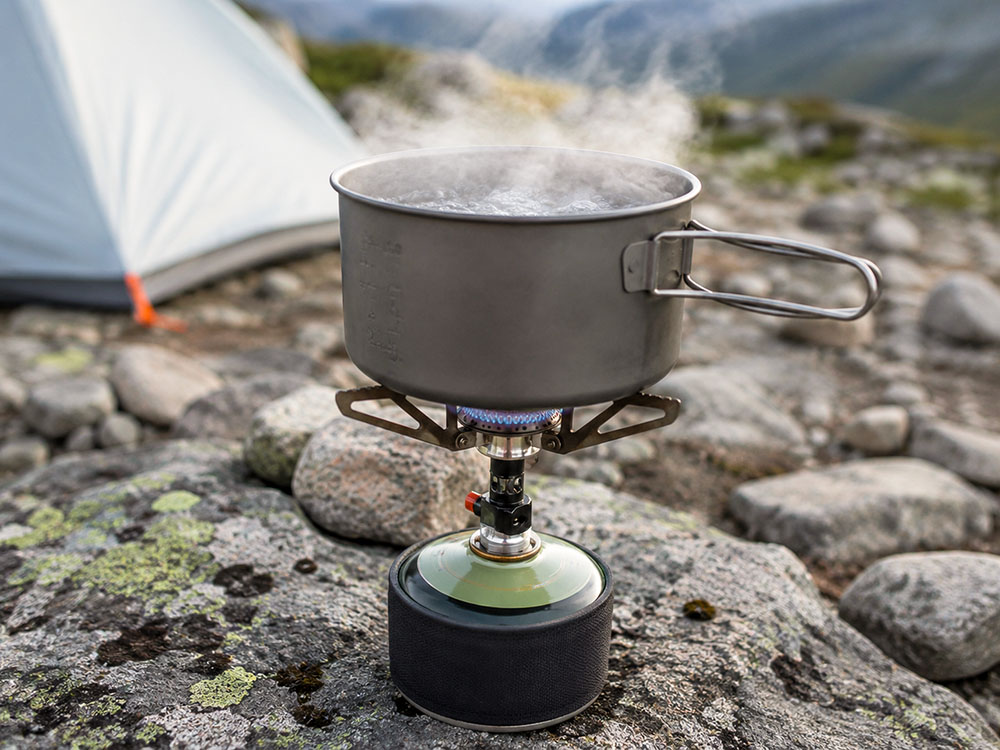
Wind is one of the biggest enemies of camp cooking. Even a moderate breeze can push the flame away from the pot, slow the boil and waste fuel. A stove that performs well indoors may feel underpowered outdoors if the burner is too exposed.
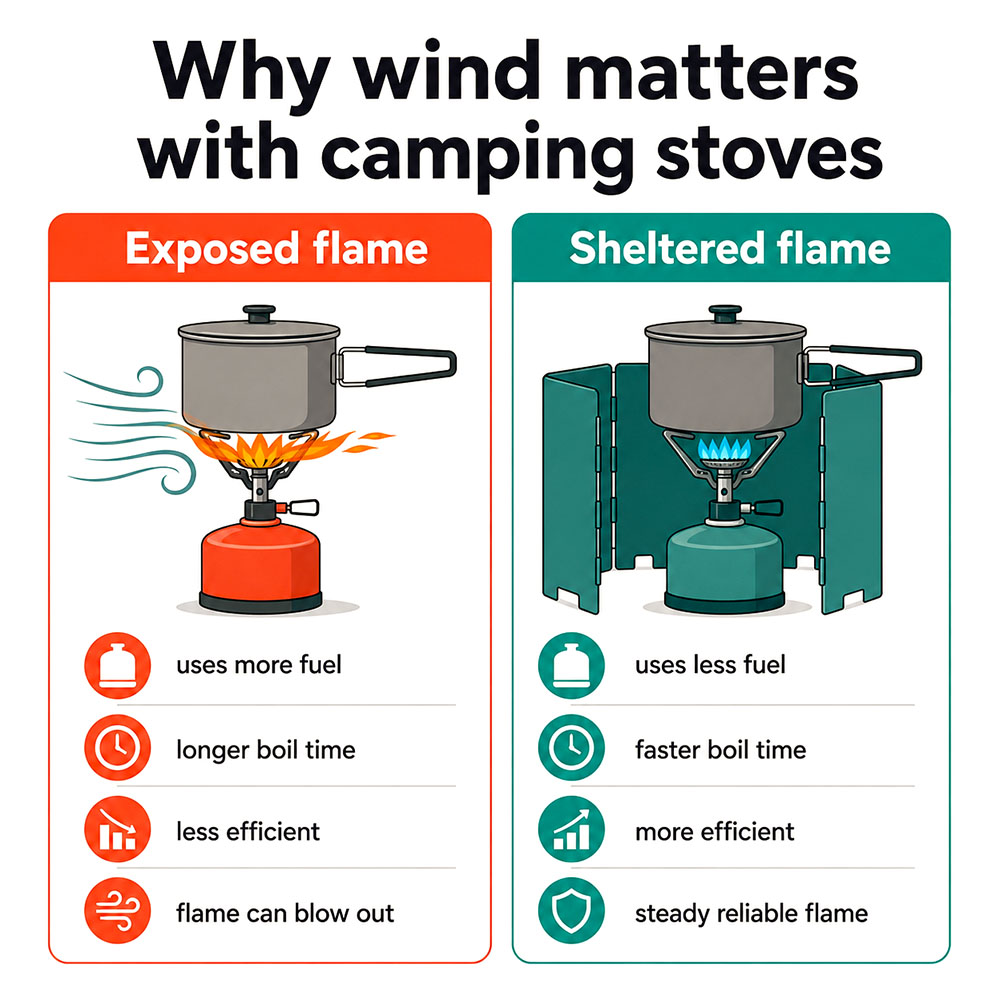
Integrated stove systems and stoves with enclosed or concave burners tend to perform better. Remote canister stoves can often be used more safely with a windscreen because the fuel canister is separate from the flame. Upright canister stoves should not be fully enclosed with a tight windscreen, as this can trap heat around the gas canister and pose a safety risk.
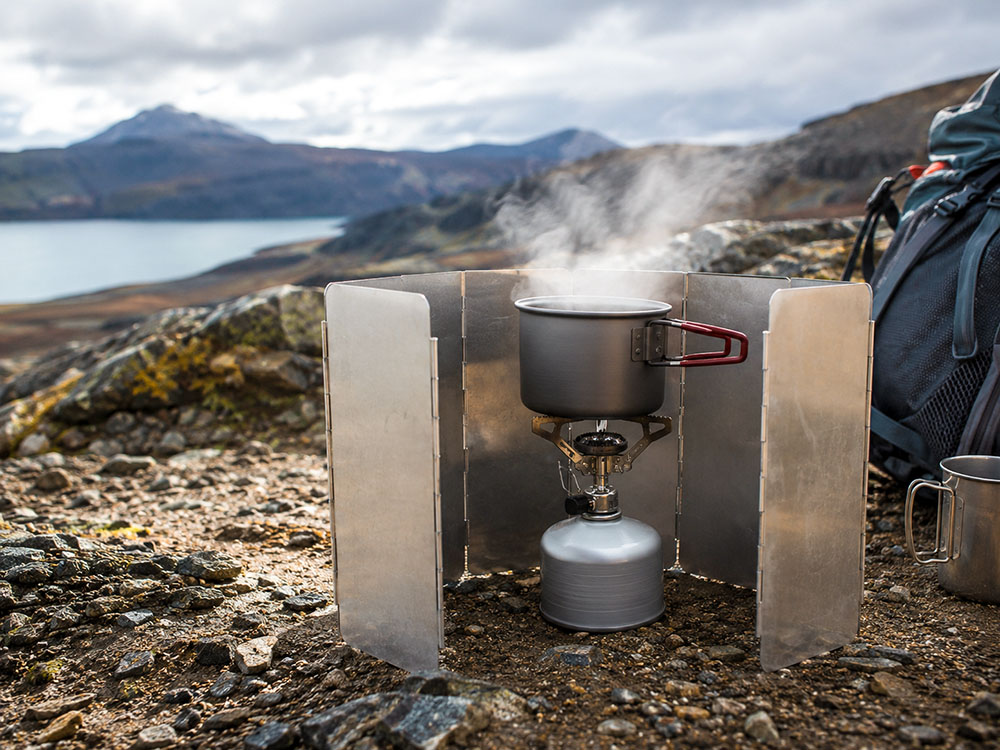
A practical wind strategy is to cook behind a natural shelter, use your rucksack or sit mat as a windbreak, keep the stove level, and use only manufacturer-approved windscreens. Never sacrifice safety for a faster boil. When I'm taking part in mountain marathons, I always take along a folded-up piece of tin foil, which I unfold and place carefully around the burner, acting as a great lightweight wind shield.
A stove tipping over is more than annoying; it can cause burns, waste food and even start a fire. Stability depends on the stove’s height, the width of the pot supports, the size of the canister and the shape of your pot. Tall pots on small burners can be wobbly, especially on uneven ground. Always try to find a flat stone or a flat patch of grass to place the stove on. If you are standing it on grass, I find that standing on the spot you are going to use and flattening the grass with your feet before you start cooking also helps with stability.
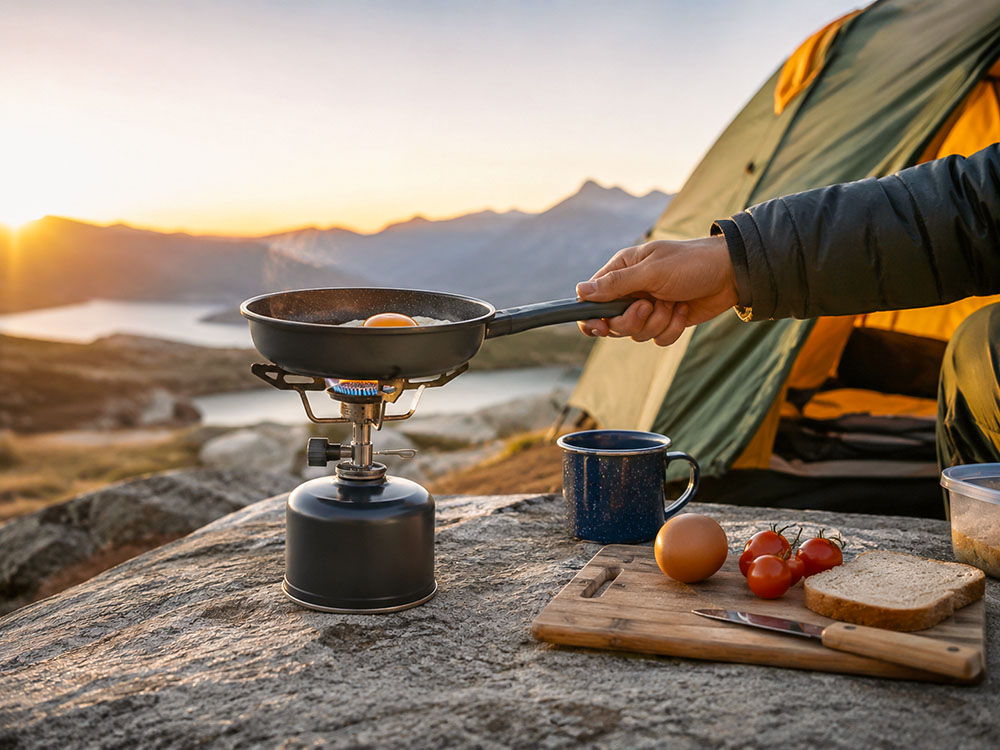
Upright canister stoves are lightweight, but because they place the pot above the canister, they are naturally more top-heavy. A canister stabiliser can help. Remote canister stoves place the burner on the ground and are usually better suited to wider pans.
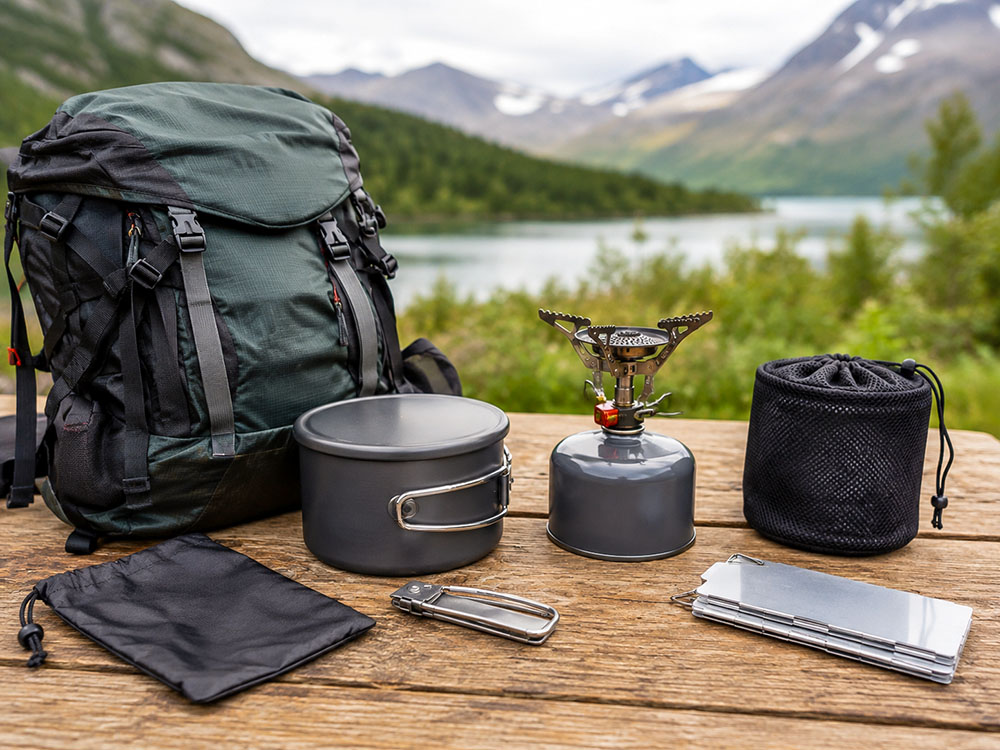
Match your pot to your stove. A narrow 750 ml or 1-litre pot works well with small burners. Wider frying pans need a wider burner and more robust support. For groups, consider a remote canister stove or a campsite stove rather than balancing a big pan on a tiny ultralight burner. Groups can afford to use a heavier, more stable burner, because they can split the cooking equipment among group members.
Some stoves are excellent for boiling water but poor at maintaining low, steady heat. That is fine if you eat freeze-dried meals, but frustrating if you want to cook rice, porridge, pasta, sauces, or anything that burns easily.
Good simmer control depends on the valve, burner design and wind resistance. Stoves such as the SOTO WindMaster and Optimus Vega are better suited to real cooking than very small boil-only burners. Integrated systems vary: some are designed mainly for fast boiling, while others have wider pots and regulators for better cooking.
Be honest about your meals. If your camping menu is tea, coffee and dehydrated pouches, you do not need the best simmering stove. If you enjoy cooking, simmer control is worth paying for and carrying a little extra for.
An integrated system, such as the Jetboil Stash, combines the burner with a dedicated pot and heat exchanger. This improves packability and can reduce fuel consumption. It is especially useful when your main task is to quickly boil water.
A separate stove and pot setup is more flexible. You can choose a titanium mug, an aluminium pan, a non-stick pot or a frying pan depending on the trip. It is often better to cook full meals rather than just boil water.
The choice comes down to convenience versus flexibility. Integrated systems are neat and efficient, whereas separate setups are adaptable and easier to customise.
Many stoves feature a piezo igniter that sparks the burner when you press a button. This is convenient, especially in bad weather or when your hands are cold. However, piezo igniters can fail, and some ultralight stoves omit them to save weight.
Even if your stove has an igniter, always carry a backup lighter, waterproof matches or a flint. A small fire steel or a second mini lighter weighs very little and can save a meal if the built-in ignition fails.
For winter or wet conditions, store your lighter somewhere dry and accessible, rather than buried at the bottom of your pack. I keep my waterproof matches in the same small dry bag as my first-aid kit.
Solo walkers can usually get away with a small burner and a 750 ml to 1-litre pot. Two people may prefer a 1-litre to 1.5-litre pot and a more stable stove. Groups should think carefully before relying on a tiny stove, especially if everyone needs hot drinks and dinner at the same time.
For groups, stability and cooking speed matter more. A remote canister stove, a larger gas stove, or a campsite two-burner stove may be more practical. Lightweight walking stoves are designed for compact cooking, not for feeding a family of four from a large frying pan.
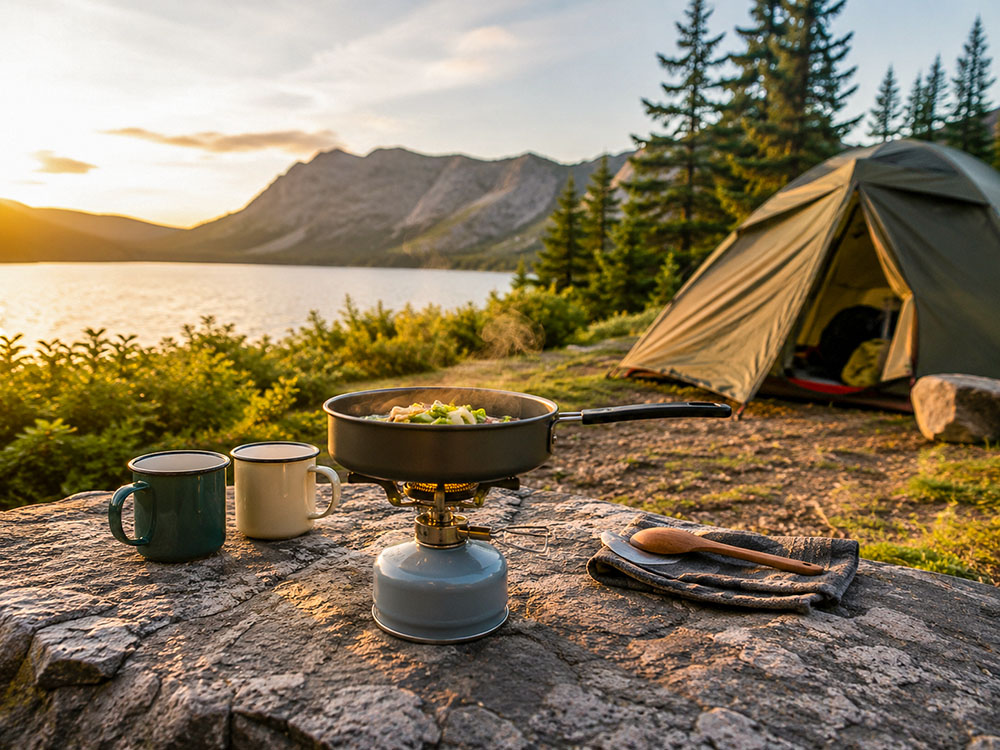
A good rule is to match pot capacity to meal style. If you need to boil water for two dehydrated meals and drinks, a one-litre pot may feel cramped. If you cook pasta or rice, a wider pot is much more comfortable.
Gas canisters are convenient but create waste and require proper disposal. Spirit stoves use liquid fuel, often available in larger bottles, but spills must be avoided. Wood stoves avoid canisters but can cause fire scars, smoke, and local impacts if used carelessly.
On many UK campsites and in protected areas, open fires are restricted or banned. Wood-burning stoves may also be banned during dry spells or periods of high wildfire risk. Always check campsite rules and local guidance before lighting any stove or fire.
Leave No Trace principles favour cooking with a stove rather than building campfires. Keep cooking areas clean, avoid scorching the ground, pack out rubbish, and never leave ash, foil, food waste or fuel residue behind.
The stove is only part of the cooking kit. Most walkers also need a pot, lid, mug, spoon, lighter, backup ignition, fuel canister, cleaning cloth, small sponge, and perhaps a pot cosy or insulated pouch. A canister stabiliser is highly recommended for upright gas stoves on uneven ground.
A lid is one of the most underrated efficiency upgrades. It reduces heat loss and helps water boil faster. If your pots don’t have lids, tin foil can serve as a temporary lid, but be careful when putting it on and taking it off, as it gets very hot.
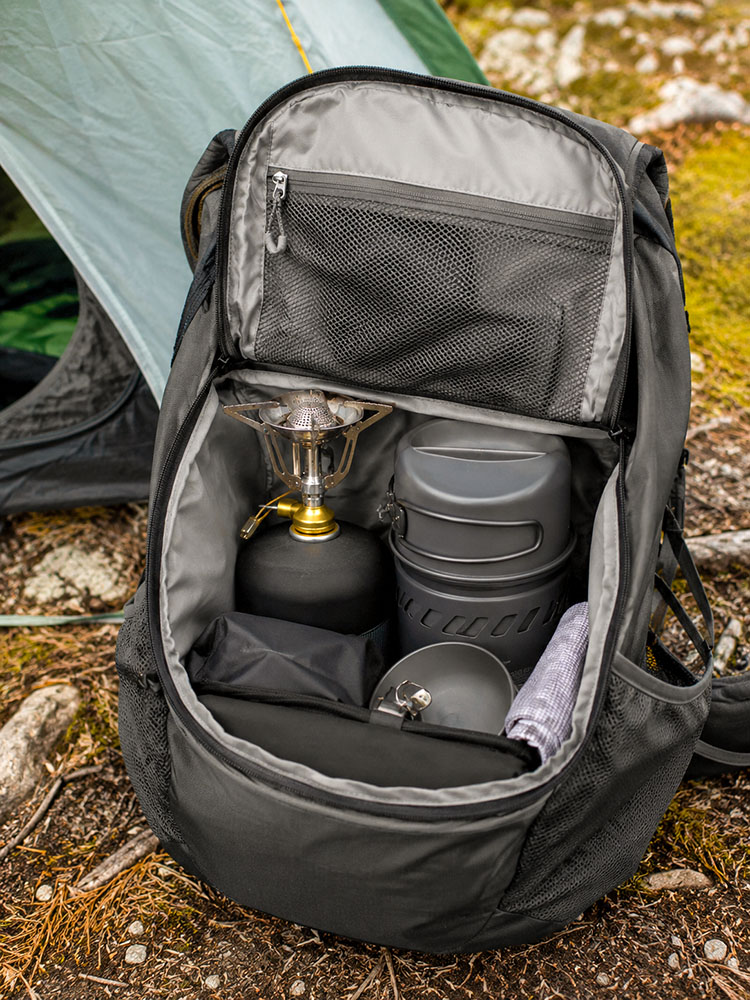
A long-handled spoon is useful for dehydrated meal pouches. A small cloth protects your pot from scratches and makes cleaning easier.
For gas stoves, consider a small plastic cap or bag for the burner to protect the threads and keep soot or dirt away from your other kit. For spirit and wood stoves, carry fuel and stove parts in separate leak- or soot-resistant bags.
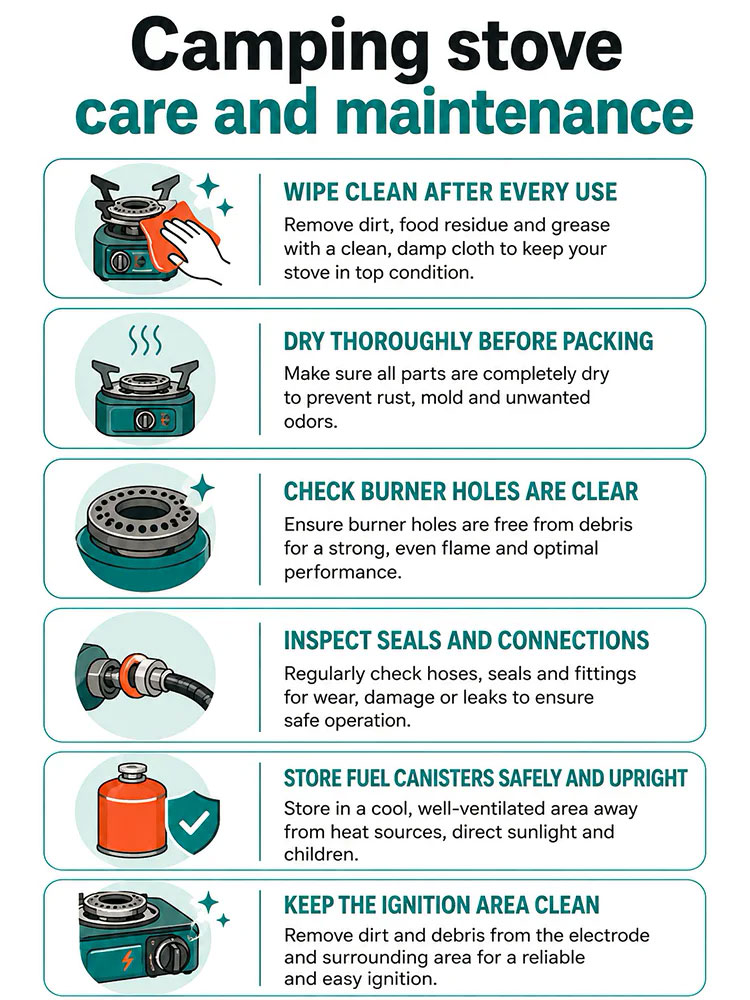
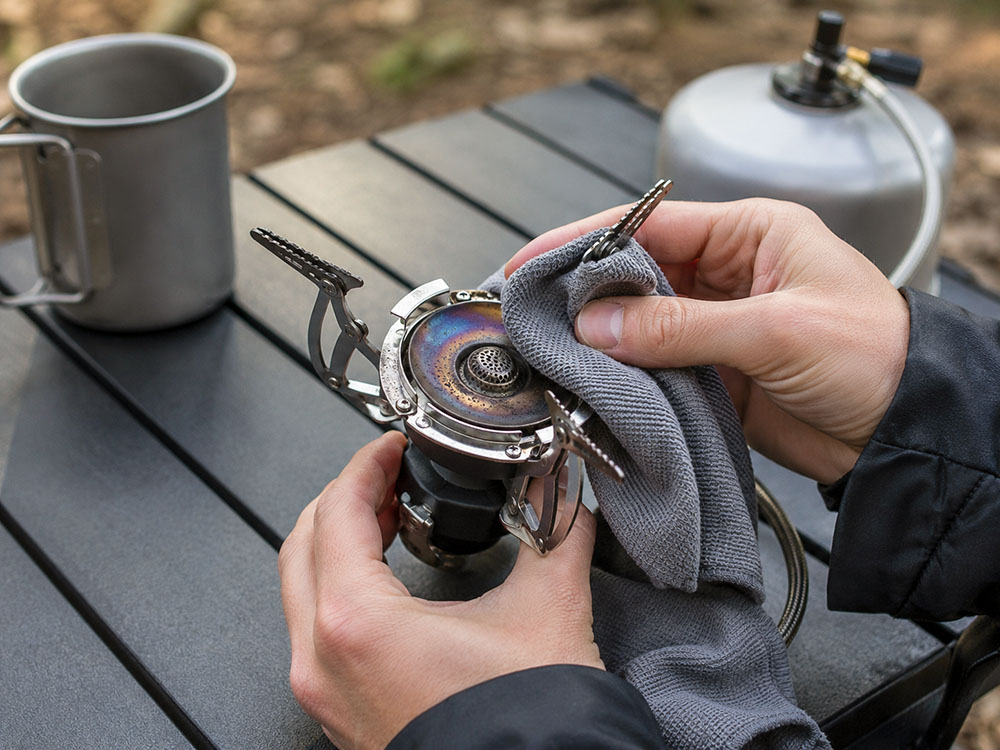
Never cook inside a tent. Fuel-burning stoves can produce carbon monoxide, a colourless and odourless gas that can be fatal. A 2023 study of isobutane/propane canister stoves in a three-season tent found that carbon monoxide levels could exceed 100 ppm within a few minutes. UK fire safety guidance also states that cooking appliances should be kept away from tent walls and not used inside tents.
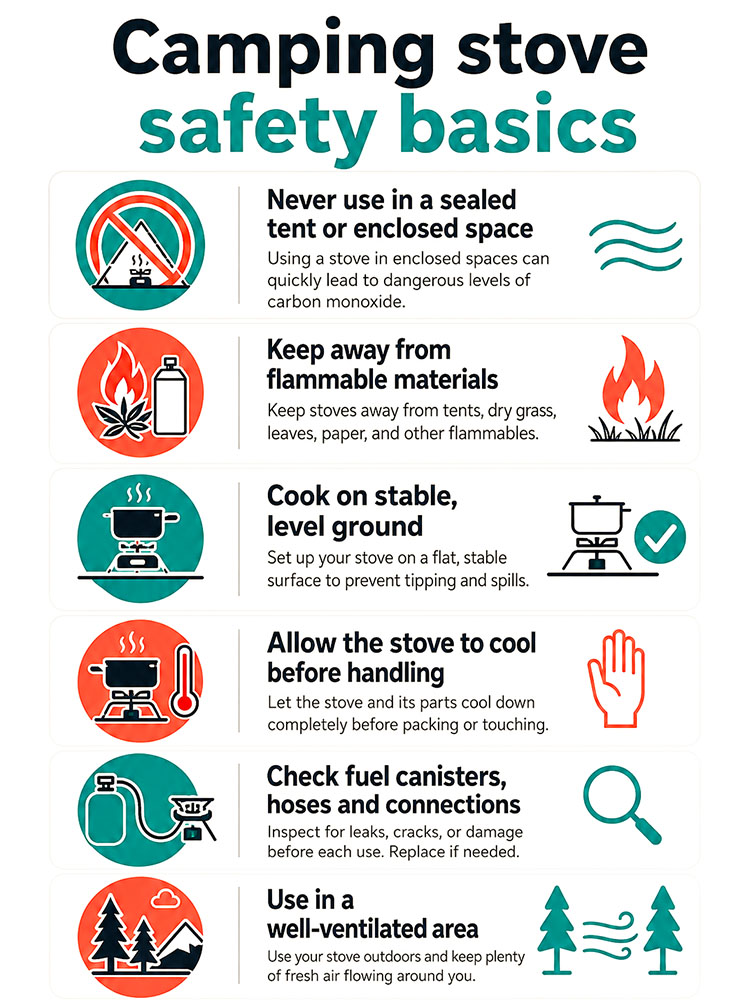
For practical UK camping, cook outside, on stable ground, away from tent fabric, long grass, dry vegetation and flammable kit. If you need shelter from rain, use a well-ventilated tarp or a suitable cooking shelter, keep escape routes clear, and never use a stove to heat a tent.
Carbon monoxide is the biggest invisible risk around camping stoves. A 2023 Wilderness & Environmental Medicine study found that isobutane/propane canister stoves used inside a three-season tent could produce carbon monoxide levels above 100 ppm within minutes. The study concluded that backpacking stoves should be used in adequately ventilated spaces, not in enclosed shelters.
A 2004 emergency medicine study on kerosene stove use inside tents also found that carbon monoxide levels were high enough to produce significant carboxyhaemoglobin levels in volunteers. The details vary by fuel and tent type, but the practical lesson is the same: do not cook in enclosed spaces.
Government and fire-safety guidance supports this. The GOV.UK's outdoor fire-safety guidance advises never to cook inside a tent and to keep cooking appliances away from tent walls. The Camping and Caravanning Club also warns that carbon monoxide is colourless and odourless and advises against cooking inside tents or awnings.
For most walkers and lightweight campers, the best all-rounder is the SOTO WindMaster with 4Flex. It is light enough for backpacking, more stable and wind-resistant than many tiny gas stoves, and versatile enough for boiling water and simple meals. If you want a simpler classic, the MSR PocketRocket 2 remains one of the easiest options for beginners and regular walkers.
For ultralight budgets, the BRS-3000T is hard to ignore, but it should be treated as a small-pot, sheltered-spot stove rather than a full cooking system. If speed and fuel efficiency matter more than cooking flexibility, the Jetboil Stash is the best lightweight all-in-one option. For proper cooking and greater stability, the Optimus Vega is the strongest pick. For slower, calmer campsite cooking, the Trangia 27-1 UL remains a classic. And for contained wood-burning where it is genuinely allowed, the Solo Stove Mesa offers a different, satisfying style of outdoor cooking.
The key is not to buy the stove with the most impressive headline figure. Buy the stove that suits your meals, route, weather, group size and tolerance for faff. A good lightweight stove should make camping easier, safer and more enjoyable - not just lighter on a spreadsheet.
Happy walking... and cooking 😊
Shop the Walks4all Amazon kit list
We've grouped some of the products mentioned in this article into our Amazon Storefront for convenience. As an Amazon Associate, we earn from qualifying purchases at no additional cost to you.
For most walkers, the SOTO WindMaster with 4Flex is a strong all-rounder because it balances low weight, simmer control, wind performance and stability. The MSR Pocket Rocket 2 is also excellent if you want something simpler and widely proven.
The BRS-3000T is one of the lightest commonly available gas stoves, weighing around 25-26 g. It is best suited to small pots and sheltered cooking rather than larger pans or windy camps.
Most lightweight gas stoves operate around 2,500-3,500 W, which is sufficient for solo and two-person walking trips. Efficiency, wind resistance and pot choice often matter more than the highest wattage figure.
BTU stands for British Thermal Unit. On stoves, it usually appears as BTU per hour and indicates heat output. A higher BTU rating can mean more power, but it does not guarantee faster cooking if the stove loses heat to the wind.
In calm conditions, many lightweight gas stoves can boil 500 ml of water in a few minutes and 1 litre in roughly 3-5 minutes. Integrated systems may be faster or more fuel-efficient, whereas spirit and wood stoves are usually slower.
Gas stoves are usually faster, lighter and easier for most walkers. Spirit stoves are quieter, simpler and often very durable, but slower. Gas is best for most backpackers; spirit stoves suit relaxed campsite cooking and those who value simplicity.
No. You should not cook inside a tent. Fuel-burning stoves can produce carbon monoxide and pose a fire risk. Cook outside in a well-ventilated area, away from the tent fabric and flammable materials.
Some form of wind protection is very helpful, but it must be used safely. Remote canister stoves can often use windscreens more easily. Do not fully enclose an upright canister stove and its gas canister, as trapped heat can be dangerous.
Many lightweight backpacking stoves use screw-threaded isobutane/propane canisters, often described as EN417 or Lindal-valve compatible. Always consult the stove manufacturer’s instructions before buying fuel.
For one person on a short overnight trip, a 100 g gas canister is often sufficient if you are mainly boiling water. For two people, in colder weather, or with more cooking, a 230 g canister provides more margin.
It depends on where you are. Many campsites, forests and protected areas restrict or ban open fires and wood-burning stoves, especially in dry weather. Always check local rules before using one.
You may be able to carry a clean, fuel-free stove, depending on the airline and airport rules, but camping gas canisters and liquid fuels are generally not permitted on passenger aircraft. Check the current airline and aviation guidance before travelling.
| Term | Plain-English meaning |
| Watts (W) | A measure of heat output. More watts usually means more potential power, but efficiency and wind resistance still matter. |
| BTU/h | Another heat-output measure. Common in US reviews. Higher BTU/h does not always mean better outdoor cooking. |
| Boil time | How long a stove takes to boil a stated volume of water, usually 500 ml or 1 litre. |
| Burn time | How long a stove can run from a given amount of fuel. This varies with flame setting and weather. |
| Fuel efficiency | How much fuel is used to boil water or cook a meal. Efficient stoves can reduce carried fuel weight. |
| Piezo ignition | A built-in spark igniter. Convenient, but still carry a backup lighter. |
| Regulator | A valve system designed to maintain steadier output as canister pressure changes. |
| Heat exchanger | Fins or rings on a pot that help transfer more heat from flame to pot, improving efficiency. |
| Remote canister stove | A gas stove where the burner is connected to the canister by a hose, improving stability. |
| Inverted canister mode | A cold-weather method on compatible remote stoves where the canister is turned upside down to feed liquid gas through a preheat tube. |
| EN417/Lindal valve | The common screw-thread self-sealing gas canister style used by many backpacking stoves. Always check compatibility. |
| Simmer control | How well a stove holds a low, steady flame for cooking rather than just boiling. |
May 2026