8 best anti-slip microspikes and ice grippers/cleats for shoes and boots in 2026: Safer walking on ice, snow and packed trails
By: Andrew Forrest - January 2026
Struggling with icy paths? Discover the 8 best microspikes and ice grippers for boots and shoes in 2026. From Yaktrax to Kahtoola, we review top traction devices for safe winter walking and hiking, whether on a hill or out in town. Learn what to buy, how to use them, and essential tips for safer steps on ice and snow.
Table of contents
This page contains affiliate links. If you buy products or services via these links, we may earn a small commission at no cost to you. If you are thinking of buying, please use our links, as it helps support our website and YouTube channel.
Whether you're navigating icy pavements on your morning commute, walking the dog on frosty footpaths, or hiking low-level snowy trails in
winter, maintaining your footing is crucial. A slip on ice can cause serious injury in seconds. That's where microspikes and ice grippers come
in - these simple traction devices strap onto your existing shoes or boots to provide extra grip on ice, snow, and other slippery surfaces.
Unlike full mountaineering crampons, which are used for technical climbing, microspikes and ice cleats are designed for everyday winter walking
and hiking. They provide confidence on packed snow, icy pavements, and moderate trails without the need for specialist boots and crampons.
Modern microspikes range from light-duty coil- or stud-based grippers (ideal for flat pavements) to chain-and-spike traction devices that grip
ice and compacted snow on slopes. When used properly, they can significantly reduce your risk of slips and falls in winter weather.
Safety disclaimer for winter traction use
The advice and traction devices discussed here are designed for low-angle, non-technical terrain, such as icy paths, roads, and easy trails.
Always assess conditions and terrain before setting out. Microspikes are NOT a substitute for proper winter mountaineering equipment or skills
on steep, high-risk terrain - in fact, confusing microspikes with full crampons can pose serious risks in winter mountains.
For steeper slopes or mountains, or where a slip could have serious consequences, you should use mountaineering crampons and an ice axe, and
ENSURE you have the training to use them. Used responsibly, these winter traction aids may help ensure your cold-weather walks are safer and
more enjoyable.
What we will cover in this Best microspikes 2026 guide
- The best microspikes and ice grippers of 2026 - our top 8 recommendations and who they're best for
- What microspikes and ice cleats do and how they improve your traction on ice and snow
- Microspikes vs. crampons: key differences and when each is appropriate
- The main types of winter traction devices (from spiked chains to coil grippers and studded cleats)
- Key features to consider when buying microspikes or ice grips (spike length, harness fit, ease of use, durability, etc.)
- Best practices for using microspikes safely (where they excel, where they're risky, care and maintenance, and when to take them off)
- A quick summary to help you choose the right ice grippers for your needs (e.g. pavement-only, mixed town and trail, or hill walking without crampons)
Best microspikes and ice grippers for 2026
At Walks4all, we have researched and tested a range of winter traction devices, rating them on traction performance on ice
and packed snow, security of fit (do they stay on your boots securely?), comfort and ease of use (especially putting them on and off with cold
hands), durability and build quality, weight and packability, and overall value for money. Below, we present our top 8 picks for 2026,
covering a variety of use cases from pavements to snowy hill trails.
Best microspikes and ice grippers at a glance:
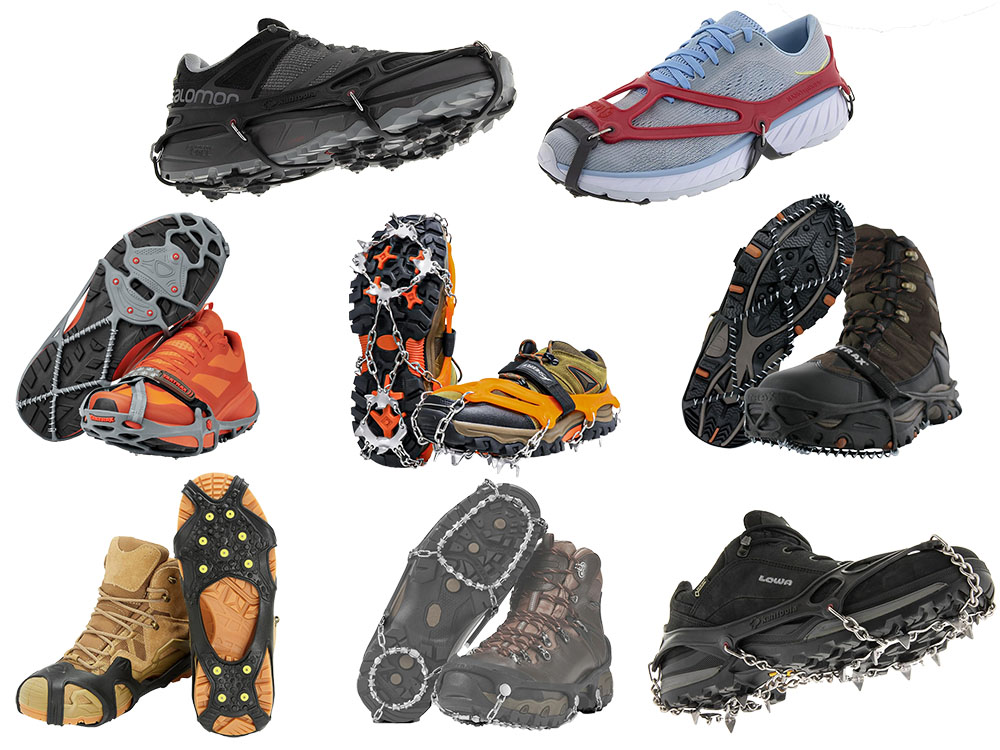
- Best overall microspikes for hiking: Kahtoola MICROspikes - Legendary traction and durability for winter hillwalking. 12 stainless steel spikes per foot bite into ice and hard snow.
- Best value ice cleats for city walking: Yaktrax Pro (Coil Traction Cleats) - Simple yet effective coil-spring cleats. Great for pavements and flat trails, and very easy to use. Low-profile design that fits almost any shoe.
- Best for running & mixed terrain: Kahtoola EXOspikes - Lightweight with 12 small tungsten-carbide spikes per foot. Designed for winter trail running and road-to-trail transitions. Durable and versatile.
- Best coil-and-spike cleats for running and mixed terrain: Yaktrax Run - they are purpose-built for runners who train through winter on a mix of icy pavements, compacted snow and light trails.
- Best budget microspikes: Sheefly 19-Spike Ice Grips - Affordable Amazon favourite. 19 stainless steel spikes (≈14 mm long) give a 360° grip. Include straps for a secure fit. Great for occasional use on icy hikes or dog walks.
- Best studded traction cleats: ICETRAX Pro Tungsten Grip Ice Cleats - Rubber cleats with eleven tungsten-carbide studs. Ideal for icy pavements and light running, where large spikes would be overkill. Packable and quick to put on.
- Best hybrid spike design: Yaktrax Diamond Grip - Uses case-hardened steel beads on chains instead of spikes. Excels on mixed ice and concrete (e.g. frequently transitioning from icy ground to bare pavement) without needing to take them on and off as often.
- Best low-profile cleats for icy pavements & road running: Kahtoola NANOspikes Footwear Traction - Minimal, road-friendly tungsten-carbide studs designed for icy pavements, hard paths and winter road runs. Ideal if you mainly run or walk on tarmac but still need serious bite on black ice.
Here's a quick reference table summarising our 8 top picks and what they're best for:
| Product |
Type of traction |
Best for |
Footwear |
Key strength |
| Kahtoola MICROspikes |
12 spike chains (~10 mm) |
Hiking & hill walking on icy trails; maximum grip on hard ice and neve |
Hiking boots / sturdy walking shoes |
Rugged, top tier traction for serious winter walkers |
| Yaktrax Pro (Coil Traction Cleats) |
Steel coils (no spikes) |
Urban/pavement, commuting, light duty on flat ice and packed snow |
Almost any footwear (shoes to boots) |
Very easy to use; low profile, all foot coverage |
| Kahtoola EXOspikes |
12 tungsten-carbide studs (~7 mm) |
Winter trail running and road to trail mixed terrain |
Running shoes, trail runners, light hikers |
Versatile, durable and light for fast movement |
| Yaktrax Run Traction Cleats |
Forefoot carbide spikes (~3 mm) + heel steel coils (1.4 mm) |
Winter running on icy pavements, compacted snow and light trails |
Road running shoes, trail runners, light hiking shoes |
Runner-focused traction: bite on toe-off plus stable heel grip |
| Sheefly 19-Spike Ice Grips |
19 stainless spike chains (~14 mm) |
Budget hiking and walking; occasional icy hikes and dog walks |
Walking boots and shoes (strap improves fit) |
Affordable with strong 360° bite and included straps |
| ICETRAX Pro Tungsten Grip Ice Cleats |
11 tungsten-carbide studs (~5 mm) |
Icy pavements, car parks, light running where big spikes are overkill |
Trainers, casual shoes, work boots, hikers |
Compact, fast on/off and excellent on black ice |
| Yaktrax Diamond Grip |
Case hardened steel beads on chains |
Mixed ice, compacted snow, rock and concrete with frequent surface changes |
Most shoes and boots (universal fit) |
Durable, all direction grip on varied winter surfaces |
| Kahtoola NANOspikes Footwear Traction |
10 tungsten-carbide studs (~5 mm) |
Icy pavements, hard paths and winter road runs on mainly tarmac |
Road running shoes, trail runners, light shoes |
Minimal, road friendly design with serious bite on ice |
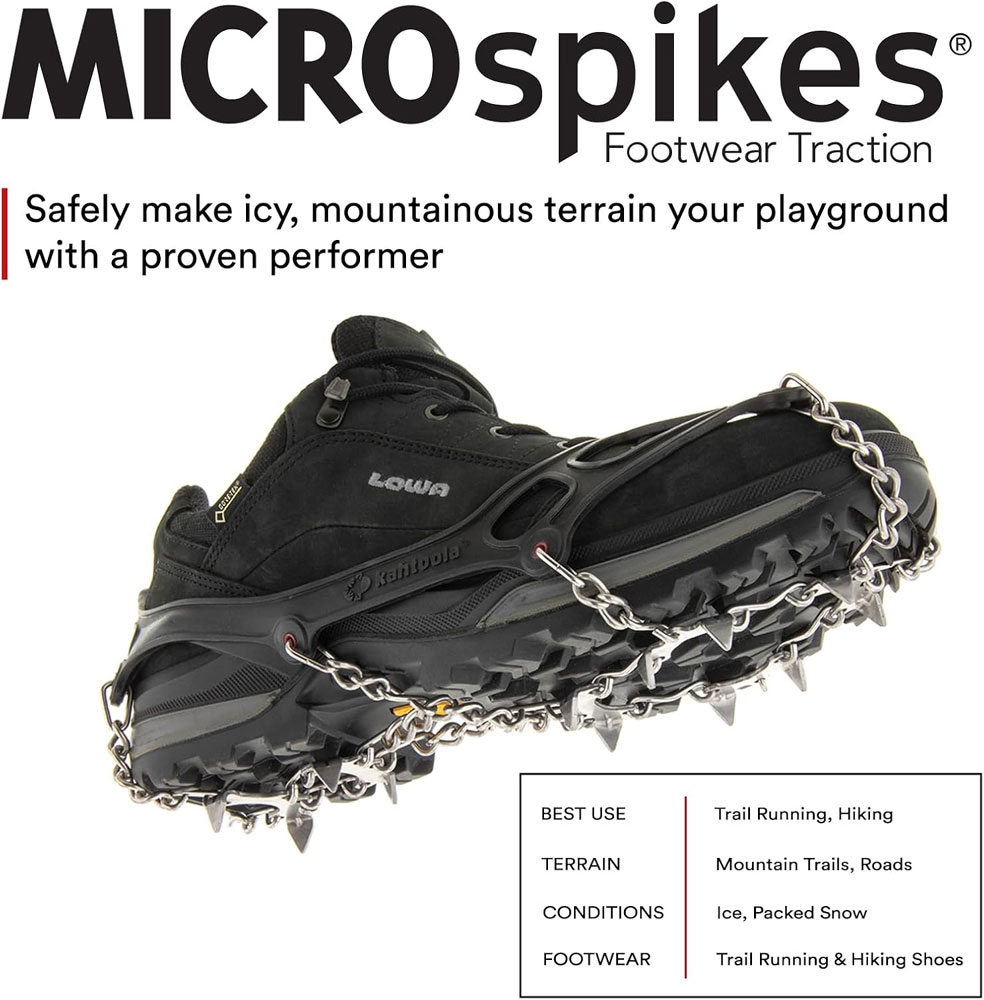
Best overall microspikes for hiking: Kahtoola MICROspikes
Kahtoola MICROspikes are the go-to choice for walkers and hikers seeking serious grip on icy trails and compacted snow. If you're doing regular
winter hill walks but don't need full crampons, this is the classic, bombproof option.
Key specifications:
- Number of spikes: 12 stainless steel spikes per foot (9.5 mm)
- Spike layout: 8 forefoot, 4 heel
- Harness: Thermoplastic elastomer (TPE) with reinforced eyelets
- Weight: 338 g/pair (size M)
- Sizes: S-XXL (fits approximately UK 3 up to 14)
- Intended footwear: Hiking boots, sturdy walking shoes (flexible enough for running shoes and trainers, though a bit heavy)
- Terrain: Ice, packed snow, moderate hills (low-angle winter mountain trails, forest tracks)
- Binding style: Stretch-on elastomer (no straps needed)
- Packability: Medium (comes with a tote sack and can be stuffed into a jacket pocket)
Key features:
- Aggressive traction: 12 hardened spikes per foot provide excellent grip on icy trails and hard-packed snow - widely regarded as ideal
for non-technical winter traction.
- A spike length of ~1 cm provides a secure grip on sheer ice.
- Durable build: Chains and spikes are made from heat-treated, corrosion-resistant 400-series stainless steel for long life. The harness
remains flexible in sub-zero temperatures (rated to -30°C), and reinforced eyelets prevent tearing.
- Secure fit: The elastomer harness cinches tightly around your boot. Once on, MICROspikes stay put and won't slide, even in deep snow.
A raised heel tab makes them easier to put on and take off.
- All-round versatility: Suitable for everything from winter hillwalking and hiking on frozen trails and icy tracks to outdoor work such
as shovelling snow. They'll even handle mixed dirt and ice (though prolonged use on rocks or concrete will dull and could start to flatten the
spikes).
Pros:
- Outstanding traction
- Easy to put on (for a spike device) - the stretchy rubber and toe/heel markings make it straightforward, even with cold hands.
- Highly durable - quality materials mean they can last many winters; replacement parts (chains/spikes) are rarely needed, and their durability means they far outlast cheap copies.
- Stable on the foot - they don't flop or feel insecure; you quickly trust your footing. Extra straps are usually unnecessary.
Cons:
- Not suitable for dry or bare ground - the 1 cm spikes are uncomfortable and even unsafe on hard surfaces such as pavements with only a dusting of snow. You'll want to remove them if the ground under you frequently alternates between ice and rock (or consider one of the smaller-spike devices on this list).
- Heavier and bulkier than lighter-duty cleats, you notice you're wearing them on each foot. For purely flat town/city walking, they're overkill.
- Premium price - usually one of the more expensive options. However, the performance and build make it a good choice for regular winter walkers.
- No adjustment strap - The simple stretch fit works for most, but in rare cases (very low-volume shoes or during vigorous running), it may shift.
Description:
The Kahtoola MICROspikes have become iconic among winter hikers - for good reason. Slip them over your boots, and within seconds you've got a
crampon-like grip underfoot. On an icy uphill trail, the difference is night and day as you can walk normally again, rather than gingerly
shuffling.
Over the last few years, I've found the 12-point spike layout provides excellent coverage - even on slick, angled ice, where several spikes dig
in securely. The chain linking the spikes distributes pressure evenly and can handle rugged terrain. MICROspikes shine on well-trodden snowy and
icy paths, where, without them, you'd be sliding everywhere.
Despite the robust traction, I find them fairly comfortable to walk in. The low-profile chains and flexible harness allow a natural stride on
snow. That said, once you hit hard, bare ground, you'll definitely want to take them off, as the spikes are long enough to make them very
unstable on solid surfaces, and you'll soon sound like a tap dancer on pavement!
Carrying them is easy; they fold into a small pouch (about 15×8×5 cm). At ~338 g for medium, they add some weight to your pack,
but it's well worth it for the safety margin they provide on ice.
Even though they're pricier than some other options, I've been using my original pair for quite a few years now and have had no durability
issues. Kahtoola is now on its fourth generation of these MICROspikes.
Who this is best for: Hikers and walkers who frequently encounter icy or snowy trails in winter and want the most secure traction short
of using technical crampons. If you do regular winter hill walks in places like the Lake District, Snowdonia, or the Scottish Highlands (below
the elevation and not on slopes where full crampons/ice axes are needed), these are ideal.
They're also great for icy woodland tracks, frozen muddy paths, or icy bridleways. For example, if you're a photographer, birdwatcher or dog
walker in winter conditions, MICROspikes will keep you on your feet.
Who it's not ideal for: People who only need traction occasionally on flat, urban pavements - the spikes are overkill for that (Yaktrax
or studded cleats for me are better for pavement use). Also, if you are trail running, the MICROspikes work, but I prefer a lighter and more
flexible option (see the Kahtoola EXOspikes below).
And of course, if you plan to tackle steep mountains or climb frozen waterfalls, etc., MICROspikes are not enough - you'd need proper
crampons
and mountaineering gear at that point.
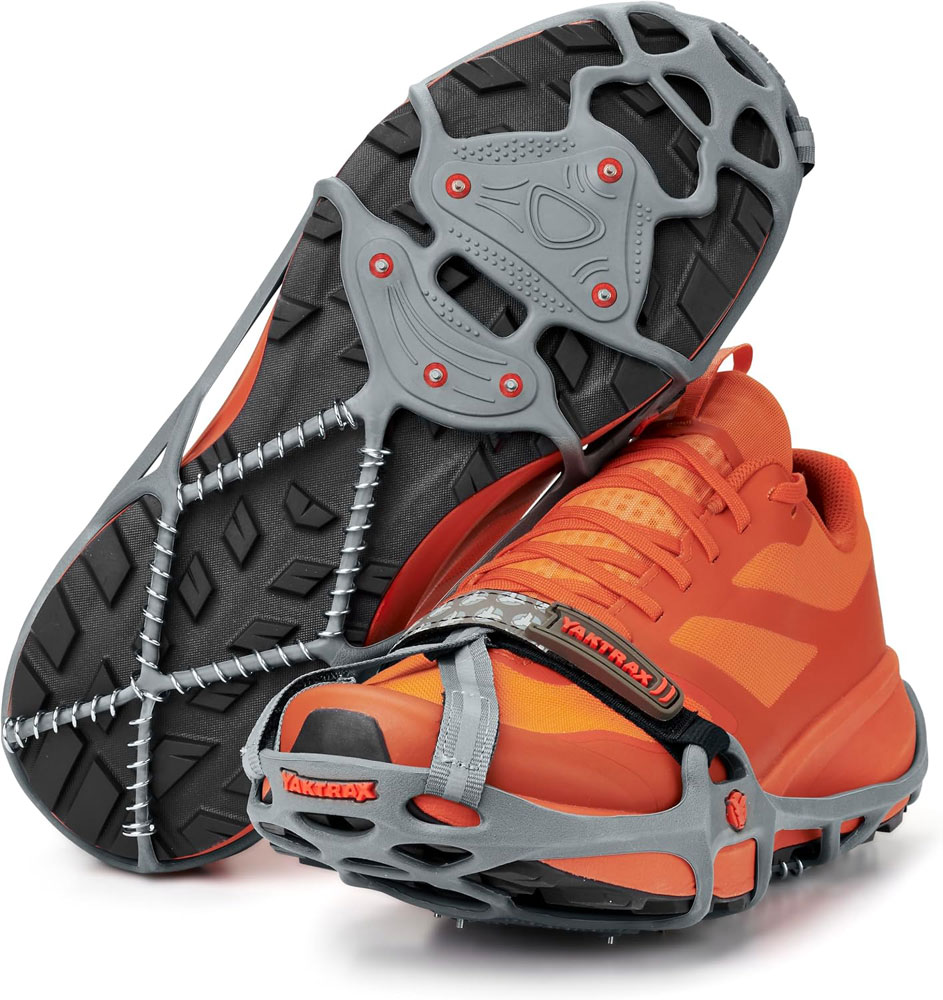
Best value for town/pavement walking: Yaktrax Pro (coil ice grippers)
Yaktrax Pro are simple, coil-style ice grippers designed for everyday winter use on pavements, park paths and gentle trails. They slip easily
over almost any footwear and are perfect for commuting, dog walking and low-level icy rambles.
Key specifications:
- Traction type: Steel coiled springs (approx. 1.4 mm gauge) wrapped around a rubber frame
- Coverage: Coils under heel and forefoot linked by an elastic frame (no individual spikes)
- Weight: ~160 g per pair (Medium)
- Size range: S-XL (covers most adult shoe sizes)
- Intended footwear: Wide range - from trainers and casual shoes to walking boots
- Typical terrain: Flat and moderately icy surfaces - pavements, park paths, driveways, light trails
- Binding style: Slip-on elastomer with an adjustable Velcro instep strap
- Packability: Excellent - very light, folds small enough to fit into a pocket or handbag
Key features:
- Spikeless coil traction: Instead of spikes, Yaktrax Pro uses a grid of steel coils that criss-cross under your foot. The coils have
edges that bite into ice and packed snow, creating hundreds of tiny gripping points. They provide 360° traction using a patented skid-lock
coil system without protruding spikes, resulting in a very natural feel when walking.
- Flexible and easy to use: The rubber harness stretches easily over most shoes or boots. The Pro version adds a Velcro strap over the
top of the foot to prevent them from slipping off - a useful upgrade on the basic
Yaktrax Walk.
They're extremely quick to put on and take off, even with cold fingers.
- Low-profile comfort: With no big spikes, you can walk normally on flat ground. They don't significantly alter your gait or raise your
foot, so they're comfortable for longer city walks.
- Good versatility: While best on ice or packed snow, the coils also help on wet concrete or light mud (though they're not really meant
for deep mud). If you hit a dry patch of pavement, the coils aren't as awkward as spikes - they'll still wear down if used on tarmac a lot, but
they won't trip you up immediately as a spike would.
Pros:
- Very easy to put on and take off - one of the simplest designs, ideal for anyone who wants fuss-free operation. Front and
back are clearly marked, and the elastic is forgiving.
- Fits almost any footwear securely - from trainers to chunky boots. The added strap on the Pro ensures they stay in place
even when you're moving a little faster or in deeper snow.
- Lightweight & packable - you can carry these in a handbag or work bag during winter to put on as needed (each is
about the size of a rolled-up pair of socks).
- Affordable - typically much cheaper than spiked microspikes. The value for money is excellent for urban use. Often,
they're under £25.
- No 'click-clack' on ground - quieter and less awkward on mixed terrain; you won't sound like you're wearing golf shoes
on the pavement.
Cons:
- Limited traction on sheer ice or steep terrain - the coils are good for flat ice, but they don't penetrate as deeply as
spikes. On very hard ice (e.g. glazed surfaces) or any incline, they are less grippy than microspikes. They can still slip on steeper hills
or very smooth ice (microspikes or crampons would outperform here).
- Not for deep snow - in deep, soft snow, the coils won't bite (nothing will, except snowshoes). These are best for a thin
layer of snow over ice or a hard snowpack.
- Durability limits - while decent, the coils can eventually stretch or snap if used heavily, especially on mixed surfaces.
They can also become clogged with gravel or grit, reducing effectiveness.
- Can be slippery on some surfaces - ironically, on very smooth indoor floors or polished stone, the coils have almost no
grip (they're not intended for indoor use). Also, on transitional surfaces such as a patchwork of ice and exposed rock, they have less bite
than spikes.
Description:
Yaktrax is practically a household name in winter traction, and the Pro model refines their classic design for more active use. I've found
Yaktrax Pro to be the go-to for everyday winter errands: slap them on your shoes when it's icy out, and that treacherous walk to the shops or
the morning stroll with the dog becomes far less stressful.
The steel coils create a grippy cradle under your foot. On level ice, they perform admirably - it's almost like having snow chains on your feet,
giving you a sure-footed feel. I've seen many a postal worker and delivery driver wearing them on icy driveways, precisely because they're light
and let you move quickly without fear of slipping.
On gentle trails (e.g. a canal towpath or a park trail in winter), Yaktrax Pro also do a fine job as long as the terrain isn't too hilly. For
town walking, these stash easily in your bag and can save you from an embarrassing spill on black ice. The Velcro strap on the Pro is a welcome
addition, as it anchors them to your shoe.
With reasonable use, I've found they do wear down, and I generally replace mine every 2 years, but they are reasonably cheap.
Who this is best for: Anyone who wants a simple, quick solution for urban and suburban winter conditions. If you're mostly dealing with icy
pavements, car parks, driveways, or the occasional icy park path, Yaktrax Pro is hard to beat for convenience.
They're perfect for commuters (keep a pair in your bag if the forecast calls for ice), older individuals who want confidence when walking
around the block.
They're also great 'just-in-case' devices - lightweight insurance in your
rucksack
for early spring/late autumn hikes when you might encounter an icy stretch but mostly won't.
Who it's not ideal for: Hikers in steep or mountainous terrain - once the trail becomes significantly steep, uneven, or icy, the limited
bite of coils won't be enough; that's when you'd upgrade to proper microspikes or crampons.
Best for running & mixed terrain: Kahtoola EXOspikes
Kahtoola EXOspikes are designed for runners and fast walkers who move between road and trail in winter. They're light, flexible and durable,
providing reliable traction on icy pavements and mixed trail conditions without feeling bulky underfoot.
Key specifications:
- Spike layout: 12 tungsten-carbide-tipped spikes per foot
- Spike length: 0.29" (7.4 mm)
- Traction design: Spikes embedded in flexible TPU lugs (no dangling chains)
- Harness: Elastomer with reinforced eyelets and integrated toe bumper
- Weight: 208 g per pair (size M)
- Size range: XS-XL (unisex; designed for both running shoes and boots)
- Intended footwear: Trail running shoes, road runners, hiking shoes and boots
- Typical terrain: 'Trail-to-tarmac' - icy pavements, snow-covered trails, mixed hard surfaces
- Binding style: Stretch-on harness (no separate strap needed)
- Packability: Excellent - compact, with a small tote bag supplied
Key features:
- Hybrid spike-cleat design: EXOspikes are engineered for maximum versatility. Instead of long, hanging chains, they feature a TPU
traction matrix - essentially a series of tough plates across your sole with small carbide spikes embedded. This means no chains to tangle,
and the spikes are shorter (7 mm) but ultra-tough, able to handle running on mixed ice and rock without wearing down quickly.
- Built for running and fast hiking: The low-profile spikes and flexible harness make EXOspikes ideal for running. They won't radically
alter your stride or balance. You can run confidently on icy pavements or trails and then cross patches of bare ground without the device
feeling awkward or prone to damage - the spikes' carbide material resists abrasion on hard surfaces.
- Secure and easy on/off: Kahtoola included features such as an ergonomic toe bail (a reinforced front lip that keeps the device
aligned and prevents it from creeping off the toe) and a raised heel tab for quick removal. The harness hugs the shoe snugly; in my experience,
EXOspikes stay put even during more dynamic activities like running downhill.
- All-round winter performer: While lighter than full microspikes, EXOspikes still provide significant grip. They excel on mixed
terrain - e.g. a trail that alternates between iced-over sections, rocks, and dry trail. They bite into ice reliably, yet aren't so aggressive
that they hinder you on rocks or firm ground.
Pros:
- Extremely versatile - ideal for those who split time between city and trail, or encounter varied conditions in a single
outing. They handle icy pavements, light snow, and trail ice in a single run.
- Runner-friendly design - lightweight and low-profile, so they don't feel as clunky as traditional microspikes. This
helps you maintain a more natural running form. They also don't have chains that could potentially snap under high-speed impact - everything
is integrated into the tough TPU frame.
- Durable spikes - Tungsten-carbide is about as hard as it gets (supposedly 100× more abrasion-resistant than steel).
These spikes can bite into ice and also withstand occasional contact with pavement or rocks without rounding off quickly. Many 'town' runners
use them for entire winters with minimal wear.
- Secure fit on diverse footwear - we've used them on running trainers, approach shoes, and hiking boots; the stretchy
harness and multiple sizing options ensure a snug fit on all. No flopping around. And no need for extra straps.
- Quick to put on - similar to Microspikes in method, but slightly easier because the whole unit is a little more flexible.
Cons:
- Not as aggressive as longer spikes - On very hard glare ice or steeper terrain, the shorter spikes can't penetrate as
deeply as longer options such as Kahtoola MICROspikes. They're a trade-off between traction and versatility. If you purely hike on very icy
mountain paths, you might still prefer the longer spikes of Microspikes for that extra bite (and confidence).
- Less effective in deep snow - The lower-profile design excels on hard surfaces, but if you step into deeper soft snow,
the spikes aren't long enough to reach firmer ground below. I find they still help a little, but not as much as a longer-spiked device would.
- Price - They often cost nearly as much as the Microspikes. The quality is high, but they do cost more than most.
- Studs can still slip on smooth, wet rock - Tungsten studs grip ice well, but if you hit, say, a wet log or a smooth, wet
stone (not frozen), they're not magic, and you could still slip because there's no soft rubber contact. I find that any traction device shares
this limitation on certain surfaces.
- Potential for pressure on very minimal shoes - If you wear extremely minimalist barefoot shoes, the hard spike plates of
EXOspikes (though small) could feel a bit pointy underfoot. I did try them out, but did not find them too comfortable with my
Vivobarefoot.
In normal shoes, trainers or boots, this is not an issue.
Description:
Kahtoola EXOspikes fill a niche that for me has grown in recent years: providing confidence on winter runs and fast hikes without the bulk of
mountaineering-grade spikes. When you first handle them, you notice the clever design - a series of three textured plates at the forefoot and
two at the heel, each with spikes, connected by a flexible harness.
This arrangement gives you traction across your foot while providing plenty of flexibility between the plates. I took EXOspikes on a mixed run
that started on icy pavement, then transitioned to a snow-covered path, and ended with rocky sections blown free of snow.
The EXOspikes excelled in these conditions - on ice and packed snow, they gripped securely (you feel a reassuring bite with each foot plant).
When I hit rocks, the spikes were short enough that I could run over them without feeling like I was standing on stilts or on overly unstable
footing, which is great for me with how clumsy I can sometimes be on slippery ground!
On pavements, you do feel the small studs (and hear a slight click-click), but it's tolerable for short stretches, much more so than running in
full microspikes, which would be quite uncomfortable and potentially damaging to the spikes. They've become a favourite among the trail runners
I know who continue training through winter, as well as hikers who want a single device that covers casual use and some hill walking.
Who this is best for: Winter runners and fast hikers who encounter varied conditions. If you run on roads with icy patches, or like to
hit snowy trails and might cross bare ground, EXOspikes are ideal. Also, those who find regular microspikes too heavy or overbuilt for their
typical hikes will love the lighter feel of EXOspikes.
They're also great for outdoor enthusiasts who want versatility: say you do a bit of everything - morning runs, weekend hikes, maybe the odd
walk up a local hill in winter - and you want one traction device that can do double duty. I do use these a lot for walking in my trainers on
packed ice on pavements in winter.
Who it's not ideal for: If your primary need is walking on very icy, steep footpaths, and you don't care about running or weight, the
Microspikes (or similar) might still be better due to their extra bite.
Additionally, if you're strictly an urban walker dealing only with flat icy pavements, EXOspikes would certainly work (they're arguably
over-engineered for that, but fine). However, cheaper studded cleats or Yaktrax might be more than sufficient in that case.
Finally, like all these devices, EXOspikes aren't meant for true mountaineering. If you think you'll need to front-point up anything or
traverse serious icy slopes, you're looking at proper crampon territory.
Best coil-and-spike cleats for winter running: Yaktrax Run Traction Cleats
Yaktrax Run are purpose-built for runners who train through winter on a mix of icy pavements, compacted snow and light trails. They combine
forefoot spikes with heel coils, so you get positive toe-off on ice without feeling like you're running on full microspikes.
Key specifications:
- Traction type: 6 carbide-steel spikes under the forefoot + 1.4 mm stainless-steel coils under the heel
- Spike length: approx. 3 mm carbide spikes for bite on ice
- Harness: High-strength natural rubber foot frame with formed toe and over-foot strap
- Design: Anatomic left/right shape for a closer fit on running shoes
- Straps & visibility: Forefoot performance strap + reflective heel tab for security and low-light safety
- Weight: Approx. 9.7-11.7 oz / 275-330 g per pair, depending on size
- Temperature rating: Tested against breakage down to about −41°F (≈ −40°C)
- Size range: S, M, L, XL (unisex; sized for running shoes - go up a size for bulky footwear)
- Intended footwear: Road running shoes, trail runners and light hiking shoes
- Typical terrain: Packed snow, icy paths, mixed city pavements, light winter trails
- Binding style: Stretch-on rubber harness with over-foot strap for extra hold
- Packability: Good - folds into a small pouch or pack pocket
Key features:
- Hybrid forefoot spikes + heel coils: Six carbide-steel spikes up front give positive grip and toe-off on ice, while the heel coils
spread load and offer a slightly smoother landing on packed snow or occasional bare sections.
- Runner-focused design: Built 'by runners, for runners', with an anatomic left/right shape and a rubber frame that's shaped around
running shoes rather than big hiking boots.
- Secure over foot strap: A performance strap across the forefoot helps keep the device centred and prevents it from creeping off the
toe during faster running or when side-loading on cambers.
- Cold-resistant rubber: The natural rubber harness is tested to very low temperatures, so it stays flexible rather than becoming
brittle in deep winter conditions.
- Reflective heel tab: Simple but useful for dark evening runs on pavements and towpaths, adding a bit of visibility from behind.
Pros:
- Excellent traction for winter runs on packed snow and ice, with spikes where you push off and coils where you land.
- More secure and aggressive than all-coil designs (e.g. Yaktrax Pro), especially on truly icy sections.
- Forefoot strap and anatomic shape provide a snug fit in proper running shoes, with minimal twisting or flapping.
- Reasonable comfort on short bare-pavement stretches, especially under the heel, where coils spread the pressure.
- Cold-weather durability thanks to carbide spikes, stainless coils and tested low-temperature rubber.
Cons:
- More faff to put on than with strap-free designs - the anatomic shape and strap make them a bit slower to fit mid-run.
But they are then more secure.
- Not ideal for very rocky or technical trails, where exposed spikes and coils can catch or feel awkward.
- Less subtle on bare tarmac than stud-only cleats like NANOspikes - you'll still feel the hardware underfoot.
- Limited utility in steeper, mountainous terrain - these are running cleats, not a replacement for microspikes or
crampons on serious hills.
- Fit is tuned for runners' shoes, so it may be less stable in very bulky boots.
Description:
Yaktrax Run sits in the 'runner' niche of winter traction: you're not looking to front-point up a gully; you just want to keep training safely
when pavements, canal paths and easy trails turn icy. The cleats feature six carbide spikes under the forefoot to deliver real bite when you push
off, backed by a matrix of steel coils under the heel for 360° traction and a slightly softer landing.
Compared with the all-coil Yaktrax Pro, the Run version feels noticeably more secure on hard ice and polished compacted snow - more like a
'mini spike system' where it matters, without committing you to full chain-and-spike microspikes. When testing, I found that the left/right-shaped
frame and over-foot strap keep them snugly aligned with my fell shoes, even when cornering and running on cambered paths.
On the flip side, the extra structure and strap make them a little slower to put on and take off mid-run than some simpler slip-on designs, and
they're still traction cleats, so you'll feel them when you hit long, dry stretches of pavement. They're also not suitable for steep hillside
traverses or technical mountain ground.
But if your winter running life is mostly roads, pavements, parks and straightforward trails that turn icy, they're a strong and runner-friendly
option.
Who this is best for
- Road and trail runners who keep training through winter on icy pavements and packed snow paths.
- Runners who want a secure, spiked forefoot for confidence on black ice.
- Runners who've outgrown all-coil cleats and want something more aggressive without going full microspike.
- Fitness walkers who mainly use running shoes and want a running-oriented fit rather than a boot-oriented device.
Who this is NOT ideal for
- Hillwalkers on steeper or more remote winter routes - full microspikes or crampons are more appropriate.
- People who mostly see bare, wet pavements with only occasional frost might feel lower-profile studded cleats more natural.
- Very technical trail runners on rocky, rooty ground where exposed coils and spikes can catch.
- Users wanting a simple slip-on for quick errands - all-coil Yaktrax or compact studded designs are easier to put on and take off.
Best budget microspikes: Sheefly 19-Spike Ice Grippers
Sheefly's 19-spike microspikes offer big-feeling traction at a budget-friendly price, making them a solid choice for occasional winter hill
days or dog walks on frozen tracks. They're ideal if you want plenty of bite without paying premium-brand prices.
Key specifications:
- Spike layout: 19 stainless steel spikes per foot (12 forefoot, 7 heel)
- Spike length: up to approx. 0.55" (14 mm)
- Chains: Welded stainless steel link chains connecting the spike plates
- Harness: Thermoplastic elastomer (TPE), with an over-foot strap
- Weight: ~410 g for Medium
- Size range: M-XL
- Intended footwear: Hiking boots, everyday winter boots, some trainers
- Typical terrain: General-purpose winter use - icy trails, snow-packed pavements, frozen tracks, and some muddy conditions
- Binding style: Stretch-on harness plus adjustable top strap for security
- Packability: Fair - comes with a carry pouch, slightly bulkier due to the spike count and length
Key features:
- High spike count & length: With 19 spikes on each foot, these provide 360° traction and redundancy - no matter how you step,
some spikes are in contact. The spikes are reasonably long (14 mm), giving penetration into snow/ice. Great for downhill traction, too, since
the heel has 7 spikes, including a wide heel plate with 3 spikes specifically for braking on descents.
- Budget-friendly materials: Made from standard stainless steel and elastic rubber, less durable than premium brands but at a lower
cost. Essentially, the basics are covered: strong spikes, sturdy chains, and a stretchy harness.
- Adjustable strap included: As for me, the cheaper elastomer didn't grip as securely as some premium brands, but the included top
strap did help keep it securely in place. This helps customise the fit over different footwear and adds security so you're less likely to
lose one in deep snow or mud. It's a nice addition for the price point.
Pros:
- Affordable - Typically significantly cheaper than big-name microspikes, as they are often under £20.
- Strong traction performance - In terms of raw grip, the combination of 19 spikes and long length means these bite very
well into ice and snow. In fact, I did find the traction surprisingly good given the price.
- Good all-arounder - They work for a variety of activities: winter walks, short hikes, even walking the dog on icy
mornings when there is enough ice for them to bite into. The included strap lets them comfortably adapt to running shoes or bulkier boots.
- Easy to put on/off - The rubber is soft enough to stretch easily, and it was easier to pull on than the premium ones, as
the frame wasn't as heavy-duty. The strap then cinches them tight. No special adjustment needed beyond that.
Cons:
- Not as durable as premium models - Longevity is usually a common trade-off at this price.
- Heavier than needed for easy use - At ~400+ grams, they're not ultralight. For a casual dog walk, you don't usually
need 19 large spikes - something lighter could do. The large spikes also mean walking on non-ice (like going into the shop) is awkward - you're
high off the ground and can skid on hard floors - and they do mark hard floors!
- Fit is not as tight as more premium models
- Not for technical terrain - Despite the beefy look, these are not rated for mountaineering or very steep icy scrambling.
Keep them to the intended moderate uses.
Description:
The Sheefly (and similar 19-spike cleats) have become hugely popular on Amazon and elsewhere due to their compelling value. Essentially, for
under £20, you get a set of crampon-like cleats that, at first glance, look just like premium models.
When I tested the Sheefly spikes on icy paths and packed snow, they performed ok and the long spikes dug into frozen ground. The traction
initially felt on par with some pricier microspikes.
They were actually easier to put on than my Kahtoola. However, this might not be entirely positive, as I noticed the frame material seemed less
durable and more prone to stretching. When walking, the sensation didn't feel as natural, and I didn't feel as secure on my footing.
For me, if you want a budget pair of microspikes, these will do the job. If you're only using them a few times each winter, they could last
you several seasons. If you want something that will last longer and give you more confidence while out walking, I'd spend extra and go for the
Kahtoola MICROspikes.
Who this is best for: Bargain hunters and occasional users. If you want the security of microspikes but can't justify £50-£60
for something you'll use twice a year, these are for you. Hikers on a budget tackling easy-to-moderate trails will find these do the job - they're
popular with many hikers in the UK who maybe only need them a couple of times per year on lower hills or during rare snowfalls.
Who it's not ideal for: Anyone needing top-tier reliability for frequent use - if you're out every weekend in winter, investing in a
higher-end brand likely pays off in durability (and warranty). Also, if you know you'll be on mixed pavement, the long spikes here are less
convenient - something like Yaktrax or a stud cleat might suit better. And again, they are not suitable for mountaineering and the steeper icy
slopes where crampons and ice axes are needed (and the ability to use them). But for general lowland winter walking, these budget cleats are
surprisingly capable.
Best studded ice cleats for pavements: ICETRAX Pro Tungsten Grip Ice Cleats
ICETRAX Pro Tungsten Grip cleats are compact, studded ice grips designed for people who spend a lot of time on icy pavements, car parks and
lightly frozen paths. They use tough tungsten-carbide studs and a grippy rubber tread to give more bite than basic rubber overshoes, while
still being small and packable enough for everyday winter use.
Key specifications:
- Traction type: 11 tungsten-carbide cleats per foot with additional rubber snow tread pattern
- Cleat layout: strategically placed for 360° traction under the forefoot and heel
- Harness: Special cold-resistant rubber compound with reinforced joints (stays flexible in low temperatures)
- Fit system: Ergonomic StayON toe cap to keep cleats centred on the shoe or boot
- Visibility: Built-in reflective heel panel for low-light visibility near roads and traffic
- Weight: Around 350 g per pair
- Size range:
- S/M - Men's 5-9, Women's 6.5-10.5
- L/XL - Men's 9.5-13, Women's 11+
- Intended footwear: Casual shoes, trainers, work boots and hiking boots
- Typical terrain: Icy pavements, compacted snow on paths, car parks, lightly frozen tracks
- Binding style: Simple slip-on harness - toe first, then stretch over heel
- Packability: Great - folds small, easy to stow in a bag, rucksack or car glovebox
Key features:
- Tungsten-carbide spikes: 11 hardened tungsten cleats per foot pierce ice and offer far greater durability than standard steel
studs - ideal if you regularly encounter black ice in winter.
- StayON toe cap: A sculpted toe section that cups the front of your shoe and prevents the cleats from twisting or working loose as
you walk.
- Snow tread traction system: Raised rubber lugs between the metal cleats improve grip on packed snow and add stability when crossing
short bare patches.
- Reflective heel: Integrated reflective panels on the heel enhance visibility in the dark - handy for roadside walking or running on
winter evenings.
- Cold-proof rubber: Special rubber compound and reinforced joints designed to remain flexible and resist cracking in harsh winter
conditions.
- Quick slip-on design: Simple 'toe in, pull over heel' fitting; easy to use in gloves after a couple of practice sessions.
Pros:
- Excellent on black ice and thin ice - tungsten studs bite into hard, flat surfaces where plain rubber soles and many
budget cleats struggle.
- Ideal for pavements and urban routes - a low-profile design that's much more natural than big spikes on tarmac and
paving stones.
- Secure fit on most footwear - the StayON toe cap helps them stay centred on both trainers and boots, reducing the risk
of a cleat coming off or rotating.
- Highly durable studs - tungsten-carbide is extremely wear-resistant, so the cleats cope better with unavoidable contact
with bare pavement than softer steel does.
- A reflective heel - a useful safety feature if you walk on or near roads in the dark.
- Very packable 'just in case' option - light enough to live in a bag, a car, or a desk drawer all winter.
Cons:
- Limited performance in deeper snow or off-road mud - short studs are best on ice and very firm snow; they don't add much
in soft slush, churned-up mud or deep snow.
- Not suitable for steep hills or mountain use - there's no forefoot spike plate or chain network for serious gradients;
they're strictly pavement-and-path tools.
- Less coverage than full microspikes - 11 studs are sufficient for flat walking, but not as confidence-inspiring as a
full chain-and-spikes grid on rough, uneven trails.
- Must be removed indoors - studs can still be slippery on smooth floors and will mark many indoor surfaces.
- Sizing is fairly broad (S/M and L/XL) - they fit me ok (UK 11.5), but very small or very large feet might find the fit
less precise.
Description:
ICETRAX Pro Tungsten Grip sits in that sweet spot between simple rubber overshoes and heavy chain-style microspikes. Designed for winter
walking, they combine 11 tungsten-carbide cleats with a moulded snow-tread sole pattern to deliver reliable grip on icy pavements, compacted
snow and frozen car parks without adding much bulk or weight.
In use, they feel more like studded winter tyres for your shoes than traditional microspikes. On a classic black-ice UK morning - the kind
where bare trainers have you (well, me, anyway) skating and slipping - the ICETRAX Pro, worn over your footwear, instantly restores confidence.
Each step gives a subtle crunch as the studs bite into the ice, while the rubber tread helps when you transition onto firm snow. Unlike big
spikes, they stay relatively comfortable when you hit short bare patches of tarmac, which is ideal for mixed urban walking. The StayON toe cap
does a good job of keeping the cleats anchored in place, reducing the faff of constantly re-centring them, which I've had to do with different
pairs in the past.
They're less at home in deep, soft snow or on rough hill paths, where a full chain-and-spikes microspike would offer more bite and stability.
But for everyday winter safety - getting to the shops, walking the dog, crossing a frozen car park, or walking around town - they're exactly
the kind of simple, robust traction aid that makes the difference between nervy shuffling and relaxed walking.
Who this is best for
- Urban and suburban walkers who mainly encounter icy pavements, car parks, and lightly snow-covered paths.
- Commuters and key workers who want a small, reliable cleat that they can throw in a bag and slip on only when conditions require it.
- Older walkers or anyone anxious about falls who want extra security without the bulk or the 'technical' feel of full hiking microspikes.
- Road runners and fitness walkers who occasionally encounter icy patches and want a studded grip that still feels comfortable on short
stretches of bare road.
Who this is NOT ideal for
- Hillwalkers tackling steep or remote winter terrain - for anything beyond low-angle paths, a full microspike or walking crampon,
plus winter skills, is more appropriate.
- Deep-snow or off-trail users who need flotation or aggressive bite in soft, unconsolidated snow.
- People walking mainly on muddy fields or slippery footpaths - here, deeper chains and spikes, or simply a very 'luggy' boot, will
often perform better.
- Anyone looking for a one-device solution from pavement to serious mountains - think of these as an everyday urban safety tool, not
a mountaineering product.
Best chain-and-bead traction: Yaktrax Diamond Grip
Yaktrax Diamond Grip are designed for people who spend a lot of time moving between ice, rock, gravel and tarmac in winter. Their rotating
steel beads provide a secure, multi-directional grip on mixed surfaces without the snaggy feel of long spikes.
Key specifications:
- Traction type: Case-hardened steel diamond-shaped beads on steel cable
- Coverage: 360° bead chain network under the forefoot and heel
- Weight: Up to 340 g per pair
- Size range: S-XL (unisex)
- Intended footwear: Most everyday shoes and boots, including flexible soles
- Typical terrain: Mixed surfaces - alternating ice, compacted snow, rock, gravel and tarmac
- Binding style: Stretch rubber harness that pulls over the toe and heel
- Packability: Good - chains fold relatively flat; usually supplied with a storage bag
Key features:
- Unique bead-based traction: Instead of spikes, Diamond Grips use sharp-edged steel beads that rotate freely on steel cables. As you
step, these beads spread the load and pivot, so there are always edges gripping in different directions. The design is self-clearing - the
beads can swivel to shed snow and to present new edges as they wear. It's a clever system, particularly good on transition surfaces (ice <-> rock).
- All-direction traction: The pattern of the chain network ensures that, whether you stride forward, side-step, or even pivot, there
are always multiple points of contact biting in. Unlike straight coils (which can slide in certain directions) or spikes (which can be less
effective on small ice nubs), the Diamond Grip provides a more continuous grip. I found them very stable on uneven, icy ground, where spikes
might catch only intermittently.
- Durability on mixed ground: Besides walkers, these are marketed to people such as outdoor workers who move from ice to concrete to
gravel. The hardened steel alloy beads are tough and wear slowly - they won't snap off like some spikes might if caught on rocks. There's no
single point of failure (such as a spike link that, if broken, would leave you without a spike).
- No high points: Because there are multiple small grip points, you don't get the teeter-totter feeling of standing on spike tips.
Walking on flat ground with Diamond Grips feels more natural than with microspikes. They also don't protrude as much, so they're less likely
to catch on loose pant hems, etc.
Pros:
- Great on variable terrain - If your route has a bit of everything (ice, packed snow, bare ground, gravel), you can leave
these on and be confident. You won't destroy them by walking on rocky bits, and they'll still grip the next icy patch. Perfect for scenarios
like shovelling an icy driveway (where you go from asphalt to snowy lawn) or hiking a trail that alternates between snow and exposed sections.
- Very stable, no rolling - The traction feels evenly distributed. Some people prefer these for walking on pavement ice
interspersed with pavement because they don't experience that sudden loss of grip when a spike hits pavement (the beads just roll a bit).
Also, they are less prone to the 'balling' issue - snow doesn't clump as much, and if it does, the bead movement helps break it up.
- Long-lasting edges - The case-hardened beads stay sharp with use. Even if a few edges dull, the bead rotates to a fresh edge.
- Easy to fit - A similar stretch-rubber design to Yaktrax coil products, just a tad sturdier. They go on easily and
stay in place. There's no left/right differentiation. You just pull on so the chains are evenly spread. The lack of rigid spikes means they
conform well to different soles (boots, shoes).
- Low maintenance - Rinse and dry them, that's it. No spikes to check for bending. The beads won't rust quickly, and if a
bit of rust appears, it's superficial.
Cons:
- Not as aggressive on pure ice as spikes - On completely smooth glare ice, microspike points that dig in might still
outperform beads, especially if the ice has a thin wet film on top.
- Can still slip on very smooth surfaces - If you encounter something like a metal grate or a pure marble floor (not that
you'd wear them indoors, ideally), the beads won't help - but neither would anything short of suction cups. On sheer wet rock, they can slide
a bit because they might not find purchase. Basically, they excel on rough ice and mixed surfaces, but sheer ice is their limit case.
- Noisy on hard surfaces - They make a crunching or scraping sound on concrete or rock (less of a high-pitched clink than
spikes, more like chains dragging). Not a big deal outdoors, but noticeable. Also, on very cold snow, they may make a slight metallic creak.
- Slightly heavier than coils - They are more robust, so they weigh a bit more than Yaktrax Pro. Still lighter than full
microspikes, though. It's a middle ground.
- Mid-range price - They cost more than basic Yaktrax, usually around the same or slightly less than entry-level microspikes.
Description:
Yaktrax Diamond Grip occupies a niche for people who frequently face inconsistent winter conditions: icy pavements, salted steps, and slushy
paths. I tried Diamond Grips on a couple of forest trails in the Alps that had frozen mud in spots, bare gravel in others, and icy puddles in
low-lying areas, and they coped admirably. I never had to think about removing them.
On the frozen mud (which was effectively lumpy ice), the beads contoured and gripped each undulation. On gravel, they just sort of sat around
the stones without any issues. Walking on a frozen footpath, I also felt secure.
These are popular with a couple of people I know who find that spikes catch on things too much, like when you shuffle your feet or fear
tripping. The Diamond Grips slide just enough on transitions to not trip you, but still catch on ice to stop a fall. They have a forgiving feel.
Who this is best for: People who frequently walk or work in mixed winter conditions. If you're a winter hiker in lowland or forest areas
where trails can be icy in parts and clear in others, Diamond Grips are excellent. Likewise, if you do a lot of outdoor work in winter, moving
between icy ground and solid ground, these will likely hold up and keep you safe.
In a town, they're good for people who might encounter more rugged conditions - e.g., if your driveway is gravel and icy, or you walk the dog
on a trail rather than just pavement. For straight city walking, they certainly work, though you might not need their heavy-duty nature unless
you prefer the design.
Who it's not ideal for: Mountaineers or very steep terrain hikers - these are not substitutes for crampons or even aggressive microspikes
if you're going up significant inclines of hard ice, where the lack of true spikes or frontpoints limits them.
Also, if your only goal is gentle pavement walking and you never step off the pavement,
Yaktrax Pro or
ICETRAX studs might be more cost-effective; Diamond Grips come into their own when terrain varies. And for dedicated runners, Diamond Grips can be used (some
do), but they are a bit heavier underfoot than something like EXOspikes or Nano-spikes, so they are not the first pick purely for running.
Best low-profile cleats for icy pavements & road running: Kahtoola NANOspikes Footwear Traction
Kahtoola NANOspikes are built for hard surfaces first - think icy pavements, compacted cycle paths, and frozen urban trails - with a low-profile
feel that suits road runners and fast walkers who don't want big chains or spikes underfoot.
They're very much the 'city cousin' of Kahtoola's MICROspikes and EXOspikes, designed to give serious bite on ice while still feeling natural
on tarmac and concrete.
Key specifications:
- Traction type: 10 concave tungsten-carbide spikes per foot embedded in TPU lugs
- Spike length: approx. 0.21" / 5.3 mm
- Traction plate: Dual-compound TPU plates to disperse impact and smooth out the feel underfoot
- Harness: Stretchy TPE elastomer with reinforced eyelets and toe bail (Kahtoola 'stretch-on' design)
- Weight (pair): approx. 176-232 g depending on size (XS-XL)
- Packed size: roughly 15 × 10 × 6 cm - folds into a small pouch or jacket pocket
- Size range (unisex): XS to XL
- Intended footwear: Road running shoes, trail runners and light hiking shoes (designed specifically for running/hiking shoe lasts)
- Typical terrain: Icy streets, pavements, urban footpaths, and hard-packed snow on paths and cycleways
- Binding style: Stretch-on harness with low-profile rivet connections (no separate strap needed)
- Warranty: 4-year Kahtoola traction warranty
Key features:
- Low-profile, road-friendly design: Purpose-built for hard, slippery surfaces, NANOspikes keep you close to the ground so your stride
still feels like 'normal' running or brisk walking, rather than clomping along on big teeth.
- 10 tungsten-carbide spikes per foot: Concave tungsten-carbide spikes are highly wear-resistant and bite into ice while shrugging off
abrasion from tarmac and concrete much better than softer steel.
- TPU traction plates for comfort: Dual-compound TPU plates spread impact forces and add extra rubber grip between the metal spikes, so
they feel surprisingly smooth when running or walking over mixed patches of ice and bare pavement.
- Updated fit and easy on/off: The current version has a larger heel tab and a wider fit range, enabling it to work with more shoe
styles, making it easier to pull them on and off with cold fingers.
- Ultralight and very packable: At roughly 180-230 g per pair, they're lighter than many running headtorches - easy to stash in a
running vest, bag or coat pocket 'just in case' the pavements glaze over.
Pros:
- Excellent for icy pavements and roads - exactly the conditions they're designed for; the spikes dig into black ice
without feeling wobbly or high-stacked.
- Very natural running and walking feel - low profile and TPU plates mean most runners don't have to change their stride
much, especially compared with chunkier microspikes.
- Highly durable spike material - tungsten-carbide tips cope far better with repeated pavement and concrete contact than
cheaper steel studs.
- Secure fit on proper running shoes - sizing is based on running and hiking shoes, so they fit well on low-volume trainers
and trail runners rather than being boot-only.
- Super light and compact - they fold in half and disappear into the small pouch; easy to carry on days when ice is
possible but not guaranteed.
- Backed by Kahtoola's 4-year traction warranty, which is reassuring if you're putting in lots of winter miles on them.
Cons:
- Not ideal for rough trails or deeper snow - the short studs are optimised for hard surfaces. For lumpy, mixed trails,
EXOspikes or full microspikes offer better bite and stability.
- Limited use on steep terrain - these are not suitable for steep hillwalking or mountain slopes; they're a winter traction
aid for pavements and low-angled paths, not a substitute for crampons or aggressive microspikes.
- Best fit is on running-style shoes - they can work with some light walking shoes, but aren't designed for bulky
three-season boots.
- Still need to come off indoors - like any studded device, they can be slippery on smooth indoor floors and will mark
some surfaces.
- Price is on the premium side compared with generic studded cleats, though you are paying for material quality and warranty.
Description:
NANOspikes sit in Kahtoola's traction line as the 'Urban Explorer' option: low-profile hardware designed for icy streets, pavements and hard
paths rather than mountain trails. Each foot has 10 tungsten-carbide spikes seated in boxy TPU lugs, backed by a dual-compound plate that
spreads the pressure. The result is a cleat that feels much more like a slightly 'clicky' running shoe than a mini-crampon.
In day-to-day use, they're ideal for UK winters, where the real hazard is often thin black ice on pavements rather than deep snow. Slip them
over your road shoes or lightweight hikers, and they give a noticeable boost in grip on frosty mornings, frozen canal towpaths and glassy
residential streets, without forcing a major change in gait.
On mixed surfaces - a bit of bare tarmac, a streak of ice, and hard-packed snow - the combination of studs and rubber lugs keeps things feeling
predictable. Runners in particular tend to appreciate that you can still move at a decent clip without the 'clank and wobble' that comes with
heavier spike chains.
They're less suited to rough, fell paths or steep, icy hill ground, where you'd want longer spikes or full chains underfoot, and they're not a
replacement for winter mountaineering gear on serious terrain. But as a specialist tool for keeping you upright on icy roads and hard urban
surfaces, they're among the most refined options currently available.
Who this is best for
- Road runners and run commuters who face icy streets, pavements and canal paths in winter and want extra grip without a major change
in stride.
- Urban and suburban walkers who mostly deal with black ice, compacted snow and frozen pavements rather than deep, off-road snow.
- Commuters and dog walkers looking for a premium, long-lasting traction aid that fits in a pocket or bag until conditions turn nasty.
- People who already use Kahtoola MICROspikes or EXOspikes for trails and want a dedicated, low-profile option for town use.
Who this is NOT ideal for
- Hillwalkers on steep or remote winter terrain - for anything beyond low-angle paths, you're into microspike or crampon territory,
plus winter skills.
- Trail runners spending most of their time on rough, uneven footpaths - EXOspikes or more aggressive microspikes will provide better
traction on lumpy trails and mixed rock/snow.
- Walkers in consistently deep, soft snow - short studs don't help much when your shoes sink; snowshoes or alternative routes are more
appropriate.
- Anyone wanting a single traction device for pavements and serious mountain days - NANOspikes are deliberately specialised for hard,
icy surfaces, not all-round winter mountaineering.
Why slips, trips and falls are so dangerous - especially as you get older
Slips, trips and falls aren't just inconvenient; as we get older, they become one of the leading threats to long-term health and even life
expectancy. Globally, falls cause an estimated 684,000 deaths each year[1],
and in the UK they are the leading cause of fatal injury in adults over 65[2].
Around one-third of people aged over 65 and half of those over 80 will experience a fall each year, with 20-30% resulting in serious injury,
such as fractures or head trauma[3].
The Global Burden of Disease study also shows that falls contribute to millions of years of life lost, demonstrating the profound
life-shortening impact they can have worldwide[4].
The consequences of a serious fall extend far beyond the immediate injury. Older adults who fall repeatedly have been shown to have a 60%
higher risk of death in the following years than those who don't fall[5]. Hip
fractures - a common outcome of slipping on ice - carry a 1-year mortality rate of 20-30% in older adults[6] [7].
Survivors often experience long-term loss of mobility, reduced independence, and a downward spiral in overall health. That's why proper traction
in winter conditions isn't just about comfort - it's a meaningful way to reduce the risk of a life-changing or life-shortening fall.
If you are unsteady on your feet, I would advise against going out in icy conditions, even with microspikes, as they may give you a false sense
of security. My mum, who is now not very steady on her feet, has had a few falls in the last five years, and I do not think microspikes would
have helped on any of those occasions.
What microspikes and ice grippers actually do (how they work)
Microspikes and ice cleats are essentially portable traction devices for your feet. They work by increasing the friction and grip your shoes
can achieve on slippery surfaces such as ice, hard-packed snow, and even wet algae-covered rocks.
Here's how they do it:
- Spikes or studs bite into ice: Just as car tyres can have studs for winter, microspikes feature metal points that dig into the ice's
surface. Ice, being relatively soft (compared to hardened steel), allows these points to penetrate slightly, creating grip where a flat rubber
sole would just slide. The sharper and harder the spikes, the more effectively they can cut into ice - that's why many use steel or tungsten
spikes.
For example, Kahtoola MICROspikes' 12 spikes each extend about 3/8" into the ice, offering excellent traction on thick ice. Even on packed
snow, the spikes can compress and grip the surface rather than just sliding over it.
The stainless steel microspikes and chain on the Kahtoola Microspikes
- Chains or plates provide stability: The metal chains or plates connecting the spikes help distribute pressure and keep them at ideal
angles. They often form a flexible net underfoot that adapts to uneven surfaces. On a rocky path with patches of ice, the chain network allows
some spikes to hit higher spots while others hit lower ones, ensuring continuous contact. Devices like Yaktrax Diamond Grip use chain-linked
beads that adjust to the terrain for multi-surface grip.
- Coils and grit for grip: In spike-less designs (Yaktrax coil types), traction is provided by edges or gritty surfaces. Yaktrax's
steel coils effectively press many small, angled edges into snow or ice, creating a textured surface that resists slipping, rather than
penetrating deeply. It's more like a snow-chain effect. Similarly, some ice cleats feature carbide-tipped studs that scratch into ice to
prevent slipping.
Stainless steel coil on Yaktrax Run
- The rubber harness keeps everything secure: The elastomer harness (the rubber frame that stretches over your shoe) is essential. It
must stay flexible in cold temperatures (often rated to -30°C) and hold the traction elements firmly against your footwear.
Good harnesses ensure the spikes stay in the correct position, such as under the forefoot and heel, rather than drifting to one side. Many
harnesses are designed to cover the toe and heel edges of the shoe, preventing the device from slipping off easily with mud or snow. Some
also feature extra straps for added security.
- Full-foot traction versus partial: Microspikes typically cover the entire sole, providing grip at the front and heel. This is
important because, generally, you push off with your toes and land on your heels.
Cheaper cleats might only have toe studs or heel spikes, which help but aren't as stable as having grip across the whole foot. Good designs
ensure balanced traction - preventing situations like your toe gripping while your heel slips out.
- Adapting to movement: Many microspike configurations allow some movement of the spikes (e.g., chains dangling, swivelling beads),
which can adjust as you walk. This helps prevent a rigid sensation and can also clear snow. For example, the rotating beads in Diamond Grips
shed snow and reposition edges as you walk. Likewise, some spiked designs feature joints that flex with your foot, enabling you to walk more
naturally even with metal underfoot.
In summary, microspikes work by giving your feet 'teeth', so they literally bite into surfaces that normally offer no grip. By covering key
areas of your foot's outsole with metal points or textured materials, they create friction where there was none. The result is that on ice,
instead of the entire weight of your step shearing off and causing a slide, those spikes or edges anchor you briefly, allowing you to push off
or put weight down without slipping.
However, it's important to note what they don't do: they lack front points like crampons (so they won't assist if you try to kick into very
steep ice), and they don't magically stick to smooth wet surfaces like bare rock or tile. They also don't enhance balance by nature; you still
need to walk carefully on very uneven or sloping terrain, but they significantly lower the risk of that sudden loss of footing on ice.
Microspikes vs crampons: What's the difference and when to use each?
Yatrax Run, Kahtoola Microspikes and Gravel crampons
It's a common question: 'Are microspikes just as effective as crampons?' The short answer is no - they have different roles. Here's a
comparison of their differences, and advice on when to use microspikes (or other ice cleats) versus when to upgrade to crampons.
Design and intended use:
- Microspikes (and ice grippers) are designed for walking and hiking on relatively gentle icy or snowy terrain - such as frozen
footpaths, icy trails, pavements, or snowy but not vertical slopes. They usually have between 6 and 24 small spikes (typically 1 cm or less
in length) or studs beneath.
- They attach via a stretchy harness and are meant to be flexible with your footwear. They excel at helping to prevent slips on ice, packed
snow, or mixed terrain that is not excessively steep.
Carbide steel spikes on Yaktrax Run
- Crampons are mountaineering tools built for steep, technical terrain. Classic crampons have 8-14 large spikes (points) made of steel
or aluminium, often with two that stick out front (front points) for kicking into ice. They attach via more rigid bindings (strap systems or
clip into specialised boots).
Crampons are intended for steep ice or hard snow - such as climbing frozen waterfalls, snow gullies, glaciers, or any slope where a slip could
send you sliding a long way. They are overkill (and even dangerous) to use on flat ground or thin ice on pavement, as they're clunky and you
could trip.
Footwear Compatibility:
- Microspikes can fit on almost any shoe or boot, from trainers and shoes to hiking boots. They're designed to be universal - you don't
need special boots. If your footwear is flexible, that's fine because the microspikes also flex.
- Mountaineering crampons often require stiff-soled boots. Some are strap-on and can be fitted onto moderately stiff hiking boots
(rated B1 in boot grading), but many (semi-automatic or automatic crampons) need boots with hard welts and very rigid soles (B2 or B3 boots).
Using crampons on too soft and flexible a boot is risky - they can pop off or not sit securely.
Terrain Steepness:
- Microspikes are suitable for low- to moderate-angle conditions. A mountaineering rule of thumb states that microspikes perform well
on slopes of up to about 15-20° on hard snow or ice. Beyond that, particularly if there is high exposure (for example, a slip-and-fall
hazard), they become inadequate.
- Why? They lack front points, so on a steep incline, only the toe edge of your boot with small spikes engages - not enough grip to
prevent sliding if it's really hard ice. Plus, the elastomer can stretch differently on steep terrain, causing the spikes not to sit as flush.
- Crampons handle steep-to-vertical terrain well. You can front-point directly into 70° ice with crampons, and they should hold
(with proper technique and training). On 30-40° firm neve (hard snow), crampons grip effectively and prevent slipping where microspikes might skid.
Essentially, any terrain where you'd need an ice axe for self-arrest, you probably also want crampons on your feet rather than microspikes.
Front points on gravel crampons
Safety and consequences:
- On easy terrain, crampons can be more hazardous, as their long points may catch on objects (rocks, roots, your other leg), leading
to falls. Microspikes perform better in this regard; they offer traction without a significant trip hazard and do not require special walking
techniques.
- On challenging terrain (steep, icy mountain), microspikes can become dangerous - they may give a false sense of security, but if you
hit a hard ice patch at a steep angle, you could slide a long way because those short spikes won't hold. With crampons (and training),
you can arrest or prevent that slip more effectively.
Weight and Convenience:
- Microspikes are lighter (often around 300-400 g) and more compact. You carry them 'just in case' while walking. You can put them on
swiftly when necessary.
- Crampons tend to be heavier (~800-1000 g for steel versions) and bulkier, and are generally reserved for planned use in
established winter conditions. They also require a bit more time to strap on correctly.
Microspikes and crampons are complementary, not competitors. Think of microspikes as the tool for most non-technical winter walking. They
greatly extend where you can safely go in winter as a hiker.
Crampons are the tool for technical winter climbing or the upper end of winter hiking (where, if you misstep, it's not just a bruise but a
potentially fatal slide).
If you're new to crampons, I highly recommend taking a winter hiking or mountaineering course to learn how to use them and an ice axe safely.
When uncertain about conditions or walking on varied routes, carry both - start with microspikes, and if you encounter terrain that feels risky
or exceeds their capability (feet slip, slope angle increases, ice hardens), that's the time to stop and switch to crampons (and possibly rope
up or use an axe).
For the usual low-level or pavement walker, crampons aren't necessary - microspikes will be your companion. But know their limitations and
respect them: if the terrain exceeds microspikes' capability, turn back or gear up like a mountaineer. No traction aid makes you invincible, so
always evaluate: could I safely stop myself if I slip here? If not, you need more than just microspikes, or you should avoid that terrain
altogether.
Types of winter traction devices
Not all ice traction aids are the same. There's a range from simple slip-on studs to full mountaineering crampons. Understanding the main types
of traction devices will help you select the right one (or combination) for your activities. Here are the primary categories:
- Chain-and-spike 'Microspikes': These are the ones we've mainly discussed - such as Kahtoola Microspikes, Hillsound Trail Crampon, etc.
They feature a harness with chains underfoot and fairly long spikes (usually 0.5-1 cm). They offer aggressive traction on ice and hard snow,
making them suitable for hiking. Within this category, some have more spikes, some fewer; some include an extra strap. If you're a hiker or
walker dealing with winter trails, this type is probably your go-to.
They range from lighter models (such as Hillsound FreeSteps6 with numerous small spikes) to heavy-duty options (Kahtoola, Hillsound Trail
Crampon Ultra, Yaktrax Summit). Opt for these when you require maximum grip but still desire flexibility.
- Coil spring cleats: Exemplified by Yaktrax Walk/Pro. These feature steel coils wrapped around a rubber frame, crisscrossing beneath
the foot. They do not have individual spikes, but the edges of the coils provide grip on packed snow and mild ice. They are very lightweight
and suitable for flat ground.
Upside: very straightforward to use, comfortable, affordable. Downside: not very effective on smooth ice or hills (coils can't penetrate ice
like spikes do, so they may still slip on hard ice or inclines). Suitable for city use or light trails with patchy ice. If your main concern
is slipping on your driveway or pavements, these could be enough.
- Studded traction cleats: These are rubber overshoes fitted with small metal studs, often tungsten-carbide. Examples include Kahtoola
NANOspikes and ICETRAX V3. They function like studded snow tyres for your feet. They perform well on black ice, lightly icy roads, or shallow
ice where the studs can scratch in.
Close up of a carbide steel spike
- They are typically low-profile and runner-friendly. However, they have fewer contact points and are not suitable for deep snow. They are ideal
for those who mainly encounter icy, flat surfaces, such as urban runners and pedestrians.
- Chain-and-bead grips: E.g., Yaktrax Diamond Grip. A hybrid between coils and microspikes - they use chains with small rough beads
that provide multi-directional grip. They're more robust on mixed surfaces than coils (since the beads are hardened steel) and don't have the
pointy spikes of microspikes.
Consider these options if you often move between ice and rock or gravel. They are versatile: perform better on hard ice than coils, and last
longer on mixed terrain than spikes (spikes can bend on rocks; beads just roll off them).
- Minimalist heel/forefoot cleats: Some devices cover only the heel or forefoot with a few spikes or coils. For example, there are
heel-only spurs to prevent back-slip, or toe-mounted cleats for uphill traction.
Generally, I would advise covering the whole foot for balanced traction. Forefoot cleats might be used by runners who want flexibility in the
heel. If you go this route, be cautious - traction imbalance can cause trips or weird gaits.
- Snowshoe traction aids: If you use snowshoes, many have built-in crampons underneath. That's a separate category, but relevant if
you're in deep snow. Snowshoes themselves are beyond scope here, but note that if snow is deep enough, microspikes won't help (they'll sink
through) - that's snowshoe territory.
- Mountaineering crampons: As discussed, these are a different league - rigid frames, require boots, and front points for steep
climbing. Types include strap-on (flexible but less secure), hybrid, and step-in (require special boots). They are also categorised as C1, C2,
and C3, indicating increasing rigidity and suitability for steep terrain. Use crampons only when terrain demands it.
Which type of winter traction device is right for you?
Which is right for you?
It boils down to your primary use-case:
- Urban or commuting on flat ground with occasional ice: Consider coil cleats or studded cleats. They are easy, affordable, and
adequate for walking to work or around town. If your pavements and drives often have black ice, studded ones (like ICETRAX/NANOspikes) are
excellent because they also handle bare pavement sections with minimal fuss.
- Dog walking and park walks, etc.: If the terrain is mostly flat, coil or studs or even light chains would suffice. If there are some
slopes in the park, perhaps a chain-and-bead or a basic microspike for confidence on hills.
- Trail walking (gentle hills): For well-maintained footpaths with occasional ice, a light microspike is a dependable choice. They
handle all conditions encountered on easy trails. If trails are well-trodden and not too steep, microspikes provide security.
- Hillwalking (mountainous but non-technical): If you're tackling higher hills where slopes can be steeper, but not too steep, and
you're not actually climbing ice walls, opt for aggressive microspikes or trail crampons (Kahtoola Microspikes, Hillsound Trail Crampon). They
will handle most situations until proper crampons are necessary. Some hillwalkers also carry an ice axe for emergency stops even when wearing
microspikes on borderline-steep terrain.
- Mixed terrain work (outdoors job): Yaktrax Diamond Grip or similar might be ideal - they won't break if you step on concrete, and you
still get good ice traction. If you work all day outside, also consider durability and ease - Diamond Grips or even strap-on cleats with
replaceable studs could be useful.
- Running on roads and pavements: Studded cleats (NANOspikes) are generally the best choice. If it's very snowy or icy, some runners
prefer EXOspikes for extra grip on trails. But on roads, studs usually provide enough grip without being cumbersome.
- Running (trail): EXOspikes or FreeSteps6 type are best - lightweight, won't interfere with stride, but provide enough traction for
most trail conditions.
Lastly, consider local conditions: In the UK, for example, much winter walking is on compacted snow that refreezes into ice on popular paths.
Microspikes are very popular for those situations. In places with more intermittent thin ice, studded or coils may be enough.
Key features to consider when buying microspikes or ice cleats
When selecting the ideal traction device for your needs, consider the following features and specifications. These can determine whether the
product is a perfect fit or a source of frustration.
Traction design: spikes, studs or coils
- Spike length and shape: Longer spikes (8-15 mm) grip better in thick ice and deep, hard snow, but can make walking on solid ground
awkward. Shorter spikes (5-7 mm) are more comfortable and suited to mixed terrain but do not penetrate as deeply into hard ice.
Also consider shape: triangular spikes (such as Yaktrax Summit) bite in different directions than simple cone spikes. Some spikes
have flat 'teeth' to improve grip on packed snow. If you mostly encounter sheer ice, slightly longer spikes or multiple small ones can be
helpful. For frosty paths, small spikes or studs are sufficient.
- Number of spikes or studs: More points generally provide more consistent traction. 12 spikes per foot (the classic Kahtoola) is a
good benchmark for hiking, as fewer can leave gaps in coverage.
Studded cleats usually have 6-10 studs; ensure they're well distributed (for example, 5 at the front, 4 at the heel, etc.), which provides
stability. If considering a budget option with, say, 10 spikes, check whether they are mostly in the forefoot or evenly spread.
- Study material: Tungsten-carbide studs are much more durable than steel. If you choose studded cleats (Yaktrax Run, ICETRAX, etc.),
carbide is preferable because it won't wear down after some pavement walking. Steel studs (cheaper models) can flatten or rust more quickly.
- Multi-directional grip: Does the design prevent side-slipping as well as forward and back movement? Spikes or studs arranged in
multiple directions (or rotating beads in Diamond Grip) help on sideways slopes or when pivoting.
Some cheaper designs have all spikes oriented vertically - great for downward push, but less effective if you slide laterally. Look for
wording like 'multi-directional spikes' or notice that spikes are placed towards the edges of the foot as well as at the centre.
Harness and fit
- Harness material and cold resistance: Most use Thermoplastic Elastomer (TPE) or rubber blends. They should remain elastic in sub-zero
temperatures. Good ones specify this (e.g., 'stays flexible to -30°C'). Cheaper rubber may become brittle in extreme cold, increasing the
risk of breakage. If you hike in very cold environments, quality harness material is essential.
Stretch on elastomer on the Kahtoola Microspikes
- Coverage and fit on the shoe: A well-designed harness will have a toe cap that securely cups the front of your shoe and a lip over
the heel. This prevents it from slipping off. It should also rise high enough on the sides of your footwear to prevent slipping.
When choosing a size, follow the manufacturer's chart - consider the type of shoe (running shoes are lower-volume than boots; if you'll wear
both, size for the larger). Some models are designed for specific footwear types (e.g., Kahtoola EXOspikes have a broad fit range, whereas
something like a Hillsound Trail Crampon Pro is intended for boots).
- Adjustability: Does it have any straps to fine-tune the fit? Top straps (as on Yaktrax Pro, Hillsound, Sheefly, etc.) are very useful,
especially if you'll use the device on different shoes or in deeper snow (straps prevent slipping off in mud).
If you have particularly narrow or wide feet, adjustability becomes more important. Most elastomer-only designs are suitable for average feet,
but they may be a bit loose on very low-volume shoes - a strap can resolve that.
If your paid doesn't come with a strap, I've found that you can create your own using
Velcro / Hook-and-Loop straps,
which you can cut to length and thread through.
- Ease of putting on and taking off: In winter, the simpler, the better. Some heavy-duty models (with extra heel cups, BOA dials, etc.)
can be trickier to use. If you have reduced hand strength or will frequently put them on in freezing conditions, opt for a design known for
easy on/off.
Yaktrax coil types are the easiest (simply stretch like a rubber band). Microspikes with thicker rubber require a little more force. Practice
at home with gloves on so you know what to do when you are out on your walks.
Footwear compatibility
- Shoe versus boot: Some products perform better on one type than on another. For instance, a very low-cut running shoe might not
secure a tall harness as effectively; some designs could slip off a tapered heel. Conversely, certain devices might not stretch over bulky
winter boots, especially if they are near the upper size limit.
- If you plan to wear them on different types of footwear, choose a model known for versatility (EXOspikes, Diamond Grip, etc., are quite
adaptable). Ensure the spikes sit flat on flexible shoes - for example, some have a plate that might rock on a very curved running shoe
sole.
- Size range overlap: If you're between sizes, usually go down a size for a tighter fit (they're stretchy). An overly large harness
can flop or allow spikes to slip to the side, which is not ideal. It's better to have to stretch a bit more than to have it loose. But maybe
try both to see which you feels the best and suits the range of shoes you want to wear them on.
Many brands list a size range (for example, M fits 8-11, W 9+). If you are near the top of a size and plan to wear thick boots, consider going
up; otherwise, lean towards the smaller size. When websites have reviews, users often mention whether the fit was just right, too small, or
too large compared to the manufacturer's sizing. However, at first, rely on the manufacturer's sizing charts.
- Boot rigidity: If you have a rigid boot (B2/B3) and want to use microspikes on easier sections, note that some microspikes don't fit
as well on very stiff soles. However, generally it's fine. If your boots are this stiff, you probably have crampons. If wearing large,
insulated boots, make sure the harness can accommodate the bulk.
Durability and materials
- Spike material: Stainless steel is common because it resists rust. Regular (carbon) steel can be stronger, but it will rust if the
coating wears off. Tungsten-carbide is usually used only for stud tips, not full spikes, as it would be too brittle as a full spike. If you
plan to use them in wet conditions and may not always dry them properly, stainless steel is a safer option.
Also consider chain thickness; cheaper models might use thinner chains that can snap under stress. Some brands specify the steel grade or
mention special heat treatment, which usually indicates better longevity.
- Connection points: Examine how spikes are attached to chains and how chains are attached to the harness. Reinforced eyelets in rubber
(metal grommets) are excellent as they reduce the risk of tearing. Welded chains are stronger than bent links. Models such as Hillsound and
Yaktrax Summit are often welded.
Rivets holding spikes - are they robust? For all the ones I've tested and worn over the years, this hasn't been an issue for me.
- Warranty/Guarantee: Some reputable brands offer good warranties (Kahtoola now offers 4 years for EXOspikes; Hillsound often offers
2 years). This demonstrates confidence in durability. The trade-off for a lower price might be no support if they fail early.
- Rust resistance: If you live near the coast (salt on roads, etc.), rust can quickly attack gear. Stainless steel spikes are essential
then. If a product just says 'steel', assume it can rust - you'll need to dry and occasionally oil it. Galvanised chains, like those on
Diamond Grip, resist rust fairly well.
Weight and packability
- If you're a backpacker or runner, every gram counts. Lighter devices (~200 g), including studded cleats and some minimalist spikes,
weigh less, while heavy-duty options can weigh 400-500 g. It might not seem like a big difference, but on your feet,
weight matters.
For long hikes, a lighter device will feel more comfortable, but make sure it's durable enough for your needs. Runners usually choose the
lightest option that offers acceptable traction.
- Pack size: Do they fold in on themselves? Microspikes often come with a small pouch. Some bulkier models (with anti-balling plates,
such as Yaktrax Summit) take up more space.
Kahtoola Microspikes rolled up ready to put in their tote sack
- If you need to stash them quickly (say, mid-hike when conditions change), consider how easy they are to carry. The difference between a
compact set that fits in a jacket pocket and one that needs to be stuffed into your bag could affect convenience.
Special features
- Anti-balling (preventing snow build-up): As mentioned, some have plates or structures to prevent snow from sticking (Yaktrax Summit
has plates, Hillsound Trail Crampon Pro features anti-snow pads). Balling is more common with crampons and wet spring snow, when
microspikes can sometimes form clumps in the chains. It's not typically a deal-breaker for walkers and hikers, but if you venture out in
spring conditions, this feature is quite useful.
- Reflective elements: Some cleats feature reflective straps or heel bits (ICETRAX V3 has a reflective strip on the heel for night
visibility). Useful if you walk on roads in the dark, though for me, a
suitable headtorch
is far better for visibility and for being seen.
- Carrying case: It may seem minor, but a good case or bag helps protect the spikes (and your other gear from them). If the product
includes one, that's a bonus. If not, you might use a small stuff sack.
Kahtoola Microspikes in their tote bag, ready to be out into a jacket or backpack pocket
- Ease of cleaning: Devices with many small crevices, such as chain meshes, can trap mud or grit. Simpler designs, such as coils and
studs, rinse off more easily. If you plan to use them in muddy and icy conditions, consider how you'll clean them. Stainless steel and rubber
are easy to maintain-just rinse and air dry. If there's fabric or straps, check that they won't retain moisture or salt.
- Replaceable parts: A few heavy-duty products allow part replacement, such as replacing individual studs or screws. Most microspikes
lack user-replaceable components (aside from straps). However, it's worth noting whether that's an advertised feature, especially for more
expensive industrial models.
Size, fit & comfort
- Foot size accommodation: Check the maximum shoe size they fit, especially if you're at the upper end. For example, Kahtoola
Microspikes XL go up to UK 14 (US 15) or so; not all brands offer XL. If you have very large feet, ensure they offer your size.
Conversely, very small feet: some start at M or S, which might be too large for, say, a woman's size 4 UK. Some brands offer XS (Kahtoola
does, Hillsound S is small). You might have to try children's traction devices for very small sizes (but those are often coil types for young
children).
- Comfort on foot: While traction devices aren't intended for all-day use on mixed terrain, they should still be reasonably comfortable
when worn. Points to consider:
- Does any part of the harness rub against your foot or ankle? (Usually not, as it fits outside the shoe.)
- Do spikes underfoot cause any pressure? In well-designed shoes, your boot sole should absorb shock; in minimalist footwear, you might
feel point pressure from certain designs. If you plan to run or jog in them, comfort is essential; you do not want something that feels
'lumpy' or that alters your gait.
- Women's versus men's: Usually no real difference - they are unisex. Just ensure sizing accounts for the typically narrower women's
shoes, if relevant (most harnesses are so stretchy that the width difference is acceptable). Some women with small feet might find that
devices don't centre well because of their width, making a strap more important.
- Compatibility with gaiters or trousers: If you wear
gaiters or
walking trousers
that cover your boots, ensure the harness or spikes won't catch or tear them. Some spike designs with chains on top might snag loose clothing.
- Usually, slim designs such as EXOspikes or Yaktrax have nothing protruding, but some with a hinge or hook may. It's a minor concern, but
worth considering.
Considering these features in relation to your specific scenario will guide you to the right purchase. Asking the right questions about features
will help match the device to your needs.
Best practices for using microspikes and traction devices safely
Owning a pair of microspikes or ice cleats is fantastic - but to get the most out of them and avoid accidents or damage, keep these best
practices in mind:
- Put them on before you need them: It's much easier (and safer) to fit microspikes before you start slipping. If you see the path
ahead becoming icy, stop on a safe, flat area and attach them. Trying to wrestle spikes onto your boots while on an icy slope or after you've
started sliding is a recipe for trouble. Anticipate conditions; it's better to have them a little early than to wish you had them when you're
already skating on ice.
- Remove them when not needed: Microspikes provide excellent traction on ice and snow, but on bare rock, pavement, or indoors, they can
be hazardous or damaged.
- Spikes can slip on smooth, hard surfaces (like polished concrete or indoor flooring), as I have personally experienced when forgetting to
take them off and entering a café during a walk... rather unceremoniously!
- Walking long distances on pavements can dull or bend spikes, stress the chains, and scratch the pavement. Therefore, when you reach clear
ground, take a moment to remove them. Carrying a plastic bag or pouch in your pack makes it easy to store them without muddying other items.
- Adjust your walking style: When wearing devices with spikes or studs, take a slightly wider stride and lift your feet a little higher
than usual to avoid catching the spikes. Especially with full spikes, try to place your feet flat on the ground with each step (this activates
all the spikes). If you normally heel-strike heavily, remember that on very hard ice a harsh heel strike could still cause slipping if the
forefoot spikes aren't engaged. So, it is better to take a more flat-footed, steady step on ice.
- On slopes, kick your foot in slightly when ascending (to set the spikes) and descend with shorter, deliberate steps. Keep your weight over
your feet so you don't lean too far back, or the front spikes might not engage. When contouring (traversing across a slope), try to edge your
feet so the side spikes grip - or better yet, step in small zigzags to keep your feet flatter rather than pointing directly sideways on the
slope.
- Avoid steep, risky terrain (unless properly equipped): As emphasised, microspikes aren't suitable for steep climbing. If you find
yourself on a slope where a fall could be seriously dangerous, reconsider your route or your gear.
- Also, never use microspikes as a substitute for crampons in known avalanche terrain or on
mountaineering/steep routes - they don't offer the necessary security or compatibility with other gear. For example, you can't front-point
with them, and you can't reliably self-arrest from a slide initiated in microspikes.
- Periodic checks during use: Every so often, especially on a long hike, glance at your feet. Make sure the microspikes are still
properly positioned, as heavy mud or unusual movement can cause them to shift.
- If one side looks skewed, adjust it before it slips off. Also, check that the top strap (if any) remains tight. This can also avert any
unnecessary pressure on them, which may cause them to fail earlier than you would like. If you hear an odd jingle or feel anything, stop to
inspect, as a chain link may have broken or the harness may have torn.
- Do not use while driving: This might sound odd, but do not forget to remove them before driving. Spikes or even studs can slip on
car pedals and possibly get stuck. Always take them off before operating vehicles.
- Bring a small towel or cloth: When you remove spikes on a walk, they'll likely be wet or covered in snow. Having a rag to wipe off
ice, mud, or snow before stowing them is handy. It keeps your
backpack
and other gear dry. If you don't have one, give the spikes a few good shakes and taps to knock off excess snow or mud, and then place them in a
dry bag
inside your rucksack or pocket.
- Maintenance after use: When you get home, rinse your spikes in cool water if they are wet, icy, or muddy, then allow them to dry. This
helps prevent rust (even stainless steel can develop surface rust) and protects the rubber from degradation caused by salts.
- If you have been on salted roads, definitely rinse them, as road salt is corrosive. Dry them with a towel or hang them to dry. Storing them
while wet in a closed container can encourage rust or mould on the straps.
- Inspections: Regularly examine your traction devices for damage. Check for tears starting at the harness, particularly around the
eyelets where the chain attaches, as well as any small splits, bent or worn-down spikes, or stretched chains.
- If a chain link is partly open, that's a failure point. You might try fixing it with pliers or a quick link; otherwise, consider replacing
the part. For stud-style cleats, check the studs. If any are missing or very worn, flush, some brands offer replacements, or it might be time
for new ones. It's better to spot an issue at home than when you're relying on them during a hike.
- Be considerate of others and indoor surfaces: Spikes are sharp, so avoid walking close behind someone in a group to prevent spiking
them. When removing them, don't do it on a hardwood floor (or many other indoor surfaces) with the spikes down, as they will scratch the
floor and are also slippery indoors. Some places don't allow them inside, so take them off at the door to prevent slips or scuff marks.
- Keep them easily accessible: If you're hiking, store the spikes in a quick-to-reach place on your backpack, such as an outer pocket
or the top lid, so you're not tempted to skip putting them on just because they're buried. When you encounter an icy patch, you want to be
able to grab and put them on swiftly. Similarly, when walking around town, carry them in a bag or even your coat pocket so you can quickly
take them out if you come across a sudden icy patch.
- Have realistic expectations: Microspikes significantly improve traction, but they don't turn you into a superhero. You still need to
walk carefully on ice. They reduce the risk, but don't eliminate it entirely.
- Additionally, avoid sudden movements or running on very slippery surfaces unless the device is specifically designed for such conditions,
until you are confident in its grip. Test its limits in a safe area and perform a small test slide by shifting your weight to observe how
well it grips.
- Don't modify them unsafely: Some might be tempted to add extra screws or alter devices. Unless you know what you're doing, it's not
recommended for general users to tamper. Use the equipment within its design parameters.
By following these practices, you'll maximise both the lifespan of your gear and your safety. The key points to remember are: use traction when
needed, avoid wearing it when it's not appropriate, and always respect winter terrain. With that in mind, microspikes and ice cleats can open
up a whole new season of enjoying the outdoors, or simply prevent you from falling on your driveway!
Safety disclaimer for winter traction use
The advice and traction devices featured here are intended for low-angle, non-technical terrain such as icy paths, roads, and easy trails.
Always assess the conditions and terrain before heading out. Microspikes are not a replacement for proper winter mountaineering equipment or
skills on steep, high-risk terrain - in fact, confusing microspikes for full crampons can put people at serious risk in the mountains in winter.
For steeper slopes or mountains (typically more than 15-20° incline), or where a slip could have serious consequences, you should use
mountaineering crampons and an ice axe instead, and very importantly, have the training to use them.
Mountain rescue is called out far too often these days to incidents that could have been avoided with the correct kit and proper use.
Avalanche awareness: Microspikes do not protect against avalanche danger. If you venture into snow-covered hills, educate yourself
about avalanche terrain and carry the appropriate safety gear (transceiver, shovel, probe). Every member of your group should know how to use
them. Check local avalanche forecasts and avoid suspect slopes. In lowland urban settings, stay alert for black ice on pavements and roads.
Finally, always follow the manufacturer's instructions for each traction device, especially regarding suitable footwear and temperatures.
Remove the devices when transitioning to dry, hard surfaces to avoid damage or tripping. Inspect your microspikes regularly for wear, and
replace them if the spikes are worn or dull, or if the chains are damaged. Used responsibly, these winter traction aids will make your
cold-weather walks much safer and more enjoyable.
Summary: Choosing the best microspikes for winter walking
Whether you're walking on icy pavements, taking the dog out on frosty mornings, or exploring low-level winter trails, the right pair of
microspikes can significantly improve grip and confidence. From light-duty ice cleats for commuters to trail-friendly microspikes for hill
walkers, there's a model to suit almost every need and shoe type. Just remember: microspikes are not a fix-all.
Know your terrain, check the weather, and don't venture onto technical ground without the right gear or skills. Stay safe, stay upright - and
enjoy winter walking with a bit more grip underfoot. With this knowledge, you should be well-equipped - literally and figuratively - to stride
safely through winter conditions.
Happy (and safe) slip-free winter walking!
Glossary of key terms for winter traction devices
- Microspikes: A generic term for slip-on traction devices with chains and spikes that cover the entire foot. It is now widely used to
refer to any spiked winter walking aid that is not a full crampon. When someone says 'bring microspikes', they are referring to this type of
device.
The word 'Microspikes' is a registered trademark of Kahtoola, dating from 2009, but it has come to be used generically for any of these
lightweight, slip-on traction devices.
- Ice cleats / Ice grippers / Ice traction device: General terms for any device that improves your footwear's grip on ice. 'Cleats'
can refer to spikes, studs, or coils - context is important. In the UK, people might use 'ice grips' or 'snow grips' for the same items. They
are essentially interchangeable with microspikes in casual use, though 'cleats' can also refer to stud-type devices.
- Crampons: Mountaineering traction devices with metal frames and 8-14 long points, designed for walking on ice and climbing steep icy
or snowy terrain. They generally require rigid boots. In addition to ice climbing, crampons help ensure safety when travelling on snow and ice,
including crossing glaciers, snowfields, and icefields, climbing snow slopes, and scaling ice-covered rocks.
Do not confuse microspikes with crampons - crampons are for serious winter mountaineering. Sometimes hikers refer to microspikes as 'crampons',
but technically they are different.
- Packed snow: Snow that has been compressed (by foot traffic, vehicles, or wind) into a denser, often hard layer. It can be almost as
slippery as ice, especially when refrozen. Microspikes are great on packed snow because the spikes grip into it for better traction.
- Verglas: A thin layer of ice glaze on rock or pavement. Extremely hazardous because it is often nearly invisible and too thin for
crampon spikes to grip effectively. Studded cleats or numerous small spikes can improve traction on verglas, but it remains very tricky. The
term originates from French and is used in mountaineering to describe thin ice on rock surfaces.
- Elastomer: A flexible, rubbery material commonly used in these harnesses. Maintains elasticity in cold weather. It can be natural
rubber or a synthetic such as TPE (thermoplastic elastomer). Key property: resistance to cracking in freezing conditions.
- Tungsten-carbide: A very hard metal compound used in small studs or spikes on some cleats (e.g., Nanospikes). Harder than steel and
retains its sharpness longer, but it can be more brittle. It is usually suitable for small studs, though. Enables use on pavements with
minimal wear.
- Stainless steel: A steel alloy containing chromium that resists rust. It is commonly used in higher-end microspikes for chains and
spikes. This means that if you forget to dry them once, they won't immediately rust, though surface rust can still form. It requires less
maintenance than bare steel.
- Frontpoints: The front-facing teeth on a crampon (projecting at the front of the boot). Used for kicking into vertical ice.
Microspikes lack frontpoints; all their spikes are oriented downwards. That's why microspikes aren't suitable for climbing anything steep, as
you can't kick into them.
- Anti-balling plates: In crampons (and Yaktrax Summit microspikes), these are plates that prevent snow from balling up (sticking in
clumps) under your foot. Snow build-up can negate your traction. Anti-balling plates address this by flexing or being non-stick.
- B1, B2, B3 boots: Categories of mountain boots ranked by increasing stiffness. B1 boots accommodate strap-on crampons for light winter
walks. B2 boots are stiffer and suitable for mountaineering with semi-automatic crampons. B3 boots are fully rigid and designed for technical
climbing.
Microspikes can fit on most of these boots, but if you're wearing B-rated boots, you're probably in terrain that requires crampons.
- Winter Skills (course): Classes are often recommended for hillwalkers transitioning to winter. They teach the use of an ice axe and
crampons, and how to assess snow conditions. Microspikes don't negate the need for basic winter skills in the mountains, such as self-arrest
and navigation in snow.
- Snow chains (for shoes): People sometimes refer to microspikes as 'snow chains for your shoes' to draw an analogy with car snow
chains. When they do, they mean devices such as Yaktrax or microspikes, which essentially function like tyre chains by providing a metal grip
around the shoe.
- Boa® System: A patented dial-lacing mechanism used on the Yaktrax Summit (and many snowboard boots, golf shoes, etc.). 'Boa
closure' is the twist knob that tightens a wire.
If you are interested in learning more terms and definitions, check out our
glossary of walking and hiking terms.
Frequently Asked Questions (FAQs) about microspikes and ice cleats
Are microspikes as good as crampons?
Microspikes provide excellent grip on ice, snow, and packed trails, but they are not a substitute for crampons. Crampons are designed
for steep, technical, or icy mountain routes and offer deeper penetration and front points. For general winter walking, microspikes are
safer, lighter, and easier to use-though they are not suitable for serious mountaineering.
Can I run in microspikes?
Yes, some microspikes are designed for winter trail or road running. They're lighter, more flexible, and designed to stay snug on running
shoes without flapping or slipping. Always check the product specifications to ensure they're compatible with your footwear and running
style.
Will microspikes damage my shoes or boots?
Microspikes are generally safe for walking shoes and hiking boots when properly sized. However, regular use can cause minor scuffing or
stress on lightweight uppers or softer midsoles. Choose suitable footwear and avoid overstretching the rubber harness.
Do I need microspikes for pavements in the UK?
They're very useful during icy spells, especially for dog walking, commuting, or tackling untreated footpaths. While not essential every
winter, they're a wise investment if you want to stay upright on frosty pavements, drives, roads, or in parks without switching to full
winter boots.
What's the difference between microspikes and ice cleats?
Microspikes typically feature chain-linked metal spikes for trail and hill walking. Ice cleats are a broader category that includes
rubber-framed devices with studs, coils, or small lugs, often designed for urban or pavement use. The best choice depends on your terrain.
Are microspikes legal to wear in the UK?
Yes, there are no legal restrictions on using microspikes outdoors in the UK. However, it's best to remove them before entering shops,
stations, or public buildings, as they can damage floors and increase the risk of slipping indoors and always remove before driving.
How long do microspikes last?
With occasional winter use and basic maintenance, microspikes can last several years. Durability depends on build quality, frequency of
use, and whether you're mainly on trails or on hard pavements. Stainless steel spikes and reinforced rubber generally last longer. I have
pairs that are still going strong after more than 5 years' use.
What size microspikes should I get?
Always check the brand's size chart and choose based on the footwear you'll be wearing, whether boots, trail shoes, or trainers. If
you're between sizes, sizing up generally works better for bulkier footwear, while sizing down offers a tighter fit.
Can I use microspikes on all types of shoes?
Most microspikes fit hiking boots and trail shoes well. Some are flexible enough for trainers or casual shoes, but fit and stability may
be compromised. Avoid using them on very soft, thin, or narrow footwear that doesn't provide a snug fit.
When should I NOT use microspikes?
Avoid microspikes on steep, exposed, or avalanche-prone terrain. They're not designed for mountaineering or deep snow. They're best
suited to low-level winter paths, pavements, and icy tracks, not to frozen gullies or mountain ridges.
Can microspikes be used indoors or on tarmac?
No. They can be slippery on smooth indoor floors and on tarmac. In addition to the risk of falling, they may scratch certain indoor
surfaces and flooring. Remove them before going indoors or when walking on clear, dry pavement.
What's the best way to store and clean microspikes?
Rinse off grit, salt, and ice or snow after each use, then let them dry thoroughly. Store them in a pouch in a cool, dry place. Check
the rubber and chains regularly for wear, and avoid storing them in damp or near heat sources such as radiators or fires.
January 2026
Related reading: