Benefits of standing desks: What the evidence really shows
By: Andrew Forrest - February 2026
What does the evidence really say about standing desks? Research on sitting less, comfort, energy, and why movement matters more than standing alone.
Table of contents
This page contains affiliate links. If you buy products or services via these links, we may earn a small commission at no cost to you. If you are thinking of buying, please use our links, as it helps support our website and YouTube channel.
If you spend most of your working day sitting, you're not alone, but modern research has made one thing clear: long, uninterrupted periods of
sitting are a health risk in their own right. That's why UK and global guidance now emphasise 'move more, sit less' and breaking up long spells
of sitting with at least light activity wherever possible.[1 ‑ 4]
Health & Wellbeing Disclaimer
The information in this article is intended for general education and wellbeing. It discusses standing desks, sitting time, movement, and
related health considerations, drawing on published research and public health guidance, primarily for generally healthy adults.
A standing desk may not be suitable for everyone. If you have a medical condition that affects balance, circulation, joints, or mobility
(such as significant musculoskeletal problems, varicose vein complications, or circulatory disorders), or if prolonged standing causes pain,
dizziness, or discomfort, you should consult your GP, physiotherapist, or another qualified healthcare professional before making significant
changes to your work setup or daily movement patterns.
This article does not provide medical advice and should not be used as a substitute for professional healthcare. Individual responses to
sitting, standing, and movement vary. Always adjust your workstation gradually, prioritise comfort and regular movement, and seek professional
advice if you experience persistent or concerning symptoms.
Standing desk benefits: Why sitting less matters
You'll often hear sitting described as 'the new smoking'. It's a catchy headline, but it isn't a literal like-for-like comparison, and public
health researchers caution against treating it that way.[5] The practical takeaway remains: many people are sedentary for most of their waking hours, and higher sedentary time is linked to worse health
outcomes in population studies.[6]
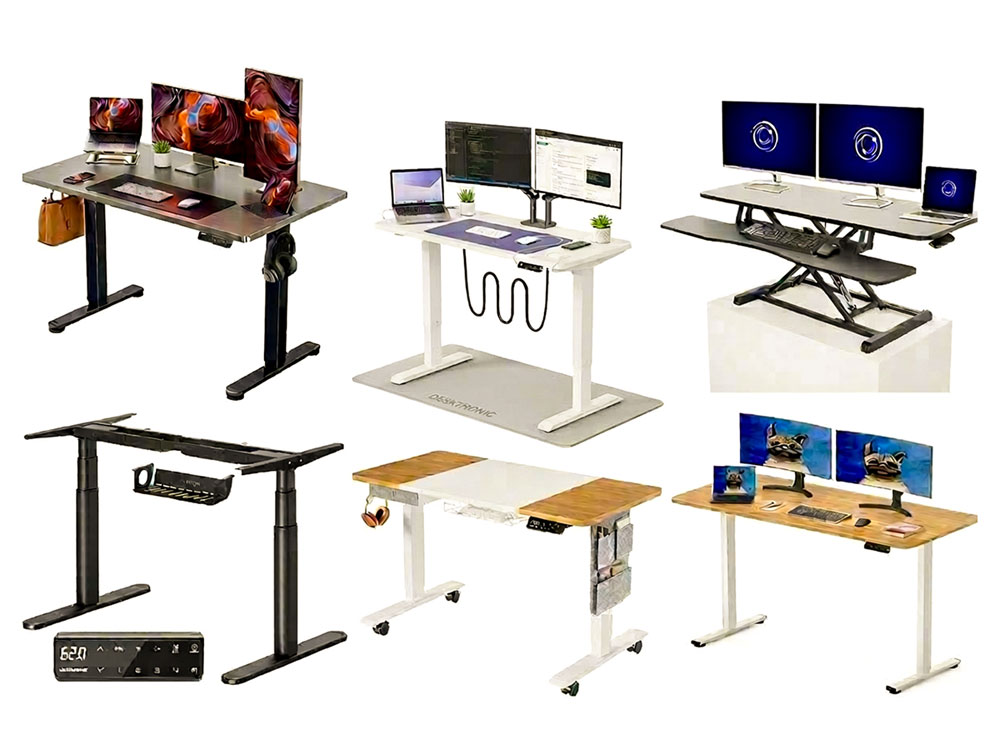
That's where a
sit-stand desk
earns its place. It won't magically 'fix' your health - but it can make a powerful behaviour change easier: less sitting at work, more position
changes, and more opportunities to move. In UK workplace trials, this typically translates into around an hour (or more) less sitting per workday
when the desk is used as intended.[7] [8] [9]
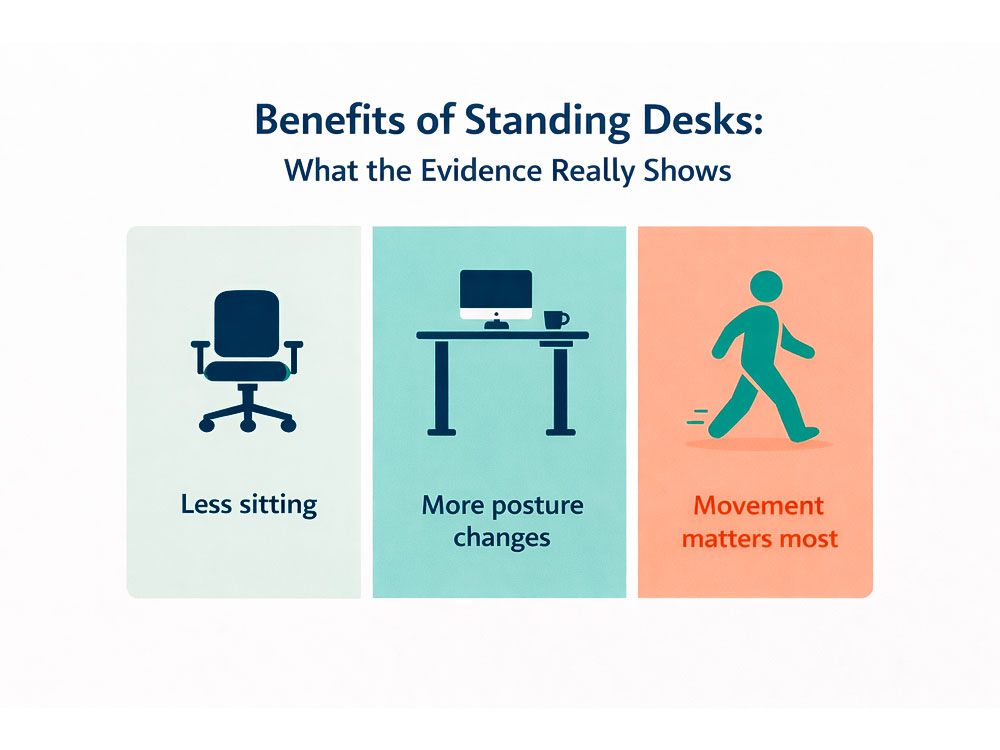
The key point: standing helps, but movement helps more. The strongest long‑term win comes from using a standing desk as a trigger to
break up sitting and add short 'movement snacks', even a couple of minutes of walking,
rather than swapping sitting still for standing still.[2] [3] [4] [10] [11] [12]
Bottom line: Will a standing desk help?
- Yes, it's usually worth considering if you sit for most of the day and are willing to alternate positions.
- The clearest evidence-backed benefit: it reduces workplace sitting time by about an hour a day in real-world trials.[7] [8] [9]
- It does not reliably cause major weight loss, ‘fix' posture automatically, or replace regular movement on its own.[1] [13] [14] [15]
- Best results come from alternating between sitting and standing and adding short movement breaks (especially walking).[2] [3] [4] [10] [11] [12]
A simple way to think about a standing desk is this: it's not a fitness tool; it's a behavioural tool. It helps you change position more often,
and that matters because the biggest problem with desk work isn't sitting full stop; it's sitting for long, unbroken stretches.
When you use a sit-stand desk properly (switching between sitting and standing and taking short movement breaks), you're interrupting sedentary
time, which is exactly what UK and international guidance aims for.[1 ‑ 4] For an even greater benefit, you can pair it with a walking treadmill or walking pad.
Now let's look at what a standing desk actually changes in real life, and what it doesn't, so you can decide whether it's worth the money for
your setup.
What a standing desk actually changes
A standing desk doesn't 'make you healthy' by itself. What it can do is change your daily routine by reducing sitting time at work, increasing
posture variation, and making it easier to build in short movement breaks.
Sitting time (the clearest and most consistent change)
In real-world workplace trials, sit-stand desks (especially when paired with prompts or coaching) reduce sitting time meaningfully:
- SMArT Work (Stand More At Work - NHS Trust, England): around 83 minutes less occupational sitting per workday at 12 months.[7] [8]
- SMART Work and Life (UK local councils): the 'intervention + desk' group spent about 64 minutes less per day at 12 months than in usual practice.[9] [16]
- Cochrane review: sit-stand desks reduce workplace sitting by about 84 to 116 minutes per day in the short- to medium-term (evidence quality rated as low).[15] [17]
Walks4all takeaway
A sit-stand desk is best thought of as a 'sitting interrupter'. If you buy one, measure success by fewer long sitting blocks, not by just how
many hours you stand.
Posture variation (helpful, but not automatic)
Height adjustment makes it easier to change posture throughout the day. However, good posture isn't guaranteed - setup still matters (screen
height, keyboard height, neutral wrists). UK DSE guidance remains the best baseline for desk ergonomics.[18]
Walks4all takeaway
If a standing desk makes you crane your neck or reach for the keyboard, it's not helping. Set-up is non-negotiable.
Energy use (often smaller than people expect)
Standing generally uses only slightly more energy than sitting. A meta-analysis found the average difference was about 0.15 kcal/min, roughly 9
kcal per hour for many adults.[13]
Walks4all takeaway
Standing desks can support healthier habits, but they're not a weight-loss shortcut.
For a bigger return, add short walks, either away from your desk or with a
walking pad.
Health outcomes: What the research supports (and what's still uncertain)
Back discomfort and musculoskeletal comfort
Across workplace studies, sit-stand setups often improve comfort for some people, particularly in the lower back, though results are not
universal:
- Systematic review and meta-analysis: sit-stand workstations may reduce low back discomfort in workers; more research is needed on 'dose' and specific populations.[14]
- Take a Stand! (office-based intervention): reduced neck-shoulder pain at three months and produced small reductions in the overall pain score, but these effects were not consistent across all regions/time points.[19]
Walks4all takeaway
If sitting makes you stiff or sore, alternating can help, but build up gradually. If your feet or legs start to complain, you've probably stood
too long without moving.
Energy, fatigue, mood and wellbeing
In UK trials, reducing sitting time has been associated with small improvements in work-related and psychological measures (such as fatigue,
work engagement, or wellbeing), but these effects tend to be modest and not guaranteed for everyone.[7] [9] [16]
Walks4all takeaway
Many people feel a bit less 'slumped' when they change position. Treat it as a nudge to move, not a cure-all.
Productivity and work performance
A common concern is whether standing reduces productivity. Overall, studies typically find little to no negative impact when people alternate
sensibly, especially once they're used to the setup.[7] [15]
Walks4all takeaway
Use standing for calls, admin and lighter tasks; sit for deep-focus work. The aim is comfort and consistency.
Cardiometabolic health: Standing helps a bit; walking helps more
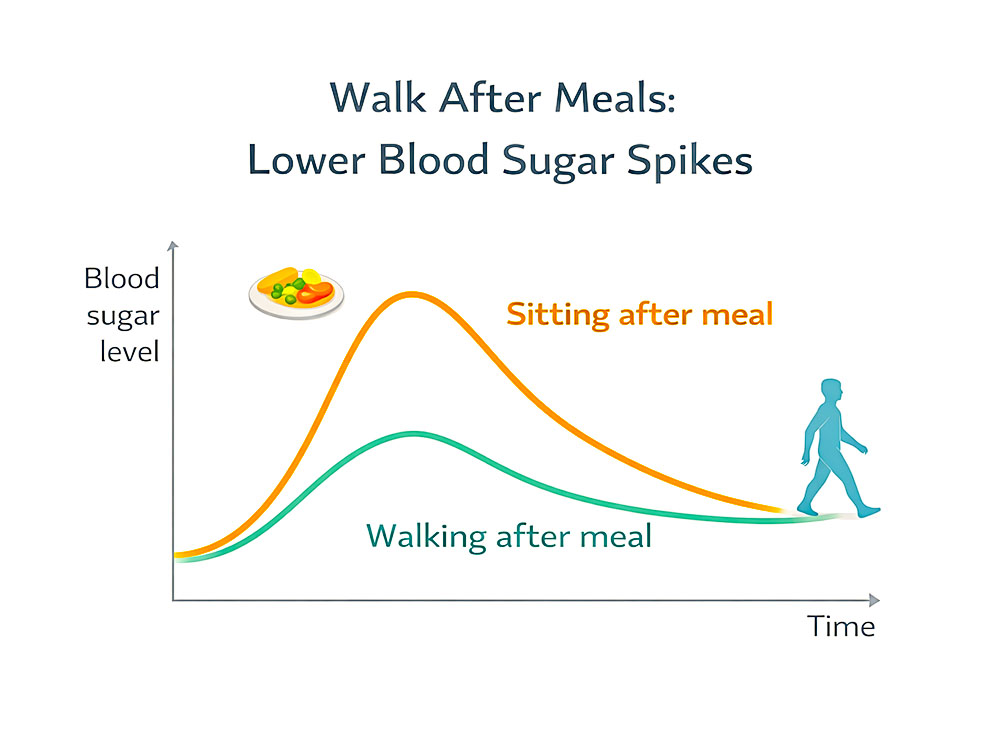
Breaking up prolonged sitting can improve post-meal glucose and insulin responses, and light walking breaks generally outperform standing breaks
in acute studies.[10] [11] A broader systematic review also supports the view that physical activity breaks can attenuate metabolic markers relevant to the prevention of
type 2 diabetes.[12]
Walks4all takeaway
If health is the goal, make your desk day less sedentary. Standing is a step; walking breaks do more of the heavy lifting.
Long-term health and 'standing all day' caution
Standing more is not automatically better. Large observational analyses using device data suggest that simply standing more does not reduce
cardiovascular disease risk, and prolonged standing may increase the risk of circulatory problems for some people.[20] [21]
Walks4all takeaway
Don't replace sitting still, with standing still. Alternate and keep it dynamic.
How long should you stand each day?
UK guidance emphasises minimising sedentary time and breaking up long periods of inactivity rather than setting a strict daily sitting limit.[1 ‑ 4] In workplace settings, an expert statement commonly cited in 'active working' guidance suggests building towards about 2 hours per day of
standing and light activity during working hours, progressing to around 4 hours per day, spread across the day.[22]
Walks4all takeaway
Aim for a pattern, not a number. If you change posture every 30-60 minutes and add a few short walks, you'll land in a sensible range without
forcing it.
Since I started using a
standing desk,
as my legs were already accustomed to standing from the amount of walking I do, I started at a higher level than the one I've included above. I
now stand for about 4 hours a day, which is about 20 hours less sitting per week, and I feel much better for it. The main areas of improvement
for me have been fewer stiff necks and less arm pain. My main standing time is during calls.
Who benefits most (and who should be cautious)
A sit-stand desk tends to help most if you:
- Sit for most of your working day and regularly lose track of time at your desk[7] [8] [9]
- Feel stiff or sore after long periods of sitting[14]
- Want a simple prompt to move more often[1 ‑ 4]
Use extra caution (or seek personalised advice) if you:
- Already stand for long periods in your job (you may need more sitting breaks, not fewer)
- Have varicose veins or other circulatory issues that worsen with prolonged standing[20] [21]
- Develop significant foot, knee or lower-leg pain when standing (build up more slowly and prioritise movement over static standing)
Common mistakes (and how to avoid them)
- When moving from sitting to standing throughout the day, build up gradually and alternate between the two
- Poor setup: adjust the screen and keyboard heights; keep your wrists neutral, and your shoulders relaxed[18]
- Standing 'like a statue': add micro-movements and short walks
- No breaks: set reminders; UK guidance supports breaking up long periods of inactivity[1 ‑ 4]
Walks4all takeaway
The desk is only half the system. Set up plus rhythm is what makes it feel good in the long term.
Circulation, comfort and standing desks
While standing desks can help reduce long periods of sitting, they can also change how load is distributed through the legs and feet - especially
if standing time increases faster than movement does.
For many people, improving
foot and leg circulation
naturally becomes part of using a standing desk comfortably over the long term. Simple habits such as regular walking breaks, calf and ankle
movement, foot positioning, hydration, and appropriate footwear can all support circulation during desk-based work.
In some cases, people also explore circulation devices, such as
foot massagers or
active circulation aids,
as an adjunct to movement, particularly if they experience cold feet, heaviness, or stiffness after prolonged sitting or standing. Used sensibly,
these approaches can complement a sit-stand routine, but they work best alongside regular movement rather than replacing it.
Quick plan: Beginner sit-stand schedule
A gentle four-week ramp that most people can stick to:
- Week 1: Stand for 10 minutes per hour (or 3-5 short blocks/day).
- Week 2: Stand for 15 minutes per hour. Add two 2-3-minute walks (mid-morning and mid-afternoon), and especially after eating, to
lower your blood sugar spike.
- Week 3: Stand for 20 minutes per hour. Keep short walks to 2-4 times/day.
- Week 4: Aim for about 2 hours/day of standing and light activity during work hours, spread out.[22]
Walks4all takeaway
Consistency beats intensity. The goal is to reduce long periods of sitting and increase frequent movement.
Summary of the benefits of standing desks
A standing desk is one of the simplest ways to reduce desk-based sitting, and the evidence supports its effectiveness, particularly when paired
with prompts, a routine or a walking pad.[7] [8] [9] [15] For comfort, many people notice small improvements in back or neck-shoulder symptoms when they alternate positions, but this isn't universal,
and 'standing all day' can backfire.[14] [19] [20] [21]
If you take one message from the evidence, make it this: use the desk to change state. Alternate between sitting and standing, and add short
walking breaks whenever you can. That combination aligns best with UK and global guidance and is the most realistic way to make a desk job less
sedentary without turning your day into a workout.[1 ‑ 4] [10] [11] [12] [24]
Frequently Asked Questions (FAQs) on the benefits of standing desks
Do standing desks burn meaningful calories?
A little. Standing uses slightly more energy than sitting, but the difference is usually small (about 0.15 kcal per minute).[13] Treat it as a behaviour tool, not a weight-loss tool.
Are standing desks worth it for health?
Often, yes, if they help you sit less and break up long periods of sitting. The strongest evidence is for reducing workplace sitting time;
long-term disease outcomes are less certain.[1 ‑ 4] [15]
Is standing for long periods bad for you?
It can be. Prolonged standing may increase lower-limb discomfort and increase circulatory risks for some people. Alternating and moving
is better than standing still.[20] [21]
How many hours should you spend standing at work?
There's no single perfect number. A commonly cited workplace recommendation is to build up to about 2 hours/day of standing and light
activity during working hours, then progress to about 4 hours/day, spread over the day.[22]
Do standing desks help with back pain?
They can help some people, especially if pain is related to prolonged sitting. Evidence suggests small reductions in low back discomfort
on average, though responses vary.[14]
Will my productivity decrease if I stand?
Usually not, if you alternate sensibly. Many people prefer to sit for deep-focus work and stand for lighter tasks (calls, admin).[7] [15]
Do I need an anti-fatigue mat?
Not always, but many people find a supportive mat improves comfort during longer standing blocks and reduces foot and leg fatigue. Start
without one; add it if your feet complain.
How often should I take walking breaks?
Can exercise 'cancel out' a lot of sitting?
Very high daily activity can offset some of the mortality risk associated with sitting, but most people don't reach those levels
consistently. Breaking up sitting remains a practical target.[23]
Who should be cautious about standing desks?
If you already stand all day at work, or if you have circulatory problems that worsen with prolonged standing, focus on alternating and
moving rather than maximising standing time.[20] [21]
February 2026
Related reading:
 Article: Vitamin D for walkers and hikers: Health benefits, deficiency, supplements, dose ranges and when 'more' isn't better
Vitamin D for walkers and hikers in the UK: benefits for bones, muscles and immunity, who's at risk, how much to take (400 IU - 4,000 IU), D2 vs D3, sunscreen effects, food sources and safety - plus a simple winter plan.
Published January 2026
Want to 'go deeper'?
We take evidence seriously at Walks4all. If you'd like to better understand how walking studies are designed, how results
should be interpreted, and what scientific terms mean, explore our guides on the following:
References on the benefits of standing desks
- NHS (n.d., accessed 2026) - Why we should sit less. What this shows: UK guidance linking long sitting to poorer metabolic health and advising people to sit less and break up long periods of sitting; notes there is not enough evidence for a strict daily sitting limit. https://www.nhs.uk/live-well/exercise/why-sitting-too-much-is-bad-for-us/
- NHS (n.d., accessed 2026) - Physical activity guidelines for adults aged 19 to 64. What this shows: UK-facing guideline summary including weekly activity targets and advice to reduce sedentary time and break up long periods of not moving. https://www.nhs.uk/live-well/exercise/physical-activity-guidelines-for-adults-aged-19-to-64/
- UK Chief Medical Officers (2019) - UK Chief Medical Officers' Physical Activity Guidelines. What this shows: Adults should minimise sedentary time and, when possible, break up extended periods with at least light physical activity. https://assets.publishing.service.gov.uk/media/5d839543ed915d52428dc134/uk-chief-medical-officers-physical-activity-guidelines.pdf
- World Health Organization (2020) - WHO 2020 guidelines on physical activity and sedentary behaviour. What this shows: Recommends reducing sedentary behaviours across age groups and replacing sedentary time with physical activity of any intensity; evidence insufficient to set a sedentary threshold. https://bjsm.bmj.com/content/54/24/1451
- Vallance JK, et al. (2018) - Evaluating the Evidence on Sitting, Smoking, and Health. What this shows: Explains why 'sitting is the new smoking' is an oversimplification and why direct comparisons to smoking are not appropriate. https://ajph.aphapublications.org/doi/10.2105/AJPH.2018.304649
- Biswas A, et al. (2015) - Sedentary time and its association with risk for disease incidence, mortality, and hospitalization in adults: systematic review and meta-analysis. What this shows: Higher sedentary time is associated with higher risk of adverse outcomes across populations (observational evidence). https://pubmed.ncbi.nlm.nih.gov/25599350/
- Edwardson CL, et al. (2018) - Effectiveness of the Stand More AT (SMArT) Work intervention: cluster randomised controlled trial. What this shows: UK NHS Trust trial showing reduced occupational sitting time at 12 months and improvements in some work-related and psychological outcomes. https://www.bmj.com/content/363/bmj.k3870
- Edwardson CL, et al. (2018) - SMArT Work (PubMed record). What this shows: Trial record and summary including the occupational sitting time reduction reported in the BMJ paper. https://pubmed.ncbi.nlm.nih.gov/30305278/
- Edwardson CL, et al. (2022) - SMART Work and Life: cluster randomised controlled trial. What this shows: UK local council trial; intervention plus desk reduced daily sitting time at 12 months and reported small wellbeing changes. https://www.bmj.com/content/378/bmj-2021-069288
- Buffey AJ, et al. (2022) - Acute effects of interrupting prolonged sitting time: meta-analysis. What this shows: Light-intensity walking breaks improved postprandial glucose/insulin more than standing breaks in acute studies. https://pmc.ncbi.nlm.nih.gov/articles/PMC9325803/
- Buffey AJ, et al. (2022) - PubMed record. What this shows: Summary results including that walking breaks outperform standing breaks for postprandial glucose/insulin in included studies. https://pubmed.ncbi.nlm.nih.gov/35147898/
- Loh R, et al. (2019) - Effects of interrupting prolonged sitting with physical activity breaks: systematic review and meta-analysis. What this shows: Activity breaks during sitting attenuate metabolic markers relevant to type 2 diabetes prevention. https://pmc.ncbi.nlm.nih.gov/articles/PMC6985064/
- Saeidifard F, et al. (2018) - Differences of energy expenditure while sitting versus standing: systematic review and meta-analysis. What this shows: Average energy expenditure difference between sitting and standing is about 0.15 kcal/min. https://pubmed.ncbi.nlm.nih.gov/29385357/
- Agarwal S, et al. (2018) - Sit-Stand Workstations and Impact on Low Back Discomfort: systematic review and meta-analysis. What this shows: Sit-stand workstations may reduce low back discomfort on average; evidence on dosage and populations is limited. https://pubmed.ncbi.nlm.nih.gov/29115188/
- Shrestha N, et al. (2018) - Workplace interventions for reducing sitting at work (Cochrane Review). What this shows: Sit-stand desks reduce workplace sitting time in short/medium term; health outcome evidence uncertain and overall quality often low. https://www.cochranelibrary.com/cdsr/doi/10.1002/14651858.CD010912.pub5/full
- NIHR Evidence (2023) - Intervention helped office workers to spend less time sitting. What this shows: Plain-English summary of SMART Work and Life outcomes including the ~64 min/day reduction in the desk group. https://evidence.nihr.ac.uk/alert/intervention-helped-office-workers-to-spend-less-time-sitting/
- Cochrane (2018) - Featured Review: workplace interventions reducing time spent sitting at work. What this shows: Summary including estimated reductions (84-116 min/day) from sit-stand desks reported as very low-quality evidence. https://www.cochrane.org/about-us/news/featured-review-workplace-interventions-reducing-time-spent-sitting-work
- HSE (updated 2025) - Good posture when using display screen equipment. What this shows: UK practical guidance on desk setup and posture that applies to seated and standing work. https://www.hse.gov.uk/msd/dse/good-posture.htm
- Danquah IH, et al. (2017) - Effects on musculoskeletal pain from 'Take a Stand!'. What this shows: Intervention reduced neck-shoulder pain at three months and small reductions in total pain score. https://pubmed.ncbi.nlm.nih.gov/28368549/
- Ahmadi MN, et al. (2024) - Standing time and long-term cardiovascular and circulatory outcomes (UK Biobank analysis, International Journal of Epidemiology). What this shows: Standing more was not associated with lower cardiovascular disease risk; prolonged standing was linked to higher risk of orthostatic circulatory disease. https://academic.oup.com/ije/article/53/6/dyae136/7822310
- Tüchsen F, et al. (2005) - Prolonged standing at work and risk of varicose veins. What this shows: Occupational prolonged standing is associated with increased risk of varicose veins. https://pmc.ncbi.nlm.nih.gov/articles/PMC1740939/
- Buckley JP, et al. (2015) - The sedentary office: expert statement (Active Working). What this shows: Commonly cited recommendation to build towards 2 hours/day standing and light activity at work, progressing to 4 hours/day; avoid prolonged static standing. https://pubmed.ncbi.nlm.nih.gov/26034192/
- Ekelund U, et al. (2016) - Does physical activity attenuate, or even eliminate, the detrimental association of sitting time with mortality? What this shows: High levels of moderate activity (~60-75 min/day) can attenuate or eliminate the increased mortality risk associated with high total sitting time in pooled datasets. https://www.thelancet.com/journals/lancet/article/PIIS0140-6736%2816%2930370-1/fulltext
- UK Department of Health / CMO factsheet (2011) - Physical activity guidelines for adults. What this shows: Older UK factsheet including the principle to minimise sedentary time for extended periods. https://www.gov.uk/government/uploads/system/uploads/attachment_data/file/213740/dh_128145.pdf
- UK Government (2020) - Health matters: physical activity (sedentary time). What this shows: Reinforces UK guideline messaging to minimise sedentary time and break up long inactivity with at least light activity when possible. https://www.gov.uk/government/publications/health-matters-physical-activity/health-matters-physical-activity-prevention-and-management-of-long-term-conditions