The best time of day to walk: Morning vs evening for energy, sleep, and blood sugar
By: Andrew Forrest - January 2026
Is it better to walk in the morning or evening? Learn the best time of day to walk for energy, sleep, blood sugar, and weight loss, backed by research.
Table of contents
This page contains affiliate links. If you buy products or services via these links, we may earn a small commission at no cost to you. If you are thinking of buying, please use our links, as it helps support our website and YouTube channel.
Walking is often described as 'simple', but the time of day you walk can subtly change how it feels and what you get out of it. Morning,
lunchtime, and evening walks interact differently with your body clock, daily routines, meals, and energy levels - which helps explain why the
same walk can feel refreshing one day and tiring the next.
This article explores how time of day, individual goals, and personal circumstances interact, drawing on current research and practical
guidance to help you make informed choices. Rather than promoting a single 'perfect' answer, we focus on what tends to work best for different
outcomes and on how to realistically fit walking into everyday life.
Health & Wellness Disclaimer
The information in this article is intended for general education and wellbeing and is designed to support safe, confident walking habits,
including guidance on exercise timing and how walking may affect energy levels, sleep, and blood sugar control.
If you have diabetes, prediabetes, insulin resistance, hypoglycaemia, cardiovascular disease, high or low blood pressure, or any condition
that may be affected by physical activity or exercise timing, or if you take medication that affects blood glucose, insulin levels, heart
rate, or blood pressure, consult your GP or an appropriate healthcare professional before changing when you walk, how long you walk, or how
intense your walking is, including walking after meals.
If you are new to exercise, returning after a long period of inactivity, or planning to increase your walking frequency, duration, or
intensity, it is sensible to seek professional advice first to ensure your approach is appropriate for your health circumstances.
The information provided is for educational purposes only and should not be considered medical advice or a substitute for professional
healthcare. If you experience dizziness, chest pain, fainting, unusual heart symptoms, or unexpected changes in blood sugar levels, stop
exercising and seek immediate medical assistance. Always consult your GP or a qualified healthcare provider for personalised medical guidance
and treatment.
Walking 'counts' whenever you do it. The NHS is clear that adults should aim for at least 150 minutes of moderate activity each week, and
brisk walking counts towards this.
But if you're asking the classic question - what's the best time of day to go for a
walk?
- the most honest answer is:
- There isn't a single best time for everyone because your goal, your sleep, your meals, and your 'body clock' (circadian rhythm) all matter.
- There are optimal times for specific outcomes, especially for blood sugar, where post‑meal walking is one of the most consistently supported
timing strategies in the research.[6 ‑ 13]
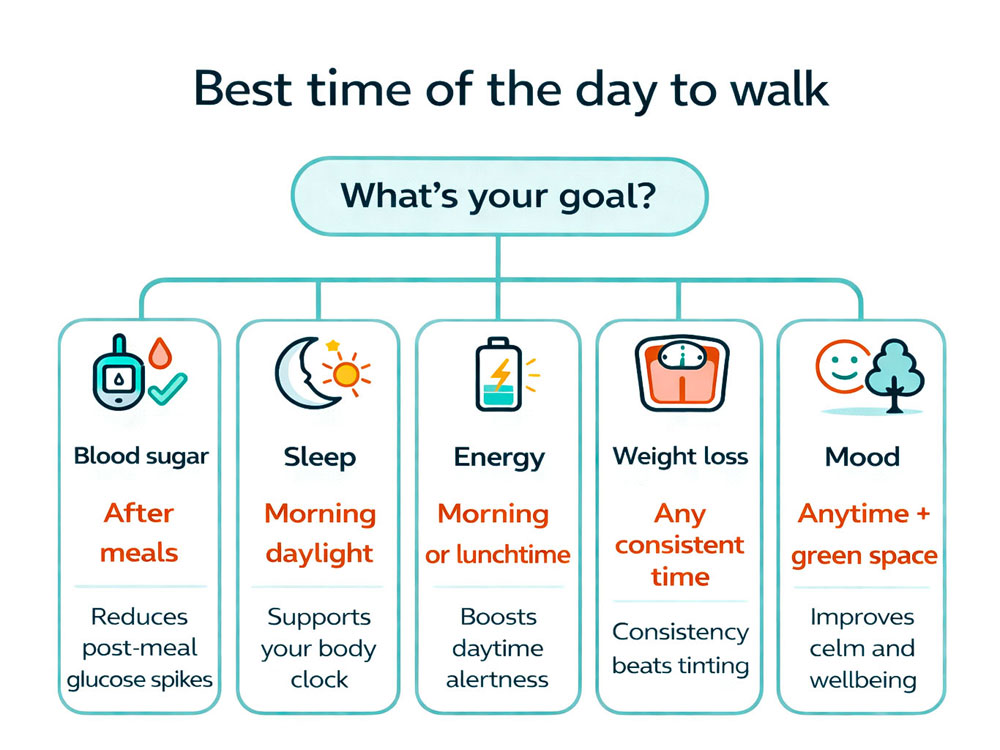
Walks4all key takeaways - what is the best time to walk?
- For blood sugar: Walk after meals, ideally within about 30 minutes (even 10-15 minutes helps; some evidence suggests even shorter
bouts help too).[6 ‑ 13]
- For sleep: A morning outdoor walk (in daylight) can support your body clock, and an early‑evening gentle walk can be calming - but if
exercise makes you feel 'wired', avoid anything too energetic close to bedtime.[26] [28] [34]
- For energy: Most people feel a lift in energy and mood after a morning or lunchtime walk, and morning daylight can help you feel more
'switched on'.[28] [32]
- For weight loss: The 'best' time is the one you'll stick to consistently; trials comparing morning and evening exercise generally
don't show a clear winner for fat loss.[17] [18]
What's your main reason for walking right now?
I want better blood sugar / fewer glucose spikes
Best timing:
10-30 minutes after eating,
especially after higher‑carb meals and often after dinner in real life.[6 ‑ 11]
If you also want a longer walk:
Consider making your longer brisk walk in the afternoon or early evening, as several studies suggest that later in the day moderate‑to‑vigorous
activity is linked to lower insulin resistance (though not all findings are causal)[1 ‑ 4] [30].
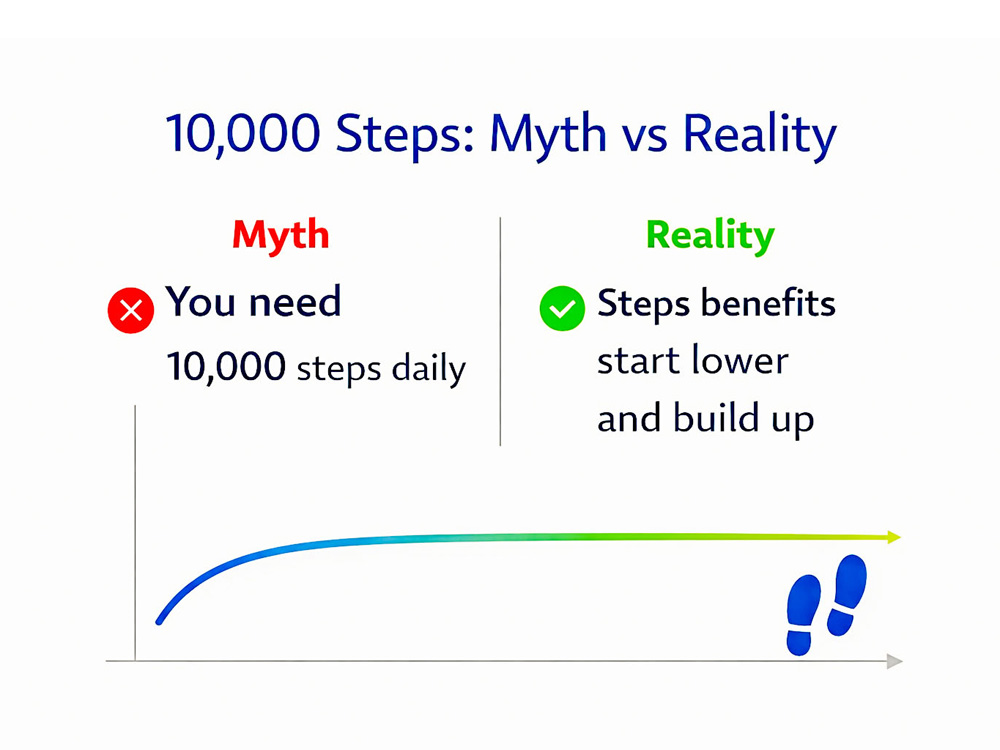
You don't have to walk the commonly quoted
10,000 steps
to start seeing health benefits; you can see benefits at a much lower number of steps.
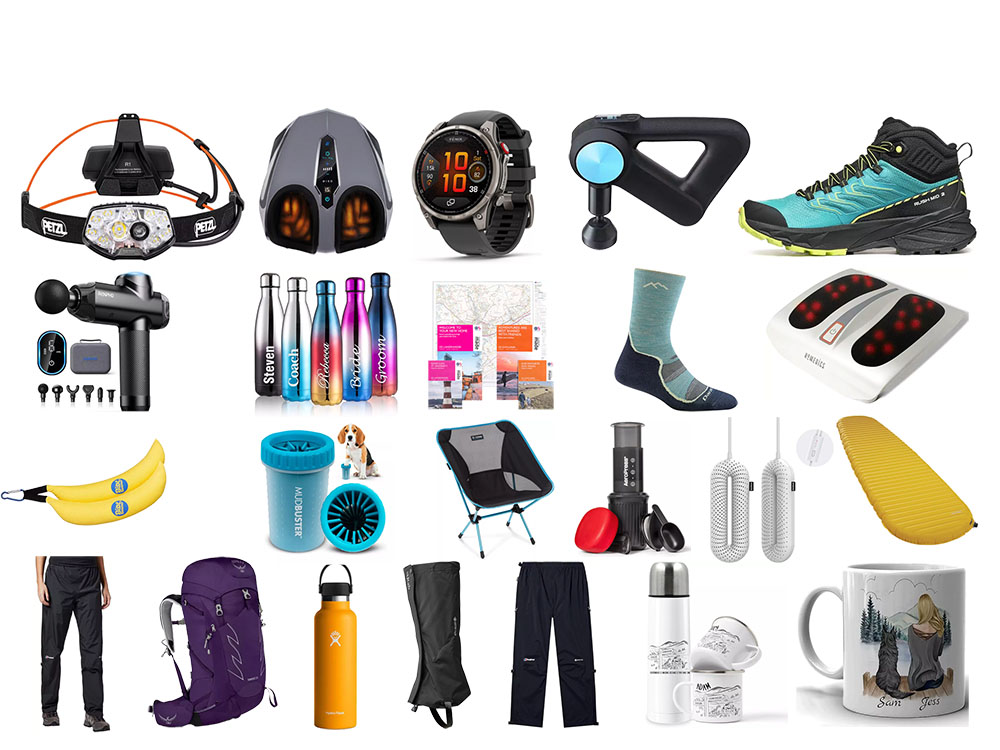
One of the great things about walking is how little you actually need to get started - a comfortable pair of shoes and a bit of time is often
enough. But if you're heading out for a longer walk, especially on hills or rougher ground, it's worth taking a little more care: pull on your
walking boots and
socks, pack a
rucksack,
and make sure you've got the
basic hiking essentials
with you. Being comfortable, prepared and weather-ready doesn't just make the walk safer - it makes it far more enjoyable.
I want to sleep better
Best timing:
Morning: A walk outdoors in daylight can help anchor your circadian rhythm (your internal clock).[28]
Early evening: A gentle walk can help you unwind.
Avoid:
If you're sensitive, avoid anything 'too energetic' in the 90 minutes before bed (the NHS advice is pragmatic here: if it keeps you awake,
shift it earlier).[34]
What the research says:
A meta‑analysis found that evening exercise doesn't generally harm sleep in healthy people, but intensity and timing can matter for some
individuals.[26]
I want more energy in the day / less brain fog
Best timing:
Morning or lunchtime, especially if you can get natural light as well.[28] [32]
Tip:
Keep it moderate (you can talk but not sing) rather than a breathless slog, which can backfire if you're starting with low fitness.[31] [32]
I want weight loss
Best timing:
The time you can repeat most days. As with many things related to weight loss, the best strategy is one you feel comfortable with, that works
for you, and that you can be consistent with.
Why:
In a randomised trial, both morning and evening exercisers lost weight, and the authors concluded there was no 'optimal' time of day for weight
loss.[17]
Practical edge:
Some people find morning walks easier to maintain during work/social chaos (better adherence); others find evening walks help reduce
stress-related snacking. Trials are mixed.[17 ‑ 21]
I want mental health / calmer mood
Best timing:
Whenever you can do it safely and regularly. However, the environment and timing can change the experience.
Interesting finding:
A small study in middle‑aged/older adults found that day vs night and green vs urban settings produced different mood and blood‑pressure
responses.[29]
Morning vs evening walks: What's genuinely different?
Morning walks: the reliable 'routine' choice
Morning tends to be when walking shines for:
- Consistency (fewer things have gone wrong so far).
- Daylight exposure can support your sleep timing later that night.[28]
- Appetite/behaviour in some people: research is mixed, but some trials suggest that timing can affect appetite and eating patterns.[17 ‑ 21]
A walking‑specific example: in overweight, sedentary post‑menopausal women, the time of day of walking was examined in relation to dietary
behaviour and body composition, with morning being preferable.[19]
Walks4all take:
If you're building a habit from scratch, mornings often win purely because they're easier to protect - not because your body can't benefit later.
Evening walks: Underrated for blood sugar and for winding down
Evening tends to be when walking shines for:
- Post‑dinner blood sugar control (more on this below).[6 ‑ 11]
- Stress relief after work (and potentially less evening 'grazing' because you've broken autopilot).
- For many people, the body feels warmer and looser, which can make brisk walking feel easier.
Concerned about how you will sleep?
Evening walks are usually fine - but if they energise you too much, take NHS advice literally: move them earlier, or keep them gentle.[26] [34]
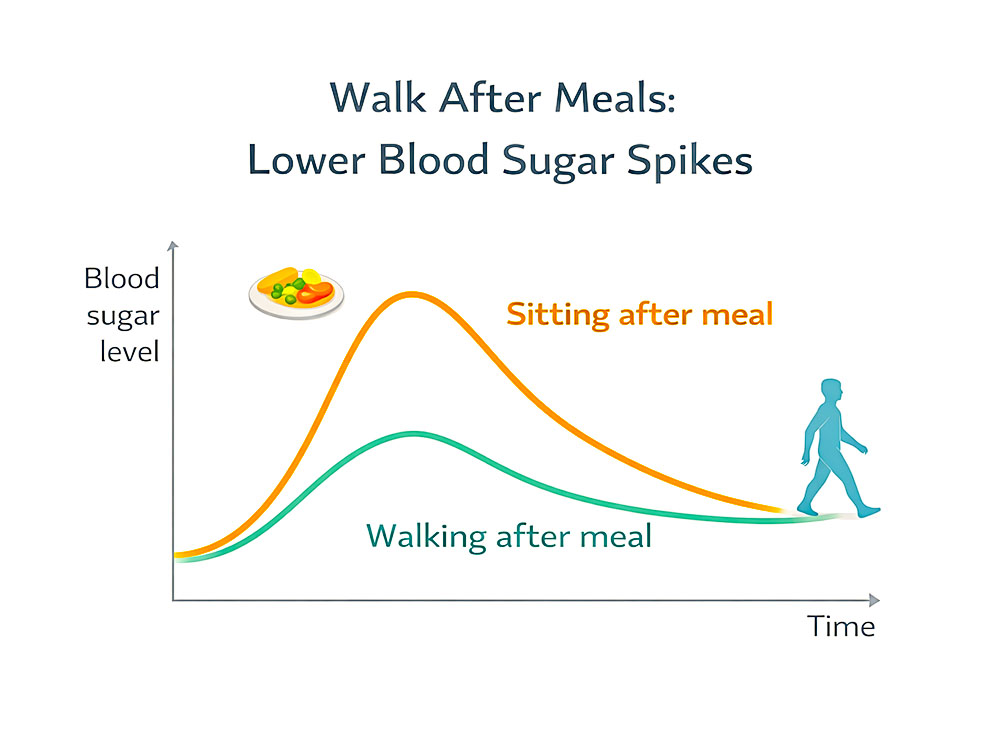
The blood‑sugar power move: Walk after meals
Why post‑meal walking works
After you eat, your blood sugar rises. A
post-meal walk
causes your leg muscles to contract, and muscles can take up glucose for fuel, leaving less glucose in the bloodstream.
What the evidence says
In people at risk of impaired glucose tolerance, three 15‑minute post‑meal walks improved 24‑hour glucose control compared with a single longer
walking session.[7]
In type 2 diabetes, advice to take a 10‑minute walk after each main meal lowered blood glucose more than taking one 30‑minute walk at another
time.[6]
A study of 30 minutes of post‑prandial brisk walking found improved glycaemic response after meals with varying carbohydrate content.[9]
A systematic review/meta‑analysis comparing exercise before and after meals supports the idea that activity close to food intake is especially
useful for limiting spikes.[10]
A review focusing specifically on 'when' to walk after a meal suggests that walking soon after eating may be more effective at lowering
post‑meal glucose than waiting.[11]
Our Walks4all practical recommendation
- Start: 10 minutes at an easy-to-moderate pace.
- Timing: Begin within 30 minutes of eating.[6] [10] [11]
- Frequency: after your biggest or most carb‑heavy meal (often dinner), then expand to more meals if helpful.
- Intensity: you don't need to 'smash it'. For blood sugar, light-to-moderate walking is often sufficient.[7] [10]
Important if you have diabetes: medication matters. Diabetes UK advises planning walks with awareness of when you last
ate and your current blood sugar levels.[37] [38]
Does the best time of day to walk vary between people (age, sex, fitness, 'body clock')?
Yes - not always dramatically, but we've included below what various studies have found.
Evidence strength: ★★★ strong, ★★ moderate, ★ emerging/limited.
| Situation |
Best timing to try |
Why (plain English) |
Evidence |
| Prediabetes / type 2 diabetes (or you track glucose and see big spikes) |
After meals, especially after dinner |
Most consistent way to blunt post‑meal spikes |
★★★[6 ‑ 13] |
| You want 'general metabolic health' |
Consider afternoon/early evening for longer brisk walks |
Some studies link late‑day MVPA with lower insulin resistance; one crossover trial in T2D favoured afternoon vs morning |
★★[1] [4] |
| You're a 'night owl' (late chronotype) |
Late afternoon/evening may feel easier |
You may be more alert later; timed exercise can interact with circadian phase |
★★[27] |
| You wake early / struggle to feel sleepy at night |
Morning outdoor walk |
Morning light exposure is linked to better next‑night sleep quality |
★★[28] |
| You sleep badly and evening exercise makes you ‘wired' |
Walk earlier or keep it gentle |
NHS guidance: avoid anything too energetic in the 90 minutes before bed if it disrupts sleep |
★★[34] |
| Post‑menopausal women focusing on body composition |
Try morning vs evening and track what works |
Walking time‑of‑day has been studied in this group; results can differ |
★★[19] |
| You're choosing based on sex differences |
Don't over‑generalise; you can experiment |
One study found men and women may get different benefits from morning vs evening training |
★[23] |
| Older adults (safety + confidence matters) |
Often daylight hours |
Practical safety + visibility can matter more than physiology |
Practical[32] [35] |
| You're very deconditioned |
Any time you can repeat, start easy |
A 'brisk' walk might already be moderate intensity for you |
Practical[31] [32] |
| You're fit and want a cardio training effect |
Time when you can hit moderate intensity consistently |
Fitness gains depend on dose/intensity more than clock time |
Practical[31] [32] [33] [39] |
Note on age/sex differences: In the UK Biobank analysis on timing of activity and type 2 diabetes risk, there was modest evidence that effects
differed by sex/age for evening activity, but morning and afternoon activity were associated with lower risk across subgroups.[3]
Where 'cardio zones' fit in to the best time of day to walk?
What a 'cardio zone' actually means
It's just a way of describing how hard your heart is working.
For walking, you'll hear two practical intensity checks:
Talk test (NHS): Moderate intensity = you can talk but not sing.[31] [32]
Heart‑rate range (BHF): Moderate intensity often falls between 50-70% of your maximum heart rate.[33]
If you prefer step goals, the American College of Sports Medicine (ACSM), has also used ~100 steps/minute as a rough indicator of moderate
intensity for many adults.[39]
Matching 'zone' to your goal
Blood sugar walk: Light to moderate. You should be able to chat easily. The timing (after meals) is key here.[6 ‑ 11]
Sleep‑support walk: Gentle to moderate. If you're doing it in the evening, avoid turning it into a 'race'.[26] [34]
Fitness walk: Aim for moderate intensity most days, and if you're already fit, add hills, extend the duration, or use intervals to reach moderate effort.[31] [32] [33]
How underlying fitness changes the 'best time' of the day to walk
Your fitness level doesn't change whether walking is good; it changes how hard walking feels.
If you're new: a 20‑minute brisk walk might feel like a workout, so timing is mainly about comfort and consistency.
If you're fitter: you may prefer walking later in the day because it's easier to maintain a steady pace and tackle hills without feeling stiff, but that's a preference or performance issue, not a requirement.
A simple weekly 'best time of day to walk' plan
If your main goal is blood sugar
After your biggest meal: 10-15 minutes of easy walking[6] [7].
Plus 2-3 days/week: 30-45 minutes of brisk walking (moderate intensity) at a time you'll stick to[31].
If your main goal is sleep
Morning: 10-20 minutes outdoor walk[28]. Evening option: 10-20 minutes of gentle walking after work or dinner, but keep it calming.[26] [34]
If your main goal is weight loss
Pick your 'protected slot' (morning or early evening). Aim for most days and focus on total weekly minutes. Trial data doesn't show a universal
'best time'.[17]
What counts as a ‘good' walk?
A good walk doesn't need to be perfect. Pace, duration, safety, and consistency matter more than precise timing.
Still curious? Explore our guides to
understanding health research, the
limitations of walking studies, and our
glossary of key terms.
Frequently Asked Questions (FAQs) about the best time to walk
What is the best time of day to walk for overall health?
The best time of day to walk is the time you can do most consistently. Consistency helps you build long-term health benefits and meet
activity guidelines over the week.[31] [32]
Is it better to walk in the morning or in the evening?
Neither is universally better - morning or evening can work well. Morning supports routine and daylight exposure, while evening can help
you wind down and may be especially useful after dinner for blood sugar.[6 ‑ 11] [28] [34]
What's the best time to walk to lower blood sugar levels?
The best time to walk to lower blood sugar is soon after a meal (ideally within 30 minutes). Even a short 10-15-minute walk after
eating can reduce post-meal glucose spikes.[6 ‑ 11]
How long should I walk after eating?
Benefits can be seen with as little as 10-15 minutes of walking after a meal. Research in people with type 2 diabetes has shown
improvements with short post-meal walks, repeated after main meals. Longer walks are not essential for blood sugar control if the timing
is right.[6] [7]
Is walking after dinner helpful for weight loss?
Walking after dinner can support weight loss, but it is not a magic solution. It adds activity and may reduce evening snacking
for some people, which can help overall energy balance. However, studies comparing morning and evening exercise do not show that one time
is universally better for fat loss.[17 ‑ 21]
Should I walk on an empty stomach in the morning?
You can walk on an empty stomach, but it isn't necessary for health benefits. For blood sugar control, walking after meals has
stronger evidence than walking fasted. If you have diabetes or are prone to low blood sugar, post-meal walking is often the safer option.[6 ‑ 11] [37]
Will an evening walk disrupt my sleep?
For most people, evening walking does not harm sleep. A large review found that evening exercise generally does not adversely
affect sleep quality. However, if walking late in the evening leaves you feeling alert or wired, it's sensible to keep it gentle or move
it earlier.[26] [34]
Does the best time to walk vary by age?
Yes, but practical factors often matter more than biology. Some studies suggest that timing effects may vary by age, but for many
older adults, daylight, visibility, and safety are more important considerations than exact timing. Walking when you feel confident and
steady is key.[3] [35]
Does the best time to walk vary by gender?
Possibly, but the evidence is not strong enough to set firm rules. One controlled study found that men and women may respond
differently to morning versus evening training. This should be treated as a reason to experiment rather than a strict guideline.[23]
What heart-rate 'zone' should I walk in?
Aim for moderate-intensity walking: you can talk but not sing. This often aligns with about 50-70% of maximum heart rate, but the
talk test is usually sufficient.[31] [32] [33]
Is it better to walk before or after breakfast?
Both are fine, but they support slightly different goals. Walking after breakfast may be easier on energy levels and blood sugar,
while a gentle walk before breakfast suits people who feel comfortable exercising early. Choose the option that feels sustainable and
doesn't cause dizziness or fatigue.[6 ‑ 11] [28]
How soon after a meal should I start walking?
Starting within 30 minutes of finishing a meal appears most effective. This timing aligns with the period when blood sugar
typically rises. Even light walking begun soon after eating can make a meaningful difference.[6 ‑ 11]
Is walking at night still good for you?
Yes, walking at night still provides health benefits. Night-time walking can support mood, relieve stress, and increase overall
activity levels. The main considerations are safety, visibility, and whether late activity affects your sleep.[26] [35]
Does the timing of my walks matter if I already walk a lot?
Timing matters less if you are already active and consistent. For regular walkers, total weekly activity and walking intensity
usually have a greater impact than the exact time of day. Timing tweaks may still help with specific goals, such as sleep or blood
sugar.[17] [31]
Can short walks really make a difference?
Yes, short walks can have meaningful health benefits when timed well. Research shows that brief post-meal walks can improve blood
sugar control, and short daily walks contribute to overall activity targets. Consistency matters more than duration alone.[6] [7] [31]
January 2026
Related reading:
Want to 'go deeper'?
We take evidence seriously at Walks4all. If you'd like to better understand how walking studies are designed, how results
should be interpreted, and what scientific terms mean, explore our guides on the following:
References
- Savikj M, et al. Afternoon exercise is more efficacious than morning exercise for improving blood glucose control in patients with type 2 diabetes: a randomised crossover trial. Diabetologia. 2019. Afternoon vs morning exercise improved glycaemic control in type 2 diabetes (randomised crossover). https://link.springer.com/article/10.1007/s00125-019-05067-z
- Moholdt T, et al. Morning vs evening exercise training and metabolic outcomes in overweight/obese men - study on meal/diet context. Diabetologia. 2021. Timing of exercise can influence metabolic outcomes under controlled conditions. https://pmc.ncbi.nlm.nih.gov/articles/PMC8476039/
- Tian C, et al. Timing of physical activity and risk of type 2 diabetes (UK Biobank cohort). Diabetologia. 2023. Morning and afternoon activity associated with lower type 2 diabetes risk; timing effects may vary modestly by subgroup. https://pmc.ncbi.nlm.nih.gov/articles/PMC10628002/
- van der Velde JHPM, et al. Timing of physical activity in relation to liver fat content and insulin resistance. Diabetologia. 2022. Afternoon/evening activity associated with lower insulin resistance (observational). https://pmc.ncbi.nlm.nih.gov/articles/PMC9892088/
- Chang (et al.). Continuous glucose monitoring-guided/personalised exercise timing for type 2 diabetes. 2025. Personalised exercise timing guided by glucose data was studied to improve patterns. https://www.sciencedirect.com/science/article/pii/S0002916525003318
- Reynolds AN, et al. Advice to walk after meals is more effective for lowering postprandial glycaemia in type 2 diabetes. Diabetologia. 2016. 10‑minute walks after meals lowered glucose more than one 30‑minute walk at another time. https://link.springer.com/article/10.1007/s00125-016-4085-2
- DiPietro L, et al. Three 15‑min bouts of moderate postmeal walking significantly improves 24‑h glycaemic control in older people at risk for impaired glucose tolerance. Diabetes Care. 2013. Three short post‑meal walks improved 24‑hour glucose control vs one longer session. https://pmc.ncbi.nlm.nih.gov/articles/PMC3781561/
- Hashimoto Y, et al. Short (10‑min) walking immediately after glucose/meal timing and effects on glycaemia. Scientific Reports. 2025. Immediate short walking reduced peak glucose compared with delaying. https://www.nature.com/articles/s41598-025-88265-0
- Bellini A, et al. The effects of postprandial brisk walking on glycaemic response after meals with different carbohydrate content. 2022. Post‑meal brisk walking improved glycaemic response after meals. https://pubmed.ncbi.nlm.nih.gov/35268055/
- Engeroff T, et al. After Dinner Rest a While, After Supper Walk a Mile? Systematic review/meta‑analysis on exercise timing around meals and postprandial glucose. 2023. Exercise timing around meals influences post‑meal glucose excursions. https://pmc.ncbi.nlm.nih.gov/articles/PMC10036272/
- Hijikata Y, et al. Walking just after a meal seems more effective for lowering postprandial glycaemia than walking later. 2011. Walking soon after meals may be more effective than later walking. https://pmc.ncbi.nlm.nih.gov/articles/PMC3036169/
- Henson J, et al. Breaking up prolonged sitting with standing or walking improves postprandial markers in women at high risk of type 2 diabetes. Diabetes Care. 2016. Walking breaks improved post‑meal markers in high‑risk women. https://pubmed.ncbi.nlm.nih.gov/26628415/
- Duvivier BMFM, et al. Breaking sitting with standing and light‑intensity walking improves 24‑h glucose levels and insulin sensitivity in type 2 diabetes. Diabetologia. 2017. Light walking breaks improved 24‑hour glucose and insulin sensitivity in type 2 diabetes. https://link.springer.com/article/10.1007/s00125-016-4161-7
- Peddie MC, et al. Breaking prolonged sitting reduces postprandial glycaemia and insulinaemia (activity breaks vs continuous activity). 2013. Frequent activity breaks reduced post‑meal glucose and insulin. https://pubmed.ncbi.nlm.nih.gov/23803893/
- Bailey DP, et al. Breaking up prolonged sitting with light‑intensity walking improves postprandial responses. 2015. Light walking interruptions improved post‑prandial responses. https://pubmed.ncbi.nlm.nih.gov/24704421/
- Buffey AJ, et al. Meta‑analysis on interrupting prolonged sitting: walking breaks vs standing for postprandial glucose. 2022. Walking breaks often outperform standing for post‑meal glucose. https://pubmed.ncbi.nlm.nih.gov/35147898/
- Brooker PG, et al. The efficacy of morning versus evening exercise for weight loss: randomised controlled trial. Obesity. 2023. No universal 'best time' for weight loss; consistency matters. https://pmc.ncbi.nlm.nih.gov/articles/PMC10108225/
- Willis EA, et al. The effects of exercise session timing on weight loss and components of energy balance (Midwest Exercise Trial 2). Int J Obes. 2020. Timing may affect components of energy balance; evidence mixed. https://www.nature.com/articles/s41366-019-0409-x
- Di Blasio A, et al. Walking time of day effects on diet, body composition, fitness in post‑menopausal women. 2010. Time-of-day walking studied in post‑menopausal women; responses can differ. https://pubmed.ncbi.nlm.nih.gov/20585298/
- Alizadeh Z, et al. 6 weeks morning vs evening aerobic exercise: appetite and anthropometric indices (women). Clin Obes. 2017. Morning vs evening aerobic exercise showed differences in appetite/body measures in one study. https://pubmed.ncbi.nlm.nih.gov/28343364/
- Creasy SA, et al. Effect of morning and evening exercise on energy balance: pilot study. Nutrients. 2022. Morning vs evening exercise influenced components of energy balance in a pilot study. https://www.mdpi.com/2072-6643/14/4/816
- Shen (et al.). Differential benefits of 12‑week morning vs evening aerobic exercise. Scientific Reports. 2025. Some outcomes differed by training time in one intervention. https://www.nature.com/articles/s41598-025-90946-1
- Arciero PJ, et al. Morning vs evening exercise: differential benefits in women and men. Frontiers in Physiology. 2022. Men and women may see different benefits from morning vs evening training. https://www.frontiersin.org/journals/physiology/articles/10.3389/fphys.2022.893783/full
- de Brito LC, et al. Time‑of‑day effects on blood pressure responses to aerobic exercise (post‑exercise hypotension). PLOS ONE. 2015. Post‑exercise blood pressure responses can vary by time of day. https://journals.plos.org/plosone/article?id=10.1371/journal.pone.0113065
- Sevilla‑Lorente R, et al. Time of day of exercise impact on cardiovascular disease risk factors: systematic review/meta‑analysis. 2023. Overall BP differences by timing not consistently significant. https://pubmed.ncbi.nlm.nih.gov/36973109/
- Stutz J, et al. Evening exercise and sleep: systematic review/meta‑analysis. Sports Medicine. 2019. Evening exercise generally does not impair sleep in healthy people. https://link.springer.com/article/10.1007/s40279-018-1016-0
- Thomas JM, et al. Effects of exercise timing on circadian rhythms. 2020. Timed exercise can shift circadian rhythms depending on when performed. https://pubmed.ncbi.nlm.nih.gov/32917378/
- Anderson AR, et al. Does morning sunlight exposure predict next‑night sleep? Daily diary study. Journal of Health Psychology. 2025. Morning sunlight exposure predicted better next‑night sleep quality. https://journals.sagepub.com/doi/abs/10.1177/13591053241262643
- Li H, et al. Green vs urban walking in daytime vs nighttime: physio‑psychological responses in middle‑aged/older adults. 2020. Day/night and green/urban walking produced different mood/BP responses. https://pmc.ncbi.nlm.nih.gov/articles/PMC7796323/
- Feng H, et al. Timing of physical activity and mortality outcomes (circadian pattern evidence). Nature Communications. 2023. Timing patterns of activity associated with outcomes (observational). https://www.nature.com/articles/s41467-023-40112-2
- NHS. Physical activity guidelines for adults aged 19 to 64. Moderate intensity definition and weekly recommendations. https://www.nhs.uk/live-well/exercise/physical-activity-guidelines-for-adults-aged-19-to-64/
- NHS. Walking for health. Walking guidance and intensity cues. https://www.nhs.uk/live-well/exercise/walking-for-health/
- British Heart Foundation. Target heart rate guidance. Moderate intensity often ~50-70% of max heart rate. https://www.bhf.org.uk/informationsupport/heart-matters-magazine/medical/ask-the-experts/heart-rate-exercise
- NHS. Every Mind Matters. How to fall asleep faster and sleep better. If exercise disrupts sleep, avoid energising activity close to bedtime. https://www.nhs.uk/every-mind-matters/mental-wellbeing-tips/how-to-fall-asleep-faster-and-sleep-better/
- NHS. Physical activity guidelines for older adults. Older adult activity recommendations. https://www.nhs.uk/live-well/exercise/physical-activity-guidelines-older-adults/
- NICE. Type 2 diabetes in adults: management (NG28) - Diet and lifestyle. Lifestyle guidance for type 2 diabetes management. https://www.nice.org.uk/guidance/ng28/ifp/chapter/diet-and-lifestyle
- Diabetes UK. Walking with diabetes. Practical walking advice and safety considerations. https://www.diabetes.org.uk/living-with-diabetes/exercise/walking-with-diabetes
- Diabetes UK. Exercise and diabetes. General exercise guidance for diabetes. https://www.diabetes.org.uk/living-with-diabetes/exercise
- ACSM. Exercise intensity infographic. Intensity cues including step-rate concepts such as ~100 steps/min. https://acsm.org/wp-content/uploads/2025/02/Exercise-intensity-infographic-PDF.pdf