By using this website, you agree to our use of cookies (needed to provide our website’s features) and our Terms of Use.
By: Andrew Forrest - February 2026
Which vitamin D should you take in the UK? Doses from 400-4,000 IU, safety limits, formats, and what the evidence actually shows and D3 vs D2.
This page contains affiliate links. If you buy products or services via these links, we may earn a small commission at no cost to you. If you are thinking of buying, please use our links, as it helps support our website and YouTube channel.
Vitamin D is one of the few nutrients whose levels are significantly affected by location and season. At UK latitudes, winter sunlight is too weak to support meaningful vitamin D production in the skin, which is why public health guidance emphasises supplementation during autumn and winter.[1] [2] [3]
Health & Wellness Disclaimer
The information in this article is provided for general educational and informational purposes only and is not intended as medical advice, diagnosis, or treatment. While we reference peer-reviewed research and official UK and international guidance, nutritional needs vary between individuals, and supplement decisions should take into account personal medical history, current medications, and professional advice.
Vitamin D supplementation may not be appropriate for everyone. You should speak to a qualified healthcare professional before starting or increasing vitamin D if you have kidney disease, hyperparathyroidism, sarcoidosis, a history of kidney stones, disorders affecting calcium metabolism, are pregnant or breastfeeding, or are taking medications that affect calcium or vitamin D balance. High doses taken over time can cause adverse effects, including elevated blood calcium levels.
Product availability, formulations and labelling can change, and it is your responsibility to check the manufacturer's instructions and dosage guidance before use. Walks4all does not provide personalised medical advice, and reliance on any information in this article is at your own discretion.

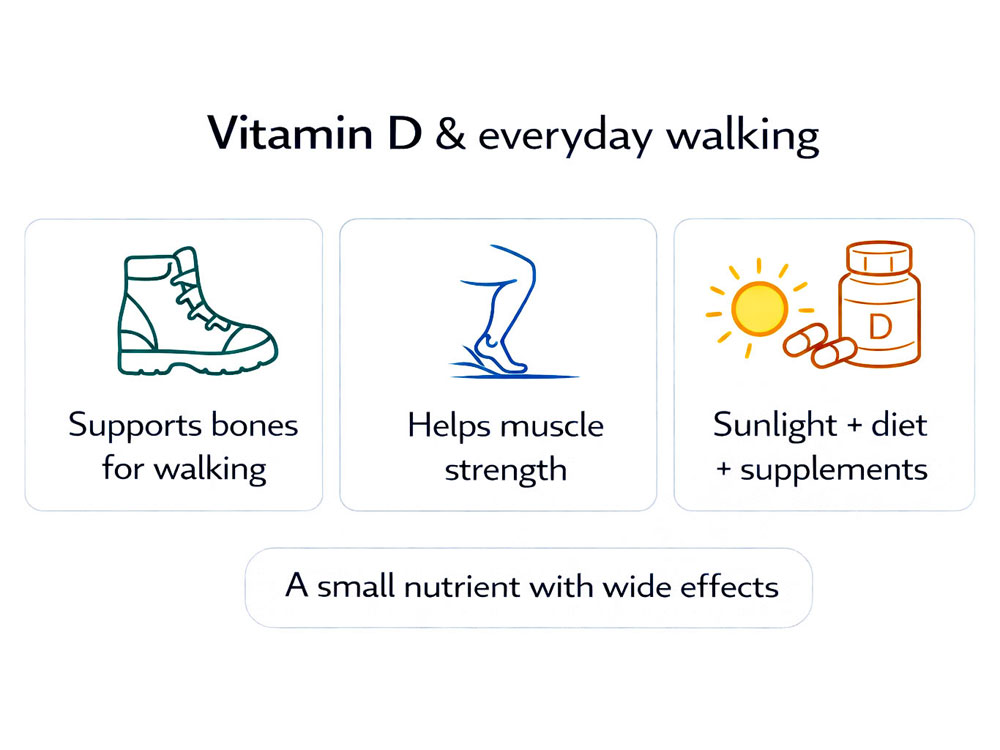
Vitamin D's most established benefits are support for bones, teeth and muscles, because it helps regulate calcium and phosphate.[1] If levels drop too low, deficiency diseases can follow, including rickets in children and osteomalacia in adults. That's why vitamin D is often seen as a 'foundational' supplement rather than a quick fix.[1] [3]

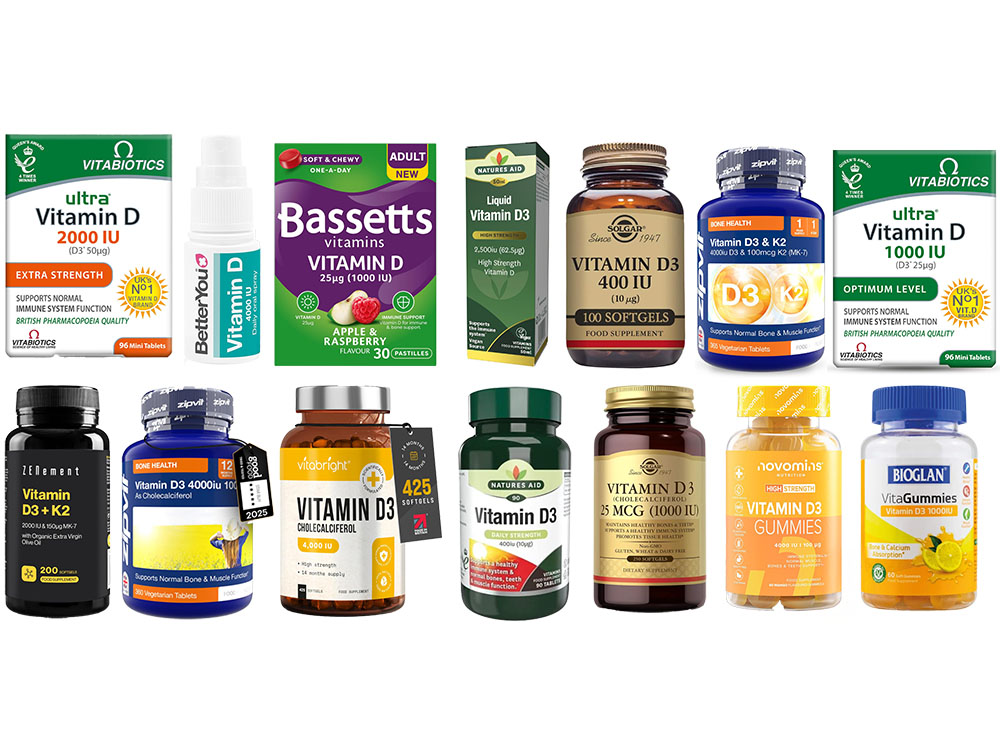
This guide helps you choose the best vitamin D supplement for you - by dose, format (tablet, softgel, spray, liquid, gummy), and diet.

| Name | Dose (daily) | Type | Vegan | Snapshot |
| Natures Aid Vitamin D3 10μg | 400 IU (10μg) | Tablet | Yes | A baseline daily dose for simple maintenance. |
| Solgar Vitamin D3 400 IU | 400 IU (10μg) | Softgel | No | Small softgel format if you prefer capsules to tablets. |
| Solgar Vitamin D3 1,000 IU | 1,000 IU (25μg) | Softgel | No | A popular daily top-up dose in an easy-to-swallow softgel. |
| Vitabiotics Ultra Vitamin D 1,000 IU | 1,000 IU (25μg) | Tablet | No | One-a-day D3 tablet for simple daily cover. |
| Bioglan Vitamin D3 VitaGummies 1,000 IU | 1,000 IU (25μg) | Gummy | No | Great if tablets are the barrier and you want easy compliance. |
| Bassetts Adult Vitamin D Pastilles | 1,000 IU (25μg) | Pastille | No | A simple one-a-day chewable option. |
| Vitabiotics Ultra Vitamin D 2,000 IU | 2,000 IU (50μg) | Tablet | No | A common winter-strength dose in a straightforward tablet. |
| Natures Aid Vitamin D3 Liquid 2,500 IU | 2,500 IU (62.5μg) | Liquid | Yes | Vegan liquid D3 if you prefer drops over pills. |
| Zipvit Vitamin D3 4,000 IU | 4,000 IU (100μg) | Tablet | No | Upper-limit band tablet for adults who want a high daily dose. |
| VitaBright Vitamin D3 4,000 IU | 4,000 IU (100μg) | Softgel | No | Upper-limit band in a softgel. |
| BetterYou Vitamin D3 4,000 IU Oral Spray | 4,000 IU (100μg) | Oral spray | No | Upper-limit band spray if you don't want pills. |
| Novomins Vitamin D3 Gummies 4,000 IU | 4,000 IU (100μg) | Gummy | No | High-strength gummy option (label-check essential). |
| Zenement Vitamin D3 + K2 | 2,000 IU + K2 (150μg) | Softgel | No | Mid-strength D3 with K2 (MK-7) in one daily softgel. |
| Zipvit Vitamin D3 + K2 MK-7 | 4,000 IU + K2 (100μg) | Tablet | No | High-strength D3 + K2 combo in one daily tablet. |
Always check labels for dose.
There isn't a 'best' vitamin D supplement, as what works for one person may be too low or too high a dose for another. So, we have split our recommendations into different dosage ranges. We cover which dose may work for you after these 'best of' choices.

Also, vitamin D is available in various forms (tablets, softgels, gummies and liquids/sprays), so we have included a range of options in each dosage band.

 |
 |


This is a simple daily vitamin D3 tablet for maintenance, the type of dose many people use as a 'winter cover' in the UK. Baseline daily intakes are the core public health approach: sufficient to reduce the risk of low status without entering high-dose territory.[2] [3]
We found the tablets easy to take daily, with no fuss - ideal if you just want a reliable low dose you'll actually stick to.

|
|


This is the same baseline dose, but in a softgel format for those who prefer capsules to tablets. Vitamin D is fat-soluble, and taking it with a meal is a practical way to support absorption.[6]
We found the softgels particularly easy to swallow, making them a good option if 'tablet fatigue' prevents you from taking them consistently.

|
|


This is a classic 'daily top-up' dose, used by people who want more than the baseline while staying well below the adult upper limit. Multiple official bodies agree on a 4,000 IU adult UL, and 1,000 IU/day sits comfortably below that ceiling.[1] [4]
We found the softgel format comfortable for daily use, and the long supply helps keep the routine simple.

|
|


A straightforward one-a-day D3 tablet format, designed for routine use during the lower-sun months. The appeal is simplicity: a clear daily dose in an easy 'add it to breakfast' routine.
We found it a straightforward one-a-day tablet that fits easily into an everyday routine without feeling 'high-strength'.

|
|


Gummies exist for one reason: compliance. If tablets are a barrier, a chewable option can make 'daily vitamin D' more realistic. Evidence also shows that non-tablet delivery (including buccal/oral spray formats) can raise 25(OH)D in practice, reinforcing that the 'best' form is often the one you'll take consistently.[12] [13] [17]
We found this an easy, low-effort way to stay consistent, especially if tablets are the barrier rather than the dose. But as with many gummies, they are generally more expensive than tablets and softgels.

|
|


Pastilles are another 'make it easy' format: chewable, portable, and simple. As with any chewable, the key is to read the label carefully for the dose per pastille vs. per serving and to make sure it fits your overall daily total.
We found these to be a straightforward 'one-a-day' chewable option if taste and routine help you stay consistent.

|
|


2,000 IU/day is a common 'winter-strength' choice for adults seeking a higher daily intake while staying under the adult UL.[1] [4] This sits in the 'stronger but still conservative' band for many people who know their sun exposure is low.
We found the tablet easy to take daily, and it's a simple step-up option if you prefer a stronger one-a-day dose over winter.

|
|


Liquid vitamin D appeals to people who dislike pills or prefer flexible dosing. While there's more direct trial evidence for tablets/capsules and sprays than for any liquid format, the key remains dose and consistency - vitamin D status rises when people reliably take an effective daily dose.[6]
We found it a practical 'high-ish dose' option in a format that's easy to take consistently if tablets aren't for you.
The NHS and other official bodies use 4,000 IU (100 μg) as the adult upper safe limit.[1] [4]

|
|
 |
|


This is the 'upper-limit band' dose. It may be appropriate in some cases (for example, if advised clinically or if you've tested low and are correcting your status), but it's not the default for everyone. Evidence from high-dose trials supports the idea that 'more' isn't automatically better for bone outcomes in otherwise healthy adults.[11]
We found the tablets easy to swallow and genuinely simple to take once a day, but we'd only choose this dose for a clear reason.

|
|


Same dose band, different format. A softgel may be easier to swallow than a tablet, which matters if that's what's preventing consistency. As with all 4,000 IU/day products, the 'do I actually need this much?' question matters most.[1] [4]
We found the softgels comfortable to swallow, making them a good fit if high-strength tablets put you off.

|
|


Oral spray delivery has peer-reviewed trial evidence showing it can raise vitamin D status. This includes a crossover study comparing buccal spray with softgel capsules and a randomised, placebo-controlled trial using an oral spray solution that successfully resolved deficiency over the study period.[12] [13]
We found it very easy to use and ideal if swallowing tablets is the main reason you don't take supplements consistently.

|
|


High-strength gummies are convenient, but label-reading matters, because 'per gummy' and 'per serving' can differ across products. If you take a high-dose gummy, it's especially important not to accidentally stack it with a multivitamin or a calcium + D product.[1]
We found them easy to take, but we'd treat the label check as non-negotiable for any high-strength gummy, softgel or tablet.

|
|


This combines a mid-strength daily D3 dose with K2 (MK-7) in a single step. The rationale for pairing is explained in the dedicated D3+K2 section later in the article, including what the evidence does and doesn't show.[14] [15] [16]
We found the softgels easy to take with a meal and a simple way to do D3 + K2 in one step.

|
|
|
|


This is a high-strength combination: the adult upper limit band for D3 plus K2 in one tablet. As with any 4,000 IU/day product, treat it with care, and avoid stacking with other vitamin D-containing supplements.[1] [4]
We found it a simple one-a-day combo, but it's firmly in the 'high-strength, use with care' category.
Vitamin D acts more like a hormone than a typical vitamin. Your body converts it into active forms that help regulate calcium and phosphate, which are essential for normal bone structure, teeth, and muscle function.[1]
When vitamin D levels are very low, bones can't mineralise properly, contributing to rickets in children and osteomalacia in adults (soft bones, aches, and weakness).[3]

Vitamin D receptors are also found throughout the body (including in immune cells and muscle), which is why vitamin D is studied beyond bone health. However, the strongest, most reliable 'why take it?' remains preventing and correcting low status.[6]

Vitamin D helps maintain normal calcium and phosphate balance, supporting bone, tooth and muscle function. This is the core, least controversial benefit. Low vitamin D status is linked to deficiency diseases such as rickets and osteomalacia.[1] [3]
Benefits appear more likely in people who start out low, and the dosing strategy matters. Some evidence supports modest benefits for physical function in specific contexts, while high-dose strategies can backfire.[3] [11] Improving foot strength can also help reduce falls in older adults.
Vitamin D supplementation has shown modest reductions in acute respiratory infections in some pooled analyses, particularly when starting at very low doses and using daily or weekly dosing rather than large boluses.[8] A bolus is a very large dose taken infrequently (for example, monthly or yearly), rather than smaller, regular daily or weekly doses.
Observational links exist, and mechanisms are plausible, yet trial results in broad healthy populations are often neutral or inconclusive.[5] [6]

Vitamin D3 (cholecalciferol) is the form your skin synthesises in sunlight, and it's the most common form used in supplements.
Both D2 and D3 can raise blood 25(OH)D, but evidence summaries commonly report that D3 tends to raise and maintain 25(OH)D more effectively than D2.[6] 25(OH)D (25-hydroxyvitamin D) is the main blood marker used to assess overall vitamin D status, reflecting your vitamin D intake from sunlight, food, and supplements over recent weeks.
Vitamin D2 (ergocalciferol) is derived from plant and fungal sources and is found in some supplements and fortified foods. D2 can work, but if you're choosing between them for everyday supplementation, most people opt for D3.[6]

Unit conversion: 1μg vitamin D = 40 IU.[1]


The Endocrine Society (2024) emphasises that for many healthy people, the case for high-dose vitamin D specifically to prevent a wide range of diseases is uncertain, and routine screening isn't necessarily needed.[5]

Vitamin D is fat-soluble, and evidence summaries indicate it's best absorbed when taken with a meal or snack containing fat.[6]
For most people, timing matters less than consistency does.
Store tablets and softgels in a cool, dry place away from direct light. For sprays and liquids, follow the label (cap tightly; avoid heat).


Vitamin D is fat-soluble, which means the body stores it rather than excreting excess quickly. As a result, problems tend to arise from very high doses taken over time, rather than from normal dietary intake or sensible supplementation.
The main risk is hypercalcaemia (too much calcium in the blood), which can cause nausea, weakness, confusion, and, in more serious cases, kidney complications. Staying within recognised upper limits and avoiding long-term, high-dose use without clinical oversight keeps vitamin D supplementation safe for most people.[1]

One often overlooked risk isn't 'too much from one tablet'; it's accidental stacking. Many multivitamins already contain vitamin D (often 5-10 μg / 200-400 IU, sometimes more), and calcium supplements, immune blends, pregnancy vitamins, and cod liver oil frequently include it as well. If you then add a separate 1,000 IU, 2,000 IU, or 4,000 IU product, your true daily intake may be much higher than you realise.
Before increasing your dose, it's worth checking all the supplements you currently take and adding up their total daily vitamin D intake. This is particularly important if you're using higher-strength products.

Label accuracy also matters: analyses of some food supplement preparations have shown discrepancies between the labelled and measured vitamin D content, underscoring the importance of choosing clearly labelled products and avoiding extreme 'mega-dose' supplements unless medically advised to do so.
A UK primary care study comparing measured vitamin D content with labelled claims found that food supplement products showed wide variation in vitamin D content compared with licensed products.[7]
Practical takeaway: keep dosing simple, know your total daily IU, and ensure it is deliberate rather than accidental. Avoid extreme 'megadose' products unless prescribed, and treat very high-dose regimens as a medical matter.[1] [4] [7]

Check with a clinician before high-dose vitamin D if you:

A large randomised trial reported fewer incident autoimmune diagnoses over time in the vitamin D group, suggesting that supplementation *may* reduce risk in some contexts.[9]
A major individual participant data meta-analysis found that vitamin D supplementation was safe and reduced the overall risk of acute respiratory tract infections, with stronger effects in people who were very deficient and in those not receiving large bolus doses.[8]
A large trial in generally healthy adults found that vitamin D3 supplementation did not significantly reduce fractures compared with placebo.[10]
A randomised clinical trial comparing 400, 4,000 and 10,000 IU/day reported lower volumetric bone density at higher doses in some measures.[11]
Vitamin D3 and K2 are often paired because they act along the same 'calcium pathway'. Vitamin D3 helps you absorb calcium from the gut and supports normal calcium and phosphate balance, which is central to bone and muscle function.[1] [6] Vitamin K2 (often MK-7) is involved in activating vitamin K-dependent proteins such as osteocalcin (bone) and matrix Gla protein (MGP) (regulation of soft-tissue calcification).
A review summarises the biological interplay: vitamin D can increase the production of some vitamin K-dependent proteins, while vitamin K is required to activate them.[16]
That said, you don't need K2 for vitamin D to cover the basics (correcting low vitamin D and supporting bone and muscle function). Evidence for hard outcomes is mixed and depends on population, baseline status, dose, and endpoints.
In postmenopausal women, one trial reported that combined vitamin K2 + vitamin D3 therapy was associated with improvements in vertebral bone mineral density.[14] However, in elderly men with existing aortic valve calcification, a 2‑year randomised trial of MK‑7 plus vitamin D found no effect on calcification progression, providing a useful counterbalance to broad 'combo is always better' claims.[15]
There isn't a single 'best' vitamin D supplement - the right choice depends on dose, form, and what you'll actually take consistently. For many people in the UK, a baseline daily dose is sufficient to reduce the risk of low vitamin D status, particularly in autumn and winter.
Others may prefer a higher daily dose, a spray, a liquid or gummy format, or a D3 + K2 combination, based on personal preference, diet, or clinical context. What matters most is that the dose is appropriate, clearly labelled, and within recognised guidance.
The evidence consistently shows that vitamin D works best when it corrects a shortfall, not when it's pushed to extremes. Staying within safe limits, avoiding accidental double-dosing from multiple products, and choosing a format you'll stick to are more important than chasing a 'perfect' supplement.
If you're considering higher doses long-term or belong to a higher-risk group, a blood test and a clinician's input can help guide your decisions. For everyone else, a simple, consistent approach to vitamin D is usually the most effective and the easiest to sustain.
Both work, but D3 is generally better at raising and maintaining 25(OH)D in most comparisons.[6]
Many people supplement in autumn and winter, and higher-risk groups may benefit year-round.[1]
Any time is fine; consistency matters most. Taking it with food can improve absorption.[6]
They can be useful for consistency; always check the dose per gummy or per serving and the total daily intake.
If you're taking higher doses long-term, experiencing symptoms, or have risk factors for deficiency, testing can be useful.[5]
February 2026
We take evidence seriously at Walks4all. If you'd like to better understand how walking studies are designed, how results should be interpreted, and what scientific terms actually mean, explore our guides on: