By using this website, you agree to our use of cookies (needed to provide our website’s features) and our Terms of Use.
By: Andrew Forrest - September 2026
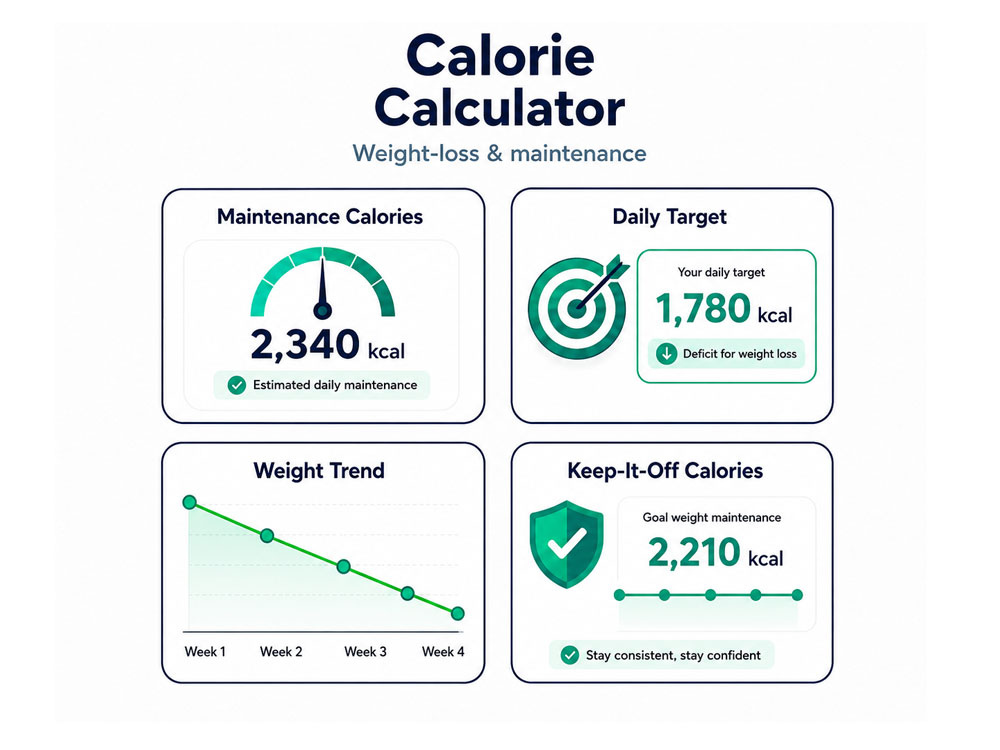
Free UK calorie and weight-loss calculator: your maintenance calories, a daily target to lose weight, and how it steps down as you lose. NHS and NICE aligned.
This page contains affiliate links. As an Amazon Associate, we earn from qualifying Amazon purchases at no additional cost to you. We may also earn commissions from other retailers, again at no additional cost to you.
Losing weight is simpler than the diet industry makes it look. Eat a little less than your body burns, steadily, and let walking support the deficit rather than carry it. The hard part is knowing your own numbers and recognising that they change as you do. A lighter body burns fewer calories, so the calorie target that worked in week one stops working by week ten unless you adjust it. We cover all of this in much more detail in our forthcoming book, Walking for Weight Loss.

Walking can widen a modest calorie deficit without forcing food intake too low, making weight loss easier to sustain.
This free calorie calculator does the work for you. Use it to estimate your maintenance calories (the number that keeps your weight steady), set a daily target to lose weight at a pace you can live with, and see how that target steps down as you lose weight. It includes your walking, so an active day earns a little more food. It gives you protein and fibre targets, not just calories, and keeps you above a lower-calorie limit. It runs in your browser, needs no account, and stores nothing.
Medical Disclaimer
This article and calculator provide general information about weight and nutrition, not medical advice, and are not a substitute for professional healthcare. The calculator is for adults seeking to lose weight. It is not for use during pregnancy or breastfeeding, for anyone under 18, or for anyone already at a healthy weight or below. It is also not suitable for anyone who has, or has ever had, an eating disorder, or who finds that counting calories, weighing, or tracking becomes distressing or difficult to keep in proportion. Calorie tools may worsen those struggles, so please do not use this one; speak to your GP and contact Beat, the UK's eating disorder charity, for free, confidential support.
If you have a health condition or take medication that affects your weight or blood sugar (insulins and sulfonylureas in particular), talk to your GP, pharmacist, or a registered dietitian before making changes. Individual responses vary, so treat every figure as a starting point, build up gradually, and stop if you feel unwell.
This article does not provide medical or dietary advice and should not replace professional healthcare. Individual responses to dieting and exercise vary. Always increase your walking distance and intensity gradually, prioritise your comfort, and seek professional advice if you experience persistent or concerning symptoms.
Your maintenance calories, a daily target you can hold, and the number that keeps the weight off once you get there. Your walking is added on top, and counted only once.
Leave your walking out of this answer. Your walking is added separately below, so it is never counted twice.
A zig-zag week averages out to exactly the same target. Some people find it easier to live with, particularly around a weekend. A zig-zag week is not more effective than eating the same amount every day, and it is not magic.
Whichever you choose, the calculator never goes below 800 calories. NICE says diets under 800 belong only inside a supervised specialist service.
| Protein a day | — |
|---|---|
| Protein at each meal | — |
| Fibre a day (the UK target) | 30 g |
Higher-protein eating is safe for healthy kidneys. If you have kidney disease, check with your GP or a dietitian before increasing it.
| Resting metabolism (BMR) | — |
|---|---|
| Calories your walking earns you | — |
| BMI | — |
| Healthy weight range for your height | — |
| Your maintenance falls by | — |
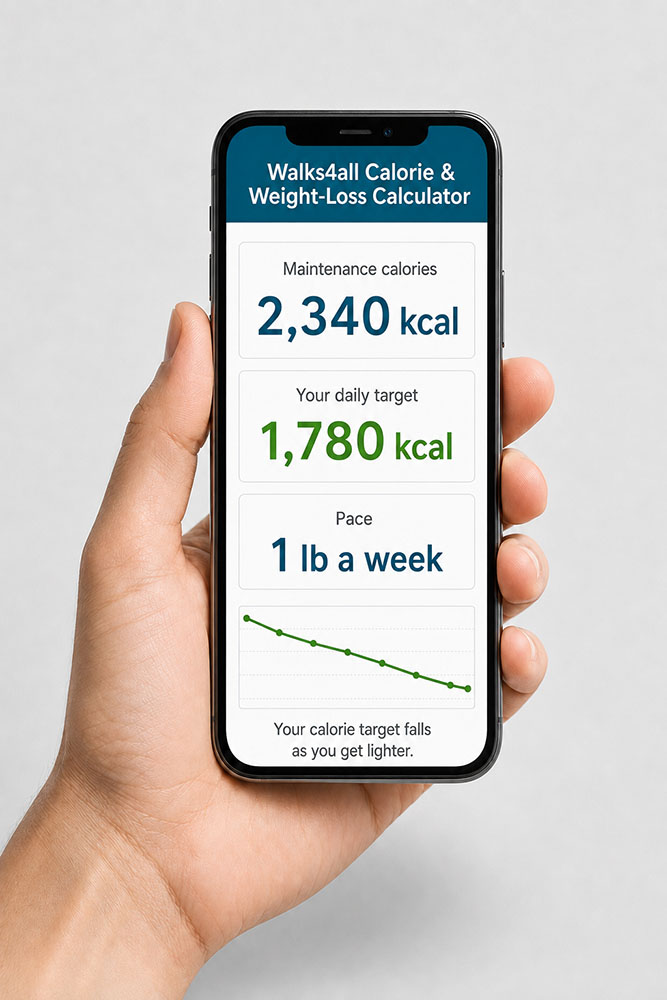
The calculator estimates maintenance calories, sets a daily weight-loss target, and adjusts steps as your body weight falls.
Enter your details, and the calculator returns four results:
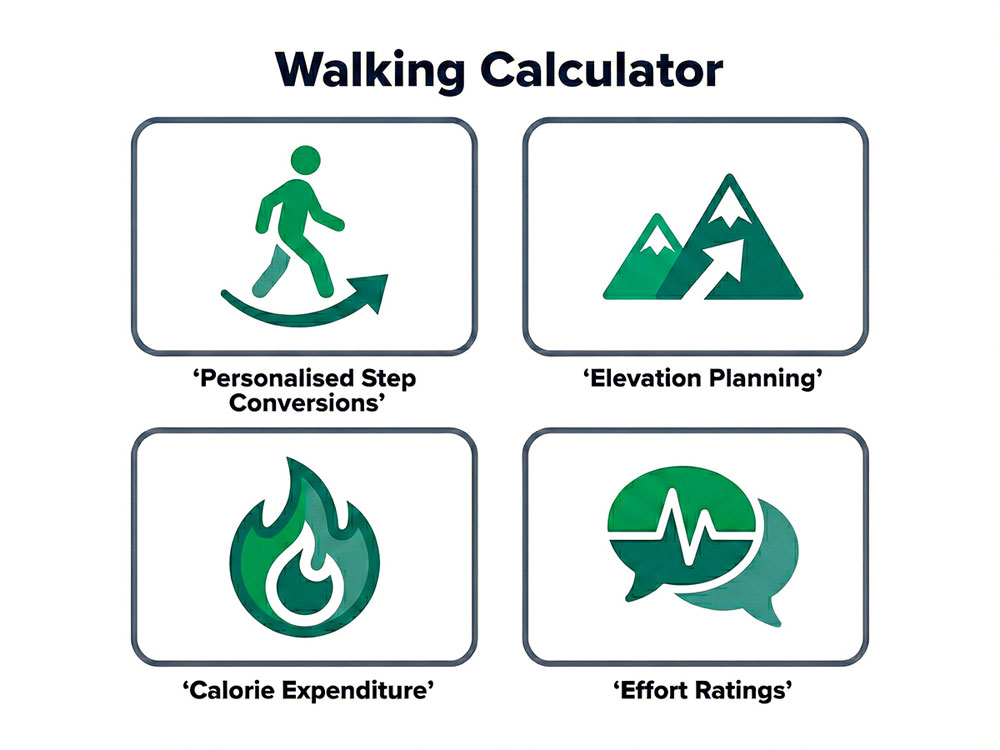
It also sets protein and fibre targets and can put it in walking terms: how many minutes, steps, or miles would cover the gap. If you would rather work the other way round, from steps to calories, distance and time, our companion Walks4all Walking Calculator does that.
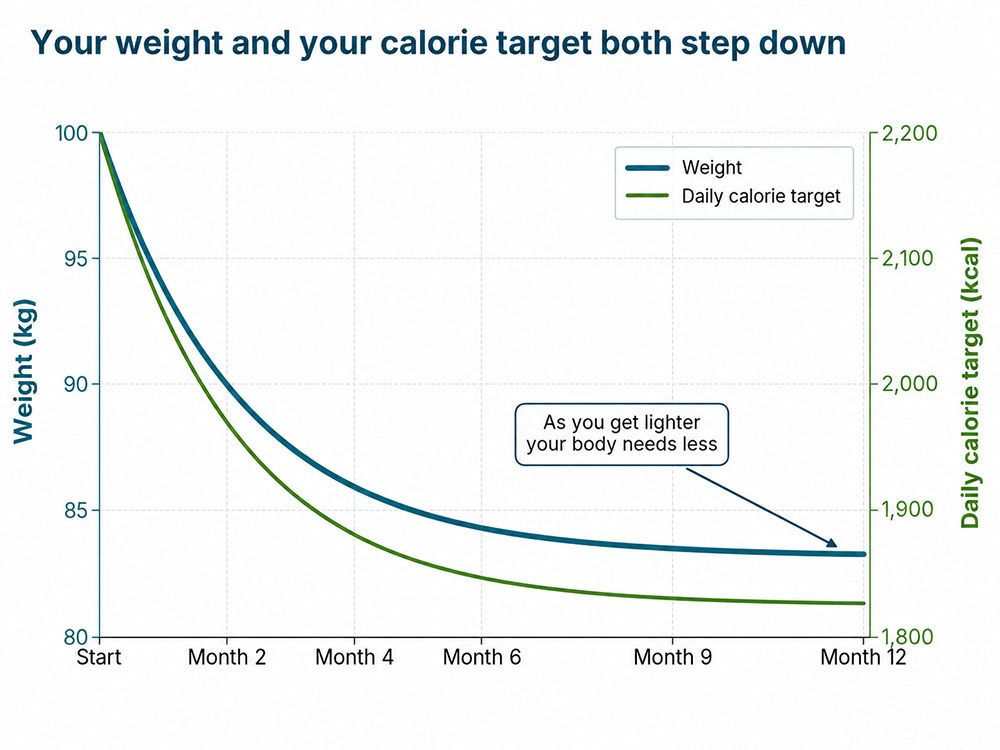
As weight decreases, maintenance needs fall too, so the calorie target must be adjusted downward to keep weight loss moving.
Most online calorie calculators give you a single number and leave it at that, as though your body will burn the same amount forever. It will not. Ours is built around the factors that actually determine whether the weight comes off and stays off:
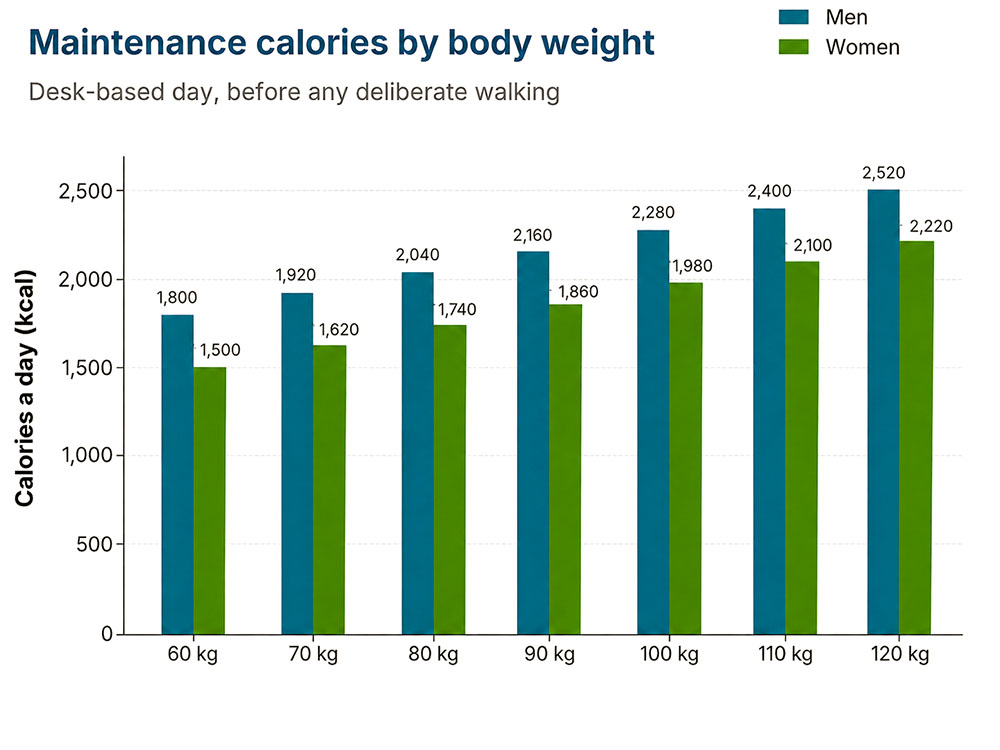
Estimated maintenance calories rise with body weight; the calculator personalises the figure based on sex, age, height, weight, activity and walking.
The tables below are rounded starting points derived from the same equations the calculator uses. Your figure depends on your exact height, age, and activity level, so use the calculator for a figure tailored to you. The three activity columns use multipliers of 1.2 for desk-based, 1.375 for lightly active, and 1.55 for moderately active. They assume a man of about 175 cm (5 ft 9 in) and aged 40, which are close to the UK averages.[20]
Calories and kcal mean the same thing here. What everyone calls a calorie is properly a kilocalorie, written kcal, and UK food labels give the energy twice: as kilojoules and as kilocalories. The kcal figure matches every number in this article and in the calculator.
Maintenance calories are the amount that keeps your weight steady (also known as total daily energy expenditure, or TDEE)
| Body weight | Desk-based, little exercise (kcal a day) | Lightly active (kcal a day) | Moderately active, exercise 3 to 5 days a week (kcal a day) |
| 60 kg (9 st 6 lb) | 1,800 | 2,060 | 2,320 |
| 70 kg (11 st 0 lb) | 1,920 | 2,200 | 2,480 |
| 80 kg (12 st 8 lb) | 2,040 | 2,340 | 2,630 |
| 90 kg (14 st 2 lb) | 2,160 | 2,470 | 2,790 |
| 100 kg (15 st 10 lb) | 2,280 | 2,610 | 2,940 |
| 110 kg (17 st 5 lb) | 2,400 | 2,750 | 3,100 |
| 120 kg (18 st 13 lb) | 2,520 | 2,890 | 3,250 |
The NHS estimates the average man's maintenance energy at about 2,500 kcal per day.[11]
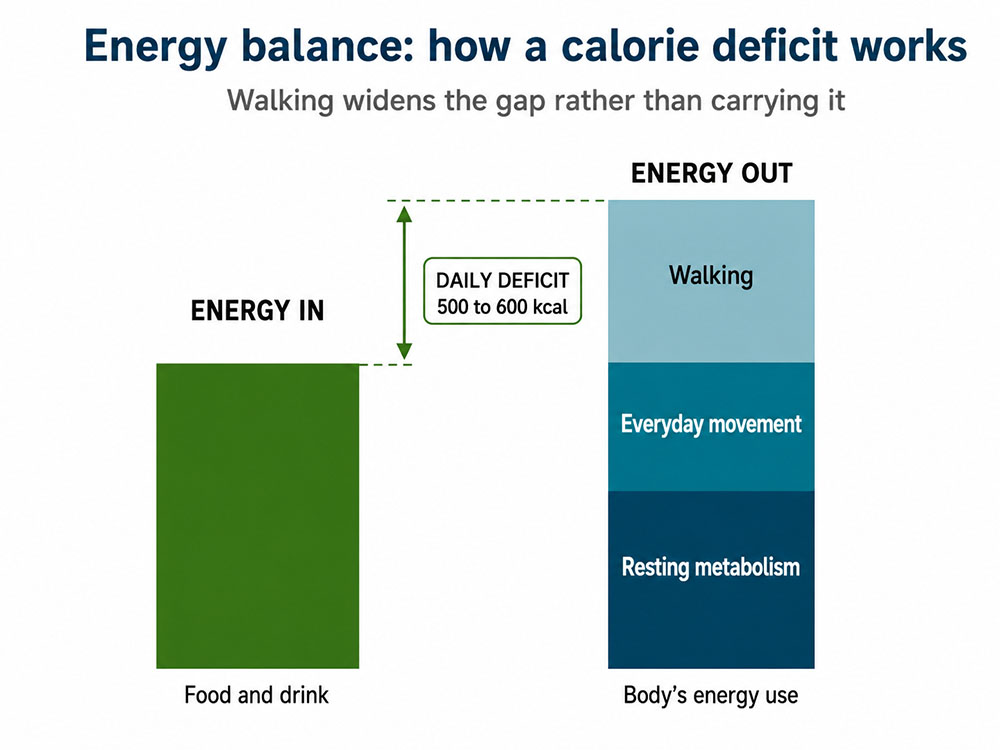
Weight loss occurs when energy use exceeds energy intake; walking adds to daily expenditure and helps create a sustainable 500 to 600 kcal deficit.
The target is 600 calories below maintenance, with intake held above 1,900 kcal a day, the men's allowance in the NHS's 12-week weight loss plan. It assumes a lightly active day, so adjust upwards if you are more active.
| Body weight | Daily target to lose weight (kcal a day) |
| 70 kg (11 st 0 lb) | about 1,900 (at the lower limit) |
| 80 kg (12 st 8 lb) | about 1,900 (at the lower limit) |
| 90 kg (14 st 2 lb) | about 1,900 |
| 100 kg (15 st 10 lb) | about 2,010 |
| 110 kg (17 st 5 lb) | about 2,150 |
| 120 kg (18 st 13 lb) | about 2,290 |
Same method for a woman of about 162 cm (5 ft 4 in), aged 40.[20]
| Body weight | Desk-based, little exercise (kcal a day) | Lightly active (kcal a day) | Moderately active, exercise 3 to 5 days a week (kcal a day) |
| 60 kg (9 st 6 lb) | 1,500 | 1,720 | 1,940 |
| 70 kg (11 st 0 lb) | 1,620 | 1,860 | 2,090 |
| 80 kg (12 st 8 lb) | 1,740 | 2,000 | 2,250 |
| 90 kg (14 st 2 lb) | 1,860 | 2,130 | 2,400 |
| 100 kg (15 st 10 lb) | 1,980 | 2,270 | 2,560 |
| 110 kg (17 st 5 lb) | 2,100 | 2,410 | 2,710 |
| 120 kg (18 st 13 lb) | 2,220 | 2,550 | 2,870 |
The NHS estimates the average woman's maintenance energy at about 2,000 kcal/day.[11]
The target is a 600-calorie deficit, with intake held above 1,400 kcal a day, the women's allowance in the NHS's 12-week weight loss plan. It assumes a lightly active day.
| Body weight | Daily target to lose weight (kcal a day) |
| 60 kg (9 st 6 lb) | about 1,400 (at the lower limit) |
| 70 kg (11 st 0 lb) | about 1,400 (at the lower limit) |
| 80 kg (12 st 8 lb) | about 1,400 |
| 90 kg (14 st 2 lb) | about 1,530 |
| 100 kg (15 st 10 lb) | about 1,670 |
| 110 kg (17 st 5 lb) | about 1,810 |
If your maintenance is not much above the lower limit, most of the work should come from increasing movement. Walking is the easiest way to widen the gap without cutting your food intake too low.
Weight loss slows as you get lighter, so the calculator's projection is the figure to trust for your plan.
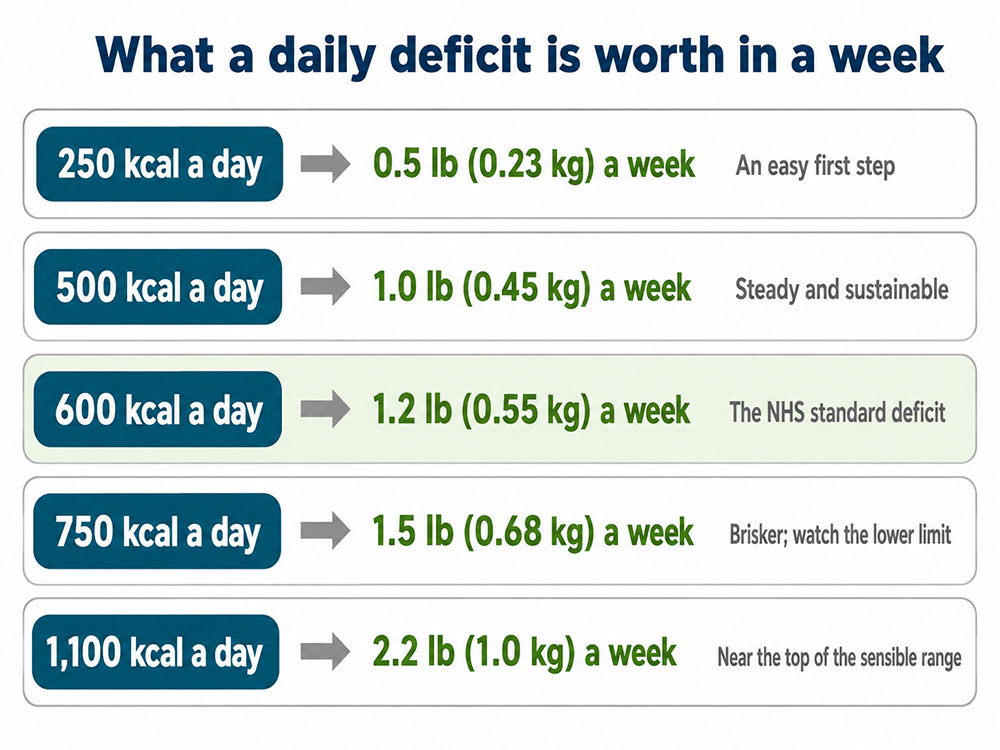
A 500 to 600 kcal daily deficit is roughly equivalent to about 1 to 1.2 lb (0.45 to 0.55 kg) of early weekly weight loss, before the rate gradually slows.
A pound of body fat holds roughly 3,500 calories, and a kilogram about 7,700, so a daily deficit translates to a weekly loss like this, at least at the start.
| Daily deficit (kcal a day) | Weekly loss | Notes |
| 250 | about 0.23 kg (0.5 lb) | An easy first step |
| 500 | about 0.45 kg (1.0 lb) | Steady and sustainable |
| 600 | about 0.55 kg (1.2 lb) | The NHS standard deficit |
| 750 | about 0.68 kg (1.5 lb) | Brisker; watch the lower limit |
| 1,100 | about 1.0 kg (2.2 lb) | Near the top of the sensible range |
Losing more than about 1 kg (2 lb) a week, or more than 1% of your body weight, is not recommended without medical supervision.[12] [14]
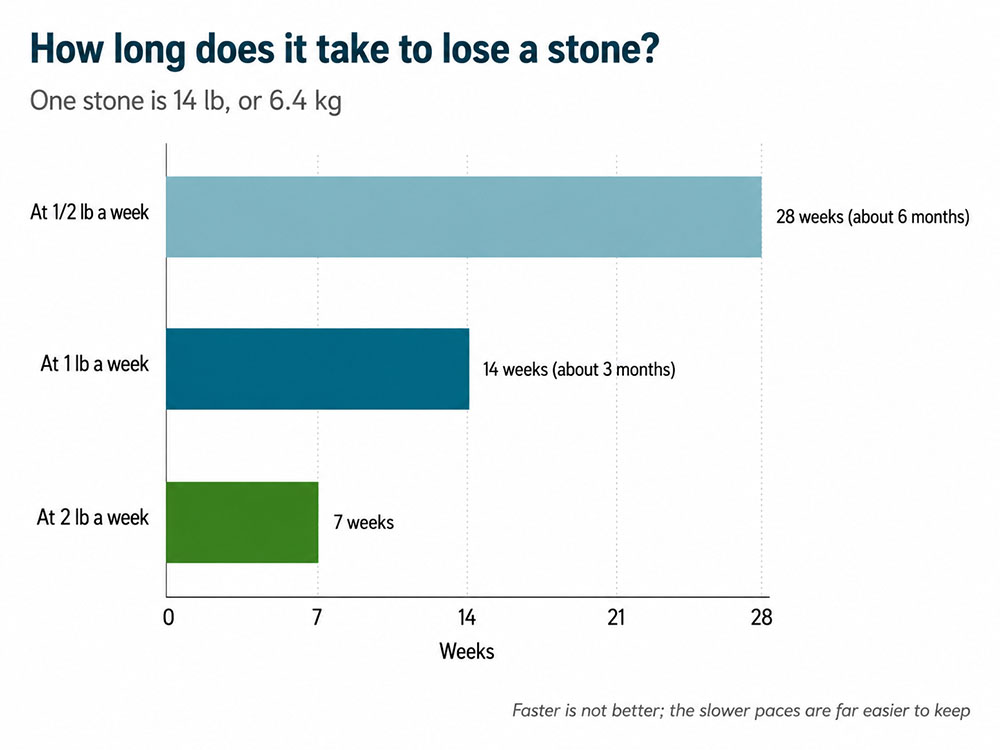
Losing one stone may take about 7 to 28 weeks depending on pace; slower plans are usually easier to sustain.
How long it takes depends almost entirely on the pace you can sustain, not on where you start. These are straight-line estimates for three common paces. In practice, each one runs a little longer because the loss flattens as you go.
| How much you want to lose | At ½ lb (0.23 kg) a week | At 1 lb (0.45 kg) a week | At 2 lb (0.9 kg) a week |
| Half a stone (7 lb / 3.2 kg) | about 14 weeks | about 7 weeks | about 4 weeks |
| 10 lb (4.5 kg) | about 20 weeks | about 10 weeks | about 5 weeks |
| One stone (14 lb / 6.4 kg) | about 28 weeks (6 months) | about 14 weeks (3 months) | about 7 weeks |
| 20 lb (9.1 kg) | about 40 weeks | about 20 weeks (about 4½ months) | about 10 weeks |
| Two stone (28 lb / 12.7 kg) | about 13 months | about 28 weeks (6 months) | about 14 weeks |
| Three stone (42 lb / 19 kg) | about 19 months | about 42 weeks (10 months) | about 21 weeks (5 months) |
Two pounds (about 1 kg) a week is the upper limit for most people, and heavier people can often maintain the upper end more comfortably than lighter ones.[12]
A pound of fat contains about 3,500 calories, and a kilogram about 7,700, so losing a stone (14 lb) means creating a deficit of roughly 49,000 calories between what you eat and what you burn. You never do that in one go; the sensible approach is to spread it over a few months.
| To lose one stone (about 49,000 kcal) | Daily deficit needed (kcal a day) | Verdict |
| in 6 weeks | about 1,170 | Too aggressive for most; not advised |
| in 2 months | about 800 | Brisk; watch the lower limit |
| in 3 months | about 540 | Sensible, close to the NHS deficit |
| in 6 months | about 270 | Easy to keep |
This is why 'lose a stone in a month' is a poor idea: it would require a deficit few people can sustain. Three to six months is about right for a stone. Enter your weight and goal into the calculator to get a timeline that accounts for the slowdown.
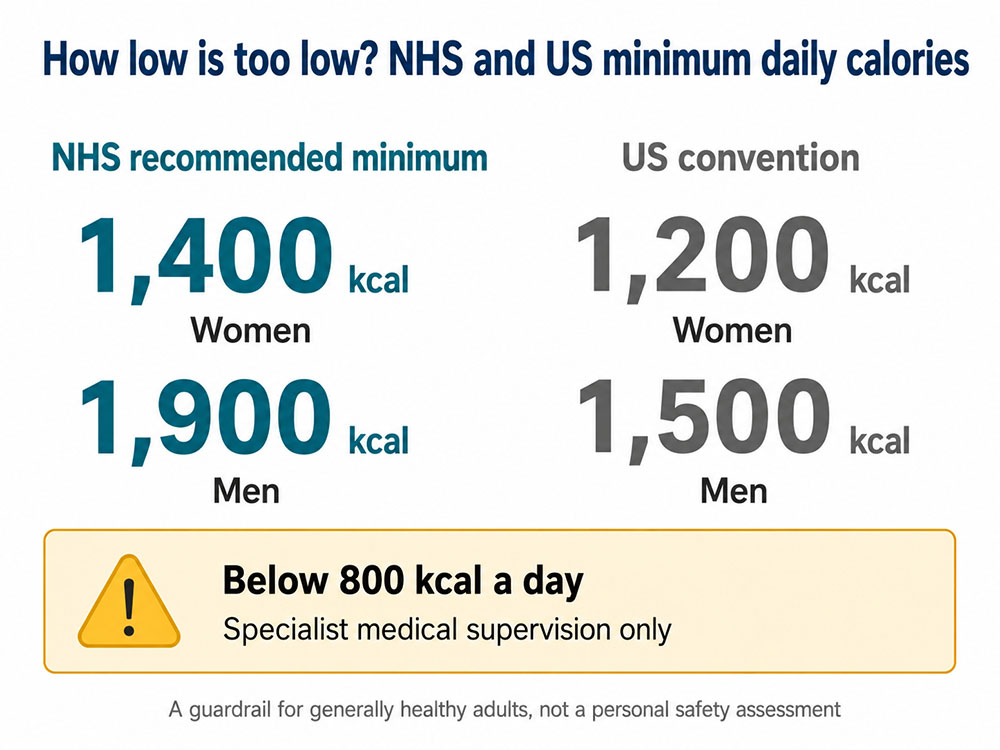
The calculator uses NHS 12-week plan allowances as its default lower limits; diets below 800 kcal a day require specialist medical supervision.
This is the number people most often get wrong, in both directions. The calculator sets a lower calorie limit and never sets a target below it. What that limit covers, and what it does not, is worth a minute's consideration.
By default, the limit matches the daily allowance in the NHS's 12-week weight-loss plan: 1,400 kcal a day for women and 1,900 kcal a day for men.[12] In the calculator, you can switch to the lower figures common in the United States and on apps such as MyFitnessPal, namely 1,200 and 1,500, which are based on American dietetic guidance rather than the NHS.[3] Do not go too low. The calculator keeps you above a minimum calorie limit and won't let you go below it.
Those figures are a guardrail for generally healthy adults, not a personal safety assessment. A calculator cannot know whether you are pregnant, taking medication, living with kidney disease or diabetes, recovering from an eating disorder, or simply older and frailer than your weight suggests. Any of those factors changes the answer.
NICE, the body that sets NHS treatment standards, defines diets of 800 to 1,200 kcal per day as low-energy diets and those under 800 kcal as very low-energy diets. It says both should be delivered within a specialist service with a registered dietitian for no more than 12 weeks, not as a long-term plan.[14]
So the 1,200-kcal figure that so many apps treat as normal sits at the very bottom of NICE's definition of a clinical intervention. Lower figures warrant serious attention. Unless a professional has advised otherwise, the NHS default is the one to follow, and walking more is almost always a better way to widen the gap than eating less.

Whole foods rich in protein, fibre and nutrients make a calorie deficit more filling and easier to maintain.
| Lower calorie limit | Women (kcal a day) | Men (kcal a day) | Source |
| NHS 12-week plan allowance (this tool's default) | 1,400 | 1,900 | NHS weight-loss guidance[12] |
| US convention (MyFitnessPal, WebMD, Healthline, Mayo) | 1,200 | 1,500 | US dietetic guidance[3] |
| Specialist supervision only | 800 to 1,200 (low-energy) and under 800 (very-low-energy) | NICE NG246[14] | |
Faster is not better, and not only because it is harder to keep up. Losing weight very quickly, or losing a great deal of it, has been linked to several specific problems. None of them is certain, and a steady pace makes each of them less likely.
That's why the calculator recommends a pace cap and favours walking over going hungry. Slow, steady weight loss helps protect your metabolism, bones, hair, and overall comfort, making it much easier to maintain.
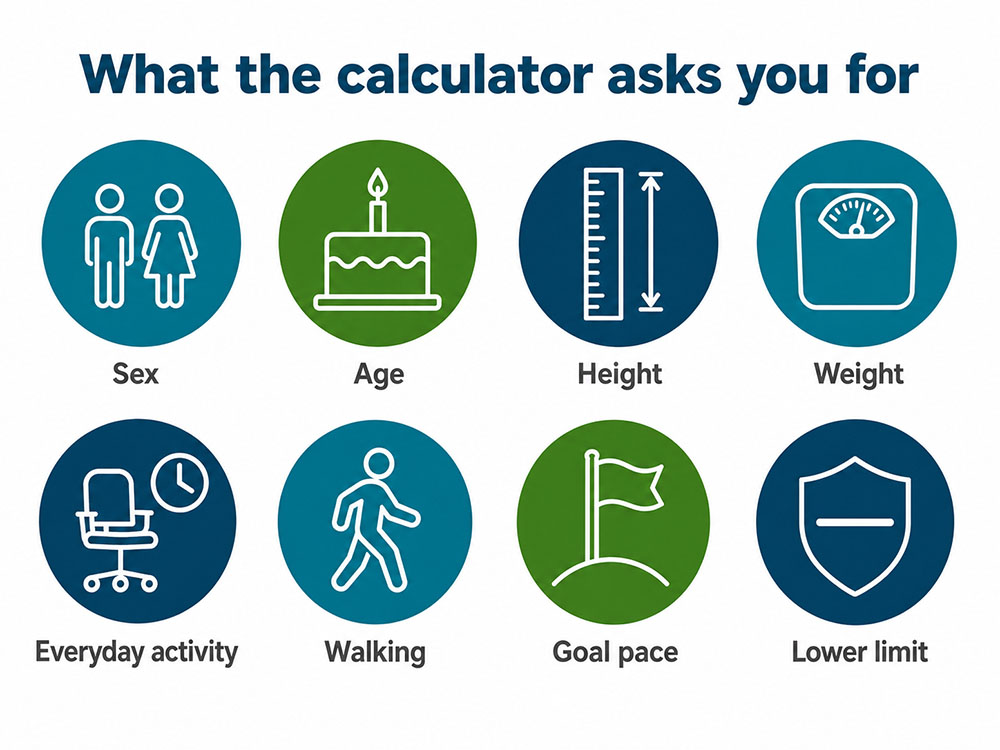
The calculator uses these inputs to estimate maintenance calories, walking expenditure, a lower-limited daily target and a realistic goal timeline.
Every field changes the answer, and understanding why helps you trust the number.
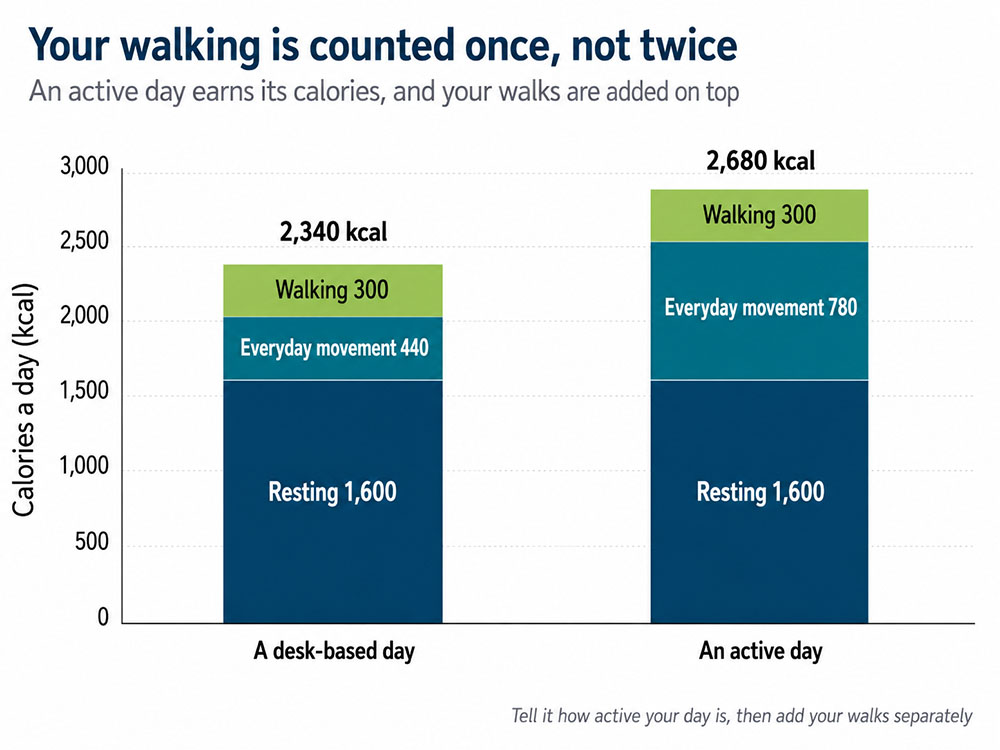
Walking is added separately to everyday activity so the calculator includes it once without double-counting exercise calories.
Nothing here is a secret formula. Every step is grounded in published, mainstream exercise science, and we would rather show our working than hide it. If you want to understand how health claims are developed and tested, see our guides on understanding health research and the limitations of walking studies.
Your resting metabolic rate, the calories you burn just by staying alive, is the starting point. We use the Mifflin-St Jeor equation, the one dietitians prefer, to estimate it from your weight, height, age and sex.[1] It is the most accurate of the common equations, but no equation is exact: about one in four or five people is more than 10% above or below their true resting rate.[2] That's why it's best to weigh yourself weekly and focus on the trend rather than relying solely on the calorie calculation.
When you enter a body-fat percentage, the system switches to the Katch-McArdle equation, which relies on lean body mass and may provide more accurate results for very lean or highly muscular individuals.
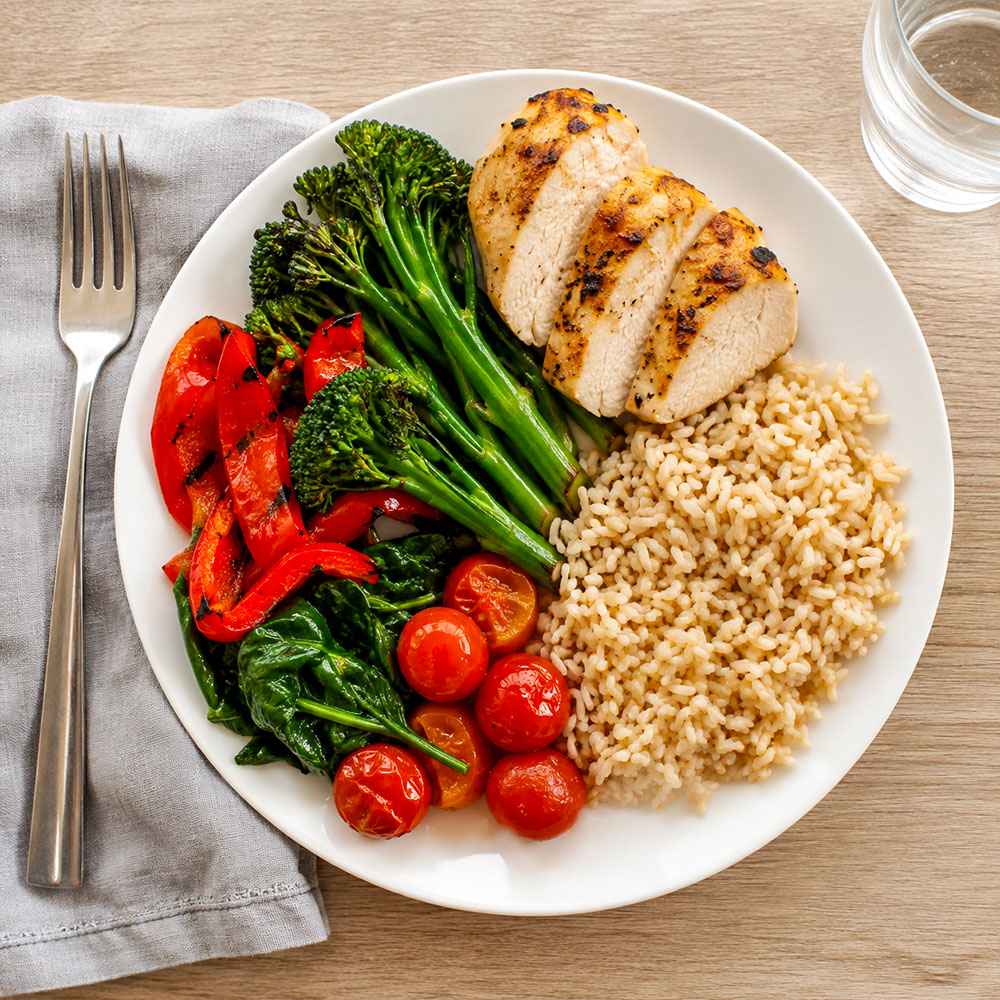
A practical weight-loss plate combines lean protein, high-fibre wholegrains and plenty of vegetables to support fullness on fewer calories.
To estimate daily calories burned at rest, we multiply it by an activity factor.[4] In a basic model, this is expressed as a single number. The walking model, however, uses a low baseline for non-walking days and adds calories from walks separately, using standard metabolic values from the Compendium of Physical Activities.[5] [6]
The main idea is to subtract the resting portion of a walk before adding it back later, which prevents double-counting the energy you'd burn while sitting. Although it seems minor, this step can significantly skew many calculators' results.
As you lose weight, a lighter body requires less energy to maintain and carry, lowering your maintenance level. At rest, this reduction is approximately 10 calories per day for each kilogram lost, or about four and a half calories per pound, as reflected in the weight component of the Mifflin equation.
The key figure for your target is higher: about 22 calories per day per kilogram, or roughly 10 calories per pound, once you account for the reduced cost of moving a lighter body and a little metabolic adaptation.[7] So a fixed deficit does not deliver a fixed weekly loss forever. The rate of loss decreases gradually, eventually levelling off, until the calorie intake that once caused weight loss becomes your new maintenance level, at which point weight loss pauses.
The calculator uses Kevin Hall's dynamic weight change model, similar to the NIH Body Weight Planner.[7] [8] It captures the characteristic 'bending curve' of weight loss: roughly half of the total loss occurs in the first year, with the majority of the remaining change happening over the next two years. The tool gradually adjusts your target weight as your projected weight decreases and encourages you to update it throughout the process.
For the deficit itself, the calculator subtracts about 500 to 600 calories a day, in line with NHS advice of around 600, and limits weight loss to roughly 1 kg (2.2 lb) a week or 1% of your body weight, whichever is lower.[12] [13] It then keeps you above your chosen lower-calorie limit. If a plan would breach that limit, the calculator eases the deficit and lengthens the timeline rather than setting a target that drops too low.[14]
The chart displays two lines: your decreasing weight and the daily calorie target, which also drops as your weight decreases. Once you reach your goal, the calorie amount needed to maintain that weight is lower than your previous maintenance because you're lighter, roughly 22 fewer calories per kilogram lost. Most calculators don't show this, but it's the point where regain starts, as people often revert to their old intake for a lighter body. Our chart highlights this figure clearly, helping you choose it consciously.
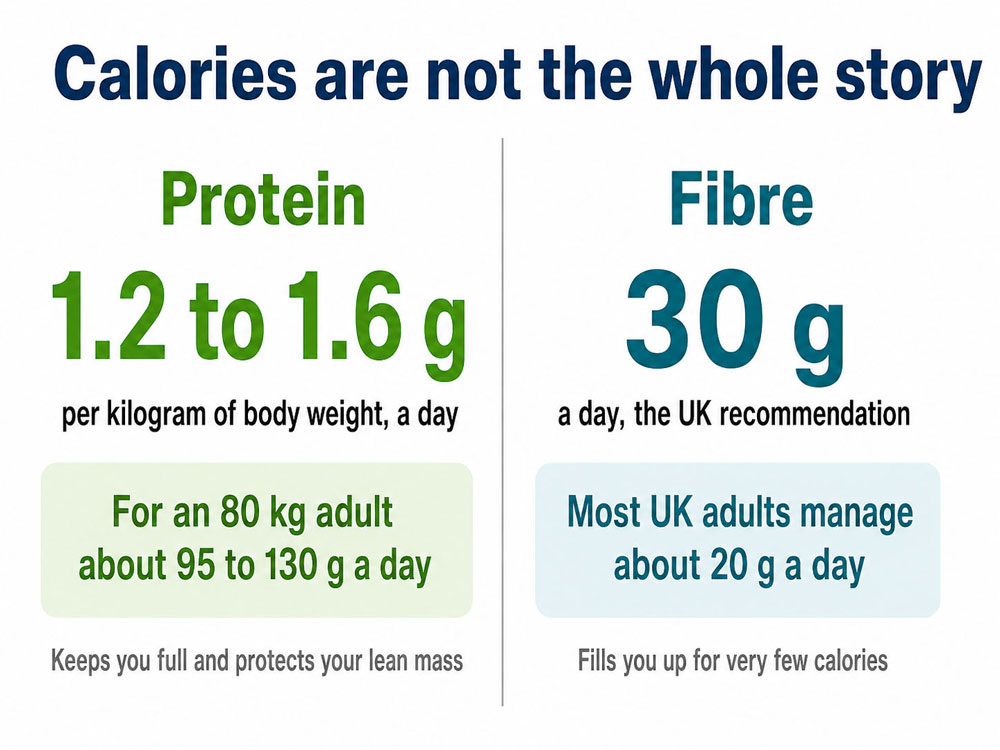
Protein helps preserve lean mass and fullness, while fibre adds volume and supports satiety during a calorie deficit.
Eating for fullness is half the battle, so the calculator provides two additional targets. Protein, at 1.2 to 1.6 g per kilogram of body weight per day, helps preserve your lean mass while you lose weight and keeps you satisfied on fewer calories. This is comfortably above the UK reference intake of 0.75 g/kg, which is a floor to avoid deficiency rather than an optimum, and well below the very high intakes often promoted online.[17] [18]
It also helps to spread it throughout the day rather than loading it all at dinner.[26] If you are over about 65, or doing regular strength training, aim for the middle of that range, because ageing muscle responds less readily to the protein in a meal.[21] [22]
Higher-protein eating is safe for healthy kidneys, but if you have kidney disease, check with your GP first.

Combining protein-rich foods with beans, wholegrains, fruit and seeds helps meet protein and fibre targets with minimally processed foods.
Fibre is essential for feeling full after eating, yet most people fall short of the recommended intake. The UK target is 30 g daily[19], but the average adult gets around 16 g, with only 4% meeting the goal.[23] Fibre matters in a calorie deficit because it adds bulk and slows digestion without adding many calories. A meal featuring vegetables, beans, whole grains, and fruit keeps you fuller than the same number of calories from soft, quick-eating foods.
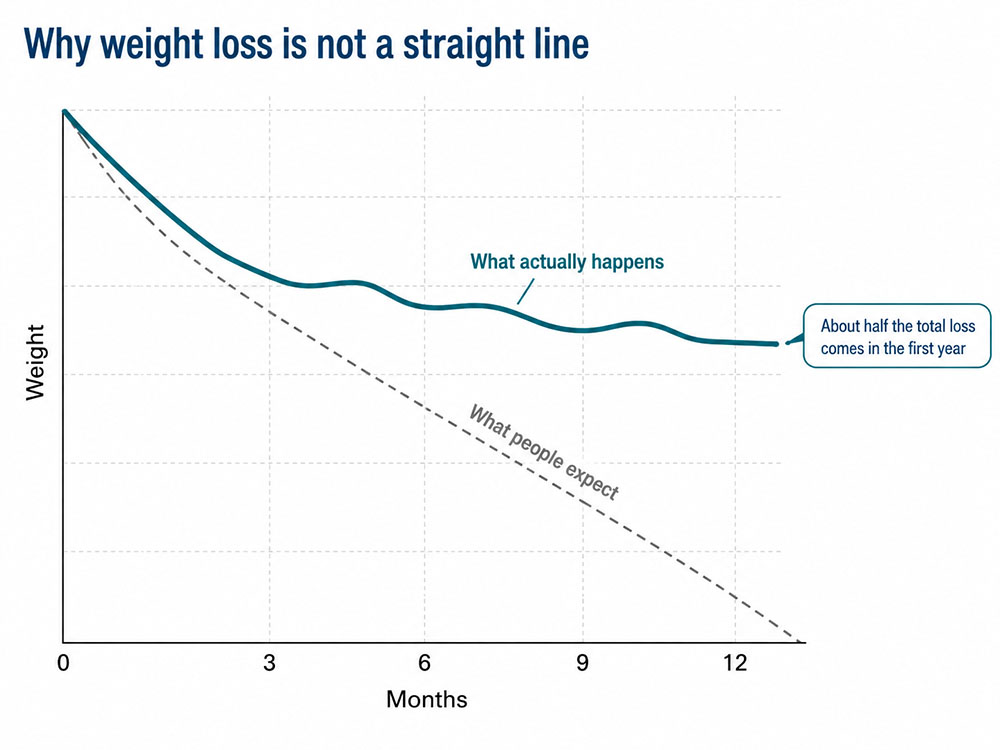
Real weight loss bends and fluctuates because calorie needs fall as the body gets lighter and short-term water changes affect the scales.
If the first week or two of your diet feels dramatic, most of the initial weight loss is water, not fat. Your body stores carbohydrates as glycogen, which holds three to four times its weight in water. When glycogen levels drop, it releases this water.[9] After that, fat loss tends to slow and stabilise over time because, as you weigh less, your body burns fewer calories.
When weight loss stalls, people often blame a broken or 'starvation' metabolism. There is a little truth to it, but much of it is exaggerated. After weight loss, the body burns slightly less than its new size would predict, an effect called adaptive thermogenesis.
Researchers disagree about this. One influential review estimates the effect at 300 to 400 calories a day and argues it lasts for years.[15] A later study of 171 women measured it at about 54 calories a day at the end of weight loss, found it had disappeared a year later, and showed that it did not predict who regained.[16] Either way, the most common reason a stall occurs is that the deficit narrows as you get lighter, with intake creeping back up unnoticed. The answer is to expect it and adjust, which is what the calculator does when you update your weight.

Taking the stairs, carrying shopping, and other everyday movement contribute to NEAT and can meaningfully increase daily calorie expenditure.
One more piece most calculators ignore. A surprising share of what you burn isn't exercise at all but the fidgeting, standing, pacing, and general pottering that researchers call non-exercise activity thermogenesis, or NEAT. It can vary by hundreds of calories a day.[24]
It also tends to fall when you diet, as the body conserves energy by moving less. That is another argument for building deliberate walking into your day: it helps protect your daily energy expenditure against the drop in NEAT, and it is the most repeatable way to do so.
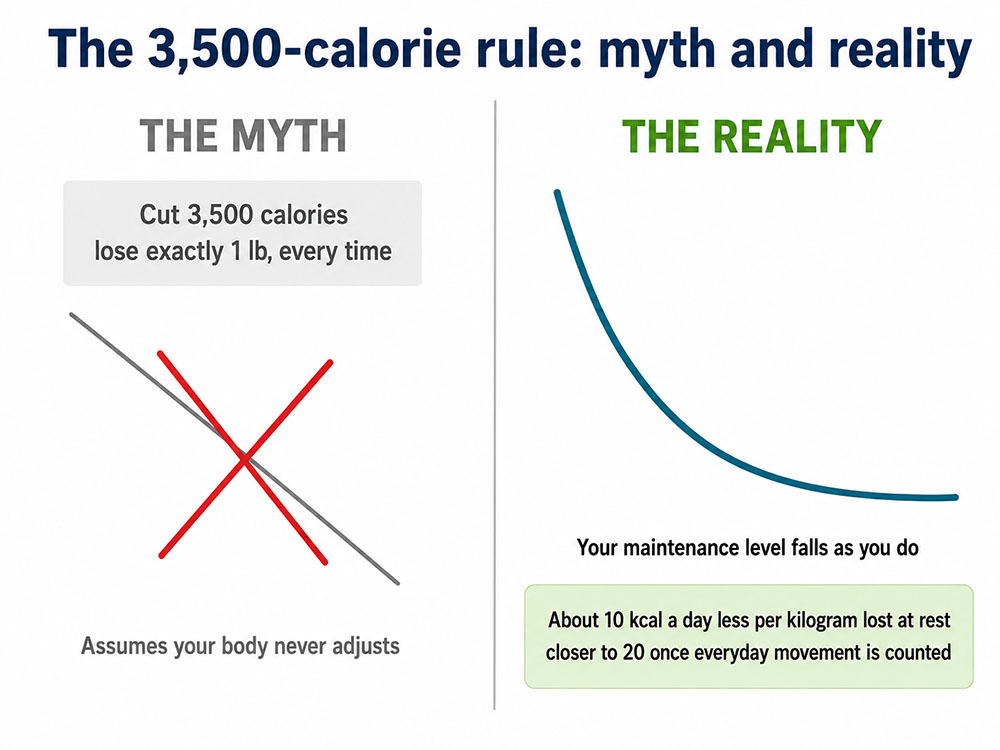
About 3,500 kcal is a rough energy equivalent for a pound of fat, but it does not predict a fixed pound of weight loss every week because calorie needs change.
Not quite. The number itself is sound: a pound of body fat contains about 3,500 calories, and that does not change. What fails is the sum built on it: that a 500-calorie daily deficit therefore results in a pound lost a week forever.
Two things break it. Your maintenance needs fall as you get lighter, so if you keep eating the same amount, the gap narrows: 500 becomes 450, then 400, and the same 3,500 calories take longer and longer to add up. And a pound on the scales is not a pound of fat. Early on, much of it is water, which costs almost nothing, so the first weeks run ahead of the rule rather than behind it. When researchers measured it, a pound lost in the fourth week of a closely monitored diet had cost about 2,200 calories.[10] Over months, the error turns the other way, and the rule ends up promising far more than people achieve.
That is why this calculator uses a dynamic model rather than the old sum.
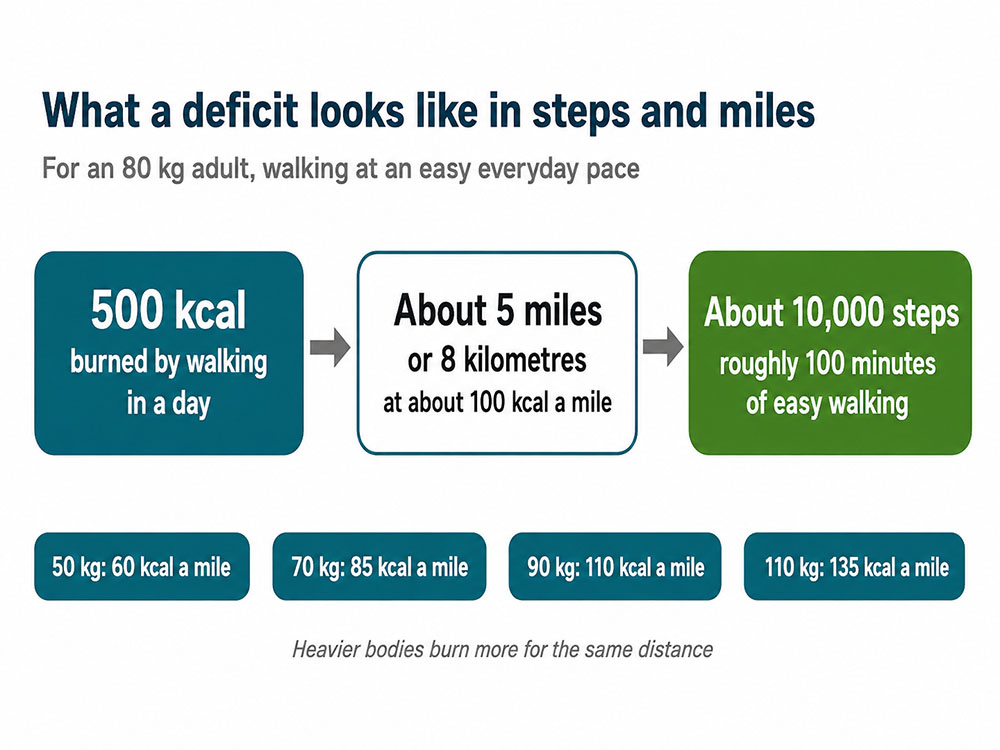
For an 80 kg adult, burning around 500 kcal by easy walking may take roughly 5 miles or 10,000 steps, although the calculator uses net rather than gross calories.
This Walks4all calculator can convert your daily deficit into walking equivalents: minutes, steps, or miles needed to burn it off. As a rough estimate, it reflects the calories burned walking at a comfortable 3 mph pace before any deduction.
| Body weight | Calories per mile (kcal) | Calories per 10,000 steps, about 4.5 miles (kcal) |
| 50 kg (7 st 12 lb) | about 65 | about 290 |
| 60 kg (9 st 6 lb) | about 80 | about 360 |
| 70 kg (11 st 0 lb) | about 95 | about 430 |
| 80 kg (12 st 8 lb) | about 105 | about 470 |
| 90 kg (14 st 2 lb) | about 120 | about 540 |
| 100 kg (15 st 10 lb) | about 135 | about 610 |
| 110 kg (17 st 5 lb) | about 145 | about 650 |
These are gross figures, the sort a watch shows; the calculator uses the net figure (it subtracts the calories you would have burned at rest), so it never double-counts your walking.[5] [6] Most people do best by splitting the work, eating a little less and walking a little more, and the calculator has a slider to adjust for this.
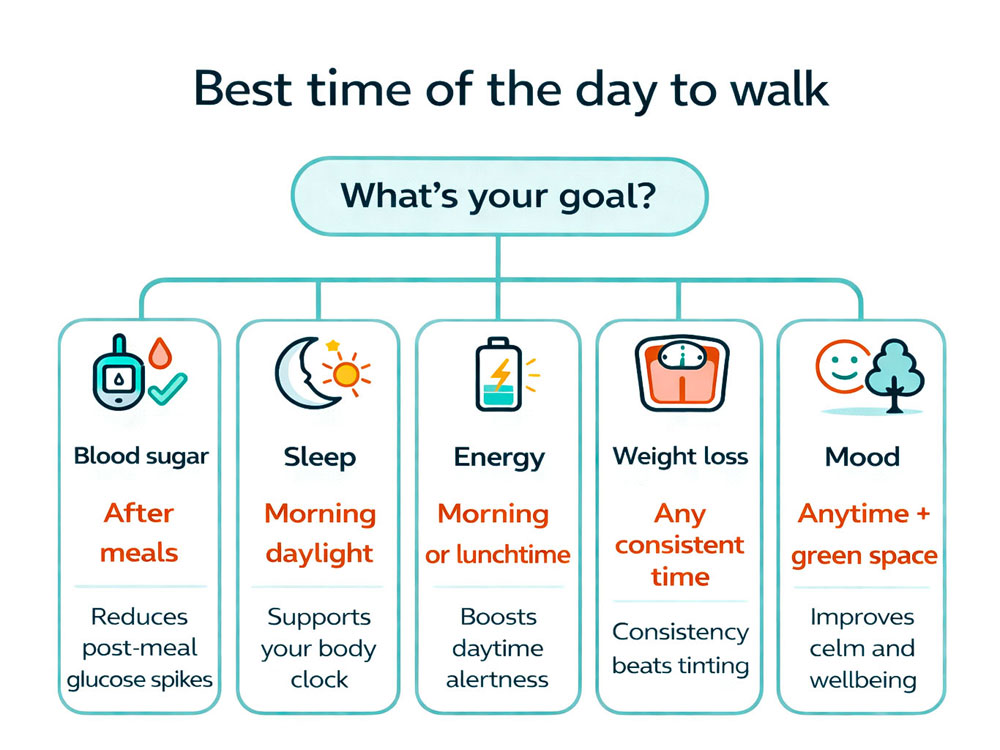
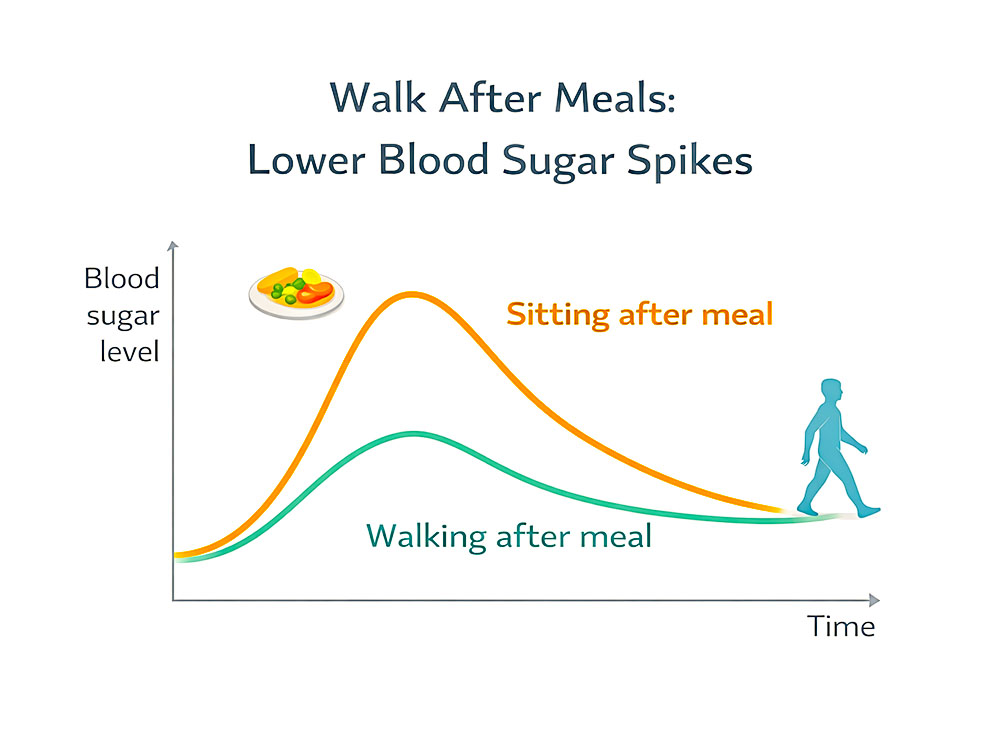
Walking belongs here not because it burns huge numbers of calories, which it does not for the effort, but because it is repeatable, protects your lean mass, steadies appetite and blood sugar, and is a habit people actually keep. A short walk after meals is especially useful for blood-sugar control, as our guide to walking after meals explains. A brisk, talk-test pace does more per minute, as our guide to brisk and zone 2 walking explains.
Your first few weeks are about building habits you can keep, not about fast loss. A few things matter more than the rest.
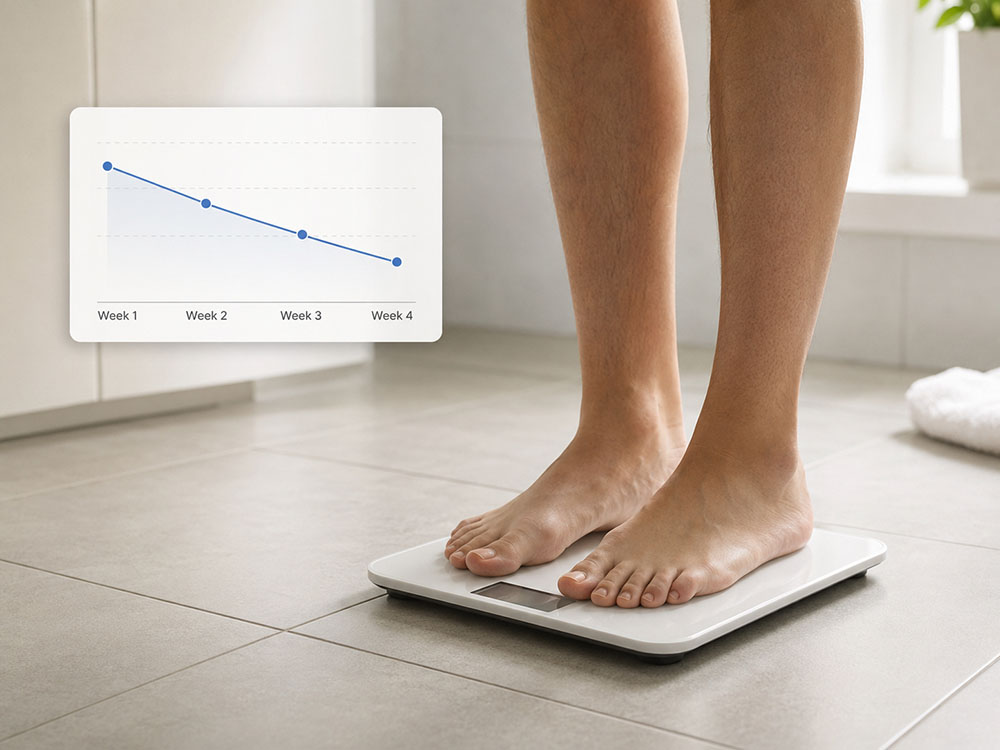
Weigh under similar conditions once a week and judge progress by the four-week trend rather than day-to-day changes in water and salt.
Set an easy pace of about half a kilogram (a pound) a week, and stick a plan you can follow. Weigh once a week under the same conditions, first thing, and watch the trend over a month rather than the day-to-day wobble, which can shift by a pound or two on salt and water alone. Weighing regularly helps most when it sits within a wider plan rather than standing on its own.[27]
If the number ever starts to feel like a verdict rather than information, step back. Build your protein intake up to target before you worry about anything more complex. Add fibre gradually to avoid stomach discomfort, and increase your walking a little at a time. Our Walking Calculator and the facts about 10,000 steps can help you set a realistic step goal.

Drinking about 500 ml of water before meals may modestly support weight loss for some middle-aged and older adults by helping reduce appetite.
Two small habits can help. Drinking a large glass of water (about 500 ml) before each meal modestly increased weight loss in a trial of adults aged 55 to 75, probably by reducing appetite.[25] Liquid calories from sugary drinks, juices, and alcohol are the easiest to cut because they add up quickly without filling you up.
Sleep matters too. When adults who habitually slept less than six and a half hours were helped to sleep about an hour longer a night, they ate 270 calories a day less without being asked to change anything else.[35] And when people following the same reduced-calorie diet had their sleep cut to five and a half hours, only about half as much of the weight they lost came from fat, with more coming from lean tissue.[36] The second study followed only ten people, so take the size of that effect with a grain of salt, though the direction is what matters here. Protecting your nights is part of the plan, not separate from it.
When the loss slows, as it will, update your weight in the calculator and let it nudge the target down. Slow is not the consolation prize. It takes less of your lean mass, and it is far easier to keep. If you want the fuller version of this approach, it is part of our forthcoming Walking for Weight Loss book, built around a simple framework for making the habit stick when motivation comes and goes.
A good calorie target is not the lowest you can bear; it is the one you can sustain while your life carries on around it. This calculator gives you that: a maintenance figure to anchor to, a daily target that stays above the NHS plan's allowances, a projection that tells the truth about the slowdown, and the keep-it-off number that most tools never mention.
Treat it as a guide rather than strict scales for your food. Weigh yourself weekly to spot trends, rely on your walking, and adjust as you go. This approach helps you lose weight and, more importantly, maintain it.
Yes. What everyone calls a calorie is technically a kilocalorie, and food labels list it as kcal. Nutrition uses the two terms interchangeably, and this article treats them as the same. UK labels must show energy in both kilojoules and kilocalories, so a 250 kcal snack also reads about 1,046 kJ. The kJ figure is roughly four times larger, so you can ignore it: read the kcal.
Most adults lose weight steadily on around 600 calories a day below their maintenance level, the figure the NHS advises, which equates to roughly half a kilogram (a little over a pound) a week; losing a full kilogram a week requires nearer 1,100 calories a day. In practice, that often means somewhere around 1,400 to 1,600 calories a day for a lightly active woman and 1,900 to 2,100 for a man, but it depends on your size and activity, and it should fall as you lose weight. Use the calculator above for a figure tailored to you.
Estimate your resting metabolism from your weight, height, age and sex using the Mifflin-St Jeor equation, then multiply by an activity factor (from about 1.2 if you are sedentary to 1.9 if you are very active). The result is your maintenance level, or total daily energy expenditure. The calculator does this for you and adds your walking separately so it is not double-counted.
Your BMR, or basal metabolic rate, is the energy you burn at complete rest just to stay alive. Your TDEE, or total daily energy expenditure, is that plus everything else you do: moving, digesting food and fidgeting. TDEE matters for weight loss because it's the number you need to eat below. The calculator first estimates your resting rate, then adds your activity to get your TDEE.
A lighter body demands less energy for activity and movement. For each kilogram lost, your maintenance calories decrease by approximately 22 calories daily, around 10 calories per pound, once typical daily activity is included. This explains why a constant calorie deficit becomes less effective over time and why the target needs to be gradually reduced. The calculator adjusts this target automatically as your weight decreases.
Only as a short-term rough guide. It assumes your calorie needs never change, but they fall as you lose weight, so the rule substantially overpredicts long-term loss. A dynamic model, like the one this calculator uses, gives a far more realistic curve that bends and eventually settles.
The NHS's 12-week weight-loss plan sets daily allowances of 1,400 calories for women and 1,900 for men, and this calculator uses those as its default minimums. Lower figures of 1,200 and 1,500 are common on US apps but come from American dietetic guidance, not the NHS. Anything under 800 calories a day is a very-low-energy diet and, according to NICE, should only be undertaken within a specialist service. These figures are a guardrail for generally healthy adults, not a personal safety assessment, so if in doubt, stick to the NHS default and ask your GP. This calculator will not set a target below your chosen limit.
Losing about 1 lb (0.45 kg) a week requires roughly a 500-calorie daily deficit; losing 1 kg a week requires about 1,100 calories a day, which is near the top of the sensible range for most people. Subtract that from your maintenance calories, but do not drop below your lower calorie limit, and expect the pace to ease as you get lighter.
For many women, it is below the 1,400 the NHS's 12-week plan allows, and for men it is well below 1,900, so treat it with caution. NICE classes 800 to 1,200 kcal a day as a low-energy diet that belongs in a specialist service, so 1,200 is the very bottom of what is considered a clinical intervention, not a sensible everyday target. Very low intakes are harder to stick to, you tend to lose more lean mass, and you may end up short on nutrients. If your calculated target dips that low, the calculator eases the deficit instead of pushing you under the limit.
Aim for about 1.2 to 1.6 g of protein per kilogram of body weight per day, spread across your meals at roughly 25 to 30 g each. For an 80 kg person, that is about 96 to 128 g per day. Protein helps protect your lean mass while you lose weight and keeps you fuller on fewer calories.
No. Counting can help for a while to get a rough sense of portion sizes, but many people lose weight by changing habits instead: more protein and fibre, more walking, smaller portions of calorie-dense foods, and fewer liquid calories. The calculator gives you targets to aim for, not a rule to obey.
The two most common reasons are that the deficit has narrowed as you have lost weight, so what was a deficit is now close to maintenance, and that your intake has crept up without you noticing (calories are easy to underestimate). Water retention from salt, hormones, or a new exercise routine can also mask fat loss for a week or two. Update your weight in the calculator, tighten the estimate, and judge by the monthly trend.
They are good starting points, not precise readouts. The underlying equation is within about 10% of the truth for most people, though some are further out, and the activity factor adds further uncertainty. Any single calorie figure, whether from a calculator, a watch or a laboratory, carries a margin of error, which is why the trend on the scales over several weeks is the true test.
If you use the walking model here, you do not need to, because your walking is already included in your maintenance figure and target. The mistake to avoid is choosing an activity level that already includes exercise and then adding your workouts on top, which double-counts them and stalls progress.
About half a kilogram to a kilogram (one to two pounds) a week suits most people, and no more than about 1% of your body weight. Losing faster tends to take more lean mass, is harder to sustain, can raise the risk of gallstones, and, above certain limits, should only be done under medical supervision. The calculator caps the pace for you.
Yes, as part of the picture. Walking does not burn enormous numbers by itself, but it is repeatable, protects your lean mass, steadies appetite and blood sugar, helps maintain your daily burn against the drop in incidental movement that dieting brings, and is the exercise people are most likely to keep up. A mile burns roughly 100 calories for a person of about 12 stone, and that is the total figure; the calculator uses the net figure, about 75 for the same mile, so it is not wrong when it shows less. Pair it with a modest deficit rather than relying on it alone.
Your maintenance calories are lower than before because you are lighter. Once you reach your goal weight, your maintenance calories drop by roughly 22 calories a day for each kilogram you lose. The calculator shows this keep-it-off number directly, so you know what to settle at instead of drifting back to your old intake, which is the classic route to regain.
At a pace of one to two pounds a week, a stone (14 lb) takes roughly 7 to 14 weeks, about a month and a half to three months. At a slower pace of half a pound a week, it takes closer to six months. Losing a stone in a single month is not advised, as it would require a daily deficit few people can maintain.
It can. Very rapid weight loss raises the risk of gallstones, tends to cause muscle and bone loss, and can slow metabolism; after large losses, it may cause temporary hair shedding or loose skin; going very low can also leave you tired, cold and short on nutrients. A pace of one to two pounds a week, supported by walking and some strength work, keeps these risks low and is far easier to sustain.[28] [30] [33] [34]
No. If you have, or have ever had, an eating disorder, or if counting calories, weighing, or tracking becomes distressing, a calorie tool may make things harder rather than easier. Please do not use this calculator. Speak to your GP and contact Beat, the UK's eating disorder charity, for free, confidential support.
September 2026
We take evidence seriously at Walks4all. If you'd like to better understand how walking studies are designed, how results should be interpreted, and what scientific terms mean, explore our guides on the following: