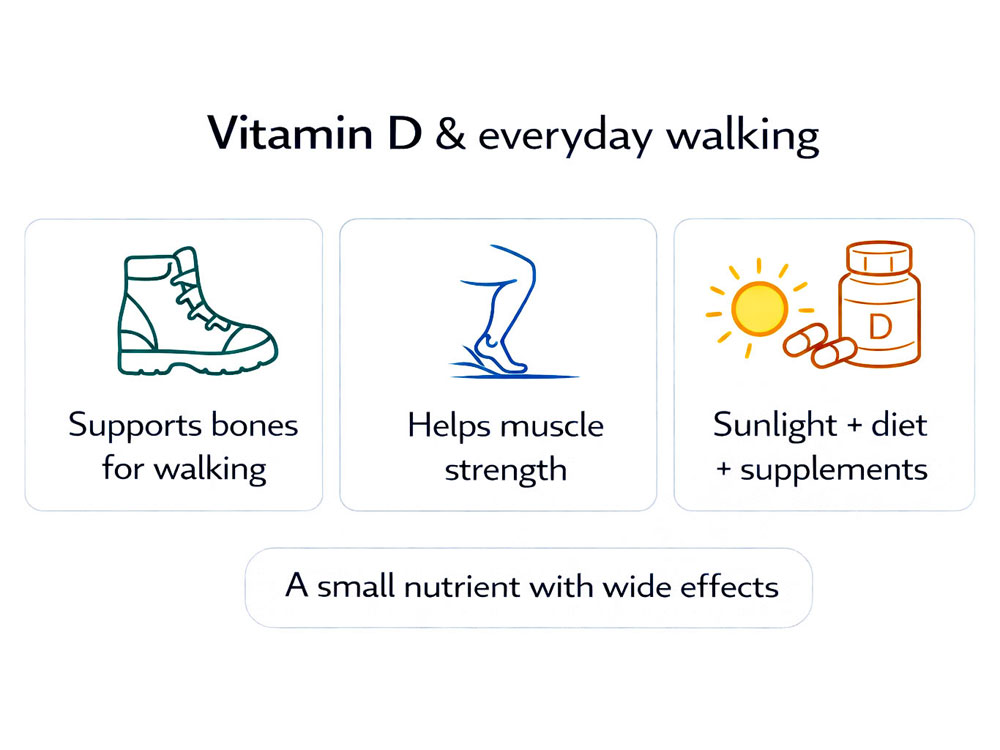
Vitamin D for walkers and hikers: Health benefits, deficiency, supplements, dose ranges and when 'more' isn't better
By: Andrew Forrest - January 2026
Vitamin D for walkers and hikers in the UK: benefits for bones, muscles and immunity, who's at risk, how much to take (400 IU - 4,000 IU), D2 vs D3, sunscreen effects, food sources and safety - plus a simple winter plan.
Table of contents
This page contains affiliate links. If you buy products or services via these links, we may earn a small commission at no cost to you. If you are thinking of buying, please use our links, as it helps support our website and YouTube channel.
Vitamin D is one of the few nutrients where your location really matters. It's often called the 'sunshine vitamin' because your body can make
it in the skin when UVB from sunlight hits it, and it then acts more like a hormone than a typical vitamin, helping regulate calcium and
phosphate for strong bones, teeth and normal muscle function. It's also studied for wider roles in immunity and wellbeing, which is why it comes
up so often in conversations about winter colds, energy and mood.
Health & Wellness Disclaimer
The information in this article is intended for general education and wellbeing and covers vitamin D, including sunlight, diet and supplement
use, potential benefits, dosing approaches, and safety considerations for generally healthy adults in the UK.
Vitamin D supplements are not suitable for everyone. If you have any medical conditions, especially kidney disease or reduced kidney function,
a history of kidney stones, high blood calcium, hyperparathyroidism, sarcoidosis or other granulomatous disease, liver disease, malabsorption
conditions (such as coeliac disease or inflammatory bowel disease), or any long-term condition, or if you are pregnant or breastfeeding, under
18, or taking prescription medicines (particularly those that affect calcium or vitamin D metabolism, such as thiazide diuretics, digoxin,
anticonvulsants, steroids, or weight-loss medicines like orlistat), you should speak to your GP, pharmacist, or another qualified healthcare
professional before starting vitamin D or changing your supplement routine. If you've been advised to limit calcium, certain supplements, or
fluids for medical reasons, do not start higher-dose vitamin D without professional advice.
This article does not provide medical advice and should not be used as a substitute for professional healthcare. Supplements are not
regulated in the same way as medicines in the UK, and product quality and dosing accuracy can vary between brands. Always follow the
manufacturer's directions, do not exceed recommended doses, and stop use and seek medical advice if you experience concerning symptoms. If you
develop urgent symptoms such as chest pain, a severe allergic reaction, confusion, fainting, severe vomiting, signs of significant dehydration,
or symptoms that could suggest dangerously high calcium (such as persistent nausea or vomiting, severe constipation, extreme thirst, frequent
urination, severe weakness, or new kidney pain), seek immediate medical attention by calling 999 or attending A&E.
Vitamin D for walkers and hikers
In the UK, sunlight isn't a reliable year-round source. Even if you walk most days, winter UVB is too weak for most people to make meaningful
vitamin D outdoors, and diet alone is often inadequate because only a handful of foods naturally contain significant vitamin D. That's why many
people use supplements as a practical 'gap filler', especially from autumn to spring.
The good news is that most people can cover the basics safely with a simple plan. UK guidance typically sits at 10 micrograms (400 IU) daily in
the darker months, while you'll see 1,000 - 2,000 IU is often used as a pragmatic middle ground internationally, and 4,000 IU/day discussed as an
upper limit rather than a target.
In this guide, we'll show you what the evidence actually supports, who's most at risk (including walkers), and how to choose a dose that's
sensible for your goals. So, whilst written with walkers and hikers in mind, this guide is for almost anyone.
Key takeaways on vitamin D
- Vitamin D supports bones, teeth and muscles by helping regulate calcium and phosphate. Low levels are linked to rickets (a childhood
condition in which growing bones don't harden properly) and osteomalacia (the softening of adult bones, which can cause bone pain and
weakness).[2] [37] [38]
- In England (2019 - 2023), low vitamin D status (<25 nmol/L) (nmol/L = nanomoles per litre, the unit UK labs use for blood vitamin D)
affected 18% of adults aged 19 - 64, 12% of adults aged 65+, and 23% of 11 - 18-year-olds. Winter is the hardest season: among people aged
11+, low status ranged from ~21 - 38% in Jan - Mar, falling to ~0 - 10% in Jul - Sep.[65]
- New UK evidence suggests that severe deficiency may be important for infections: in a UK study (≈36,000 adults), severe vitamin D
deficiency was associated with a higher risk of hospital admission for respiratory tract infections.[86]
- UK advice is typically 10 micrograms (mcg) / 400 IU per day (IU = 'international units', another way vitamin D dose is labelled; for
vitamin D, 1 mcg = 40 IU) in autumn and winter, and year-round for higher-risk groups.[66] [68] [69]
- The online debate often spans: 400 IU/day (UK baseline) → 1,000 - 2,000 IU/day (a common 'safe-for-most' range used internationally)
→ 4,000 IU/day (upper limit - the highest daily intake considered unlikely to cause harm for most adults) → occasional 5,000 IU/day
in podcast culture. The evidence doesn't support the claim that 'more is always better' for everyone.[66] [69] [70] [71] [73] [74]
- Some trials suggest that vitamin D supplementation may reduce the risk of influenza (one meta-analysis reported a 22% reduction), but
effects vary by population and dosage.[87]
- High-dose patterns have shown harm signals in some trials (e.g., large annual boluses (a very large dose taken infrequently, such as
monthly or yearly) increasing falls and fractures; very high daily doses reducing bone density).[26] [27] [28]
What vitamin D does in the body
Vitamin D acts more like a hormone (a chemical messenger that travels in the bloodstream and affects how tissues work) than a typical vitamin.
Its best-established role is in helping your body regulate calcium and phosphate, key minerals for bone structure and muscle function.[2] [3] [22]
When vitamin D levels are very low, the body can't mineralise bone properly (meaning it can't lay down minerals to make bone hard and strong):
- In children, this can contribute to rickets (bones don't mineralise properly during growth).[38]
- In adults, it can contribute to osteomalacia (soft bones), often accompanied by aches, pains, and weakness.[37]
Vitamin D also acts through vitamin D receptors (VDRs) (protein 'switches' in cells that respond to vitamin D signals and influence gene
activity) throughout the body. This helps explain why vitamin D is studied in many tissues beyond bone (including muscle and immune cells).[22]
Immune angle (why vitamin D is often discussed for colds/flu)
One proposed mechanism is that vitamin D signalling can influence antimicrobial peptides (natural infection-fighting proteins your body produces)
and components of innate immune defence.[90] [91]
Beyond bones, scientists have explored vitamin D's role in:
- Skeletal muscle performance and strength (effects are generally small and more likely in deficient groups).[35] [36]
- Benefits of immune function, including respiratory infections, benefits appear most consistent in people starting with lower levels and with
daily or weekly dosing rather than large boluses (very large doses taken infrequently).[39 ‑ 42]
- Longer-term outcomes, such as autoimmune disease, in which one large trial reported a reduction in incident diagnoses over time.[53] [54]
- 'Optimisation' endpoints and emerging markers (e.g., telomere attrition in a VITAL substudy (VITAL = the VITamin D and OmegA-3 TriaL; a large,
long-running randomised trial)). 'Telomere attrition' here refers to the shortening of the protective caps on chromosomes over time, often
discussed as a marker of cellular ageing.[57]
Walks4all takeaway
We see vitamin D as 'foundational': it's not a performance hack, but it can be the difference between feeling robust and feeling flat, creaky
or weak, especially when training load goes up, and winter light goes down. Walking can help with vitamin D intake, but in the UK winter, it
won't reliably 'solve' vitamin D on its own.
How common is low vitamin D in the UK?
England's National Diet and Nutrition Survey data (2019 - 2023) show that low vitamin D status is not uncommon, and winter is when it hits
hardest:
- Adults (19 - 64): 18% had low status (<25 nmol/L)
- Adults (65+): 12%
- Adolescents (11 - 18): 23%
- Seasonal swing: among ages 11+, low status reached ~21 - 38% in Jan - Mar and fell to ~0 - 10% in Jul - Sep[65]
A separate large UK Biobank analysis offers a helpful angle: 'severe' deficiency is concentrated in certain groups. Overall, profound deficiency
(<10 nmol/L, an extremely low blood level) was uncommon (~0.48%), but among Asian participants, it was much more common, with similarly
elevated rates of severe deficiency.
Importantly, this study found that ambient UVB (the amount of vitamin D-forming UVB light in the environment at your location and time of year)
was a powerful predictor of risk, and reported associations suggested that supplement use and oily fish intake were linked to markedly lower odds
of very low vitamin D status.[11]
A UK infection statistic that's hard to ignore
In a UK analysis of approximately 36,000 adults, those with severe vitamin D deficiency were more likely to be admitted to hospital for
a respiratory tract infection than those with sufficient vitamin D.[86]
This doesn't prove that vitamin D supplements prevent infections (it's observational), but it strengthens the case for correcting genuine
deficiency, particularly among
older walkers,
people with darker skin, and anyone prone to winter bugs.
Walks4all takeaway
This is the part that matters for walkers: being active outdoors helps, but it doesn't make you immune. If your walks are early or late,
you're covered up, you avoid the sun, you have darker skin, or it's winter, you can still be low. I like the idea of a 'seasonal check-in'
mindset: if you live at UK latitudes, assume vitamin D is a winter problem unless you've proven otherwise with a blood test.
Why winter walking doesn't guarantee vitamin D
Vitamin D production in the skin depends on UVB (the part of sunlight that triggers vitamin D production and is also responsible for sunburn),
not just daylight. Classic research shows that at higher latitudes, winter sunlight can be insufficient for vitamin D synthesis in the skin[1],
and UK guidance recognises that vitamin D production from sunlight is limited in autumn and winter.[66] [68]
Even in autumn, spring and summer, the amount of vitamin D you produce depends on:
- Skin type/pigmentation
- Amount of skin exposed
- Time of day (UVB peaks around midday)
- Weather, shade, clothing, sunscreen (a product applied to the skin to reduce the amount of ultraviolet light that gets through)
- Where you are in the UK (latitude)
UK-based modelling and fieldwork suggest that for darker skin types, exposure of the hands and face may be insufficient, and longer exposures
(with more skin area exposed) are required to achieve meaningful vitamin D levels.[7] Studies in UK South Asian adults found that recommended summer exposures were often insufficient to reach 'sufficient' status.[6]
Walks4all takeaway
If I want walking to support vitamin D, I consider timing and skin exposure, not just
steps.
A winter sunrise walk is fantastic for mood and routine, but it's not a vitamin D strategy. A short, safe midday walk in late spring, summer
or early autumn (without burning) is more relevant.
Signs of vitamin D deficiency: what it can feel like
Vitamin D deficiency can be silent. When symptoms do appear, they're often non-specific, including:
- Bone aches and pains
- Muscle weakness
- Low energy or feeling run down
- Increased risk of falls in older adults (in some contexts)[29 ‑ 34]
If you're concerned, the key test is a serum 25-hydroxyvitamin D (25(OH)D) level (the main blood marker used to estimate your overall vitamin
D status over the past several weeks).[65] [69]
A neutral clinical setting for a blood test can also help visualise what testing looks like.
Walks4all takeaway
If you've got unexplained aches, weakness, or recurring niggles, especially in winter, consider whether vitamin D is part of the picture. It's
one of the simplest things to check and address.
Vitamin D sources: sunlight, food, fortified foods
Sunlight
In the UK, sunlight-driven vitamin D is best thought of as a spring/summer bonus rather than a reliable year-round supply. Studies at UK
latitudes show that summer exposure can raise levels, but 'optimal' targets are harder to achieve for many people, particularly those with
darker skin pigmentation.[4 ‑ 8]
Food
Vitamin D is naturally present in only a few foods. Oily fish is the best-known source; eggs and meat contain smaller amounts.[65] [66]
Fortified foods
Some foods are fortified (for example, certain breakfast cereals and some plant milks), but fortification is inconsistent. In practice, many
people struggle to meet UK targets through diet alone.[65] [66]
Mushrooms: a genuinely useful 'food hack' (with a caveat)
Mushrooms contain ergosterol, which converts to vitamin D2 when exposed to UV light. Controlled studies show that UV exposure can substantially
increase vitamin D2 levels in mushrooms.[101] [102] [103]
In real life, 'windowsill mushrooms' can be a helpful trick, especially for plant-based diets - but results will vary with the season, UV
intensity, and exposure time.
Walks4all takeaway
Food-first is ideal, but vitamin D is one of those nutrients where diet alone often isn't realistic, especially in winter. Mushrooms are a
useful addition, but I'd treat them as a bonus, not your whole plan.
Does sunscreen stop you from making vitamin D?
We want safe sun exposure (burning is never worth it), but vitamin D is synthesised in the skin.
The mechanism: Yes, sunscreen can block UVB
UVB (the vitamin D-producing part of sunlight) is also the part most responsible for sunburn. Sunscreen reduces the amount of UV radiation
that reaches the skin. In a classic experiment, sunscreen (SPF 8) greatly reduced cutaneous vitamin D3 production after UV exposure.[75] [77]
But the 'SPF number' is measured under lab conditions, and most of us don't replicate
SPF (sun protection factor - a laboratory measure of how well a sunscreen reduces UVB-driven sunburn when applied thickly and evenly) is tested
at 2 mg/cm2 (a very generous layer; most people apply much less in practice). Reviews and application studies suggest that people
typically apply it well below that level, which means the true UV-blocking performance is often lower than the label implies.[83] [84] [85]
What real-world studies have found
For years, reviews have noted that, in real-world use, sunscreen doesn't consistently prevent vitamin D deficiency at the population level.[78] [79] A randomised trial in Australia found that regular sunscreen use did not meaningfully reduce vitamin D status over the study period.[76] A 'sun holiday' study found that proper sunscreen use prevented sunburn while still allowing vitamin D levels to rise.[80]
In a more recent 2025 test, the open-label Sun-D Trial (open-label means participants knew which group they were in; randomised means assignment
was by chance) compared routine SPF50+ sunscreen use on days when the UV Index (a forecast scale of sunburn risk; higher = more intense UV) was
predicted to reach ≥3 with discretionary use.
The routine SPF50+ group had lower 25(OH)D levels than the discretionary group, suggesting that consistent 'daily high-SPF' behaviour can reduce
vitamin D levels in some real-world settings and that some people may need supplementation.[81] A 2025 systematic review and meta-analysis also supports the view that sunscreen can impair vitamin D3 synthesis and may be associated with lower
25(OH)D.[82]
Vitamin D and skin health
Vitamin D biology matters in the skin itself: skin cells have the machinery to produce and respond to active vitamin D, and vitamin D signalling
plays a role in skin barrier and keratinocyte function.[104] Research also links vitamin D receptor signalling to skin lipid production, which is involved in barrier integrity.[105]
This means that your skin doesn't just make vitamin D from sunlight; it can also use vitamin D locally as a working ingredient. Skin cells can
convert vitamin D into its active form and respond to it, which helps the skin behave normally.
That vitamin D 'signal' helps skin cells grow and mature properly and supports the skin's protective outer barrier (the layer that helps keep
moisture in and irritants and germs out). It also influences the skin's production of natural oils and fats (lipids) that act as the skin's
'mortar', helping keep the barrier strong and less leaky.
Walks4all takeaway
For walkers and others, I don't think this is an either-or. Skin cancer is real, and burning is never worth it. My approach is: protect your
skin from burning first, then treat vitamin D as a separate, solvable nutritional issue (baseline UK dosing in winter, and testing whether you
need to go higher or are at high risk). If you're religious about using high-SPF daily sunscreen, cover up most of the time, avoid midday sun,
or all of the above, your vitamin D levels might be lower, so plan accordingly.
Vitamin D Supplements: what type, what form, and how to take them
Vitamin D2 or D3?
Vitamin D supplements are mainly available as:
- D3 (cholecalciferol) - the form your skin makes; commonly found in supplements, traditionally animal-derived, though vegan lichen-derived D3 also exists
- D2 (ergocalciferol) - a plant/fungal form of vitamin D used in some supplements
A meta-analysis (a statistical method that combines results from multiple studies) found that D3 generally raises 25(OH)D more effectively than
D2, though both can be effective.[14]
Tablet, capsule, drops... or spray?
If pills don't suit you, sprays and drops are alternatives.
Evidence suggests:
- Oral spray vitamin D can be as effective as capsules in improving vitamin D status in adults.[18]
- A crossover study also compared buccal spray (absorbed via the lining of the mouth or cheek) with a capsule in healthy participants and those
with malabsorption (when the gut doesn't absorb nutrients properly).[19]
- A 2020 systematic review and meta-analysis (a structured search and summary of all relevant studies on a topic) examined buccal spray
delivery overall.[20]
Take vitamin D with food (ideally with fat)
Vitamin D is fat-soluble (meaning it can be stored in the body rather than being excreted quickly in urine). Studies show that vitamin D
is better absorbed when it is taken with a meal, and that a meal containing fat can increase absorption compared with a fat-free meal.[15] [16] [17]
A simple breakfast example can make this practical:
What about taking vitamin D late in the day - can it affect sleep?
I have read that taking vitamin D late in the day can disturb sleep. However, the evidence is inconclusive. A meta-analysis suggests that
vitamin D supplementation may improve some sleep outcomes in some contexts, but trials vary widely.[98]
A randomised controlled trial in people with low vitamin D did not show improvements in sleep outcomes after supplementation.[99] Observational work also links lower vitamin D with greater sleep variability (how consistent your sleep timing and duration are), but this
doesn't prove that supplementation fixes it.[100]
Walks4all takeaway
Take Vitamin D3 with breakfast or lunch, and choose a format you'll actually stick to. The best supplement is the one you remember. If you
notice sleep disruption, try taking it earlier in the day. Consistency and taking it with food matter more than chasing a perfect dosing
schedule.
How much vitamin D should you take?
Here's the ranges you'll typically see:
The UK baseline: 400 IU/day (10 mcg/day)
UK guidance commonly recommends 10 mcg (400 IU) daily in autumn and winter for most people, with year-round supplementation for higher-risk
groups.[66] [68]
The 'safe for most' international middle: 1,000 - 2,000 IU/day (25 - 50 mcg/day)
Many countries and clinicians use 1,000-2,000 IU/day as a pragmatic dose range for adults, particularly when sunlight exposure is limited and
dietary intake is low.[65] [69] [71]
The upper limit: 4,000 IU/day (100 mcg/day)
This number matters. It appears repeatedly as a tolerable upper intake level (the highest daily intake unlikely to cause harm for most people,
but not a 'target') across multiple guidance sources.[66] [69] [70]
The podcast/biohacker voice: 5,000 IU/day (125 mcg/day)
Some longevity/performance voices advocate higher intakes, often framed in terms of achieving higher blood levels rather than meeting a minimum
requirement. For example, Dr Peter Attia has written about a practice approach in which they either don't supplement if levels are adequate or
use 5,000 IU/day if supplementation is warranted.[73] Huberman Lab's public Q&A content also discusses higher-dose approaches while emphasising individual variability and testing.[74]
Why the debate exists
People are arguing about different goals:
- Goal A: prevent deficiency diseases (rickets/osteomalacia). This is a public health minimum, often defined as keeping most people above a
low threshold.[37] [38] [68]
- Goal B: optimise biomarkers (measurable markers in blood or tests that reflect what's happening in the body - here, usually 25(OH)D levels).
This is where many podcasts land - sometimes targeting ranges more typical of sunnier climates.
- Goal C: prevent chronic disease (cancer, cardiovascular disease (CVD - conditions affecting the heart and blood vessels, including heart
attack and stroke), diabetes, and depression). This is the hardest goal because trials are inconclusive, baseline levels vary, and endpoints
differ.[21] [22] [44 ‑ 56]
Walks4all takeaway
I'm not anti-higher-dose in principle, but I am anti-guessing. If you're taking more than the baseline UK dose because you want 'optimal', I
think that should trigger a different approach: test, dose, re-test, ideally with clinician input. The evidence clearly shows that some
high-dose strategies backfire. After listening to various 'experts' on podcasts, I tried 4,000 IUs for quite a while, but after reading more
studies, I've reduced my intake back down to 2,000 IUs. I haven't really noticed any difference in taking less, and I'm happy with my blood
markers.
Health benefits of vitamin D
Bones and fractures
The most consistent story is:
- Vitamin D plus calcium can reduce fractures in some older, higher-risk groups (especially when the baseline intake or status is low).[23] [24]
- In generally healthy populations, large trials have often found no meaningful reduction in fracture risk with vitamin D alone.[21] [22] [29]
So, vitamin D alone is often neutral for fracture prevention in broad populations, but vitamin D plus calcium can show modest benefits in some
analyses. One meta-analysis reported a 16% reduction in hip fracture risk with combined supplementation across relevant trials.[88]
Muscle and falls
This is where the dosing strategy can matter:
- Some evidence suggests that vitamin D may modestly improve muscle function, particularly in those with a deficiency.[35] [36]
- A meta-analysis of older adults found that daily vitamin D supplementation (often 800-1,000 IU/day) was associated with beneficial effects
on strength and balance, particularly when the baseline vitamin D status was low.[89]
- A meta-analysis in healthy younger adults reported that supplementation improved upper- and lower-limb strength compared with controls
(effects can depend on baseline).[92]
- Falls data are inconclusive. A 2026 Finnish trial of daily vitamin D supplementation did not show the large protective effect many people
hope for.[33]
- Meta-analyses vary according to inclusion criteria, baseline status, and dose patterns.[31] [32]
- Importantly, very large bolus strategies have raised safety concerns.[26] [27] A large bolus is a single, one-off dose taken all at once, rather than smaller amounts spread over time. For vitamin D, this usually means a
very high monthly or yearly dose (e.g., a single mega-dose capsule), rather than a daily supplement.
Respiratory infections (colds, flu, Covid)
This is one of the more nuanced areas:
- Earlier meta-analyses found that vitamin D supplementation was associated with a small reduction in acute respiratory infections (ARIs)
(short-term infections such as colds, flu-like illness, and similar respiratory infections), with stronger signals in certain dosing patterns
and populations.[39] [40]
- Updated analyses incorporating newer trials have reported a weaker and less consistent overall effect.[41]
- In CORONAVIT (a UK trial testing a 'test-and-treat' vitamin D strategy in adults), a test-and-treat approach was not associated with a
reduction in the risk of ARI/COVID.[42]
Influenza-specific evidence: A systematic review and meta-analysis of randomised trials found that vitamin D supplementation was associated with
a reduced risk of influenza (a 22% lower risk in the pooled results).[87]
UK observational data: In UK adults, severe deficiency was associated with a higher risk of hospital admission for respiratory tract
infections.[86]
Mechanistic plausibility: Vitamin D signalling can influence antimicrobial peptide pathways and aspects of innate immune defence (one reason it
is continually studied in infection contexts).[90] [91] So, Vitamin D may help your body's first-line immune system by switching on natural germ-fighting proteins and supporting the early
'rapid response' defences that help you deal with infections.
Mood and cognition
Vitamin D is discussed for mood and cognition for two main reasons:
- Mechanism: Vitamin D receptors and metabolism are present in brain tissue, and vitamin D signalling may influence neurodevelopment and
neurotransmitter pathways, including serotonin regulation, as suggested by experimental work.[93] [94] [95]
- Observational links: low vitamin D is associated with a higher risk of cognitive impairment or dementia in some cohorts and meta-analyses,
but these associations do not prove that prevention is effective.[96] [97]
Clinical trials of depression and cognition are mixed and often neutral in broad populations: large ancillary analyses have generally not shown
dramatic effects of supplementation across the board.[55 ‑ 58]
Emerging angles in relation to vitamin D
A VITAL substudy reported that 2,000 IU/day of vitamin D3 over 4 years was associated with less telomere attrition (slower telomere shortening,
a marker often linked to cellular ageing). This is interesting, but not a reason to megadose - more replication is needed.[57]
Walks4all takeaway
Vitamin D looks most helpful when it's correcting a shortfall, not when it's pushing already-adequate people higher and higher. Walking is the
same: the biggest gains come from moving people from 'inactive' to 'active', not from obsessing over tiny marginal tweaks. On mood and brain
health: 'low vitamin D isn't good', but claims that supplements prevent dementia cannot be substantiated until trials prove it.
Can you take too much vitamin D? Yes - and the risk isn't theoretical
Vitamin D is fat-soluble (stored rather than quickly excreted). Over time, excessive intake can raise calcium levels (hypercalcaemia), which can
cause serious harm.
Key safety signals in the literature include:
- Annual very high-dose vitamin D increased the risk of falls and fractures in older women in a major RCT (a randomised controlled trial in
which people are randomly assigned to receive a treatment or a placebo/control).[26]
- Monthly high-dose regimens have raised concerns in some trials.[27]
- A high-dose daily trial (including 10,000 IU/day) showed lower bone density over time than lower-dose groups.[28]
- Meta-analyses report an increased risk of hypercalcaemia (too much calcium in the blood) and hypercalciuria (too much calcium excreted in
urine) with supplementation in some contexts.[59]
- Reviews warn that toxicity cases may rise as supplement use increases, particularly with high-dose products.[60]
Walks4all takeaway
Don't take high-dose vitamin D on autopilot. Unlike vitamin C, vitamin D is fat-soluble, and can accumulate in the body over time. If you're
regularly taking larger doses (especially above 4,000 IU/day), treat it like any other strong intervention: have a clear reason, consider a
blood test, and involve a clinician if you're using it long-term.
Why vitamin D research can look contradictory (and why supplements are harder to 'prove' than drugs)
A major reason vitamin D headlines sometimes differ is that nutrient trials face design challenges that drug trials don't.
With a new drug:
- Most participants start with (effectively) no exposure to the drug.
- A placebo group can be kept close to zero.
- You're testing a clear 'on' vs 'off'.
With vitamin D:
- Everyone starts with a baseline level from the sun, food, and prior supplements.
- People's baseline levels vary widely by season, skin type, age, body fat, and lifestyle.[1] [7] [11] [12] [13]
- The relationship between vitamin D status and outcomes often follows a threshold curve (meaning benefits are greatest below a certain level;
above that, more vitamin D may add little): if you're already on the 'good enough' part of the curve, adding more may do little.[61] [62]
- Placebo contamination (people assigned to a placebo continuing to take vitamin D on their own outside the trial) is common, making it harder
to detect real effects.[61] [73]
- Trials can be underpowered if they don't account for baseline status and expected effect sizes.[64]
Researchers such as Heaney have argued that many vitamin D RCTs historically paid too little attention to baseline status and dose response - treating
a nutrient like a drug, which can bias results toward 'no effect'.[61] [62] [63]
Walks4all takeaway
This is why we shouldn't overreact to a single study. As I do when looking at walking studies, we need to look for patterns across trial design,
baseline status, and dose. If a trial gives vitamin D to a population that's already mostly sufficient, it's not surprising that the result is
neutral. The question isn't 'does vitamin D work?', it's 'for whom, at what baseline, at what dose, for which outcome?'
A walker's protocol for vitamin D (UK-focused)
This is a practical approach that respects public health guidance while recognising that many walkers read beyond it.
Step 1: Start with the UK baseline (especially October - March)
Consider 10 mcg (400 IU) daily in autumn and winter, in line with UK guidance.[66] [68]
Step 2: Go year-round if you're at higher risk
Year-round supplementation is commonly advised or considered if you:
- Have darker skin pigmentation (need more UVB exposure to make vitamin D)[6] [7] [11]
- Cover most skin for cultural/religious reasons[66]
- Are housebound or mostly indoors[66]
- Have obesity (lower circulating vitamin D status is common)[12] [13]
- Have malabsorption issues (your gut doesn't absorb nutrients properly)[19]
Step 3: If you're considering 'higher for optimal', test - don't guess
If you're thinking in the 1,000-2,000 IU/day range (or higher), I'd treat that as a separate pathway:
- Get a baseline 25(OH)D blood test (the standard blood marker for vitamin D status)
- Make a plan with a clinician where appropriate
- Re-test after a reasonable period and adjust
This is the range I currently take and monitor when I have blood tests done. On my n=1 test, this works best for me.
Step 4: Avoid high-dose boluses unless prescribed
Given the fall/fracture signals observed in some very high-dose bolus trials, I'd be cautious about 'one giant dose a month' approaches unless
you have been medically advised.[26] [27]
Step 5: Nail the basics that make supplements work better
- Take vitamin D with a meal, ideally one containing some fat.[15] [16] [17]
- Pick a form you'll stick to (tablet, drop, or spray).[18] [19] [20]
Walks4all takeaway
Walking is the daily habit that keeps you healthy; vitamin D is the seasonal 'maintenance' that prevents winter from quietly undermining you.
My default is simple: follow the baseline guidance, and if you want to play at the 'optimal' end, measure rather than guess.
Frequently Asked Questions (FAQs) about vitamin D
When should I take vitamin D, in the morning or at night?
What matters most is consistency. Because vitamin D is fat-soluble, taking it with a meal containing some fat is likely to improve
absorption, so breakfast or lunch is often practical.[15] [16] [17]
Should walkers take vitamin D all year?
Many walkers do well with seasonal supplementation (especially October-March), but higher-risk groups may need it year-round. If you
have darker skin, spend most of your time covered, are mostly indoors, or consistently use a high-SPF daily sunscreen, year-round
supplementation may be sensible, ideally guided by a blood test.[66] [68] [81]
Can I get vitamin D through a window?
No meaningful amount. Ordinary window glass blocks most UVB (the part of sunlight that helps produce vitamin D). The time you spend
walking outside matters far more for vitamin D than sitting in a sunny room.[3]
Does sunscreen stop vitamin D production?
It can reduce it, especially when applied thickly and regularly. In real-life settings, it often doesn't cause a major deficiency on its
own, but recent evidence suggests that routine daily use of high-SPF sunscreen can lower vitamin D levels in some people, so
supplementation may be a safer option than skipping sunscreen.[75] [78 ‑ 83]
How long do I need to be in the sun for vitamin D in the UK?
It depends on the season, time of day, skin type, and the amount of skin exposed. In the UK during winter, sunlight is generally not
strong enough to support reliable vitamin D production. In late spring and summer, short, safe midday exposure can help, but the exact
'minutes' vary widely from person to person.[1] [4 ‑ 8] [66]
Is D3 better than D2?
D3 usually raises 25(OH)D more effectively in trials, but D2 can still work. Vegan D3 (lichen-derived) is an option if you avoid animal
products.[14]
Should I take vitamin D with food?
Yes, if you can. Taking vitamin D with a meal, especially one containing some fat, generally improves absorption.[15] [16] [17]
Is 4,000 IU/day vitamin D safe?
4,000 IU/day (100 mcg/day) is widely cited as an upper limit for most adults, not a recommended target. If you're routinely taking this
level (or more), it's sensible to test, re-test, and seek clinician input, as 'more' isn't necessarily better.[66] [69] [70]
What are the signs I might be low in vitamin D?
It can be symptom-free. When symptoms do appear, they can include bone aches, muscle weakness, low energy, and a general sense of being
run down. If you're unsure, a 25(OH)D blood test is the most reliable way to assess your vitamin D status.[37] [65] [69]
Can too much vitamin D be harmful?
Yes. High or prolonged dosing can raise blood calcium (hypercalcaemia) or urinary calcium (hypercalciuria), and some high-dose trial
patterns have been associated with increased falls and fractures or reduced bone density.[26] [27] [28] [59] [60]
Can vitamin D help prevent the flu specifically?
Some trial evidence suggests that vitamin D supplementation may modestly reduce the risk of influenza, but results vary, and it's not a
substitute for vaccination or for basics such as sleep and hand hygiene.[87]
Do mushrooms really provide vitamin D?
Yes, UV exposure can increase vitamin D2 in mushrooms. A 'windowsill' approach can help, but the amount depends on UV intensity, exposure
time, and mushroom type.[101] [102] [103]
Does vitamin D affect sleep?
The evidence is inconclusive. Some studies suggest links between vitamin D status and sleep quality and regularity, but trials don't
consistently show that supplementation improves sleep for everyone.[98] [99] [100]
References on vitamin D
- Webb AR, Kline L, Holick MF (1988) - Influence of season and latitude on the cutaneous synthesis of vitamin D3. What the study shows: Demonstrates that winter UVB at higher latitudes can be insufficient for meaningful skin vitamin D production. https://pubmed.ncbi.nlm.nih.gov/2839537/
- Holick MF (2007) - Vitamin D deficiency. What the study shows: Clinical overview of deficiency, consequences (including rickets/osteomalacia) and prevention. https://pubmed.ncbi.nlm.nih.gov/17634462/
- Wacker M, Holick MF (2013) - Sunlight and Vitamin D: a global perspective for health. What the study shows: Reviews sunlight-driven vitamin D biology and why deficiency is common worldwide. https://pmc.ncbi.nlm.nih.gov/articles/PMC3897598/
- Kift R, Rhodes LE, Farrar MD, Webb AR (2018) - Is Sunlight Exposure Enough to Avoid Wintertime Vitamin D Deficiency in United Kingdom Population Groups? What the study shows: UK-latitude modelling suggesting some groups remain at risk of winter deficiency and may need oral intake support. https://pubmed.ncbi.nlm.nih.gov/30071636/
- Rhodes LE, Webb AR, Fraser HI, et al. (2010) - Recommended summer sunlight exposure levels can produce sufficient but not 'optimal' 25(OH)D at UK latitudes. What the study shows: Summer exposure can raise vitamin D, but reaching higher targets is harder for many. https://pubmed.ncbi.nlm.nih.gov/20072137/
- Farrar MD, Kift R, Felton SJ, et al. (2011) - Sun exposure and vitamin D status in UK adults of South Asian origin. What the study shows: Summer exposure guidance may be insufficient for many South Asian adults to reach common sufficiency thresholds. https://pubmed.ncbi.nlm.nih.gov/21918215/
- Webb AR, Kazantzidis A, Kift RC, et al. (2018) - Sunlight and skin type as drivers of vitamin D deficiency at UK latitudes. What the study shows: Darker skin types require longer/larger exposures at UK latitudes to achieve similar vitamin D status. https://www.mdpi.com/2072-6643/10/4/457
- Webb AR, Kazantzidis A, Kift RC, et al. (2018) - Meeting vitamin D requirements in White Caucasians at UK latitudes: providing a choice. What the study shows: Estimates time outdoors and/or oral intake needed for year-round adequacy at UK latitudes. https://pubmed.ncbi.nlm.nih.gov/29673142/
- Oskarsson V, et al. (2021) - Influence of geographical latitude on vitamin D status. What the study shows: Reviews how latitude relates to population vitamin D status and seasonal variation. https://pmc.ncbi.nlm.nih.gov/articles/PMC9661368/
- Kimlin MG (2007) - Location and vitamin D synthesis validated by UV measurements. What the study shows: UV measurements validate how geography influences vitamin D production potential. https://pubmed.ncbi.nlm.nih.gov/17142054/
- UK Biobank publication (2025) - Prevalence and determinants of profound vitamin D deficiency (25(OH)D <10 nmol/L) in the UK Biobank. What the study shows: Profound deficiency patterns by group and strong links to ambient UVB, supplementation and diet. https://www.ukbiobank.ac.uk/publications/prevalence-and-determinants-of-profound-vitamin-d-deficiency-25-hydroxyvitamin-d-10-nmol-l-in-the-uk-biobank-and-potential-implications-for-disease-association-studies/
- Wortsman J, et al. (2000) - Decreased bioavailability of vitamin D in obesity. What the study shows: Obesity is linked with lower circulating vitamin D due to reduced bioavailability. https://pubmed.ncbi.nlm.nih.gov/10966885/
- Drincic AT, et al. (2012) - Volumetric dilution explains lower vitamin D status in obesity. What the study shows: Suggests dilution effects contribute to lower measured vitamin D in obesity. https://pubmed.ncbi.nlm.nih.gov/22262154/
- Tripkovic L, et al. (2012) - Comparison of vitamin D2 and vitamin D3 supplementation in raising 25(OH)D: systematic review and meta-analysis. What the study shows: D3 generally raises 25(OH)D more than D2. https://pubmed.ncbi.nlm.nih.gov/22552031/
- Mulligan GB, Licata A (2010) - Taking vitamin D with the largest meal improves absorption. What the study shows: Taking vitamin D with a main meal improved achieved blood levels. https://pubmed.ncbi.nlm.nih.gov/20200983/
- Dawson-Hughes B, et al. (2015) - Dietary fat increases vitamin D3 absorption. What the study shows: Vitamin D absorption is higher with fat-containing meals. https://pubmed.ncbi.nlm.nih.gov/25441954/
- Silva MC, Furlanetto TW (2018) - Intestinal absorption of vitamin D: a systematic review. What the study shows: Summarises factors influencing vitamin D absorption in the gut. https://pubmed.ncbi.nlm.nih.gov/29025082/
- Todd JJ, McSorley EM, Pourshahidi LK, et al. (2016) - Vitamin D3 supplementation using an oral spray solution resolves deficiency. What the study shows: Oral spray delivery can raise vitamin D status similarly to other oral forms when dosed appropriately. https://pubmed.ncbi.nlm.nih.gov/27015912/
- Satia MC, et al. (2015) - Buccal spray vs capsule vitamin D3: randomised crossover (including malabsorption). What the study shows: Buccal delivery can raise vitamin D; includes data relevant to malabsorption. https://nutritionj.biomedcentral.com/articles/10.1186/s12937-015-0105-1
- Grammatikopoulou MG, et al. (2020) - Efficacy of vitamin D3 buccal spray supplementation: systematic review and meta-analysis. What the study shows: Summarises evidence that buccal sprays can improve vitamin D status. https://pubmed.ncbi.nlm.nih.gov/31936098/
- Bolland MJ, Grey A, Avenell A (2018) - Vitamin D supplements and musculoskeletal health: systematic review and meta-analysis. What the study shows: In broad populations, evidence does not strongly support vitamin D supplements for musculoskeletal outcomes. https://pubmed.ncbi.nlm.nih.gov/30293909/
- Bouillon R, et al. (2022) - Vitamin D supplementation and health outcomes: evidence synthesis. What the study shows: High-level review of human evidence across outcomes, highlighting where benefits are and are not supported. https://www.nature.com/articles/s41574-021-00593-z
- Chapuy MC, et al. (1992) - Vitamin D3 and calcium to prevent hip fractures in elderly women. What the study shows: Vitamin D plus calcium reduced hip fracture risk in older institutionalised women. https://pubmed.ncbi.nlm.nih.gov/1350979/
- Weaver CM, et al. (2016) - Calcium plus vitamin D supplementation and fracture risk: meta-analysis. What the study shows: Combined supplementation can reduce fractures in certain higher-risk groups. https://pmc.ncbi.nlm.nih.gov/articles/PMC4715837/
- Trivedi DP, et al. (2003) - Four-monthly oral vitamin D3 supplementation and fractures/mortality: RCT. What the study shows: Intermittent dosing affected fracture and mortality outcomes in an older population. https://pubmed.ncbi.nlm.nih.gov/12609940/
- Sanders KM, et al. (2010) - Annual high-dose vitamin D and falls/fractures: RCT. What the study shows: Very high annual bolus dosing increased falls and fractures in older women. https://pubmed.ncbi.nlm.nih.gov/20460620/
- Bischoff-Ferrari HA, et al. (2016) - Monthly high-dose vitamin D and falls/functional outcomes: RCT. What the study shows: High monthly doses did not deliver the hoped-for benefits and raised safety concerns in some analyses. https://pubmed.ncbi.nlm.nih.gov/26747333/
- Burt LA, et al. (2019) - High-dose vitamin D and bone density/strength: RCT. What the study shows: Very high daily dosing reduced bone density compared with lower doses. https://pubmed.ncbi.nlm.nih.gov/31454046/
- LeBoff MS, et al. (2022) - Vitamin D supplementation and incident fractures (VITAL). What the study shows: Large trial found no significant fracture reduction with vitamin D in generally healthy adults. https://pubmed.ncbi.nlm.nih.gov/36262619/
- Appel LJ, et al. (2021) - STURDY: four doses of vitamin D3 and falls in older adults. What the study shows: Higher doses were not clearly superior for fall prevention. https://pubmed.ncbi.nlm.nih.gov/33284677/
- Wei D, et al. (2022) - Vitamin D supplementation and falls: systematic review/meta-analysis. What the study shows: Pooled evidence varies by baseline status and dosing patterns. https://pmc.ncbi.nlm.nih.gov/articles/PMC9399608/
- Torres-Lopez E, et al. (2025) - Vitamin D supplementation and fall risk: meta-analysis. What the study shows: Updated pooled evidence on falls with attention to dosing strategies. https://pubmed.ncbi.nlm.nih.gov/40943885/
- Rikkonen T, et al. (2026) - Finnish Vitamin D Trial: daily vitamin D3 supplementation and falls. What the study shows: Daily supplementation did not produce a large protective effect on falls in the overall trial population. https://pubmed.ncbi.nlm.nih.gov/41531181/
- Dawson-Hughes B, Rosen CJ (2025) - Vitamin D supplementation and falls/fractures: review. What the study shows: Summarises why many modern trials show neutral effects in broadly sufficient populations and discusses dosing nuances. https://pubmed.ncbi.nlm.nih.gov/39100895/
- Beaudart C, et al. (2014) - Vitamin D supplementation and muscle function: meta-analysis of RCTs. What the study shows: Small benefits may occur, especially in deficient groups; overall effects modest. https://pubmed.ncbi.nlm.nih.gov/25247305/
- Stockton KA, et al. (2011) - Vitamin D supplementation and muscle strength: systematic review/meta-analysis. What the study shows: Stronger effects in deficient participants; neutral in many replete adults. https://pubmed.ncbi.nlm.nih.gov/20924748/
- Minisola S, et al. (2020) - Osteomalacia and vitamin D status: clinical update. What the study shows: Diagnosis and management overview of osteomalacia and vitamin D's role. https://pmc.ncbi.nlm.nih.gov/articles/PMC7839817/
- Rios-Leyvraz M, et al. (2024) - 25(OH)D thresholds and rickets risk: systematic review and IPD meta-analysis. What the study shows: Defines vitamin D thresholds associated with nutritional rickets risk in children. https://pubmed.ncbi.nlm.nih.gov/38280944/
- Martineau AR, et al. (2017) - Vitamin D supplementation to prevent acute respiratory tract infections: IPD meta-analysis. What the study shows: Modest protective effect, stronger in low baseline and daily/weekly dosing patterns. https://pubmed.ncbi.nlm.nih.gov/28202713/
- Jolliffe DA, et al. (2021) - Vitamin D supplementation to prevent acute respiratory infections: updated evidence synthesis. What the study shows: Effects vary and depend on trial selection and dosing schedules. https://pubmed.ncbi.nlm.nih.gov/33798465/
- Jolliffe DA, et al. (2025) - Updated meta-analysis on vitamin D and acute respiratory infections. What the study shows: Incorporating newer trials, overall effect appears weaker/less consistent. https://pubmed.ncbi.nlm.nih.gov/39993397/
- Jolliffe DA, et al. (2022) - CORONAVIT trial: test-and-treat vitamin D and ARI/COVID outcomes. What the study shows: Test-and-treat strategy did not reduce ARI/COVID outcomes in the trial population. https://www.bmj.com/content/378/bmj-2022-071230
- Murai IH, et al. (2021) - Single high-dose vitamin D3 in hospitalised COVID-19: RCT. What the study shows: Single high-dose vitamin D did not improve key hospital outcomes. https://pubmed.ncbi.nlm.nih.gov/33595634/
- Manson JE, et al. (2019) - Vitamin D supplements and prevention of cancer/CVD (VITAL). What the study shows: No significant reduction in major CVD events or cancer incidence overall. https://pubmed.ncbi.nlm.nih.gov/31733345/
- Scragg R, et al. (2017) - Monthly high-dose vitamin D and cardiovascular disease (ViDA): RCT. What the study shows: Monthly high-dose vitamin D did not reduce cardiovascular events. https://pubmed.ncbi.nlm.nih.gov/28384800/
- Barbarawi M, et al. (2019) - Vitamin D supplementation and cardiovascular outcomes: meta-analysis. What the study shows: Pooled trial data shows little/no CVD benefit in many populations. https://pubmed.ncbi.nlm.nih.gov/31215980/
- Chowdhury R, et al. (2014) - Vitamin D supplementation and mortality: meta-analysis. What the study shows: Suggested small reductions in all-cause mortality in some analyses; effects vary by formulation/dose. https://pubmed.ncbi.nlm.nih.gov/24690623/
- Keum N, et al. (2019) - Vitamin D supplementation and cancer incidence/mortality: meta-analysis. What the study shows: Generally neutral for incidence; possible reduction in cancer mortality in some analyses. https://pubmed.ncbi.nlm.nih.gov/30796437/
- Kuznia S, et al. (2023) - Vitamin D3 supplementation and cancer mortality: systematic review and IPD meta-analysis. What the study shows: Individual participant data suggests potential reduction in cancer mortality in some settings. https://pmc.ncbi.nlm.nih.gov/articles/PMC10214278/
- Vaughan-Shaw PG, et al. (2020) - Vitamin D supplementation and colorectal cancer survival: meta-analysis. What the study shows: Suggests vitamin D may be associated with improved survival in colorectal cancer contexts; research ongoing. https://pubmed.ncbi.nlm.nih.gov/32929196/
- Virtanen JK, et al. (2022) - Finnish Vitamin D Trial: vitamin D and prevention of CVD/cancer. What the study shows: Large RCT testing higher-dose vitamin D; main outcomes largely neutral. https://pmc.ncbi.nlm.nih.gov/articles/PMC9071497/
- Pittas AG, et al. (2019) - Vitamin D (4000 IU/day) and prevention of type 2 diabetes (D2d): RCT. What the study shows: Overall effects modest/neutral; not a universal diabetes prevention solution. https://pubmed.ncbi.nlm.nih.gov/31173613/
- Hahn J, et al. (2022) - Vitamin D and omega-3 supplementation and incident autoimmune disease (VITAL): RCT. What the study shows: Reported reduced incident autoimmune disease diagnoses over time. https://pubmed.ncbi.nlm.nih.gov/35082139/
- Costenbader KH, et al. (2024) - Autoimmune outcomes after VITAL supplementation: follow-up. What the study shows: Follow-up analysis exploring persistence and timing of autoimmune findings. https://pubmed.ncbi.nlm.nih.gov/38272846/
- Okereke OI, et al. (2020) - Long-term vitamin D3 and depression risk (VITAL-DEP). What the study shows: Large ancillary analysis generally neutral for depression prevention overall. https://pmc.ncbi.nlm.nih.gov/articles/PMC7403921/
- Kang JH, et al. (2021) - Vitamin D and cognitive outcomes: VITAL ancillary study. What the study shows: Cognitive outcomes largely neutral in broad populations studied. https://www.nature.com/articles/s41598-021-02485-8
- Zhu H, et al. (2025) - Vitamin D3 and leukocyte telomere length: 4-year VITAL findings. What the study shows: Reported less telomere attrition with 2,000 IU/day over 4 years in a substudy. https://pubmed.ncbi.nlm.nih.gov/40409468/
- Tan L, et al. (2025) - Vitamin D supplementation and cognition in older adults with hypertension/mild cognitive deficits. What the study shows: Population-specific trial; outcomes may not generalise broadly. https://pmc.ncbi.nlm.nih.gov/articles/PMC12234330/
- Malihi Z, et al. (2016) - Vitamin D supplementation and hypercalcaemia/hypercalciuria: systematic review/meta-analysis. What the study shows: Quantifies increased risk of calcium-related adverse events in some supplementation contexts. https://pubmed.ncbi.nlm.nih.gov/27604776/
- Taylor PN, Davies JS (2018) - A review of the growing risk of vitamin D toxicity from inappropriate practice. What the study shows: Reviews toxicity risk and why high-dose supplementation can be hazardous. https://pubmed.ncbi.nlm.nih.gov/29498758/
- Heaney RP (2012) - Vitamin D - baseline status and effective dose. What the study shows: Explains why baseline status matters and why trials can look negative if designs ignore nutrient biology. https://pubmed.ncbi.nlm.nih.gov/23006390/
- Heaney RP (2014) - Guidelines for optimising design and analysis of clinical studies of nutrient effects. What the study shows: Argues for nutrient-specific trial design principles (baseline, dose-response, thresholds). https://pubmed.ncbi.nlm.nih.gov/24330136/
- Boucher BJ (2020) - Why do so many trials of vitamin D supplementation fail? What the study shows: Discusses methodological reasons nutrient trials can appear neutral. https://ec.bioscientifica.com/view/journals/ec/9/9/EC-20-0274.xml
- Wyse C, et al. (2021) - Vitamin D and disease seasonality: UK Biobank-related analysis. What the study shows: Evidence and discussion relevant to interpreting vitamin D associations and seasonality. https://www.cell.com/iscience/pdf/S2589-0042(21)00223-6.pdf
- UK Government (2019-2023) - National Diet and Nutrition Survey report. What the study shows: UK prevalence and strong seasonal swing in low vitamin D status. https://www.gov.uk/government/statistics/national-diet-and-nutrition-survey-2019-to-2023/national-diet-and-nutrition-survey-2019-to-2023-report
- NHS - Vitamin D. What the study shows: UK public guidance on supplementation timing, at-risk groups and safety limit warnings. https://www.nhs.uk/conditions/vitamins-and-minerals/vitamin-d/
- NHS Inform Scotland - Vitamin D. What the study shows: Scotland-facing guidance on vitamin D, sunlight and supplementation. https://www.nhsinform.scot/healthy-living/food-and-nutrition/vitamins-and-minerals/vitamin-d/
- SACN (2016) - Vitamin D and Health. What the study shows: UK evidence review underpinning supplementation recommendations and thresholds. https://assets.publishing.service.gov.uk/media/5a804e36ed915d74e622dafa/SACN_Vitamin_D_and_Health_report.pdf
- NIH Office of Dietary Supplements - Vitamin D fact sheet (Health Professional). What the study shows: Dose conversions, intake levels, status thresholds, toxicity and evidence summaries. https://ods.od.nih.gov/factsheets/VitaminD-HealthProfessional/
- National Academies (IOM/FNB) - Dietary Reference Intakes for Calcium and Vitamin D. What the study shows: Upper intake level framework and rationale for population guidance. https://nap.nationalacademies.org/catalog/13050/dietary-reference-intakes-for-calcium-and-vitamin-d
- Endocrine Society (2024) - Vitamin D for the prevention of disease (clinical practice guideline). What the study shows: Updated clinical guidance on vitamin D for disease prevention contexts. https://www.endocrine.org/clinical-practice-guidelines/vitamin-d-for-prevention-of-disease
- NICE - Sunlight exposure: risks and benefits (expert paper). What the study shows: UK messaging on balancing vitamin D benefits with skin cancer risk. https://www.nice.org.uk/guidance/ng34/evidence/expert-paper-7-overview-of-sunlight-exposure-messages-pdf-2311152883
- Attia P - Vitamin D(e)ja vu: new study, same old problems. What the study shows: Discusses trial interpretation, baseline status, placebo contamination and practice dosing approach. https://peterattiamd.com/vitamin-d-nejm-study/
- Huberman Lab - Vitamin D dosing/testing discussion. What the study shows: Public Q&A summarising dose conversations and emphasising individual variability/testing. https://ai.hubermanlab.com/s/Tc4NYICh
- Matsuoka LY, et al. (1987) - Sunscreens suppress cutaneous vitamin D3 synthesis. What the study shows: Sunscreen can markedly reduce vitamin D3 production under experimental UV exposure. https://pubmed.ncbi.nlm.nih.gov/3033008/
- Marks R, et al. (1995) - Effect of regular sunscreen use on vitamin D levels: randomised trial. What the study shows: In a real-world setting, regular sunscreen use did not necessarily cause major vitamin D deficiency. https://pubmed.ncbi.nlm.nih.gov/7726582/
- Faurschou A, et al. (2012) - Sunscreen application and vitamin D synthesis under UV exposure. What the study shows: Vitamin D response depends on sunscreen thickness and UV exposure conditions. https://pubmed.ncbi.nlm.nih.gov/22512875/
- Neale RE, et al. (2019) - The effect of sunscreen on vitamin D: a review. What the study shows: Little evidence of meaningful 25(OH)D reduction in typical real-world use; highlighted gaps for high SPF. https://pubmed.ncbi.nlm.nih.gov/30945275/
- Passeron T, et al. (2019) - Sunscreen photoprotection and vitamin D status (consensus). What the study shows: Broad-spectrum sunscreens preventing sunburn are unlikely to compromise vitamin D status in healthy populations under usual use. https://pmc.ncbi.nlm.nih.gov/articles/PMC6899926/
- Young AR, et al. (2019) - Optimal sunscreen use during a sun holiday allows vitamin D synthesis without sunburn. What the study shows: Vitamin D can rise even with sunscreen when used to prevent sunburn in high UV settings. https://pubmed.ncbi.nlm.nih.gov/31069787/
- Tran V, et al. (2025) - The effect of daily sunscreen application on vitamin D: Sun-D Trial. What the study shows: Routine high-SPF use (vs discretionary) lowered 25(OH)D in a year-long trial; some users may need supplements. https://pubmed.ncbi.nlm.nih.gov/40927943/
- Gatta E, et al. (2025) - Sunscreen and 25-Hydroxyvitamin D Levels: systematic review and meta-analysis. What the study shows: Pooled evidence suggests sunscreen can impair vitamin D synthesis and may reduce 25(OH)D. https://pubmed.ncbi.nlm.nih.gov/40246233/
- Petersen B (2013) - Application of sunscreen - theory and reality. What the study shows: People typically under-apply sunscreen relative to lab testing, reducing achieved protection. https://pubmed.ncbi.nlm.nih.gov/24313722/
- Heerfordt IM, et al. (2018) - Sunscreen use optimised by two consecutive applications. What the study shows: Quantifies how application and reapplication improve coverage. https://pubmed.ncbi.nlm.nih.gov/29590142/
- Kim SM, et al. (2010) - Relation between amount of sunscreen applied and achieved SPF. What the study shows: Labelled SPF assumes thick application; typical thin application reduces effective protection. https://pubmed.ncbi.nlm.nih.gov/19962787/
- Bournot AR, et al. (2025) - Association between serum 25-hydroxyvitamin D status and hospitalization for respiratory tract infections in United Kingdom adults. What the study shows: Severe vitamin D deficiency was associated with a higher risk of hospital admission for respiratory tract infections compared with sufficient status; observational evidence supporting correcting deficiency. https://pubmed.ncbi.nlm.nih.gov/41475552/
- Zhu Z, et al. (2022) - Association Between Vitamin D and Influenza: Meta-Analysis and Systematic Review of Randomized Controlled Trials. What the study shows: Pooled RCT evidence suggested vitamin D supplementation was associated with a modest reduction in influenza infection risk. https://www.frontiersin.org/journals/nutrition/articles/10.3389/fnut.2021.799709/full
- Yao P, et al. (2019) - Vitamin D and Calcium for the Prevention of Fracture: A Systematic Review and Meta-analysis. What the study shows: Vitamin D plus calcium showed modest fracture benefits in some analyses, including reduced hip fracture risk. https://pubmed.ncbi.nlm.nih.gov/31860103/
- Muir SW, Montero-Odasso M (2011) - Effect of Vitamin D Supplementation on Muscle Strength, Gait and Balance in Older Adults: A Systematic Review and Meta-analysis. What the study shows: Daily vitamin D (often ~800-1,000 IU) was associated with improvements in strength and balance in older adults, with greater effects in low-status groups. https://pubmed.ncbi.nlm.nih.gov/22188076/
- Gombart AF (2009) - The vitamin D-antimicrobial peptide pathway and its role in protection against infection. What the study shows: Reviews evidence that vitamin D signalling can induce antimicrobial peptide gene expression, supporting a plausible mechanism for infection-related research. https://pubmed.ncbi.nlm.nih.gov/19895218/
- White JH (2010) - Vitamin D as an inducer of cathelicidin antimicrobial peptide expression: past, present and future. What the study shows: Summarises how vitamin D signalling influences innate immune responses including antimicrobial peptide regulation. https://pubmed.ncbi.nlm.nih.gov/20302931/
- Tomlinson PB, et al. (2015) - Effects of vitamin D supplementation on upper and lower body muscle strength levels in healthy individuals: a systematic review with meta-analysis. What the study shows: Supplementation was associated with improvements in upper and lower limb strength vs control, with variability likely influenced by baseline status. https://pubmed.ncbi.nlm.nih.gov/25156880/
- Patrick RP, Ames BN (2014) - Vitamin D hormone regulates serotonin synthesis. Part 1: relevance for autism. What the study shows: Mechanistic evidence that active vitamin D can influence genes involved in serotonin synthesis pathways, supporting plausibility for mood-related research. https://pubmed.ncbi.nlm.nih.gov/24558199/
- Cui X, et al. (2015) - Vitamin D and the brain: key questions for future research. What the study shows: Reviews converging evidence linking low vitamin D with neuropsychiatric outcomes; highlights uncertainties and research gaps. https://pubmed.ncbi.nlm.nih.gov/25448739/
- Eyles DW (2020) - Vitamin D: Brain and Behavior. What the study shows: Review of vitamin D roles in brain development and adult brain function; not proof of clinical prevention outcomes. https://pubmed.ncbi.nlm.nih.gov/33553986/
- Huang Y, et al. (2025) - Association of vitamin D with risk of dementia: a dose-response meta-analysis of observational studies. What the study shows: Lower vitamin D associated with higher dementia risk with small dose-response; causality cannot be inferred. https://pubmed.ncbi.nlm.nih.gov/41001202/
- Littlejohns TJ, et al. (2014) - Vitamin D and the risk of dementia and Alzheimer disease. What the study shows: Prospective cohort evidence that deficiency associated with higher risk of dementia/Alzheimer's; observational association. https://pubmed.ncbi.nlm.nih.gov/25098535/
- Abboud M, et al. (2022) - Vitamin D Supplementation and Sleep: A Systematic Review and Meta-Analysis of Intervention Studies. What the study shows: Intervention evidence on vitamin D and sleep is mixed across populations, doses and endpoints. https://pubmed.ncbi.nlm.nih.gov/35268051/
- Larsen AU, et al. (2021) - No improvement of sleep from vitamin D supplementation: insights from a randomized controlled trial. What the study shows: In a vitamin D-insufficient population, supplementation did not significantly improve measured sleep outcomes. https://pubmed.ncbi.nlm.nih.gov/34881361/
- Culver MN, et al. (2025) - Vitamin D is associated with sleep variability in apparently healthy adults. What the study shows: Lower vitamin D status associated with greater objective sleep variability; observational and does not prove supplementation will fix sleep. https://pubmed.ncbi.nlm.nih.gov/39873709/
- Mau JL, Chen PR, Yang JH (1998) - Ultraviolet irradiation increased vitamin D2 content in edible mushrooms. What the study shows: UV exposure can substantially increase vitamin D2 content in mushrooms via ergosterol conversion. https://doi.org/10.1021/jf980602q
- Kristensen HL, et al. (2012) - Increase of vitamin D2 by UV-B exposure during the growth phase of white button mushroom (Agaricus bisporus). What the study shows: UV-B exposure can produce mushrooms with defined vitamin D2 content. https://pmc.ncbi.nlm.nih.gov/articles/PMC3321259/
- Taofiq O, et al. (2017) - UV-irradiated mushrooms as a source of vitamin D2: A review. What the study shows: Reviews evidence that UV-irradiated mushrooms can raise vitamin D2 content and contribute to serum 25(OH)D; highlights practical variables and gaps. https://doi.org/10.1016/j.tifs.2017.10.008
- Bikle DD (2012) - Vitamin D and the skin: Physiology and pathophysiology. What the study shows: Reviews how vitamin D and its receptor influence skin biology including differentiation and barrier-related functions. https://pmc.ncbi.nlm.nih.gov/articles/PMC3687803/
- Oda Y, et al. (2009) - Vitamin D receptor and coactivators SRC2 and SRC3 regulate keratinocyte differentiation and barrier formation. What the study shows: Demonstrates VDR signalling involvement in lipid production and skin barrier formation. https://pubmed.ncbi.nlm.nih.gov/19052561/
January 2026
Related reading:
 Article: Why foot health matters more as you age: Mobility, balance, fall prevention and staying independent for life
Your feet support every step you take. As we age, subtle changes in foot strength, structure, circulation, and sensation can quietly ripple outward, affecting balance, confidence, walking speed, joint health, and long‑term independence.
Published January 2026