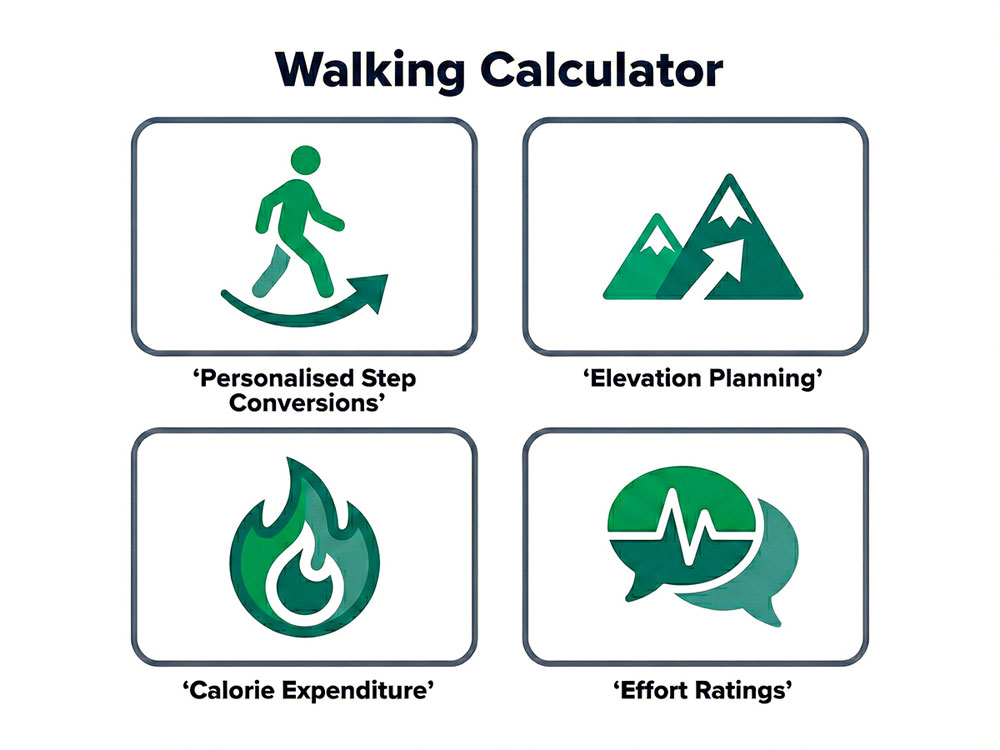
Precision plan your hikes. Our science-backed Walking Calculator uses Naismith's Rule and metabolic data to convert steps to miles and estimate calorie burn. Try it today!
This page contains affiliate links. If you buy products or services via these links, we may earn a small commission at no cost to you. If you are thinking of buying, please use our links, as it helps support our website and YouTube channel.
Walking isn't just 'steps = distance'. Hills, surface type, speed, and the weight you carry can dramatically affect your time and
calorie cost. This comprehensive guide and interactive walking calculator tool bring it all together.
Use the Walks4all Calculator to convert steps to miles or km, estimate walking time (including uphill and downhill
adjustments), calculate net and total calories burned, and obtain a practical effort rating that reflects how a walk actually feels.
Health & Wellbeing Disclaimer
The information in this article is intended for general education and wellbeing. It discusses walking metrics, hiking time estimation,
calorie expenditure, and physical effort levels, drawing on published research and established exercise physiology models, primarily for
generally healthy adults.
Physical activity - particularly strenuous hiking, significant elevation gain, or carrying a load - may not be suitable for everyone. If you
have a medical condition affecting your heart, lungs, joints, or balance (such as cardiovascular disease, respiratory issues, chronic back
pain, or osteoarthritis), or if walking causes chest pain, dizziness, or severe discomfort, you should consult your GP, physiotherapist, or
another qualified healthcare professional before making significant changes to your physical activity or attempting challenging terrain.
This article does not provide medical advice and should not be used as a substitute for professional healthcare. Individual responses to
physical exertion vary. Always increase your walking distance and intensity gradually, prioritise your comfort, and seek professional advice
if you experience persistent or concerning symptoms.
Walks4all Walking Calculator
Personalised walking and hiking metrics and time estimations
Personal Stats
Activity Details
Total Time
--
Calories Burned
--
--
Equivalent
--
Effort Level
--
Effort is calculated by combining walking intensity (speed and gradient) with total volume (distance), duration, load weight, and terrain surface.
Calorie calculation uses Net Burn (activity only) as the primary value, with Total Burn (including metabolic resting rate) highlighted in blue.
Most standard calculators use a generic '2,000 steps per mile' formula. The Walks4all tool uses multi-factor biometric analysis:
Precision conversions: Steps ↔ Miles/KM using height and sex-informed stride estimation.[11][12]
True hiking time: Implements Naismith's Rule and Langmuir's Corrections for elevation.[6][7]
Energetic accuracy: MET-based energy cost adjusted for terrain, incline, and backpack load.[1][17][32]
Effort intelligence: Provides an Effort Rating (Easy → Epic+) based on cumulative fatigue.[22]
Quick conversion tables (Male)
The following tables provide estimates based on a standard UK average male height of 175 cm (5'9"). This figure is sourced from the Office for
National Statistics (ONS) as the representative average for adult men in the United Kingdom. Because stride length is directly proportional to
height (approximately 41.5% of stature for men), your results will vary according to your height.
Male: Miles to Km & estimated steps
Distance (Miles)
Distance (Km)
Est. Steps (at 5'9")
1 Mile
1.61 Km
~2,216
2 Miles
3.22 Km
~4,432
5 Miles
8.05 Km
~11,080
10 Miles
16.09 Km
~22,160
26.2 Miles (Marathon)
42.16 Km
~58,058
Male: Km to Miles & estimated steps
Distance (Km)
Distance (Miles)
Est. Steps (at 5'9")
1 Km
0.62 Miles
~1,377
2 Km
1.24 Miles
~2,754
5 Km
3.11 Miles
~6,885
10 Km
6.21 Miles
~13,770
20 Km
12.43 Miles
~27,540
Male: Steps to Miles & Km
Step Count
Distance (Miles)
Distance (Km)
1,000 Steps
0.45 Miles
0.73 Km
2,000 Steps
0.90 Miles
1.45 Km
5,000 Steps
2.26 Miles
3.63 Km
10,000 Steps
4.51 Miles
7.26 Km
Male height variance: Shorter men will take more steps per mile, while taller men will take fewer. Stride length is determined by leg
length and biomechanical efficiency.
Quick conversion tables (Female)
The following tables provide estimates based on a standard UK average female height of 162.5 cm (5'4"). This figure is derived from Office for
National Statistics (ONS) data for adult women in the UK. Women generally have a slightly different stride-to-height ratio (approximately 41.3%),
which is reflected in the calculations below.
Female: Miles to Km & estimated steps
Distance (Miles)
Distance (Km)
Est. Steps (at 5'4")
1 Mile
1.61 Km
~2,398
2 Miles
3.22 Km
~4,796
5 Miles
8.05 Km
~11,990
10 Miles
16.09 Km
~23,980
26.2 Miles (Marathon)
42.16 Km
~62,828
Female: Km to Miles & estimated steps
Distance (Km)
Distance (Miles)
Est. Steps (at 5'4")
1 Km
0.62 Miles
~1,490
2 Km
1.24 Miles
~2,980
5 Km
3.11 Miles
~7,450
10 Km
6.21 Miles
~14,900
20 Km
12.43 Miles
~29,800
Female: Steps to Miles & Km
Step Count
Distance (Miles)
Distance (Km)
1,000 Steps
0.42 Miles
0.67 Km
2,000 Steps
0.83 Miles
1.34 Km
5,000 Steps
2.08 Miles
3.36 Km
10,000 Steps
4.17 Miles
6.71 Km
Female height variance: Shorter women will take more steps per mile, while taller women will take fewer. Stride length is determined by
leg length and biomechanical efficiency.
The Walking Calculator inputs: Why every detail matters
Our calculator requires specific inputs because each one fundamentally alters your walking economy, stride length, or energy cost.
Sex (Male/Female): Used to refine stride-length estimation. Women typically have a stride-to-height ratio of 0.413, whereas men average 0.415.[11][12]
Age: Metabolism and gait efficiency change with age. We apply an adjustment to account for the higher metabolic cost of walking often observed in older adults.[14]
Height: The strongest predictor of stride length. Stride length is estimated as a proportion of stature, making it key to accurately convert steps into distance.[12][25]
Speed: Speed is the primary driver of intensity. If you are unsure of your pace, you can estimate it by counting your steps for one minute: 100 steps per minute is a standard baseline for a brisk walk (approx. 3.0 mph). Alternatively, you can time yourself over a set distance, such as 1 mile. If it takes you 20 minutes, then 60 / 20 = 3 miles per hour.
Weight & Backpack weight: Energy cost scales with total mass. We include your backpack weight because moving a load against gravity significantly increases the workload.[3][4]
Nordic poles: Using poles increases energy expenditure because the upper body contributes to propulsion and stabilisation, raising metabolic demand.[15][27]
The Nordic pole adjustment is specifically for the Nordic Walking technique, rather than simply using
hiking poles
for stability.
Standard hiking poles are primarily used for balance and joint protection, so they don't significantly affect your metabolic rate. True Nordic
Walking involves a vigorous, purposeful backward push that engages the shoulders, chest, and core, increasing oxygen consumption and calorie
burn by about 20%.
If you are using poles for balance while hiking, leave the toggle set to 'No' to ensure your calorie estimate remains accurate.
Ascent (Metres climbed): Climbing increases the energy cost and slows your pace. Our model anchors these costs in classic slope physiology.[17][18]
Terrain surface: Soft or uneven ground (sand, mud, deep snow) increases energy cost because mechanical efficiency falls and stabilisation demands rise.[19][21]
The methodology: How we calculate results
We use three established pillars of exercise and mountaineering science.
Walking time (Naismith & Langmuir)
Naismith's Rule: We add 1 minute for every 10 metres of ascent. This is an average, I personally find that, as I am quite a strong uphill walker, I lose less than 1 minute for every 10 metres of ascent.[6]
Langmuir's Corrections: We adjust for descents. Gentle downhill sections can be faster than flat ground, but steep descents slow you down significantly because of braking and foot placement. This is hard to correct for without knowing the exact profile of the hill being descended.[7][17]
Calories burned (METs & Pandolf)
Net burn: Your 'exercise credit' - the calories burned above your resting state.
Total burn: This includes your Basal Metabolic Rate (BMR) for that period. Your BMR is the number of calories your body burns at rest to maintain essential life-sustaining functions, such as breathing, circulation, and cell production.
The Pandolf Equation: For walks with packs, we use load-carrying prediction logic to ensure your burn reflects the cost of carrying weight.[3][26]
The physics of calorie burn: Moving mass
Understanding your energy expenditure is a matter of physics. Your body burns calories to power the muscles that move your mass over a distance.
Because weight is the primary mass being moved, a heavier person requires more mechanical work, and therefore more energy (calories), to cover
the same ground as a lighter person.
When you add vertical ascent, you are moving that mass against gravity, which exponentially increases the energy cost compared with flat terrain.
Although men and women burn calories at slightly different rates due to differences in muscle-to-fat ratios (Basal Metabolic Rate), the Net Burn
- the energy used specifically for walking - is almost entirely dependent on the walker's weight and the intensity of the effort.
Quick guide: Calories burned by weight (10,000 steps)
Estimates based on a brisk walking pace on flat, firm ground.
Weight in kg (Imperial)
Total Steps
Est. Calories Burned
45 kg (100 lbs)
10,000
~275 kcal
55 kg (121 lbs)
10,000
~335 kcal
65 kg (143 lbs)
10,000
~395 kcal
75 kg (165 lbs)
10,000
~455 kcal
85 kg (187 lbs)
10,000
~515 kcal
95 kg (209 lbs)
10,000
~575 kcal
105 kg (231 lbs)
10,000
~635 kcal
Quick guide: Calories burned by weight per mile
Estimates based on a standard brisk pace of 3.0 mph.
Weight in kg (Imperial)
Distance
Est. Calories Burned
45 kg (100 lbs)
1 Mile
~65 kcal
55 kg (121 lbs)
1 Mile
~80 kcal
65 kg (143 lbs)
1 Mile
~95 kcal
75 kg (165 lbs)
1 Mile
~110 kcal
85 kg (187 lbs)
1 Mile
~125 kcal
95 kg (209 lbs)
1 Mile
~140 kcal
105 kg (231 lbs)
1 Mile
~155 kcal
Note: These figures represent Net burn (activity calories only). For a more precise figure tailored to your walk or hike,
use the Walks4all Calculator above.
Effort rating & the Talk Test
Effort is a tiered logic system that combines intensity (speed/slope) and volume (distance/time).
Effort Level
Context & Physiology
The Talk Test
Easy
Casual stroll, firm/flat ground.
You can speak in full, comfortable sentences.
Moderate
Brisk walk or light hills.
You can talk but pause for breath occasionally.
Hard
Power walking or steep gradients.
You can only manage short phrases.
Epic
Very steep or long duration (>5 hrs).
Talking is difficult; focused on breathing.
The Fatigue Factor: We add a '+' to ratings when duration exceeds 5 hours. Perceived exertion is predictably related to fatigue and tends
to increase over time.[22][24]
Walking downhill: Time and calories
It's a common myth that downhill is 'free'. While it feels easier on the lungs, steeper descents require eccentric muscle contractions to slow
your body. This can increase your metabolic rate compared with a gentle stroll and place higher impact forces on your knees and ankles.[6][17]
Is 10,000 steps a myth?
The '10,000 steps'
target originated as a marketing campaign in the 1960s. While it is a useful motivational tool, it isn't a 'one-size-fits-all' metric. Intensity
matters: 5,000 steps up a mountain are far more beneficial for cardiovascular health than 10,000 steps on a flat pavement.
Environmental & technical nuance
To ensure full transparency in your planning, it is important to understand why 'real-world' results sometimes differ from those recorded by
digital tracking.
GPS vs. step counter discrepancies
A step counter records every micro-movement and lateral adjustment, whereas
GPS 'smooths' your path into straight lines between pings. For trail walking, the step count is often a more accurate reflection of the number of
steps taken.
However, step counters do not measure distance directly; they record strides, and distance is generally estimated from your stride length. GPS
devices remain the primary tool for
mapping and measuring distance, and they also generally count steps.[40]
Pace-to-stride variance & posture
As you increase your walking speed, your stride length naturally increases. Maintaining an efficient posture, keeping your core engaged and
your gaze forward, ensures that this longer stride remains efficient.[39]
The Treadmill Effect: Indoor vs. outdoor gait
Scientific data confirms that when walking on a moving belt, people naturally adopt a shorter stride length and a higher cadence than when
walking overground.[41] This shift is often a psychological response to the treadmill deck's spatial constraints.
The 'invisible incline': Wind & temperature
A 20-mph headwind can increase energy expenditure by up to 10-15%, effectively turning a flat road into a gentle incline.[38] Similarly, walking in extreme cold requires additional energy for thermoregulation.
Building your foundation: Advice for beginners
For those just starting their walking journey, the most important metric isn't the distance on the map, but the consistency of your routine.
The NHS recommends at least 150 minutes of moderate-intensity activity per week to maintain cardiovascular health, which is about 22 minutes of
brisk walking each day.
The secret to long-term success is to start small. If you are new to exercise, begin with a manageable 10-minute loop and add a few extra
minutes each day. As you build stamina, you will naturally move from 'Easy' to 'Moderate' effort ratings. However, increasing your activity
levels can take a toll on your body. Understanding
why foot health matters more as you age
is essential for staying injury-free.
If you find your feet feel heavy, tired, or sore after a walk, proactive recovery is key. Using the
best circulation devices or the
best foot massagers
after a long session can help soothe aches, improve blood flow, and ensure you are ready to get back on the trail the next day.
Conclusion: Walking smarter, not just further
The primary takeaway from modern walking science is that a 'step' is not a fixed unit of effort. By shifting your focus from raw numbers to
high-quality metrics and accounting for elevation, pack weight, and terrain resistance, you turn a simple stroll into a precision workout.
Understanding these variables lets you plan your routes with confidence, ensuring you never underestimate a trail or overexert yourself.
Ultimately, the aim of using advanced walking analytics is to build a sustainable, lifelong habit. Whether you are using the Walks4all Calculator to hit a calorie target or to estimate your arrival time at a summit, data-driven planning is your best tool for progress. Respect
your biometrics, prioritise your recovery, and keep moving towards your goals, one well-measured step at a time.
Happy calculated walking!
Frequently Asked Questions (FAQs) about the Walking Calculator, steps, distance, time and calories
How many steps are there in a mile when walking?
On average, there are 2,000 to 2,500 steps in a mile. This varies by height; a person who is 5'4" takes roughly 2,400 steps, whereas a
person who is 6'2" may take only 2,100 steps.[11][25]
Is walking better than running for fat loss?
Yes, because walking at a brisk pace keeps you in the fat-oxidation zone, where the body prioritises fat stores for fuel, usually
Zone 2.
While running burns more total calories per minute, a high proportion of those calories come from glucose.
Is the Walks4all Walking Calculator accurate?
Yes, because it uses the 2024 Adult Compendium of Physical Activities and accounts for biometrics, load, and terrain. Unlike generic
trackers, it accounts for the 'hidden' energy cost of hills and pack weight.
How many calories do I burn when walking 10,000 steps?
On average, 10,000 steps burn 400-500 kcal. However, if those steps are taken on an incline or while carrying a backpack, energy
expenditure can increase significantly.[3][17]
What is a brisk walking pace?
In the UK, a brisk pace is roughly 3mph (4.8km/h) or faster. Physically, this is the point at which your heart rate rises, and you can
talk, but would struggle to sing.
How does walking uphill affect calorie burn?
Adding just a 3% incline can increase calorie burn by nearly 50%. Walking uphill requires significant work against gravity, engaging the
glutes and calves much more than flat walking does.[18]
Why use Naismith's Rule for hiking?
Because horizontal distance is only half the story. Naismith's Rule ensures your time estimate accounts for the extra effort and time
required to climb vertical metres.[6]
Does carrying a backpack burn more calories?
Yes, because moving additional mass requires more mechanical work. Carrying a 10 kg
backpack
can increase your metabolic demand by 10-15%, depending on your speed and the incline.[3][5]
Are step counters or GPS more accurate?
For trail walking, step counters are often more accurate at recording step counts. While GPS measures spatial distance directly, its
signal can 'wander' or smooth out winding paths, missing the micro-adjustments of a trail. However, step counters do not measure distance
directly; they record strides, with distance calculated from your stride length. GPS remains the primary tool for mapping and neasuring
distance travelled, but a step counter more accurately reflects the physical work of each stride.[40]
What are the benefits of Nordic walking?
Nordic walking engages the upper body, increasing total energy expenditure by up to 20% compared with standard walking without making it
feel significantly harder.[15][27]
How does terrain affect walking effort?
Soft or uneven surfaces (such as sand, mud, or snow) create resistance. These surfaces require more energy for stabilisation and force production,
increasing the 'energy tax' on your walk.[19][21]
Does walking downhill burn calories?
Yes, because your muscles must contract eccentrically to brake your descent. While it is easier on the cardiovascular system, it
places a heavy load on the joints and requires metabolic energy to maintain your speed.[17]
How far is 10,000 steps in miles and kilometres?
On average, 10,000 steps is about 4.5 to 5 miles (7.2 to 8.0 kilometres). The exact distance depends on your stride length; taller people
will cover more ground in 10,000 steps than shorter people.
How many calories do you burn per mile when walking?
Most adults burn between 80 and 100 calories per mile walked. The primary variable is your body weight. The heavier you are, the more
energy is required to move your mass over that distance.
Is 5 miles a day a lot of walking?
Yes, 5 miles a day is an excellent activity level that significantly exceeds the sedentary average. It equates to roughly 11,000-12,000
steps and meets most international health recommendations for cardiovascular fitness.
How many steps are there in 5km?
For most walkers, 5 km is roughly 6,500 to 7,500 steps. Using UK average heights, a male (5'9") takes approximately 6,885 steps, while a
female (5'4") takes roughly 7,450 steps to cover 5 km.
We take evidence seriously at Walks4all. If you'd like to better understand how walking studies are designed, how results
should be interpreted, and what scientific terms mean, explore our guides on the following:
References for the Walking Calculator: Steps, distance, time, calories & effort
Herrmann SD, Willis EA, Ainsworth BE, et al. (2024). 2024 Adult Compendium of Physical Activities: A third update of the energy costs of human activities. Journal of Sport and Health Science. This study provides the updated metabolic equivalent values used to calculate precise calorie expenditure. https://pmc.ncbi.nlm.nih.gov/articles/PMC10818145/
Grant B, et al. (2022). Why does the metabolic cost of walking increase on compliant substrates? Journal of the Royal Society Interface. Research indicates that compliant surfaces like sand increase the mechanical work required for each step. https://pmc.ncbi.nlm.nih.gov/articles/PMC9709563/
Pandolf KB, Givoni B, Goldman RF. (1977). Predicting energy expenditure with loads while standing or walking very slowly. Journal of Applied Physiology. This established model predicts energy expenditure when carrying backpack loads at various speeds. https://pubmed.ncbi.nlm.nih.gov/908672/
Drain JR, Sampson JA, Billing DC, et al. (2017). The Pandolf load carriage equation under-predicts the metabolic rate of contemporary military load carriage. Journal of Science and Medicine in Sport. This update refines the original Pandolf equation for modern load-carriage scenarios. https://www.sciencedirect.com/science/article/abs/pii/S1440244017309970/
Hudson S, et al. (2024). Systematic review of physiological and biomechanical responses to load carriage during walking. Applied Ergonomics. A review of how the body adapts biometrically to carrying external weight during gait. https://www.sciencedirect.com/science/article/pii/S0003687023001618/
Fritz S, Carver S. (1998). Modelling Naismith's Rule: Implications for wilderness recreation and search and rescue. University of Leeds. The foundational study testing the accuracy of Naismith's Rule for mountain travel. https://www.geog.leeds.ac.uk/papers/98-7/
Wood A, Mackaness W, et al. (2023). Improved prediction of hiking speeds using a data-driven approach. PLOS ONE. Data-driven analysis showing how hiking speeds vary based on gradient and terrain. https://pmc.ncbi.nlm.nih.gov/articles/PMC10727444/
Tobler W. (1993). Three Presentations on Geographical Analysis and Modeling. Tobler's research on the exponential relationship between slope and human walking speed. https://www.lukatela.com/hrvoje/papers/tobler93.html
Soerensen L, Larsen KSR, Petersen AK. (2020). Validity of the Talk Test as a method to estimate ventilatory threshold and guide exercise intensity in cardiac patients. J. Cardiopulm. Rehabil. Verification of the Talk Test as a reliable gauge for ventilatory thresholds. https://pubmed.ncbi.nlm.nih.gov/32604216/
Journal of Cardiopulmonary Rehabilitation and Prevention. (2026). Talk Test for the Prescription of Aerobic Exercise. Clinical guidelines for using speech comfort to prescribe exercise intensity. https://journals.lww.com/10.1097/HCR.0000000000001022
Adult Compendium of Physical Activities. (2024). Online Database. The primary database for physical activity intensities and metabolic costs. https://pacompendium.com/
Boyer KA. (2023). Age-related changes in gait biomechanics and metabolic cost. NIA Workshop. Evidence on how aging impacts walking economy and energetic demands. https://pmc.ncbi.nlm.nih.gov/articles/PMC10008437/
Baek S, et al. (2021). Estimation of energy expenditure of Nordic walking. Sensors. Measurement of the increased metabolic demand when using Nordic poles. https://pmc.ncbi.nlm.nih.gov/articles/PMC7893942/
Russo L, et al. (2023). Nordic walking vs ordinary walking: kinematic differences and technique factors. Applied Sciences. Analysis of biomechanical differences between standard and Nordic walking. https://pmc.ncbi.nlm.nih.gov/articles/PMC10204468/
Minetti AE, Moia C, Roi GS, Susta D, Ferretti G. (2002). Energy cost of walking and running at extreme uphill and downhill slopes. Journal of Applied Physiology. Classic research on energy cost over extreme uphill and downhill gradients. https://journals.physiology.org/doi/10.1152/japplphysiol.01177.2001
Silder A, Besier T, Delp S. (2012). Predicting the metabolic cost of incline walking. Journal of Biomechanics. Predictive models for the oxygen cost of walking on various inclines. https://pmc.ncbi.nlm.nih.gov/articles/PMC4504736/
Zamparo P, Perini R, Orizio C, Sacher M, Ferretti G. (1992). The energy cost of walking or running on sand. Eur. J. Appl. Physiol. Comparative study of energy expenditure on firm versus sandy surfaces. https://pubmed.ncbi.nlm.nih.gov/1327762/
Hosseini-Yazdi SS, et al. (2025). The energetic cost of human walking as a function of uneven terrain amplitude. Journal of Experimental Biology. Data on how uneven terrain increases the energetic cost of human gait. https://pubmed.ncbi.nlm.nih.gov/39882683/
Zhao H, et al. (2022). Validity of using perceived exertion to assess fatigue. Scientific Reports. Assessment of how subjective ratings of effort correlate with physical fatigue. https://pmc.ncbi.nlm.nih.gov/articles/PMC8896022/
Pimental NA, Pandolf KB. (1979). Energy expenditure while standing or walking slowly uphill or downhill with loads. Ergonomics. Specific measurements of energy costs for slow hiking with heavy loads. https://pubmed.ncbi.nlm.nih.gov/527574/
Chen S, et al. (2026). Effect of Nordic Walking on anthropometrics and metabolic markers. Frontiers in Public Health. Meta-analysis of the metabolic health markers improved by Nordic walking. https://pmc.ncbi.nlm.nih.gov/articles/PMC12782928/
Ludlow LW, Weyand PG. (2017). Walking economy is predictably determined by speed, grade, and gravitational load. J. Appl. Physiol. Study confirming that walking economy is determined by speed, grade, and mass. https://journals.physiology.org/doi/10.1152/japplphysiol.00504.2017
Moore CC, et al. (2021). Development of a cadence-based metabolic equation for walking. ACSM. Development of cadency-based metabolic equations for walking. https://pmc.ncbi.nlm.nih.gov/articles/PMC7896743/
Zadarko E, et al. (2025). Energy expenditure of special forces soldiers in relation to speed and a 20-kg load. Military Medicine. Energy expenditure data for high-intensity hiking with significant loads. https://pmc.ncbi.nlm.nih.gov/articles/PMC12788011/
Kasovic M, et al. (2024). Carrying police load increases gait asymmetry. Gait and Posture. Analysis of how carrying weight increases gait asymmetry and instability. https://pmc.ncbi.nlm.nih.gov/articles/PMC11428323/
Weyand PG, et al. (2021). Can laboratory equations predict field energy expenditure? Journal of Applied Physiology. Comparison between laboratory-derived equations and real-world field results. https://pmc.ncbi.nlm.nih.gov/articles/PMC8560389/
Pimental NA, et al. (1979). Graded walking load record. Ergonomics. Records of metabolic costs across various graded walking loads. https://pubmed.ncbi.nlm.nih.gov/527574/
Pugh LG. (1971). The influence of wind resistance in running and walking and the mechanical efficiency of work against horizontal or vertical forces. Journal of Physiology. Research on how headwind resistance increases the work of walking. https://www.ncbi.nlm.nih.gov/pmc/articles/PMC1331759/
Grieve DW, Gear RJ. (1966). The relationship between length of stride, step frequency, time of swing and speed of walking for children and adults. Ergonomics. Fundamental research on the relationship between speed, cadence, and stride. https://www.tandfonline.com/doi/abs/10.1080/00140136608964391
Ranacher P, et al. (2016). Why GPS distance is different from the true distance travelled. International Journal of Geographical Information Science. Analysis of GPS distance errors compared to true ground distance. https://www.tandfonline.com/doi/full/10.1080/13658816.2015.1086924
Malatesta D, et al. (2003). Metabolic adaptation and mechanical efficiency of treadmill and overground walking in healthy and obese children. Human Movement Science. Study on the differences in mechanical efficiency between treadmill and overground gait. https://pubmed.ncbi.nlm.nih.gov/12963488/