Zone 2 walking: Can brisk walking count and when does it become Zone 3?
By: Andrew Forrest - February 2026
Can brisk walking count as Zone 2? Learn how to use the Talk Test, cadence and heart rate to stay in Zone 2, avoid Zone 3 drift, and understand what studies show about health benefits.
Table of contents
This page contains affiliate links. If you buy products or services via these links, we may earn a small commission at no cost to you. If you are thinking of buying, please use our links, as it helps support our website and YouTube channel.
If you could improve your cardiovascular fitness, endurance, and metabolic health without running and without turning every session into an
exhausting effort, would you?
That is the appeal of Zone 2 training.
Health & Wellness Disclaimer
The information provided in this article is for general educational and wellbeing purposes only and does not constitute medical advice.
Consult your GP or a qualified healthcare professional before starting or modifying any exercise programme, particularly if you have
cardiovascular disease, arrhythmia, respiratory conditions, metabolic disorders, balance impairment, musculoskeletal injury, or are taking
medication that affects heart rate or blood pressure. If you are pregnant, recently postnatal, recovering from illness or surgery, or managing
chronic medical conditions, obtain individualised medical guidance before undertaking structured, high-intensity training.
Stop exercising immediately and seek medical attention if you experience chest pain, severe shortness of breath, dizziness, fainting,
palpitations, or any other unusual symptoms. Participation in physical activity is at your own risk. Walks4all accepts no liability for injury
or adverse outcomes arising from the use of the information provided.
Zone 2 represents steady aerobic intensity, the effort range in which your body strengthens its cardiovascular system, improves
mitochondrial efficiency, and enhances metabolic flexibility, while remaining sustainable enough to repeat frequently.[18]
Unlike high-intensity training, Zone 2 allows volume to accumulate safely. That accumulated volume, when performed consistently, is what drives
many long-term adaptations linked to improved health outcomes.
However, wearable devices divide exercise into numbered heart-rate zones using estimated formulas. These formulas vary between individuals,
and the physiological definition of Zone 2 can differ depending on whether it is defined by the ventilatory threshold, lactate markers, or
percentage of predicted maximum heart rate.[18] [19] [20]
So the key practical question for walkers becomes clear. Can brisk walking, something you can do almost every day, count as Zone 2?
For many people, yes, provided that effort, not speed, defines the intensity.
Walks4all key takeaways
- Zone 2 is defined by effort, not by pace or watch notifications.
- If you can speak in full sentences but not sing, you are likely in Zone 2.[11 ‑ 16] [32] [34]
- Around 100 to 120 steps per minute often corresponds to Zone 2 for many adults on flat ground.[1 ‑ 7] [9]
- Hills, heat, fatigue and load can push brisk walking into Zone 3 without changing the speed.
- Consistency at moderate intensity is strongly linked to cardiovascular and metabolic health benefits.[21 ‑ 31]
What are heart rate zones?
Most wearable devices divide effort into five heart-rate zones, each calculated as a percentage of the predicted maximum heart rate.
Zone 1 is very easy effort, typically a warm-up pace.
Zone 2 is a steady aerobic effort that feels purposeful but sustainable.
Zone 3 is a noticeably harder tempo effort.
Zone 4 is a hard effort that is difficult to sustain.
Zone 5 is near-maximal effort for short durations only.
Zone 2 is the intensity that can be sustained for extended periods, often 45 to 90 minutes, depending on conditioning, while breathing remains
elevated but controlled.
What does Zone 2 feel like?
In practice, Zone 2 feels steady rather than strained.
You feel warmer, and your breathing is faster than at rest, yet you can still speak comfortably in full sentences. Singing would feel
awkward.[11 ‑ 16] [32] [34]
Zone 3 feels distinctly stronger. Speech shortens to brief phrases, breathing becomes more noticeable, and the effort feels closer to pushing
than to cruising.[11 ‑ 16]
Can brisk walking be in Zone 2?
Yes. For many adults, brisk walking naturally falls within the moderate aerobic intensity range.
Public health guidance defines moderate activity as an effort at which you can talk but not sing.[32] [34]
The Talk Test has been validated against ventilatory and lactate thresholds in multiple studies.[11 ‑ 16]
For beginners or those returning to exercise, even a moderate pace may raise heart rate into Zone 2. As fitness improves, a slightly higher pace
or incline may be needed to achieve the same physiological stimulus.[18]
When does brisk walking become Zone 3?
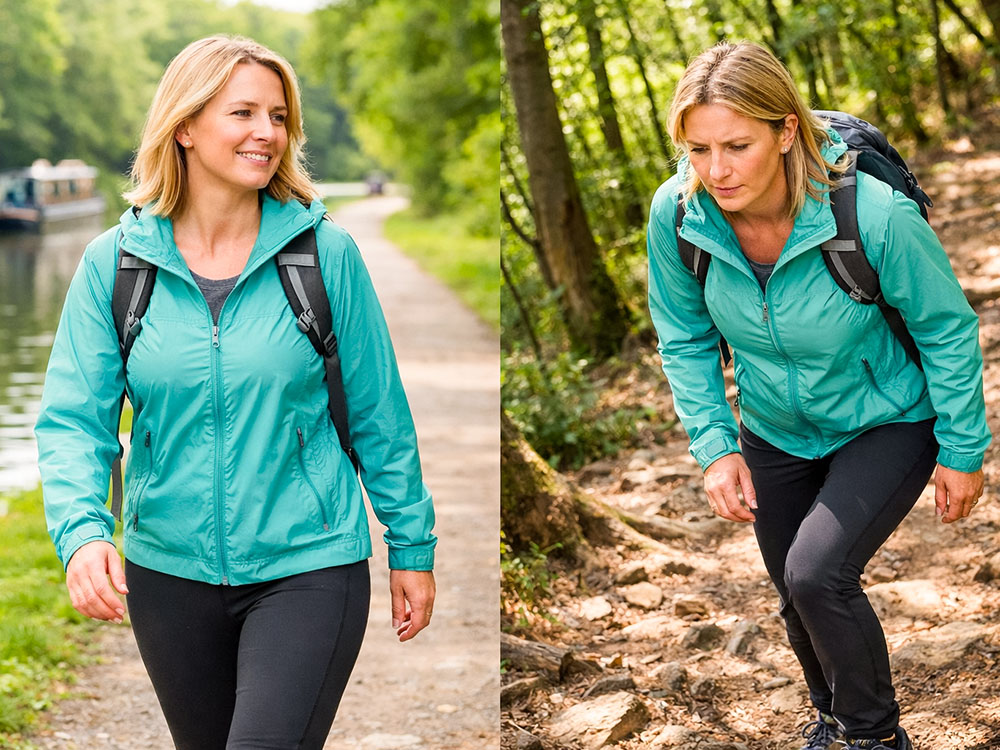
Brisk walking can transition into Zone 3 without a noticeable change in speed.
Indicators include shortened speech, increased breathing, and difficulty sustaining pace for 45 to 60 minutes.
External and internal factors increase effort cost, including hills, headwind, heat, accumulated fatigue, load carriage, or increased
cadence.[6] [8] [18]
Recognising these factors enables you to adjust pace or terrain to maintain the intended intensity.
The Walks4all Method: Talk test and cadence, with optional heart rate
Talk test
Zone 2 means full sentences remain comfortable.
Zone 3 means speech shortens noticeably.[11 ‑ 16]
Cadence
Cadence refers to the number of steps per minute.
Large validation studies support approximately 100 steps per minute as a practical moderate-intensity threshold for many adults.[1 ‑ 7] [9]
Vigorous intensity is typically about 130 steps per minute.[1] [2]
On flat ground, a working Zone 2 range for many adults typically falls between 100 and 120 steps per minute.
Walks4all Zone 2 cadence reality check
Across adult calibration studies, the median moderate-intensity cadence is approximately 100 steps per minute.
Average thresholds cluster around 103 steps per minute.
A practical working range for many adults sits between 100 and 120 steps per minute.[1 ‑ 10]
This consistency across independent studies strengthens cadence as a practical, real-world anchor.
Using heart rate wisely
Heart rate can help identify trends and an upward drift over time.
However, age-predicted maximum heart rate formulas contain individual variability.[19] [20]
If device zone alerts conflict with breathing cues, prioritise physiological perception, that is, how your body feels during exercise.[11 ‑ 16]
How to tell if you're drifting out of Zone 2
Zone 2 should feel steady and conversational.
Spot these early signs that you are edging into Zone 3 before it feels obviously hard:
- Speech begins to shorten, shifting from full sentences to brief phrases.
- Cadence creeps up (e.g., 110 → 120-125 steps/min) without intending to speed up.
- Heart rate drifts upward across a long, steady walk at the same pace.
- Breathing becomes 'noticeable' rather than background.
- External load increases (hills, headwind, heat, carrying a bag) while walking at the same speed.
How long should a Zone 2 walk be?
Use these practical ranges as a guide.
Choose the shortest option that you can repeat most days:
- Minimum effective dose: 20-30 minutes per session.
- Solid health benefit range: 45-60 minutes per session, most days.
- Weekly targets: 150-300 minutes of moderate effort, spread over the week.
- Longer sessions (60-90+ minutes) are optional and should be added gradually.
Zone 2 walking for weight management
Zone 2 is sustainable, making weekly volume easier to maintain. That consistency supports fat loss when combined with appropriate nutrition.
Think of Zone 2 as the 'engine' for adherence, not a magic fat-burning switch.
Helpful tips:
- Track weekly minutes, not just long walks.
- Use mostly flat terrain to limit fatigue and make tomorrow's walk manageable.
- Pair with gentle strength training 2x/week to maintain muscle.
- Prioritise sleep and protein intake to support recovery and appetite regulation.
Zone 2 walking benefits: What the studies show
Randomised controlled trials and meta-analyses show that moderate-intensity walking interventions improve cardiovascular risk profiles, lipid
markers, glycaemic control, and cardiorespiratory fitness.[21 ‑ 27]
Long-term cohort studies link a faster habitual walking pace with reduced mortality and a lower risk of cardiovascular events.[28 ‑ 31]
These benefits occur without requiring high-intensity training. The ability to sustain moderate effort consistently appears central to
effectiveness.
Walks4all Zone 2 walking workouts
Option A involves 30 to 60 minutes of steady conversational effort.
Option B involves taking three 10-minute walks or two 15-minute walks throughout the day.[25]
Option C involves shortening stride length, easing the pace slightly, or choosing flatter terrain if effort rises.
How to progress your Zone 2 walking over time
As your fitness improves, you may need a little extra stimulus to stay in Zone 2. Progress slowly - change only one variable at a time:
- Add small inclines or gentle trails 1-2 days per week.
- Increase the duration by 5-10 minutes per session every 1-2 weeks.
- Slightly increase cadence (2-5 steps/min) while keeping speech comfortably conversational.
- Use poles for technique and posture on hilly terrain.
- Introduce a light load (e.g., a small backpack) sparingly; prioritise form and joint comfort.
Common mistakes people make with Zone 2 walking
- Chasing pace instead of monitoring breathing and speech.
- Relying solely on watch zones despite the known HRmax prediction error.
- Starting too fast; skipping an easy 5-10-minute warm-up.
- Turning every session into a race walk and accumulating excessive fatigue.
- Assuming heavy sweating is required for effectiveness.
- Ignoring how hills, heat, or headwinds quietly push effort into Zone 3.
Zone 2 walking indoors vs outdoors
Both options work - choose the one that helps you stay consistent.
Notice the practical differences:
- Outdoors: terrain, wind, and temperature vary; effort may drift if you don't adjust your pace.
- Indoors (treadmill): pace and incline are controllable; cadence tracking is easier; heart rate may be slightly lower for the same perceived effort.
If you are walking indoors on a walking pad or under-desk treadmill, you may still be able to reach Zone 2 walking depending on how fast your
walking pad operates. If you are using a walking pad with a
standing desk,
it is difficult to type at Zone 2, but you might still be able to hold calls while walking.
Step-rate examples for different heights and ages
Cadence is a guide, not a rule. Individuals of different heights, stride mechanics, and fitness levels can reach Zone 2 at different step rates.
Typical real-world observations include:
- Shorter adults may reach Zone 2 at slightly higher cadences (e.g., 110-120 spm on flat ground).
- Taller adults may be in Zone 2 at slightly lower cadences (e.g., 100-110 spm).
- Older adults often benefit from using the Talk Test first, with cadence as a secondary check.
Zone 2 vs Steps per day: How do they work together?
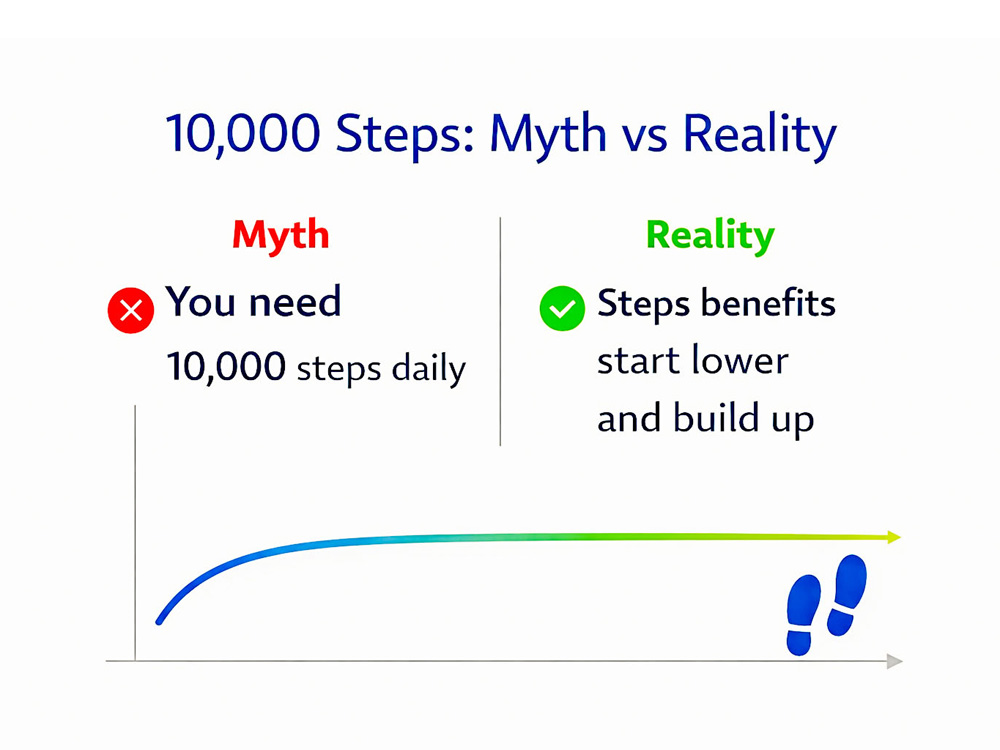
Steps measure total daily movement; Zone 2 measures a specific training intensity. Both matter, but they are not the same.
- You can hit a high step count with mostly light activity and minimal time in Zone 2.
- Deliberate Zone 2 walks boost step counts while delivering aerobic training benefits.
- Blend the two: maintain an active day (steps) and add 3-5 dedicated Zone 2 walks each week.
Who should be cautious with Zone 2 training?
Most healthy adults can safely use Zone 2 walking. Still, take extra care and seek personalised advice if any of the following apply:
- Use of medications that affect heart rate or blood pressure (e.g., beta-blockers).
- Cardiac conditions, pacemaker, known arrhythmias, or unexplained chest symptoms.
- Balance limitations, neuropathy, or foot pain that worsens with increased volume.
- Recent illness, surgery, or postnatal recovery.
- Autonomic dysfunction (e.g., POTS) with variable heart rate responses.
- Any injury aggravated by longer or hillier walks.
Frequently Asked Questions (FAQs) on Zone 2 walking and brisk walking
Can brisk walking be Zone 2?
Yes. Brisk walking can be in Zone 2 when your breathing is faster but controlled, and you can talk comfortably in full sentences.[11 ‑ 16] [32] [34]
Is Zone 2 walking the same speed for everyone?
No. Fitness, stride mechanics, hills, and how zones are calculated can all affect what zone 2 looks like for different people.[6] [8] [9] [10] [18]
Is 100 steps per minute Zone 2?
Often, yes. Research indicates that around 100 steps per minute is a practical minimum marker for moderate intensity in many adults, which
commonly overlaps with Zone 2.[1 ‑ 7] [9]
At what heart rate does walking become Zone 3?
Walking tends to reach Zone 3 when breathing feels noticeably laboured, and you can speak only in short phrases, often on hills, in heat,
or at a higher cadence.[11 ‑ 16]
Can beginners reach Zone 2 just by walking?
Yes. If you are new to exercise, even a modest walking pace can raise your heart rate into Zone 2, which is a good starting point for
training.[18]
Is incline walking in Zone 2 or Zone 3?
It can be either. A gentle incline can keep you in Zone 2 at a slower pace, while a steeper hill can push you into Zone 3 even when
walking slowly. Use the Talk Test.[11 ‑ 16]
Do I need a heart rate monitor for Zone 2 walking?
No. The Talk Test is a practical method that aligns with physiological thresholds used for exercise prescription, and cadence provides a
simple numerical anchor.[1 ‑ 7] [11 ‑ 16]
Is Zone 2 walking good for fat loss?
It can support fat loss by making it easier to maintain a consistent weekly activity volume. Fat loss still depends on overall energy
balance, but Zone 2 helps many people stay consistent.[26] [27]
Is walking in Zone 3 bad?
No. Zone 3 is simply harder aerobic work. It can improve fitness, but it is more fatiguing, which is why many people prefer Zone 2 for
sustainable weekly volume.[18]
Why does my watch show Zone 3 when I feel fine?
This is common. Zone calculations rely on predicted maximum heart rate and on different zone models, and both can misclassify effort.
Use breathing and speech as a reality check.[18] [19] [20]
Walking intensity can rise for practical, everyday reasons, such as carrying a load or pushing a buggy, even if the pace remains similar.
February 2026
Related reading:
Want to 'go deeper'?
We take evidence seriously at Walks4all. If you'd like to better understand how walking studies are designed, how results
should be interpreted, and what scientific terms mean, explore our guides on the following:
References on Zone 2 walking and brisk walking
- Tudor-Locke C, et al. Walking cadence (steps/min) and intensity in 21-40 year olds: CADENCE-adults. 2019. What the study shows: Calibrates step rate against intensity in adults 21-40, supporting cadence thresholds (including about 100 steps/min) as practical markers of moderate-intensity walking. https://pmc.ncbi.nlm.nih.gov/articles/PMC6337834/
- Tudor-Locke C, et al. Walking cadence (steps/min) and intensity in 41 to 60-year-old adults: CADENCE-adults. 2020. What the study shows: Extends cadence-intensity calibration into midlife adults, supporting step-rate heuristics for moderate and vigorous intensity across ages. https://pubmed.ncbi.nlm.nih.gov/33168018/
- Tudor-Locke C, et al. Walking cadence (steps/min) and intensity in 61-85 year olds: CADENCE-adults. 2021. What the study shows: Shows cadence thresholds remain useful in older adults, supporting cadence as a practical field tool for targeting moderate intensity. https://pmc.ncbi.nlm.nih.gov/articles/PMC8461976/
- Aguiar EJ, et al. Cadence-based Classification of Minimally Moderate Intensity During Overground Walking in 21- to 40-Year-Old Adults. 2019. What the study shows: Overground validation supports at least 100 steps/min as a workable threshold for achieving at least moderate (at least 3 METs) intensity in young adults. https://pmc.ncbi.nlm.nih.gov/articles/PMC7200288/
- O'Brien MW, et al. Step Rate Thresholds Associated with Moderate and Vigorous Physical Activity in Adults. 2018. What the study shows: Identifies step-rate thresholds linked with moderate and vigorous intensity and shows thresholds can vary by method and definition, supporting cadence as a guide rather than a fixed rule. https://pmc.ncbi.nlm.nih.gov/articles/PMC6266480/
- Slaght J, et al. Walking Cadence to Exercise at Moderate Intensity for Adults: A Systematic Review. 2017. What the study shows: Across studies, about 100 steps/min is a practical heuristic for moderate intensity in adults, while acknowledging individual and context variation. https://pmc.ncbi.nlm.nih.gov/articles/PMC5387837/
- Abel M, et al. Determination of step rate thresholds corresponding to physical activity intensity classifications in adults. 2011. What the study shows: Supports step rate as a usable field measure for classifying walking intensity. https://pubmed.ncbi.nlm.nih.gov/21297184/
- Rowe DA, et al. Stride rate recommendations for moderate-intensity walking. 2011. What the study shows: Provides stride/step-rate recommendations that can help adults achieve moderate-intensity walking in practice. https://pubmed.ncbi.nlm.nih.gov/21681194/
- Chiang TL, et al. Individualized walking cadence thresholds of moderate to vigorous intensity for Taiwanese obese young adults. 2025. What the study shows: Demonstrates cadence thresholds can differ by population and body size, supporting individualised cadence targets rather than one fixed number for everyone. https://pmc.ncbi.nlm.nih.gov/articles/PMC12523200/
- Bae WR, et al. Determination of moderate walking intensity using step rate and VO₂ reserve in healthy men. 2024. What the study shows: Using VO₂ reserve can yield higher 'moderate intensity' cadence thresholds, showing how definitions and population affect cadence cut-offs. https://pmc.ncbi.nlm.nih.gov/articles/PMC10851523/
- Persinger R, et al. Consistency of the talk test for exercise prescription. 2004. What the study shows: The Talk Test demonstrates consistency for prescribing exercise intensity, supporting speech comfort as a repeatable intensity guide. https://pubmed.ncbi.nlm.nih.gov/15354048/
- Foster C, et al. The talk test as a marker of exercise training intensity. 2008. What the study shows: Talk Test stages correspond to meaningful shifts in exercise intensity, supporting its use to regulate training effort. https://pubmed.ncbi.nlm.nih.gov/18277826/
- Quinn TJ, et al. The Talk Test and its relationship with the ventilatory and lactate thresholds. 2011. What the study shows: Talk Test performance relates to ventilatory and lactate thresholds, linking conversational ability to physiological intensity boundaries. https://pubmed.ncbi.nlm.nih.gov/21774751/
- Ballweg JA, et al. Reliability of the Talk Test as a surrogate of ventilatory threshold. 2013. What the study shows: Supports Talk Test reliability as a practical surrogate for ventilatory threshold. https://pmc.ncbi.nlm.nih.gov/articles/PMC3772610/
- Reed JL, Pipe AL. The talk test: a useful tool for prescribing and monitoring exercise intensity. 2014. What the study shows: Review supports the Talk Test as a practical method for prescribing and monitoring exercise intensity in real-world settings. https://pubmed.ncbi.nlm.nih.gov/25010379/
- Vieira AM, et al. Application and Measurement Properties of the Talk Test in Cardiopulmonary Diseases: A Systematic Review. 2022. What the study shows: Systematic review summarises Talk Test measurement properties and applicability, including cardiopulmonary disease contexts. https://pmc.ncbi.nlm.nih.gov/articles/PMC11266803/
- Garber CE, et al. ACSM position stand: Quantity and Quality of Exercise for Developing and Maintaining Cardiorespiratory, Musculoskeletal, and Neuromotor Fitness in Apparently Healthy Adults. 2011. What the study shows: Authoritative guidance on exercise intensity and volume, supporting practical intensity tools and moderate-intensity training principles. https://pubmed.ncbi.nlm.nih.gov/21694556/
- Meixner C, et al. Zone 2 training: definitions, physiological markers, and individual variability. 2025. What the study shows: Explains that 'zone 2' can be defined using multiple markers and varies between individuals, supporting personalised, effort-led approaches. https://pmc.ncbi.nlm.nih.gov/articles/PMC11986187/
- Tanaka H, Monahan KD, Seals DR. Age-predicted maximal heart rate revisited. 2001. What the study shows: Shows limitations of common age-predicted HRmax estimates, supporting that watch-based zones can misclassify individuals. https://pubmed.ncbi.nlm.nih.gov/11153730/
- Nes BM, et al. Age-predicted maximal heart rate in healthy subjects. 2013. What the study shows: Provides an alternative HRmax equation but reinforces prediction error remains, supporting effort-based cross-checks like breathing and speech. https://pubmed.ncbi.nlm.nih.gov/23358061/
- Hardman AE, et al. Brisk walking and serum lipid and lipoprotein variables in previously sedentary women. 1994. What the study shows: Brisk walking interventions in sedentary women can improve lipid and lipoprotein markers. https://pubmed.ncbi.nlm.nih.gov/7894958/
- Murphy MH, et al. Training effects of short and long bouts of brisk walking in sedentary women. 1998. What the study shows: Both short and longer brisk-walking bouts can improve fitness-related outcomes, supporting accumulated 'chunks' of brisk walking. https://pubmed.ncbi.nlm.nih.gov/9475657/
- Tully MA, et al. Brisk walking, fitness, and cardiovascular risk: a randomised controlled trial in primary care. 2005. What the study shows: Brisk walking programmes can improve fitness and cardiovascular risk profiles in primary care settings. https://pubmed.ncbi.nlm.nih.gov/15917061/
- Praet SFE, et al. Brisk walking compared with an individualised medical fitness programme for patients with type 2 diabetes: a randomised controlled trial. 2008. What the study shows: Brisk walking can be an effective structured intervention option for people with type 2 diabetes in controlled trial settings. https://pmc.ncbi.nlm.nih.gov/articles/PMC2292420/
- Miyashita M, et al. Accumulating short bouts of brisk walking reduces postprandial lipaemia and systolic blood pressure. 2008. What the study shows: Accumulating short brisk-walking bouts can improve post-meal lipid markers and systolic blood pressure, supporting shorter sessions adding up. https://pubmed.ncbi.nlm.nih.gov/18996856/
- Murtagh EM, et al. The effects of walking on risk factors for cardiovascular disease: an updated systematic review and meta-analysis. 2015. What the study shows: Meta-analysis supports that walking interventions improve multiple cardiovascular disease risk factors across studies. https://pubmed.ncbi.nlm.nih.gov/25659592/
- Hanson S, Jones A. Is there evidence that walking groups have health benefits? A systematic review and meta-analysis. 2015. What the study shows: Walking groups are associated with measurable health and wellbeing benefits, suggesting social walking can support adherence and outcomes. https://pubmed.ncbi.nlm.nih.gov/26238438/
- Imran TF, et al. Walking and mortality in the Physicians' Health Study. 2019. What the study shows: Higher walking volume is associated with lower mortality risk in large cohort analysis. https://pmc.ncbi.nlm.nih.gov/articles/PMC6743067/
- Qin X, et al. Association of walking pace with incident cardiac arrhythmias: UK Biobank cohort study. 2025. What the study shows: Faster habitual walking pace is associated with lower incidence of cardiac arrhythmias in a large UK cohort. https://pubmed.ncbi.nlm.nih.gov/40234043/
- Liu L, et al. Daily Walking and Mortality in Racially and Socioeconomically Diverse U.S. Adults. 2025. What the study shows: Even modest amounts of faster walking time are associated with lower mortality in a large, diverse cohort. https://pmc.ncbi.nlm.nih.gov/articles/PMC12449391/
- Wu Y, et al. The association between walking speed and mortality and noncommunicable diseases: a meta-analysis. 2025. What the study shows: Meta-analysis supports that faster walking speed is associated with lower mortality risk and lower risk of several noncommunicable diseases. https://pubmed.ncbi.nlm.nih.gov/40266699/
- NHS. Exercise: health benefits. What the study shows: UK public health guidance uses 'talk but not sing' as a practical cue for moderate intensity activity such as brisk walking. https://www.nhs.uk/live-well/exercise/exercise-health-benefits/
- NHS. Physical activity guidelines for older adults. What the study shows: UK guidance outlines activity recommendations for older adults, supporting regular moderate activity and safe progression. https://www.nhs.uk/live-well/exercise/physical-activity-guidelines-older-adults/
- CDC. Measuring Physical Activity Intensity. What the study shows: Public health guidance describes practical intensity cues, including the talk test approach, for classifying moderate intensity activity. https://www.cdc.gov/physical-activity-basics/measuring/index.html
- CDC. Physical Activity Guidelines for Americans, 2nd edition (PDF). 2018. What the study shows: Guidelines outline recommended weekly activity amounts and intensity concepts, supporting moderate-intensity walking as a health-promoting behaviour. https://www.cdc.gov/physical-activity/media/pdfs/Physical_Activity_Guidelines_2nd_edition.pdf