By using this website, you agree to our use of cookies (needed to provide our website’s features) and our Terms of Use.
By: Andrew Forrest - January 2026
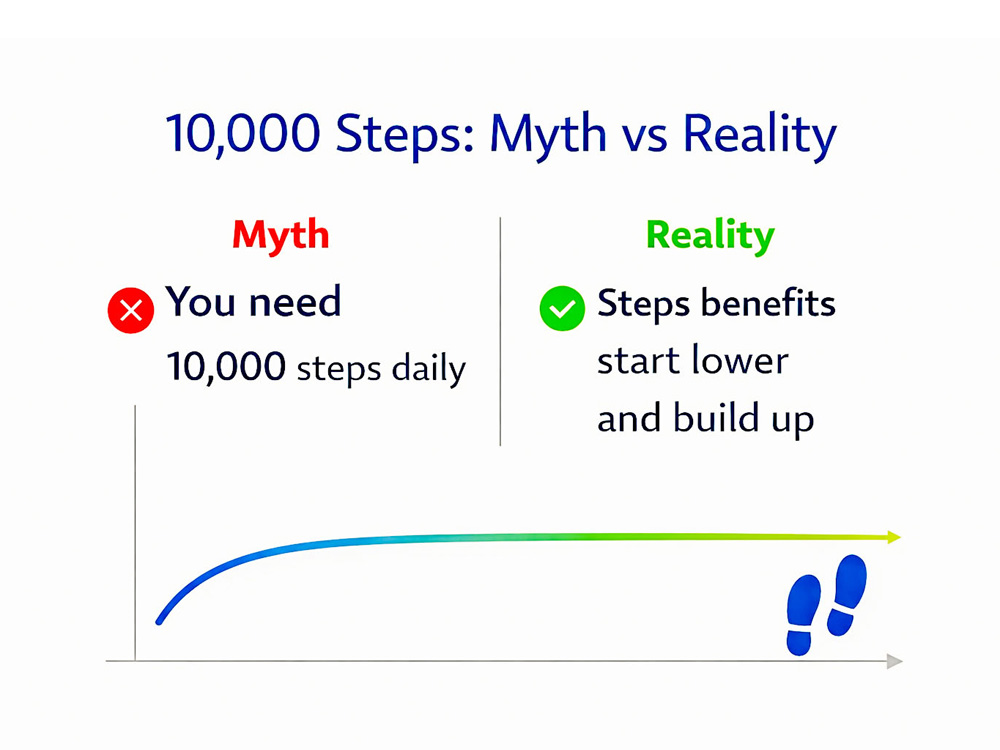
Walking 10,000 steps (roughly 5 miles or 8 km) each day is often touted as the ticket to better health. But is 10,000 steps truly a magic number? Where did it come from, and do you need that many steps to stay healthy?
This page contains affiliate links. If you buy products or services via these links, we may earn a small commission at no cost to you. If you are thinking of buying, please use our links, as it helps support our website and YouTube channel.
For many people, '10,000 steps a day' has become a default fitness goal - the number splashes across fitness trackers, health apps, and wellness challenges. In this article, we'll explore the origin of the 10,000-step target, how it became so popular, and what modern science says about how many steps per day you really need.
We'll bust the myth that you must hit 10k daily, reveal the genuine health benefits of walking (and the step counts at which those benefits kick in), and provide tips on increasing your daily steps. By the end, you'll understand how to use step counts as a motivational tool - without feeling guilty if you don't always hit that five-digit goal. Let's start at the beginning.
Health & Wellness Disclaimer
The information in this article is provided for general education and wellbeing purposes and is intended to support safe, confident walking as part of an active lifestyle.
Walking is suitable for most people. However, if you have a medical condition affecting your heart, circulation, balance, joints, or mobility - or have been advised to limit physical activity - you should consult your GP or a qualified healthcare professional before significantly increasing your daily step count.
If you are new to exercise, returning after a long break, or planning to increase your walking volume quickly, it is sensible to build up gradually and to seek professional advice if you are unsure what is appropriate for your individual circumstances.
This content is not intended as medical advice and should not be used as a substitute for personalised healthcare guidance. If you experience chest pain, dizziness, shortness of breath, or other concerning symptoms while walking or exercising, stop immediately and seek medical assistance.
The 10,000 steps target didn't originate in medical science - it began as a marketing concept. In 1965, a Japanese company named Yamasa Clock created one of the first commercial pedometers, calling it the 'Manpo-kei'. In Japanese, man means 10,000, po means steps, and kei means metre, so the name literally means '10,000 steps metre'.

The device was launched around the time of the 1964 Tokyo Olympics as part of a campaign to encourage people to move[1]. The choice of 10,000 was somewhat arbitrary: one explanation is that the Japanese character for '10,000' (万) resembles a person walking, making it a catchy branding gimmick[1].

The idea caught on, and walking clubs and public health programmes in Japan began promoting 10,000 steps per day as a general fitness goal.
Over time, this concept spread worldwide. Fitness tracker companies adopted 10,000 steps as the default goal on their devices, and it became ingrained in popular culture as the benchmark for an 'active' day. Importantly, no scientific study originally determined that 10,000 was the ideal number of daily steps - it gained credibility through repetition and simplicity.

After all, it's a nice round number and an easy target to remember. But does it truly represent a health threshold? To answer that, researchers eventually put the 10k rule to the test.
It turns out that 10,000 steps is more of a myth than a mandate. While taking plenty of steps is beneficial, modern studies have debunked the idea that you must reach 10,000 to be healthy.

In fact, many health benefits occur at much lower step counts. The '10,000 steps' figure has only a limited scientific basis[1] - it was a marketing invention that stuck. Researchers have been asking: how many steps per day are actually needed to achieve measurable health improvements?
Here's what the science shows:


Our Walks4all take:
The 10,000-step target is not a hard-and-fast rule grounded in a specific scientific threshold. It's an arbitrary number within a healthy activity range. The good news is that you don't need a full 10k steps to improve your health - even a few thousand steps a day has significant benefits, and hitting ~7,000-8,000 steps daily confers most of the advantages seen at 10,000 steps[4].
If 10,000 steps feels daunting, you can aim lower and still win big. The flip side is that going beyond 10k isn't harmful, but it may yield only small incremental gains for most people. So, think of 10,000 steps as an aspirational goal or a convenient number if you're already quite active, rather than a strict prescription.
The real 'trick' is simply to move more than you currently do. If you're averaging 2,000 steps now, try 4,000; if you usually get 5,000, try 7,000, and so on. Every extra step helps, and the biggest health gains come from moving from very low activity to moderate activity levels.

Walking is one of the easiest and most accessible forms of exercise - it requires no special equipment, can be done almost anywhere, and is gentle on the body. Even without focusing on step counts, it's well known that regular walking (or any moderate physical activity) can dramatically improve your health. Since we can now measure our steps, researchers have studied how step count relates to specific health benefits.
Below, we outline the key health benefits of walking and indicate roughly how many daily steps studies suggest you need to start seeing each benefit. Keep in mind that individual results vary, but these findings give a general idea of the step 'levels' of walking that matter.
Perhaps the most important benefit: walking more can help you live longer. Studies consistently show that higher daily step counts are linked to lower all-cause mortality (a lower risk of death from any cause). Crucially, you don't need anywhere near 10k steps for this effect to appear:
As mentioned earlier, around 4,000 steps per day is a key threshold at which significant mortality benefits begin. In one study, sedentary women averaging ~2,700 steps had the highest death rates, but those who reached ~4,400 steps/day cut their risk of death by 41%[2].
With more steps, the risk kept dropping until about 7,500 steps/day, where it levelled off[2]. In practical terms, moving from very low activity to roughly 4-5k steps/day produced substantial longevity gains, and ~7k+ steps/day was associated with the greatest longevity benefits in that older population[2].
In a general adult population (middle-aged men and women), a large study found that 8,000 steps/day was associated with about a 50% lower risk of death than 4,000 steps/day. At 12,000 steps/day, the risk of death was about 65% lower than at 4,000 steps. This indicates a level-response relationship: more steps = lower mortality risk, up to a high level. But even 8k steps - well below 10k - gave a huge benefit (half the risk of those walking 4,000 steps/day[3]).
A 2023 meta-analysis quantified this nicely: it found that, on average, for every additional 1,000 steps per day, a person's risk of premature death dropped by about 8-11%[4] up to ~10k steps. Even an extra 500 steps a day (about 5 minutes of walking) was linked to a few per cent lower mortality risk. This underscores that any increase in movement helps. The largest relative gains were seen when people moved out of the <3k steps range into the 4k, 5k, 6k range.
Our Walks4all take:
Where to start: If you are currently sedentary, aim for at least 3,000-5,000 steps a day to significantly improve longevity. That level is associated with notable reductions in the risk of death[4]. From there, adding more steps will continue to help, though with gradually smaller returns.
Aiming for ~7,000-8,000 steps daily is a great goal for longevity benefits, as studies suggest 7,000+ steps/day is associated with 50-70% lower mortality risk[5] compared to very low activity. Remember that beyond ~7,500-10,000 steps, the added survival benefit plateaus[2]. In short: move more, worry less about hitting an exact 10k.
Walking is a fantastic exercise for your heart and circulatory system. It counts as moderate aerobic activity, strengthening the heart muscle, improving circulation, and lowering blood pressure and cholesterol.
Here's how step counts relate to heart health:
Lower risk of heart disease and stroke: Research shows that people who take more steps have a significantly lower risk of heart attacks, stroke, and heart failure. For example, one analysis found that getting around 6,000-9,000 steps per day was associated with a 40-50% lower risk of cardiovascular disease[5] (such as coronary heart disease or stroke) compared with getting only ~2,000 steps per day. That means that if you currently take just a couple of thousand steps, increasing to ~6k or more could halve your long-term risk of a heart attack.
Benefits even at modest step counts: Even fairly low daily step counts can support heart health. A systematic review found that as few as ~2,300 steps/day was linked to a lower risk of dying from heart disease[4]. Essentially, any walking is better than none for your cardiovascular system.
One study of people with hypertension (high blood pressure) found that taking just an extra 1,000 steps each day was associated with significant reductions in cardiovascular events. In that group, every additional 1k steps led to about a 9% lower risk of a heart attack, a 22% lower risk of heart failure, and a 24% lower risk of stroke[8]. Notably, among hypertensive individuals, those who got above 3,000 steps/day had a 17% lower risk of major heart events[8] than those around 2,000-2,300 steps. So just crossing ~3k steps was a meaningful improvement for high-risk people.
Step 'levels' for heart health: A large meta-analysis found a linear reduction in cardiovascular mortality[5] as steps increased - risk kept falling up to about 10k steps/day. It identified ~7,000 steps/day as an 'optimal' volume[5], associated with ~50% lower risk of heart disease mortality (and ~7,100 steps/day for a 51% lower risk of cardiovascular events).

However, you don't need that many to start benefiting. Even roughly 2,700-3,000 steps/day yielded an ~10% reduction in the risk of death from heart disease in that analysis[5].
Our Walks4all take:
If you're sedentary, aim for at least 3k steps daily to support your heart, then push towards 5k, 7k, etc., for greater benefit. Between 6,000 and 10,000 steps/day appears to be a sweet spot for most heart benefits in older adults, whereas younger adults might see continued gains up to ~13k[5]. Regardless of age, regular brisk walking lowers blood pressure and improves circulation, which, over time, significantly reduces your risk of heart attacks and strokes.
Don't forget intensity: While total steps matter most for basic heart health, some research suggests that walking faster can confer additional cardiovascular benefits. A study in the UK found that people who walked at a brisk pace (higher stepping cadence) had better heart health outcomes than slower walkers[8], even when total steps were similar.
Brisk walking increases your heart rate, enhancing aerobic fitness and maintaining artery flexibility. To get the most benefit for your heart, focus not only on step count but also on walking quality - include some brisk sessions, like a 30-minute fast walk, if possible.

A good indicator of a brisk pace is being able to talk but not sing while walking. Nonetheless, any walking pace is beneficial - every gentle walk supports your heart health.
Walking is a calorie-burning activity, and regular walking can help with weight control and metabolic health (such as blood sugar regulation). While step counts don't directly measure exercise intensity, they correlate with the amount of activity you get, which in turn influences the calories burned.
Calories burned: The exact number of calories you burn while walking depends on your body weight, speed, and terrain, but rough estimates are available. On average, walking 10,000 steps (about 5 miles for most people) burns roughly 300-500 calories[11]. It can be a bit more for heavier individuals or if walking briskly (up to ~600-800 calories[11] in some cases), and less for lighter individuals or at a slower pace.
For many, 10k steps is roughly equivalent to ~5 miles of walking and perhaps 2 to 2.25 hours of activity spread throughout the day. If you can do that daily, you'd burn approximately 3,500 extra calories per week, which is roughly 1 lb of fat (since 1 lb of fat is ~3500 kcal). No wonder people often choose 10k steps as a weight-loss goal - it can indeed contribute significantly to a calorie deficit over time.
Fewer steps still burn substantial calories: You don't need to hit 10k to burn calories. Every 1,000 steps you take burns roughly 40-50 calories (this varies, but a common figure is ~0.04-0.05 kcal per step for a 70 kg person). So even a 5,000-step day might burn about 200-250 calories beyond your resting level. Over 7 days, that could be on the order of 1,400+ calories - not trivial at all. If you currently maintain your weight with minimal exercise, adding an extra 5k steps each day could help you lose ~0.4 lb in a week (assuming diet is controlled), or ~1.5-2 lb per month, which is a healthy, sustainable rate.
Weight loss and fat reduction: Walking alone results in modest weight loss unless paired with dietary changes, but it still helps. Studies have shown that people who increase their daily steps (e.g. by using pedometers to set goals) tend to lose a small amount of weight compared with those who remain sedentary - often in the range of a few pounds over several months[14], assuming no increase in calorie intake.
More importantly, walking helps prevent weight gain. It improves your body's insulin sensitivity and helps regulate blood sugar, reducing the risk of type 2 diabetes. In fact, research has found that higher daily step counts are associated with a lower incidence of diabetes and metabolic syndrome[12]. Even 30 minutes of brisk walking (about 3,000-4,000 steps) per day, when done consistently, can significantly improve markers such as blood glucose control and waist circumference.
Where benefits start: For weight management, any increase in steps boosts your daily calorie burn. Aim to reach at least 5,000-7,000 steps per day to move out of the 'low activity' category. This level of daily movement, combined with sensible eating, helps ward off the gradual weight gain many adults experience. If weight loss is a goal, aim for 8,000-10,000 steps daily (and beyond, if possible) to maximise your calorie expenditure from walking.
Remember, however, that diet plays a crucial role, as walking off 500 calories can be undone by a couple of extra biscuits or a sugary drink. So, think of walking as a tool to tip your energy balance and improve your fitness, rather than as a free pass to eat whatever you like. Many people find that meeting a step goal also motivates them to make healthier food choices, creating a virtuous cycle for weight control.
Metabolic perks: Walking frequently can slightly raise your resting metabolic rate by preserving lean muscle mass, and it definitely helps reduce visceral fat (the unhealthy fat around organs). It's also a low-impact way to reduce inflammation in the body.
Compared with being sedentary, getting, say, 7,000+ steps a day is linked to lower triglyceride (blood fat) levels and higher HDL ('good') cholesterol, both of which are positive for metabolic health. If you can incorporate a walk after meals (even a 10-minute stroll), it can blunt blood sugar spikes, which, over time, reduces the risk of diabetes.
Our Walks4all take:
Walking off some calories each day and keeping your muscles active are great for your metabolism - they help you maintain a healthy weight and keep your blood chemistry in check.
Walking isn't just good for the body - it's also powerful for the mind. If '10,000 steps' has one unquestionable benefit, it's that it encourages people to get outside, breathe fresh air, and break up sedentary time, all of which can boost mental well-being.
Here are the mental health and cognitive upsides of walking, and how they relate to step counts:
Improved mood and lower risk of depression: Regular physical activity, including walking, is a proven mood lifter. It releases endorphins and can reduce symptoms of anxiety and depression. Research specifically examining step counts found that adults who achieved at least ~5,000 steps per day had significantly lower depressive symptoms[7] than those who did under 5k.
In cross-sectional studies (snapshots in time), people logging 5,000+ steps tended to report better mood and less depression. Moreover, in long-term prospective studies, individuals averaging 7,000 or more steps a day had a lower risk of developing depression[7] than less active people. So it seems that the 5k-7k steps range is a meaningful threshold for mental health benefits, again, far below 10k.
Stress reduction and creativity: Going for a walk is a great way to clear your head. Even a brief walk (a few thousand steps) can reduce stress hormones such as cortisol, especially in a pleasant environment or green space. Many people find that walking boosts their creativity and problem-solving - there's a reason people take 'walk breaks' to think through tough problems.
These benefits aren't easily quantified by a step count, but the act of moving, at any step count, helps to relax and refresh the mind. If you're stuck at a desk feeling sluggish or stressed, even a 10-minute walk can markedly improve your mental state.
Cognitive benefits and dementia risk: Exciting research indicates that higher daily step counts are linked to better brain health, particularly in older adults. A large UK study published in 2022 found that about 9,800 steps per day was the 'optimal level' associated with a 50% lower risk of dementia onset compared with minimal activity. Importantly, they also found that even around 3,800 steps/day was associated with a 25% lower risk of dementia[6]. In other words, moderate daily walking may help protect the brain as you age.
The mechanism isn't entirely clear, but it likely involves improved blood flow, reduced vascular risk factors, and perhaps direct exercise benefits on brain-derived neurotrophic factor (BDNF), which supports neuronal health.
Additionally, walking at a brisk pace showed an additional benefit for reducing dementia risk in that study, suggesting that intensity can also play a role. But the key is that you don't need to be a marathon runner: a daily habit of moving (on the order of a few thousand steps) correlates with maintaining cognitive function.
Better sleep and energy: Regular walkers often report better sleep quality and higher energy levels day to day. Physical activity helps regulate your circadian rhythm. While there isn't a specific step threshold for sleep benefits, one could infer that meeting the standard physical activity guidelines (which might correspond to ~7,000-8,000 steps/day) is linked to more restful sleep at night.
With better sleep comes better mental focus and mood during the day - a virtuous cycle. So in striving to reach your step goals, you may incidentally improve your sleep hygiene, which also boosts mental health.
Social connection and confidence: Walking can also have indirect mental health benefits by increasing social interactions (if you walk with friends or join walking groups) and boosting self-esteem. Hitting a step goal can give a sense of accomplishment.
Many people find that gradually increasing their walking and fitness makes them feel more confident and capable, which translates into a more positive mental outlook. Again, there's no magic number, whether it's 6,000 steps or 10,000 steps, whatever goal you set and achieve can provide a psychological lift.
Our Walks4all take:
Even relatively low levels of walking (a few thousand steps a day) are associated with better mental well-being than being completely sedentary. Try to get at least 5,000 steps daily as a mental-health maintenance level, and more if possible.
Use walks as 'me time' - listen to music or a podcast, chat with a friend, or just enjoy the scenery. The mind-clearing benefits kick in quickly. And over the long term, maintaining a good step count could help keep your brain sharp and your mood elevated.
Walking offers additional perks beyond the headline health outcomes:
Stronger muscles and bones: Walking is a weight-bearing exercise, so it helps strengthen your leg and core muscles and maintains bone density. While it's not as intense as running or resistance training, a high daily step count does put repeated mild stress on bones that signals them to retain calcium and stay strong.
This can help reduce the risk of osteoporosis over time. Studies show that older adults who are more active (e.g. taking more daily steps) tend to have better bone density than their sedentary peers, likely due to frequent micro-loads on the skeleton.
Joint health and balance: There's a misconception that a lot of walking might wear out your knees, hips or feet, but in fact, moderate walking improves joint health. The movement lubricates the joints and strengthens the muscles around them. For people with knee osteoarthritis, like me, walking can reduce pain and improve function - as long as it's not overdone.
If you're not used to walking, build up gradually to allow your joints to adapt. Higher step counts also improve your balance and coordination, especially when walking on varied terrain. This can significantly reduce the risk of falls in older adults. In fact, higher daily step counts have been linked to a lower incidence of falls in older adults[13] - likely because regular walking keeps the body's balance systems tuned.
Reduced risk of certain cancers: Emerging evidence suggests that regular physical activity, including walking, can lower the risk of some cancers. For instance, women who stay active have a reduced risk of postmenopausal breast cancer, and physical activity is linked to a lower risk of colon cancer in both sexes. While studies typically measure activity in minutes or METs, it can be inferred that those consistently achieving higher step counts are in the lower-risk groups.
The BHF article we cited notes that research has linked 10,000 steps/day to a reduced risk of developing cancer[13] (along with heart disease and dementia). The exact mechanism is complex, but exercise may help regulate hormones, reduce inflammation, and improve immune surveillance, all of which can help prevent cancer.
Better quality of life: People who walk more often report higher overall quality of life - better mobility, greater independence in old age, and even improved digestion and gut health. Walking can help alleviate constipation, for example, and generally keeps your body's systems running smoothly. It's also associated with a longer healthspan (the number of years lived in good health, not just total years lived). Essentially, the more you move, the longer you're likely to remain free of chronic disabilities.
Environmental and social benefits: While not a direct health outcome, choosing to walk rather than drive for short trips (if feasible) can have broader benefits - reduced carbon emissions and greater social engagement in your community. These factors indirectly contribute to public health and individual well-being (e.g., cleaner air, safer streets). So, your stepping habit might even be doing some collective good!
Our Walks4all take:
Walking and accumulating steps each day provides comprehensive health benefits - physical, mental, and even social. Critically, you don't need to hit 10,000 for most of these benefits to manifest. Any increase in your daily steps is a step in the right direction.
The key takeaway is to move more and sit less. Whether that means 6,000, 8,000, or 12,000 steps for you, the goal is to find a sustainable physical activity routine that keeps you healthy.
Many people wonder what 10,000 steps actually translates to in terms of distance. The distance covered per step varies from person to person (based on factors like height and walking speed), but here are some useful estimates:
On average, 10,000 steps ≈ is 5 miles (8 kilometres). For an average-height adult, 1 mile of walking = ~2,000 to 2,500 steps[10]. This means if you walk 10k steps, you're likely covering roughly 4.5 to 5 miles. For metric-minded readers, 10k steps is roughly 8 km. On average, it would take most people about 1.5 to 2 hours of walking to accumulate 10,000 steps, if done all at once.

Step length variations: Taller individuals or those with a longer stride might cover a mile in around 1,900-2,000 steps, while shorter individuals might take around 2,400-2,500 steps per mile. If you're curious about your step length, you can measure it by walking a known distance (say, 1 mile or 1 km) and counting your steps, then dividing the distance by the number of steps.
Quick conversion: As a rule of thumb for a moderate pace:
These are rough figures, but they give a sense of the variations in steps. So, if you managed only 5,000 steps today, that's still around a 4 km walk - nothing to sneeze at!
Higher step counts: 15,000 steps would be roughly 7.5 miles (12 km), and 20,000 steps would be around 10 miles (16 km) - that's a very active day for most people. Remember, everyday activities around the house or office also contribute to step count, not just dedicated walks. So, distances can accumulate throughout the day.
Knowing the distance can be motivating: For example, realising that walking an extra 2,000 steps is roughly equivalent to an extra mile might encourage you to take a quick evening stroll around the block. Many people find it fun to convert steps into distance and even to 'walk' virtually to far destinations over time (using their cumulative miles).
If you prefer metric: approximately 1 km = 1,300-1,500 steps[10], depending on stride. So 10k steps is ~8 km, as stated above.
Using this information, you can set distance goals as well as step goals. For instance, aiming for '3 miles a day' of walking might resonate more than a step count. In fact, some health guidelines suggest that adults should get around 150 minutes of moderate exercise per week, which for walking translates to roughly 30 minutes a day, five days a week.
30 minutes of brisk walking is roughly 2-3 km, which is about 3,000-4,000 steps. So, the classic guidelines are roughly equivalent to ~7,000-8,000 steps per day on those days (once you include daily activity). This again shows that 10k is above and beyond the basic recommendations.
Our Walks4all take:
Feel free to use whichever metric motivates you - steps or distance. Some people love watching the step counter tick up, while others prefer thinking, 'I walked 4 miles today!'. Both reflect your activity. The end goal is to move enough to benefit your health. For me, I've always been a 'miles walked' kind of man.
Another common question is how steps translate into calories burned. As mentioned in the weight management section, walking 10,000 steps per day burns roughly 300-500 calories[11] for most people.

The range is wide because calorie burn depends on several factors:
Despite these variables, here are some handy calorie estimates:
Per mile: A rule of thumb is about 80-100 calories per mile for an average adult (roughly 1.6 km). So if you walk 5 miles (8 km) for 10k steps, you might burn about 400-500 calories. This aligns with the earlier figure.
Per step, an average person burns roughly 0.04-0.05 calories. That's about 4-5 calories for 100 steps. It sounds tiny, but it adds up to over 1,000 steps (~40-50 kcal). If you weigh more, it could be closer to 0.06 cal/step; if less, maybe 0.03 cal/step.
10k steps examples: The British Heart Foundation notes that 10,000 steps burn between 300 and 800 calories[11], depending on weight and height. To break that down: a petite person might be at the lower end (300 kcal), an average person around 400-500 kcal, and a larger or faster-walking person at 600-800 kcal.
What about lower step counts?
These are ballpark figures. If you want a personalised estimate, some fitness apps or wearable trackers use your weight and speed to calculate calorie burn more precisely.
Keep in mind: The calorie numbers might not seem huge (a fancy sweet coffee drink can negate 5,000 steps worth of exercise!), but over time they are significant. Burning an extra 300 calories a day through walking, if not offset by eating more, could lead to roughly 0.6 lbs (0.3 kg) of weight loss per week. Plus, walking has metabolic benefits beyond just the raw calories, such as improved insulin sensitivity, etc., which can aid weight management.
Many people use step counting as a fun way to challenge themselves to burn more calories. For instance, you might set a goal to burn an extra 100 calories a day by adding ~2,000+ steps. Over a year, that could burn ~36,500 extra calories, equivalent to about 10 pounds of fat - purely through walking. Not everyone will lose 10 pounds, as bodies adjust (and appetites might increase), but it certainly helps tilt the balance in favour of weight control.
Our Walks4all take:
Walking is an effective, low-impact way to increase your daily calorie expenditure. Whether your goal is weight loss, maintenance, or simply offsetting a desk job's sedentary lifestyle, counting steps can help you reach a daily calorie-burning target. Just remember that diet and exercise go hand in hand - for best results, do both: move more and mind your nutrition. It is often said that you cannot out-exercise a bad diet!
If you find you're not reaching the step count you want, don't worry - there are plenty of simple ways to sneak more steps into your day. Here are some practical, real-world tips to boost your step count (and overall activity), even if you have a busy schedule:


Finally, remember to wear comfortable shoes, well-fitting socks, and stay hydrated. If you're increasing your walking, you want to avoid blisters or foot pain. Good footwear and possibly an insole can make a big difference if you're racking up lots of steps.

Increasing your daily steps doesn't necessarily mean setting aside an hour to exercise (though if you can, great!). It's more about integrating movement into your lifestyle - a concept known as 'NEAT' (Non-Exercise Activity Thermogenesis). These are the calories and movements you burn outside of formal workouts. By making small tweaks to your routine as listed above, you can dramatically raise your NEAT and step count without feeling like you're spending a lot of extra time.
Every step truly does count - so find what works for you and step it up!

It originated in Japan in the 1960s as a marketing slogan for a pedometer. A device called the Manpo-kei (meaning '10,000-step meter' in Japanese) was released in 1965 ahead of the Tokyo Olympics[1]. The manufacturers chose 10,000 because the Japanese character for 10,000 (万) looks like a person walking, and it was a memorable number.
The concept caught on and over the years became popular worldwide, but it wasn't based on medical research - it was essentially a marketing-driven goal that gained cultural popularity.
No - 10,000 steps is not a strict requirement. It's a great goal if you can reach it, but it's not a magic cut-off. Many health benefits occur at lower step counts (e.g. 5k or 7k steps). Studies have shown significant health improvements with 4,000-8,000 steps per day, well below the 10k mark[3].
For example, ~7,000 steps/day is linked to substantially lower mortality and morbidity risk. The 10k target is best seen as an upper-end goal for extra benefit or motivation. If you currently walk very little, you will get healthier by taking more steps, whether that's 5k or 10k. In short, 10,000 steps is not a 'must' for health; it's an optional challenge. Doing something is far better than doing nothing; you don't fail by not hitting 10k steps.
There's no universal cut-off, but general guidelines and research provide some categories. Often:
In summary, getting ~7,000 steps or more per day is a good ballpark for being 'active' in a health sense. Even 5,000+ has been linked to health benefits (such as a reduced risk of depression, as one meta-analysis noted). If you're looking for a simple target: aim for at least 150 minutes of moderate activity per week (per WHO and NHS guidelines) - that often translates to roughly 7,000 steps a day on average.
For most people, 10,000 steps is about 5 miles. In metric, that's about 8 kilometres. However, it depends on your stride length.
On average, 1 mile is about 2,000 steps[10], give or take a few hundred. So if you want a quick conversion: your step count divided by 2,000 is roughly your miles walked. For example, 6,000 steps is roughly 3 miles, and 15,000 steps is about 7.5 miles.
If you track kilometres, 10,000 steps is ~8 km, so roughly 1,250 steps per kilometre (using an average stride). Remember, these are estimates - individual differences matter. But it gives a sense: hitting 10k steps means covering quite a distance!
Roughly around 400-500 calories for an average adult, but it can range from about 300 up to 800 calories[11], depending on factors:
A commonly cited rule is ~100 calories per mile for an average person. Since 10k steps is ~5 miles, that's ~500 calories. The British Heart Foundation notes that 10k steps burns 300-800 kcal, depending on weight and height. So yes - it's significant!
Keep in mind that calorie burn also depends on your baseline metabolism. Fitness trackers often estimate calorie burn based on your weight. For smaller step counts, 1,000 steps might burn roughly 40-50 calories; 5,000 steps might burn 200-250 calories. It's a useful way to think about balancing food intake and activity - e.g., a 500-calorie dessert might 'cost' about 10k steps to burn off. But since walking has many benefits beyond calories, don't let that equation discourage you from a treat here or there.
It can certainly help, especially combined with a healthy diet. Walking 10k steps burns around 500 calories for many people. Over 7 days, that's ~3,500 calories, roughly equivalent to 1 pound of fat. So, in theory, yes, walking 10k steps daily without increasing calorie intake could lead to losing about a pound a week.
In practice, weight loss might be a bit slower because your body can adjust (and people sometimes eat a bit more when they exercise due to increased appetite). However, many individuals do find that walking 10k a day helps them steadily lose weight or at least inches off the waist. It's a sustainable, low-impact form of exercise.
Just avoid rewarding yourself with a huge treat every time you hit 10k, or you might end up eating back the calories! Pair your walking habit with mindful nutrition for the best results. Aside from the scale, also notice improvements in how your clothes fit, your stamina, and your leg muscle tone - walking can definitely firm things up over time.
Absolutely, yes. Nothing special happens suddenly at 10,000; benefits are incremental. Even going from, say, 1,000 to 3,000 steps a day is hugely beneficial for your health. Research shows that most health gains occur at the lower end of the step spectrum:
Focus on improving your own baseline. If you average 3k now, aim to consistently do 5k; if you do 5k, aim for 7k, etc. Any increase will benefit your heart, lungs, waistline, and mood. Every step is a gain for your health, not an all-or-nothing target.
Both matter, but in different ways. For basic health outcomes and longevity, the total number of steps per day is a stronger predictor than step intensity. In studies, when adjusting for total steps, walking speed (steps/minute) often didn't significantly change mortality risk - meaning 8,000 slow steps and 8,000 brisk steps had similar benefits for mortality[3]. So, if you're mainly focused on health and not fitness, just get your steps in at any pace you can.
However, intensity isn't irrelevant, as walking faster improves cardiovascular fitness more.
The recommendation is: First, get into the habit of reaching a reasonable step count each day, even at a comfortable pace. That's the foundation. Once you're consistent, if you're able, try to include a portion of those steps as 'brisk walking' (e.g. a 20-minute power walk). You can gauge briskness by the talk/sing test (can talk but not sing easily while walking).
For example, 100 steps per minute is often considered a moderate-intensity pace[15]. If you get at least 30 minutes of brisk walking on most days (which might be ~3,000+ steps at a faster pace), you'll be meeting standard exercise guidelines and overall movement - this confers fitness benefits such as better aerobic capacity, blood pressure, and endurance.
Not everyone can walk fast because of joint issues or other factors, and that's okay: slow walking still counts and is far better than sitting. To sum up, step count is king for general health, and step intensity is a bonus - great to have for extra fitness if you can manage it.
For general health, 10k steps a day is an excellent level of activity for most people, likely exceeding the basic public health exercise recommendations. It depends on what those steps involve: if 10k steps include some brisk walking that raises your heart rate, then you're effectively doing a good chunk of moderate exercise.
10k leisurely steps spread over a day still burn calories and keep you moving, but may not strengthen your heart as much as, say, a continuous 30-minute aerobic session. However, purely from a health standpoint (reducing the risk of chronic diseases and improving longevity), accumulated daily activity - even in short bouts - has been shown to be effective.
Yes, 10k steps daily will put most people in the 'physically active' category and yield health benefits across the board. For many, that's roughly 60-90 minutes of walking, which meets the 150 min/week moderate exercise guideline.
One thing to watch: if all your steps are very slow and you still spend hours sitting without interruption, you might want to make sure you occasionally elevate your heart rate. But in general, someone hitting 10k/day is likely doing enough. Of course, 'enough' depends on your goals:
If your goal is cardio fitness or endurance, you might supplement steps with more intense exercise (such as jogging, cycling, or sports) because 10k steps (especially if slow) may not significantly improve VO2 max (a measure of cardiovascular fitness) - though they will maintain basic fitness.
If your goal is to build muscle strength, walking won't replace resistance training, so you'd need to add some strength exercises.
However, for overall health and maintaining a healthy weight, 10k steps is a great daily routine. In fact, studies show health markers continue to improve up to a point as daily steps increase, and 10k is near that high end of typical free-living activity[5]. So, consider 10k steps a solid baseline for an active lifestyle. If you enjoy other activities, mix them in, but if walking is what you like, 10k a day will serve you very well.
Adding in more steps is easier than you might think. Here are a few quick ideas:
In short, treat movement as a lifestyle, not a gym-based workout. Small changes like taking the long way around the supermarket aisles or pacing while brushing your teeth can help those numbers without feeling like structured exercise. You'll be surprised how quickly it becomes second nature to find chances to walk. Remember: Sitting is the new smoking, so every chance you get to stand up and move is beneficial.
Still curious? Explore our guides to understanding health research, the limitations of walking studies, and our glossary of key terms.
January 2026
We take evidence seriously at Walks4all. If you'd like to better understand how walking studies are designed, how results should be interpreted, and what scientific terms mean, explore our guides on the following: