By using this website, you agree to our use of cookies (needed to provide our website’s features) and our Terms of Use.
By: Andrew Forrest - July 2026
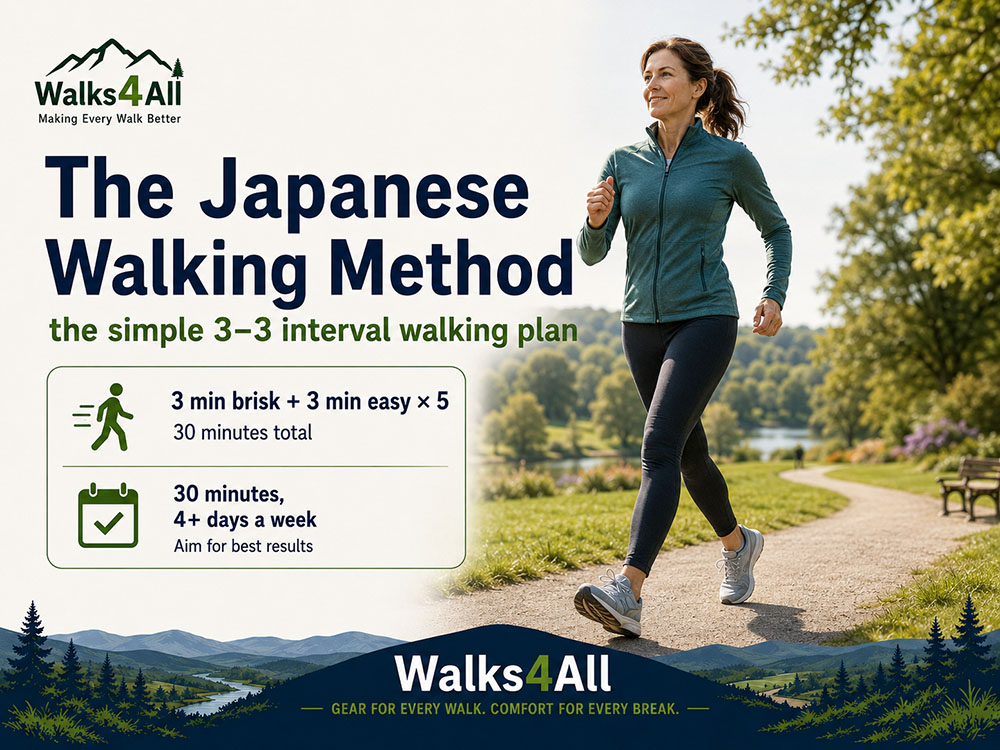
Japanese walking means 3 minutes brisk, 3 minutes easy, five times over. Here is how to do it properly, what the research really shows, and who it suits.
This page contains affiliate links. As an Amazon Associate, we earn from qualifying Amazon purchases at no additional cost to you. We may also earn commissions from other retailers, again at no additional cost to you.
Japanese walking, known to researchers as interval walking training, involves alternating three minutes of brisk walking with three minutes of easy walking, repeated five times for about thirty minutes, on four or more days a week. In trials, it improved fitness, leg strength, and blood pressure more than steady walking did. It is a fine, low-cost way to get fitter in less time, though the claims that it beats 10,000 steps are overstated.[1 ‑ 4]
If your online feeds have filled up with people striding around the park on a three-minute-on, three-minute-off timer, you have encountered Japanese walking. It is the fitness trend of the moment, but the odd thing is that it is not new at all.
Japanese researchers developed it more than twenty years ago, and the science behind it is stronger than that underpinning most viral workouts. It is also wrapped in a fair amount of hype. This guide gives you the method in full, what the research does and does not show, and how to do it well, with every claim tied to the study behind it.
We write evidence-led walking books and articles, and we read the original trials rather than repeating headlines. Where the research is strong, we say so; where it is thin or oversold, we say so too.
Health & Wellness Disclaimer
The information in this article is intended for general education and wellbeing and focuses on walking, particularly interval and brisk walking (the Japanese walking method), and on lifestyle habits that may support overall fitness and health.
Interval walking involves short bursts of higher-intensity efforts. If you have any medical condition affecting your heart, circulation, blood pressure, breathing, joints, bones, balance or blood sugar, such as heart disease, angina, a previous heart attack, an irregular heart rhythm, uncontrolled high blood pressure, a lung condition, arthritis or joint problems, osteoporosis, a history of falls, or diabetes (type 1 or type 2), or if you are pregnant, or if you take medicines that affect your heart rate or blood glucose (for example beta-blockers or insulin), consult your GP or another qualified healthcare professional before starting or increasing brisk-interval walking.
If you are new to exercise, returning to activity after a long break, recovering from illness, injury or surgery, or significantly increasing your walking intensity, frequency or duration, it is sensible to seek professional guidance to ensure your approach is safe and appropriate for your individual circumstances. Build up gradually rather than starting at full intensity.
The information provided is for general educational purposes only and does not constitute medical advice or a substitute for professional healthcare. Stop and seek help if you experience chest pain or tightness, unusual breathlessness, dizziness or faintness, an irregular or racing heartbeat, or sharp joint pain. If symptoms are severe, call 999 or attend A&E. Always consult your GP or a qualified healthcare provider for personalised medical advice, diagnosis and treatment.
Japanese walking is a form of interval walking training (IWT): you alternate between three minutes of brisk walking and three minutes of gentle walking, repeating the cycle five times to make a thirty-minute session. On social media, it is also known as 'the 3-3 method' or '3×3 walking'. The principle is simple: instead of plodding at a steady pace, you push hard, recover, and push again, which asks more of your heart and legs than a flat stroll ever does.
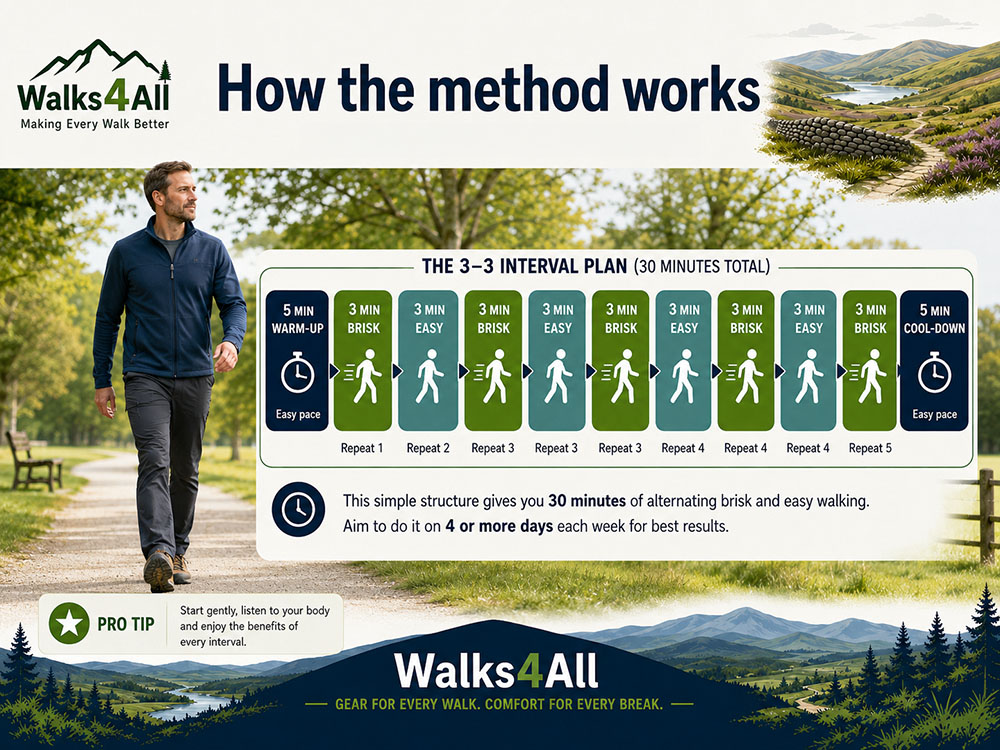
This hybrid timeline makes the Japanese walking structure clear at a glance: warm up, alternate brisk and easy blocks five times, then cool down.
IWT was developed at Shinshu University in Matsumoto, Japan, by Professor Hiroshi Nose and Dr Shizue Masuki, whose team has studied it for two decades. A quick correction is worth making, as many people online believe it was created by 'Dr Tanaka'. Hiroaki Tanaka of Fukuoka University was a different researcher, known for 'slow jogging', a separate method.[1] [2]
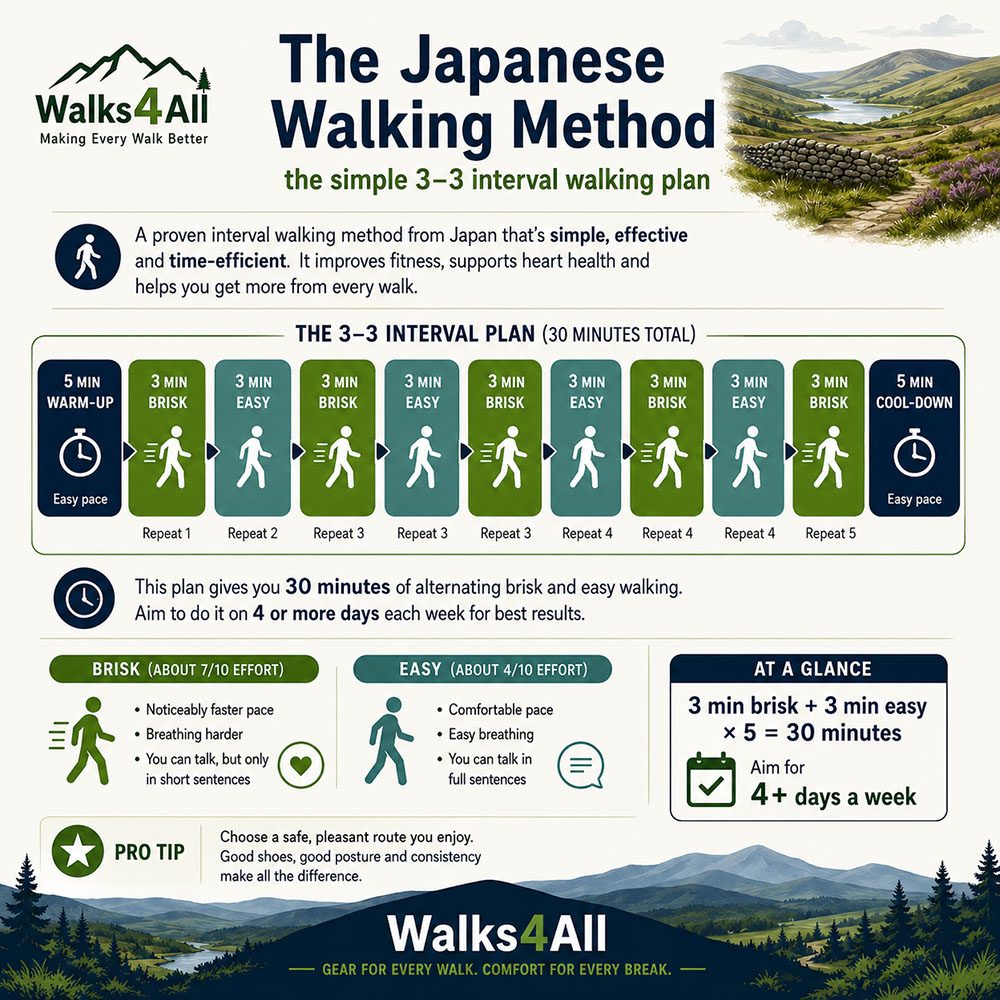
The Japanese walking method is a simple interval walking training plan: alternate 3 minutes brisk walking with 3 minutes easy walking 5 times, then repeat on 4+ days a week.
The whole session takes about 40 minutes, including a warm-up and cool-down.
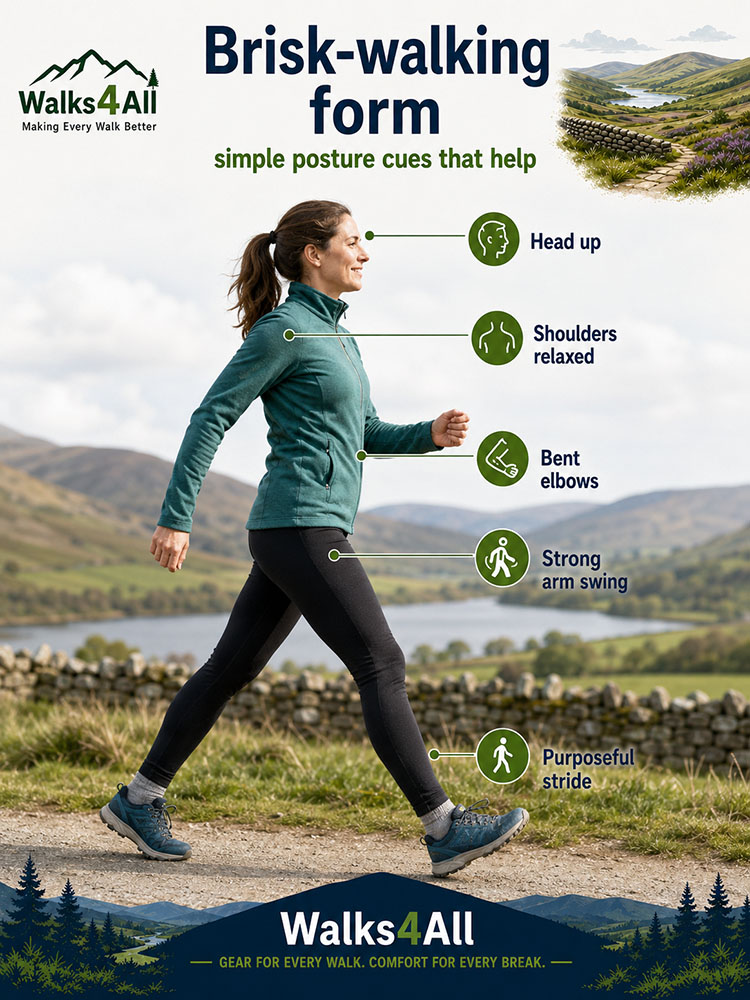
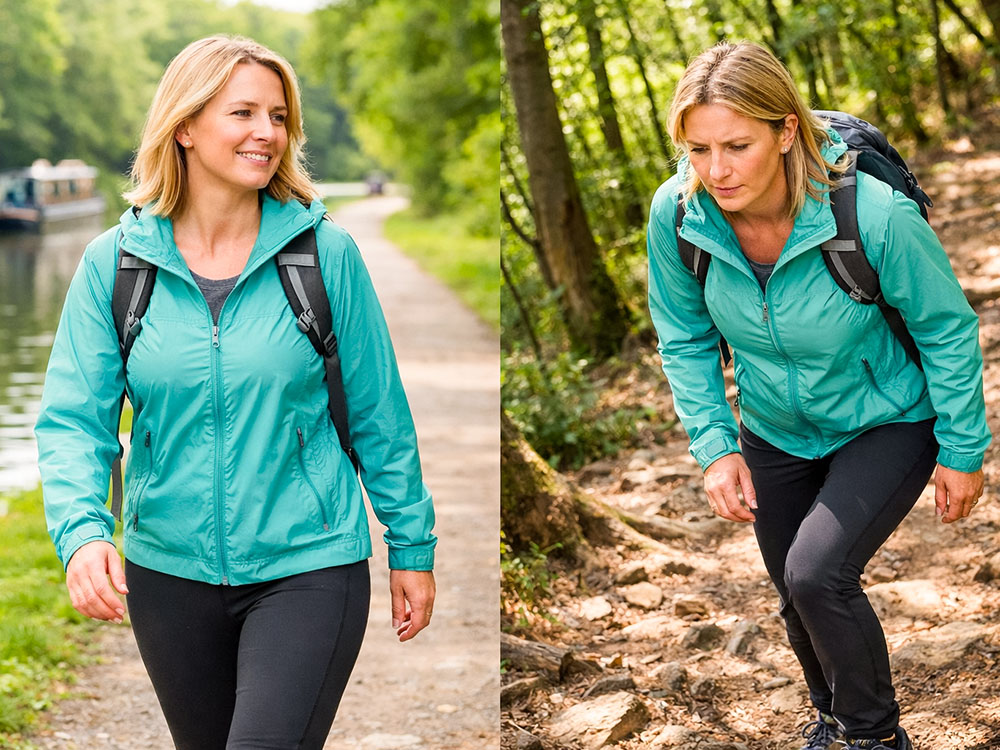
Good brisk-walking form helps the hard blocks feel purposeful: stand tall, keep you shoulders relaxed, bend your elbows and swing your arms naturally.
Here it is, step by step:
1. Warm up for five minutes at an easy, comfortable pace.
2. Walk briskly for three minutes at an effort where you are breathing hard and can speak only in short sentences.
3. Walk gently for three minutes, slowing to a pace at which you could hold a full conversation.
4. Repeat that brisk-then-gentle cycle five times, which totals thirty minutes of intervals.
5. Cool down for five minutes at an easy pace, and stretch if you wish.
6. Aim to do it on four or more days a week. This is the frequency used in the research.[1] [2]
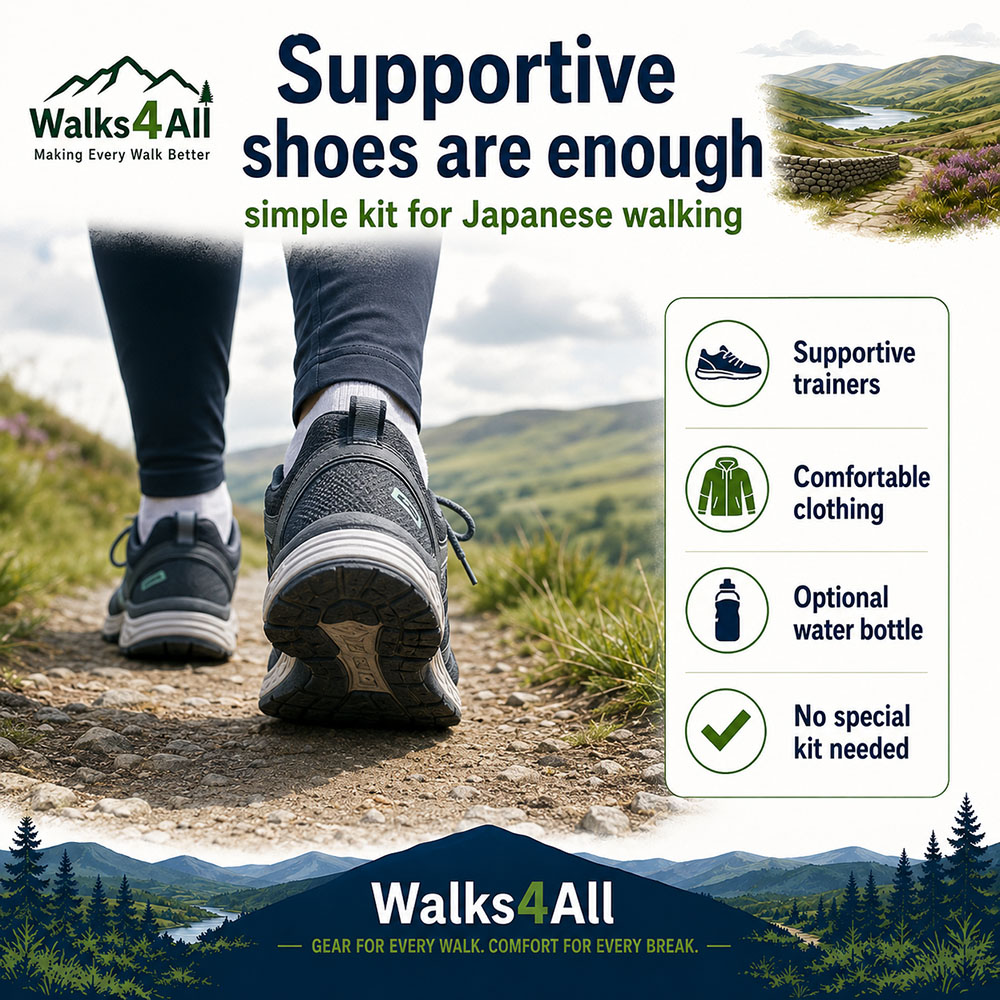
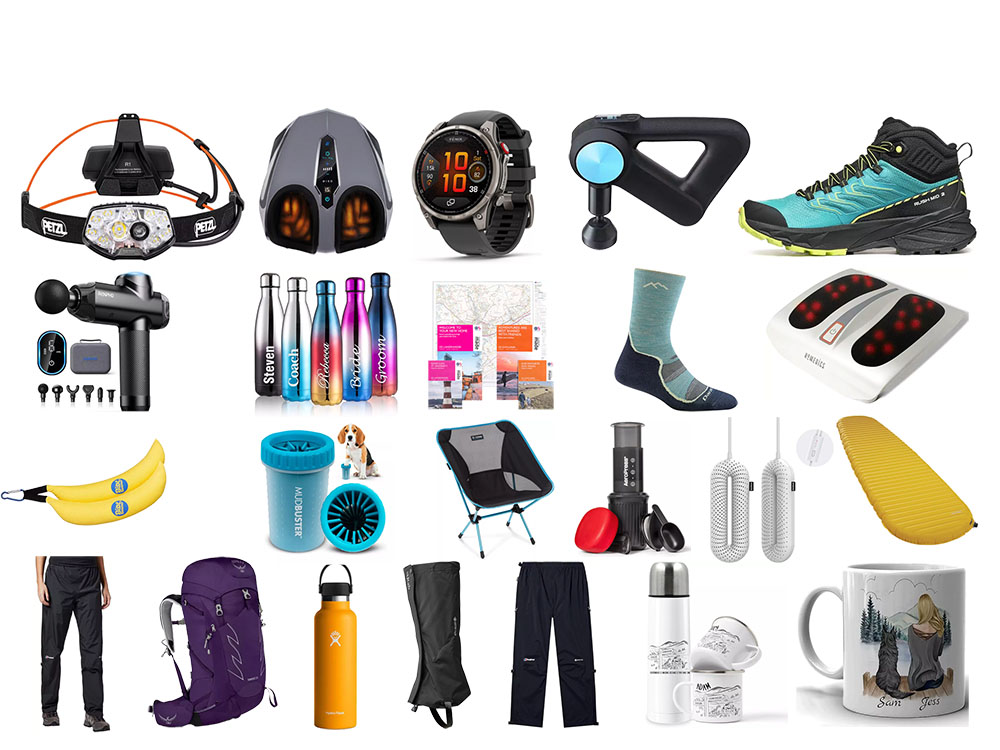
The kit for Japanese walking is simple: supportive trainers, comfortable clothing, a safe route and, if useful, water and a timer.
You need nothing more than supportive shoes, a safe route or a treadmill, and a way to time three-minute blocks. A phone timer or a free interval-timer app works.
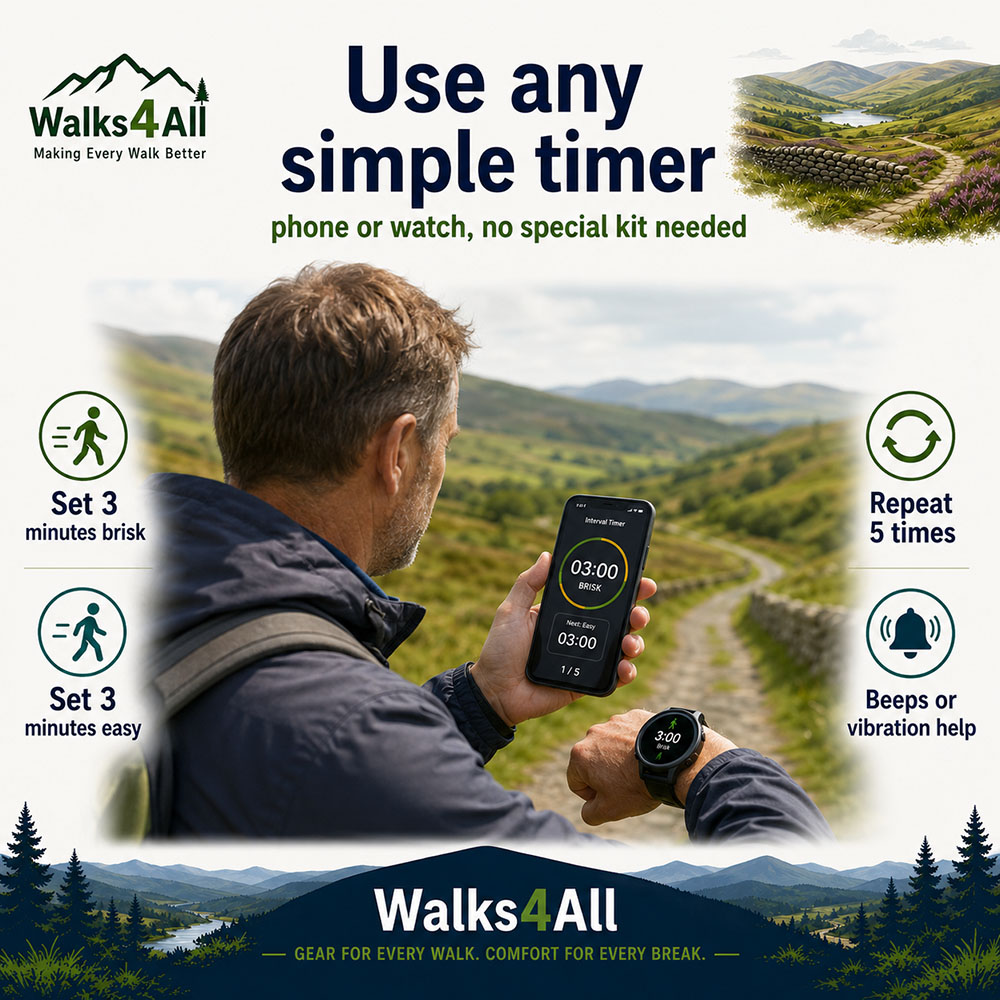
A phone timer, smartwatch or interval app is enough to track the 3-minute brisk and 3-minute easy blocks in Japanese walking.
The most common mistake is not pushing hard enough on the brisk blocks and not slowing down enough on the easy ones. The original studies set the brisk pace at about 70% of a person's peak aerobic capacity and the easy pace at about 40%, both measured in a lab. You do not have a lab, so use effort instead.[1] [2]
Here are three ways to gauge it.
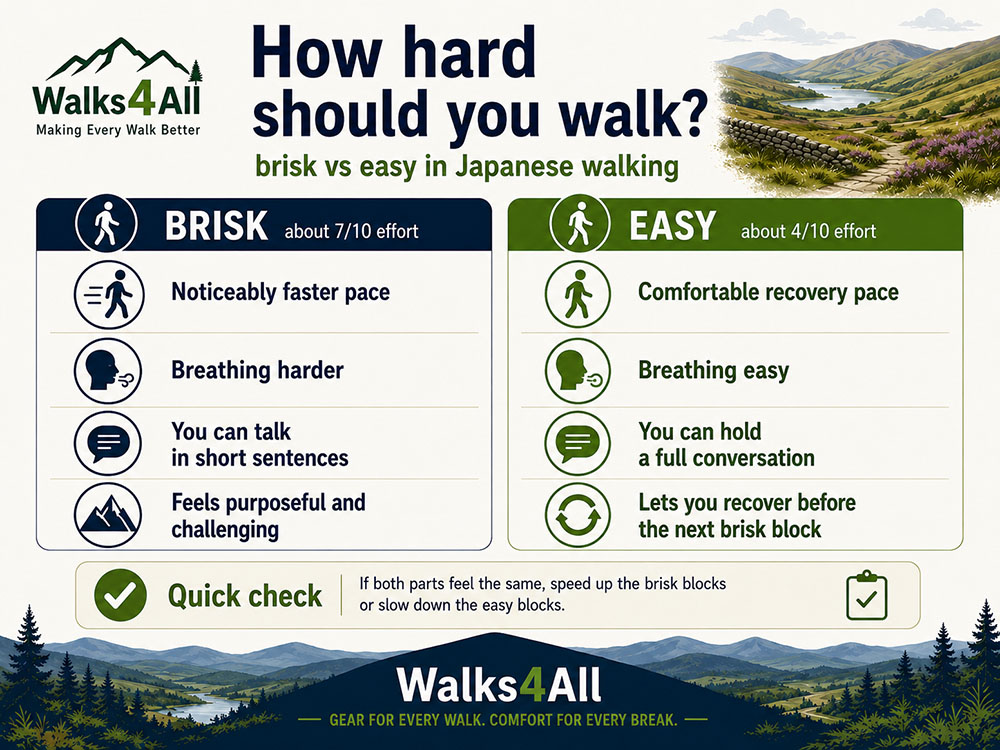
Use perceived effort, breathing and the talk test to keep the brisk blocks challenging and the easy blocks genuinely easy during Japanese walking.
| Gauge | Brisk (hard) block | Gentle (easy) block |
| Effort out of 10 | About 7/10 | About 4/10 |
| The talk test | Breathing hard; short sentences only | Comfortable; full conversation |
| Heart rate, if worn | About 70-80% of maximum | About 50-60% of maximum |
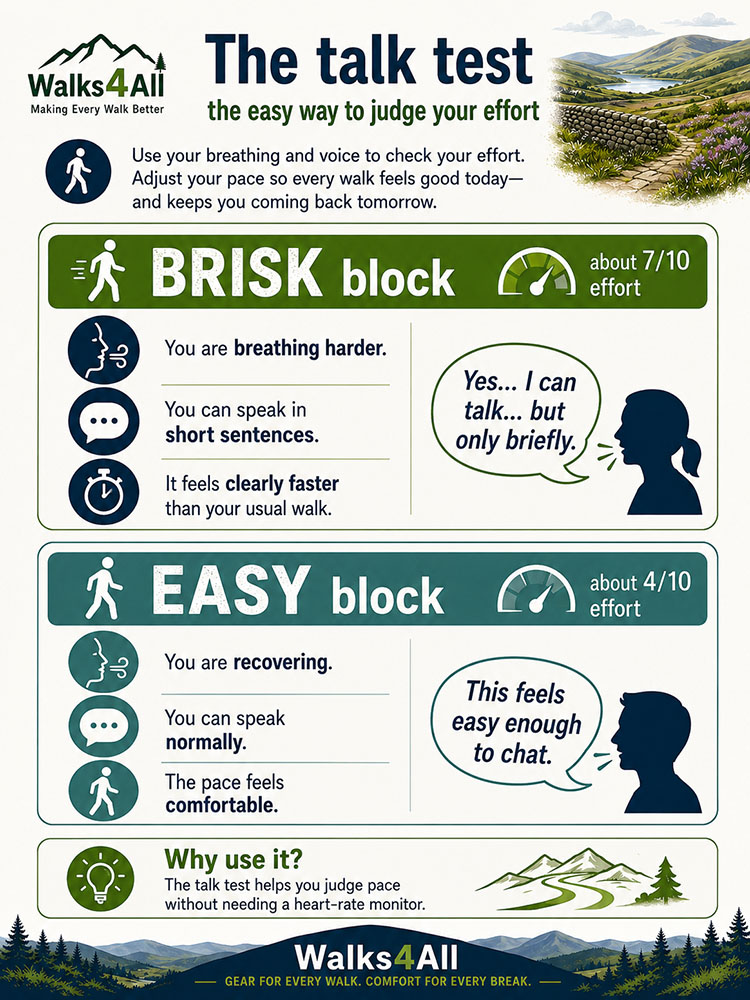
The talk test is a practical, no-gadget way to judge Japanese walking effort: brisk should make speech brief, while recovery should allow easy conversation.
One caution to note is that if you take beta-blockers or other medicines that lower your heart rate, the heart-rate targets will not apply. Use the effort scale and the talk test instead, after checking with your doctor that it is safe to do so.
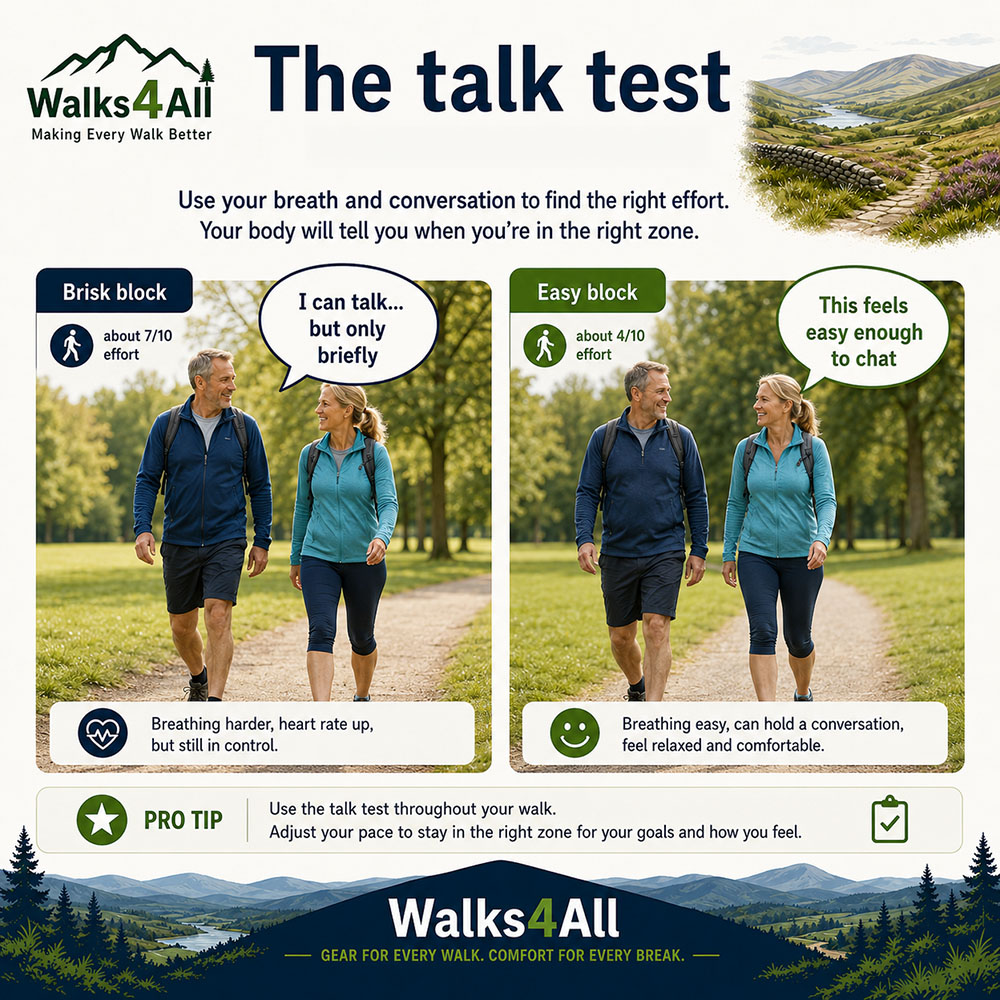
Speech cues make Japanese walking intensity easy to judge: brisk blocks should limit conversation, while easy blocks should let you chat comfortably.
This is where Japanese walking earns its reputation, and where that reputation is often inflated on social media.
Three studies provide most of the evidence.
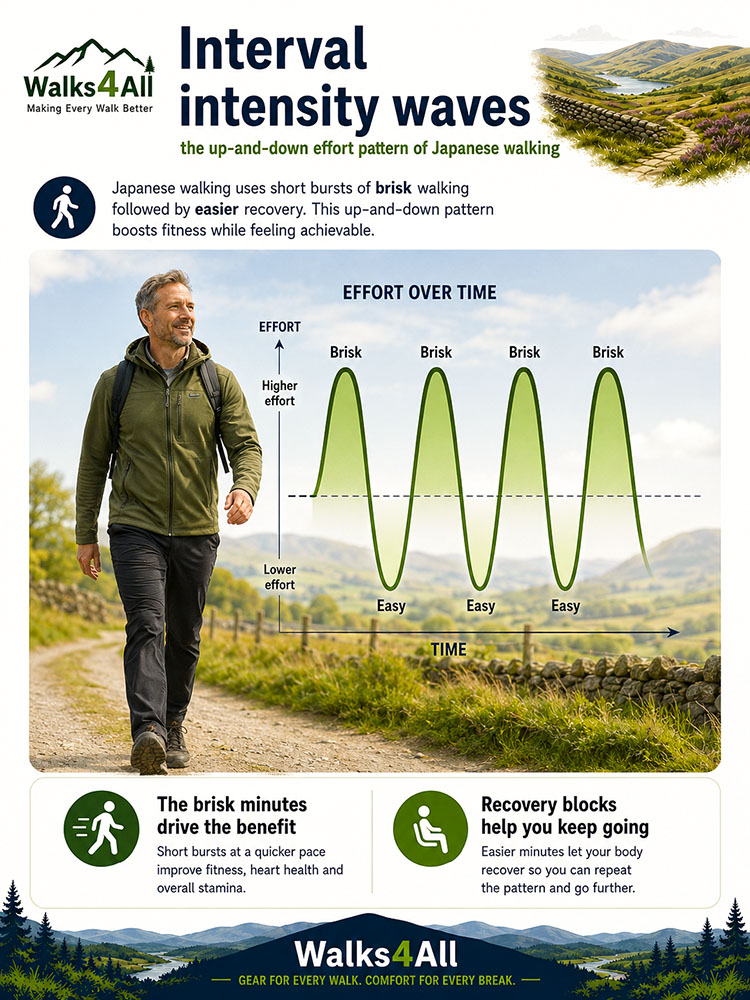
Japanese walking works by alternating between periods of high effort during brisk blocks and low effort during recovery blocks, creating an achievable interval pattern.
Fitness, leg strength and blood pressure
The landmark trial, published in Mayo Clinic Proceedings in 2007, followed 246 adults with an average age of 63 for five months. It compared
interval walking with ordinary continuous walking (aiming for 8,000 steps a day) and with no walking. The interval walkers came out clearly
ahead: knee-extension strength rose by 13%, knee-flexion strength by 17%, and peak aerobic capacity by 8–9%, with a larger drop in resting blood
pressure than the steady walkers, whose numbers barely moved. (Nemoto and colleagues, 2007.)[1]
It is the fast minutes that count
A larger follow-up study of 679 middle-aged and older adults, again published in Mayo Clinic Proceedings (Masuki and colleagues, 2019), found
that interval walking increased estimated aerobic capacity by about 14% and reduced a lifestyle-disease score, covering blood pressure, blood
sugar, and body mass, by about 17%.
The key insight from that study is that the benefit was tracked by brisk minutes rather than total minutes. Gains rose as fast-walking time
climbed to roughly 50 to 60 minutes a week, then levelled off, while slow and total walking time predicted little. In plain terms, the hard bits
do the work, so an hour a week of real effort is about the target.[2]
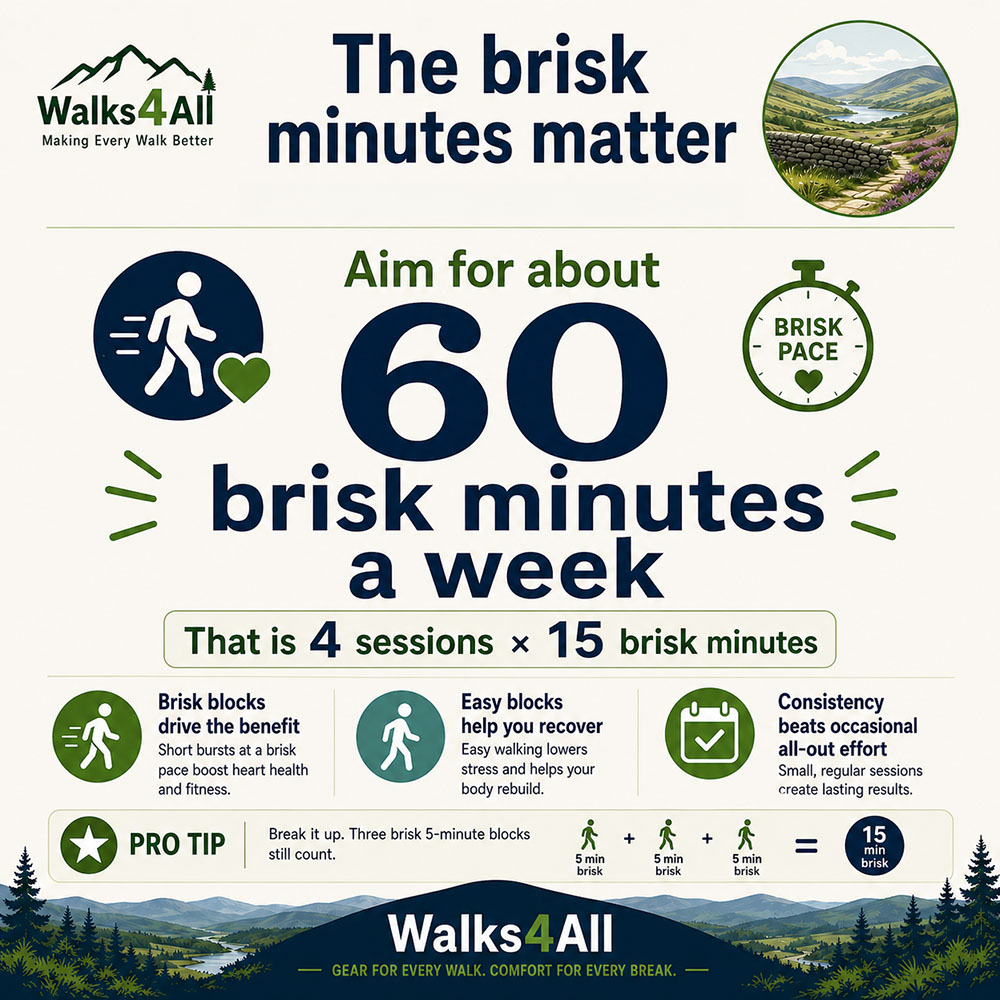
The brisk minutes appear to drive much of the benefit in Japanese walking, so a realistic target is around 60 minutes of brisk effort per week.
Blood sugar and type 2 diabetes
The effect is not only Japanese. A Danish randomised trial in Diabetes Care (Karstoft and colleagues, 2013) assigned people with type 2 diabetes
to either interval walking or continuous walking, matched for effort, five sessions a week for four months.
The interval walkers improved their fitness by about 16%, lost body and visceral fat, and improved their blood sugar control. The continuous
walkers, doing the same amount of work, changed on none of those measures. That independent replication is a major reason the method is taken
seriously.[3]
The limitations of the studies
Most articles on Japanese walking skip giving you details about the studies. The strongest studies largely come from one research group and rely
on middle-aged and older participants, mostly Japanese, so we cannot assume the exact numbers apply to everyone. Many benefits were measured
against sedentary or steady-walking comparators, and those who stick with a training study tend to be more motivated.
None of this makes Japanese walking a bad idea. It makes it a well-supported practice that is sometimes oversold. Treat the eye-catching figures
you see elsewhere ('depression halved', '40% fitter', 'reverses ageing') with caution, as they are usually unsourced.
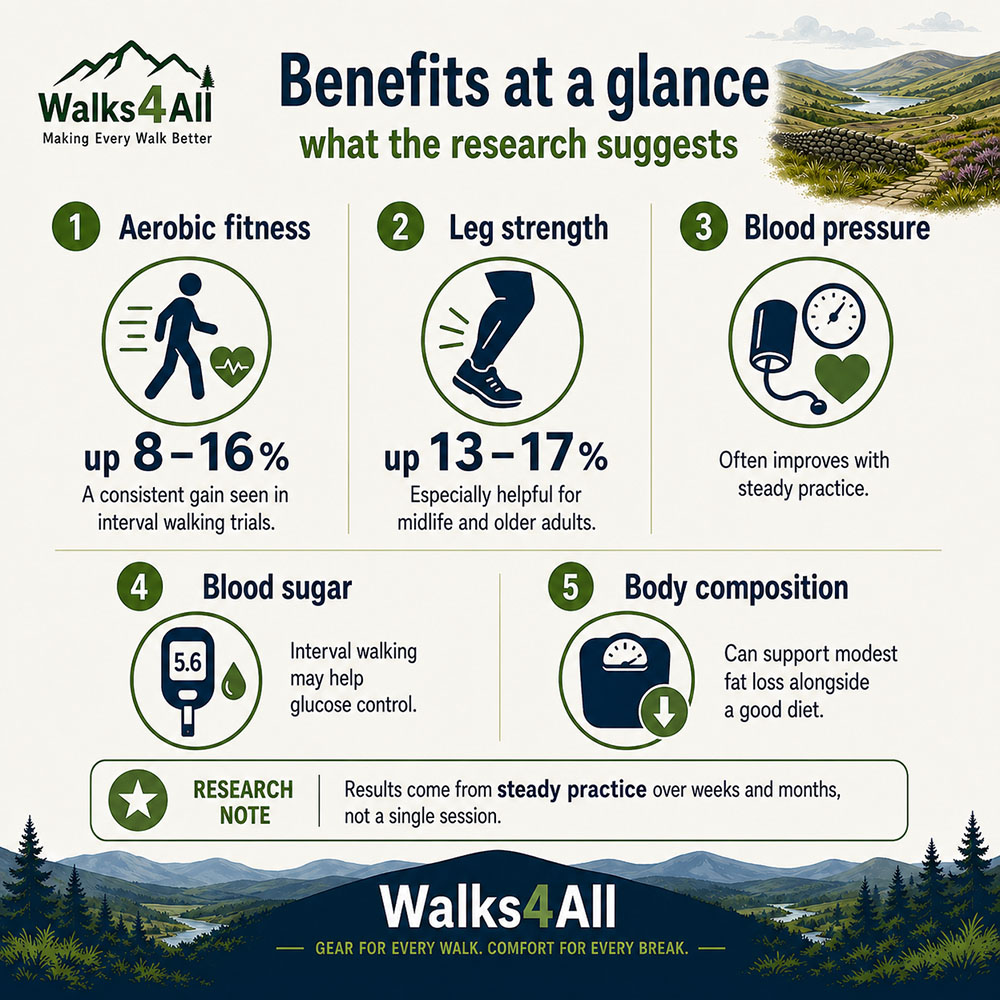
Published interval walking studies suggest Japanese walking can improve aerobic fitness and leg strength, with additional benefits for blood pressure and blood sugar control.
| Benefit | What the research shows | How solid |
| Aerobic fitness | Up about 8-16% across the trials | Strong |
| Leg strength | Knee-extension +13%, flexion +17% | Strong |
| Blood pressure | Larger fall than steady walking | Strong |
| Blood sugar | Improved control in type 2 diabetes | Good |
| Body fat | Modest loss, including visceral fat | Moderate |
| Mood, sleep, brain | Plausible, but thin in these studies | Early |
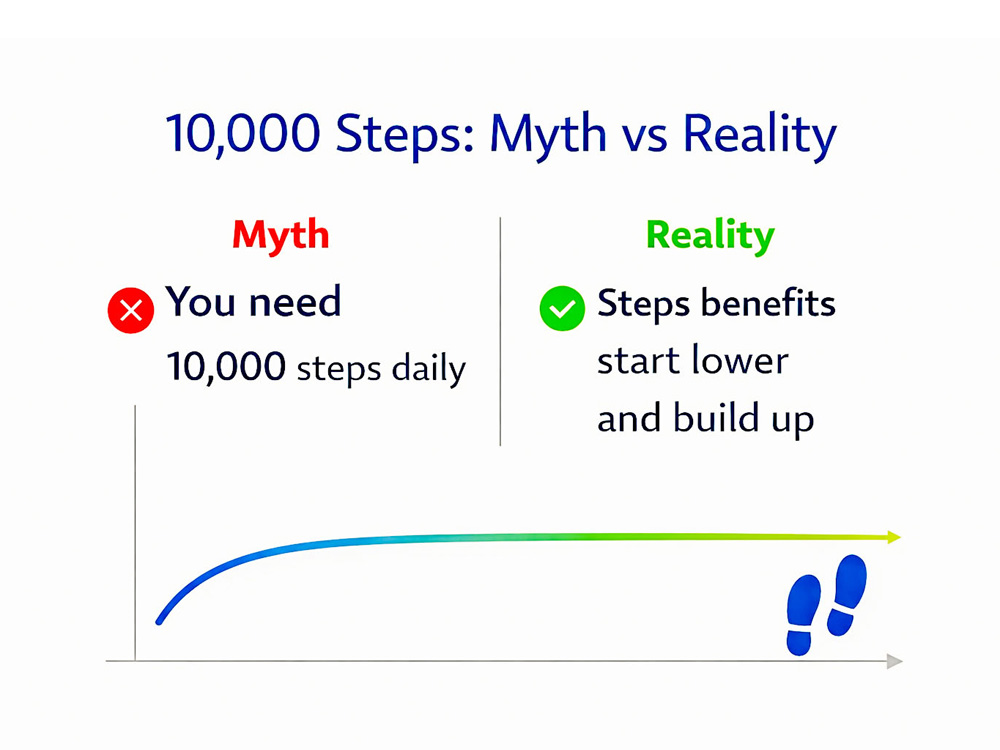
This is the comparison everyone makes, usually phrased as 'better than 10,000 steps'. It pays to compare them fairly, since one is a workout and the other is a target. The 10,000 target is not a scientific figure; it began as a 1960s marketing slogan for a Japanese pedometer, the manpo-kei, meaning '10,000-step meter'.
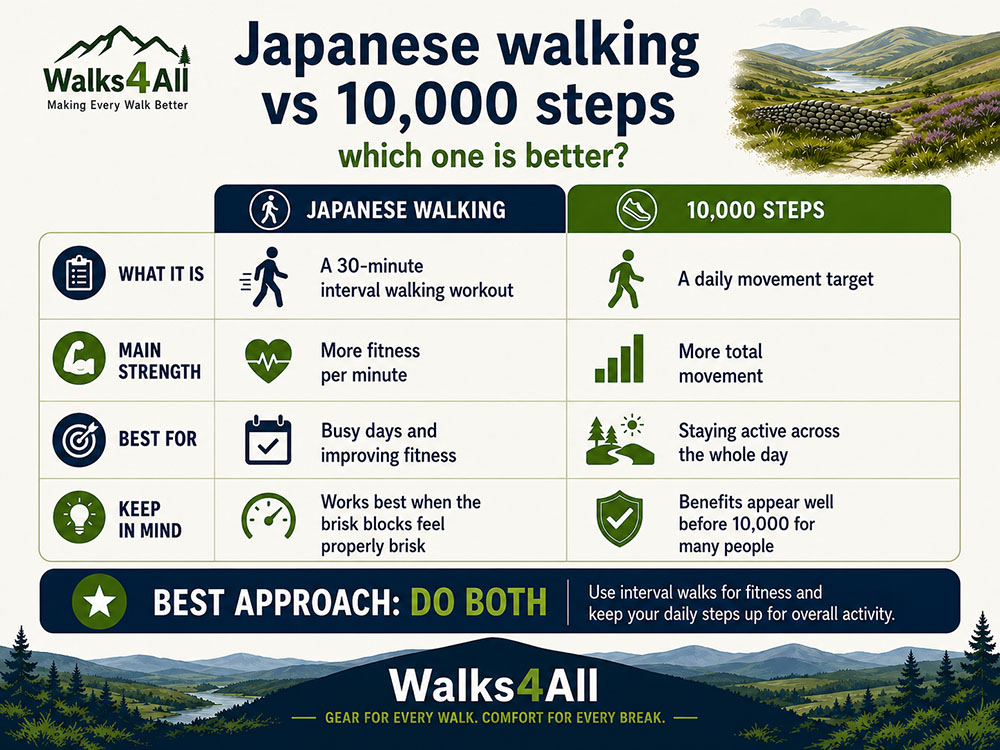
Japanese walking and 10,000 steps are not rivals: interval walking improves fitness per minute, while daily steps support total activity and calorie burn.
A 2022 meta-analysis of nearly 47,500 adults in The Lancet Public Health (Paluch and colleagues) found that the health benefit of steps continues to rise only up to about 6,000 to 8,000 steps a day for adults over 60, and up to 8,000 to 10,000 steps a day for younger adults, after which it levels off. The authors said there is 'little evidence' for the 10,000 figure.[4]
So the two are not really 'rivals'. Ten thousand steps is a volume target; Japanese walking is an intensity method. Walking 10,000 steps burns more calories throughout the day, supporting weight management and providing many other health benefits.
Japanese walking delivers more fitness per minute, which helps if you are short on time. The sensible approach for most people is to do both: keep your daily steps up and swap two or three of those walks for interval sessions.
| Japanese walking | 10,000 steps a day | |
| What it is | An intensity workout (30 min) | A daily movement target |
| Time needed | About 30-40 min, 4 days a week | Often 90-120 min across a day |
| Best for | Fitness and blood pressure, fast | Total activity and calorie burn |
| Main limit | Can feel dull; not for spot fat loss | Time-consuming; intensity is low |
Partly, and that is no criticism. Japanese walking is a low-impact, walking-paced cousin of high-intensity interval training ('HIIT'). The difference is accessibility: there is no jumping, no gym required, and little risk of injury, which is exactly why it suits older and less fit people who would never take up sprint intervals.
The trade-off is that if you are already fit, brisk walking may not raise your heart rate enough, and you would get more from jogging intervals. Compared with ordinary continuous walking, the interval version wins in terms of fitness for the same amount of time spent, mostly because the hard blocks push you harder than you would be on a steady walk.
A little, and mostly through the fitness and fat-loss changes above rather than dramatic calorie burn. In the diabetes trial, the interval walkers did lose body fat, but weight loss always depends far more on what you eat than on any single workout.
No exercise can 'target' belly fat specifically, no matter what a video promises, and for pure calorie burn, a long daily walk beats a short interval session. Use Japanese walking to get fitter and steadier on your feet; use your kitchen to lose weight.

Japanese walking is especially relevant for midlife and older adults because the main trials studied this group and found improvements in fitness and strength.
For most people, walking is about as safe as exercise gets, and the interval version is low-impact. Still, the brisk blocks are meant to be demanding, so a few cautions are in order.
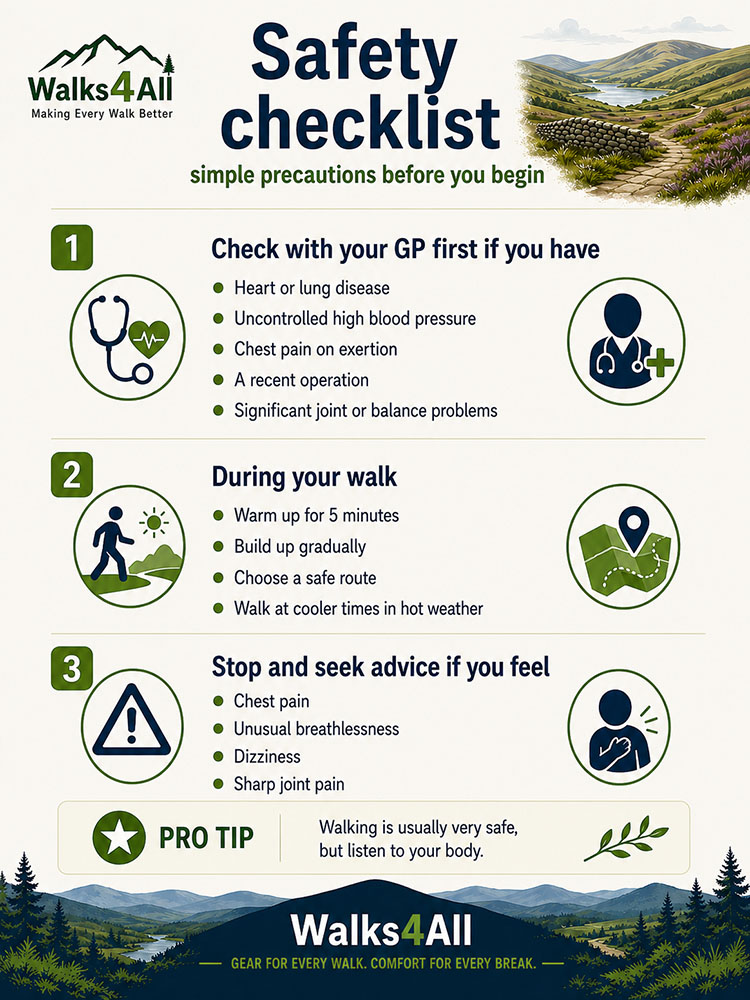
Japanese walking is low-impact for many people, but brisk intervals should be built up gradually and stopped if warning signs appear.
A note on pregnancy: walking is usually encouraged during pregnancy, but the intensity of your intervals should be discussed with your midwife or GP beforehand.
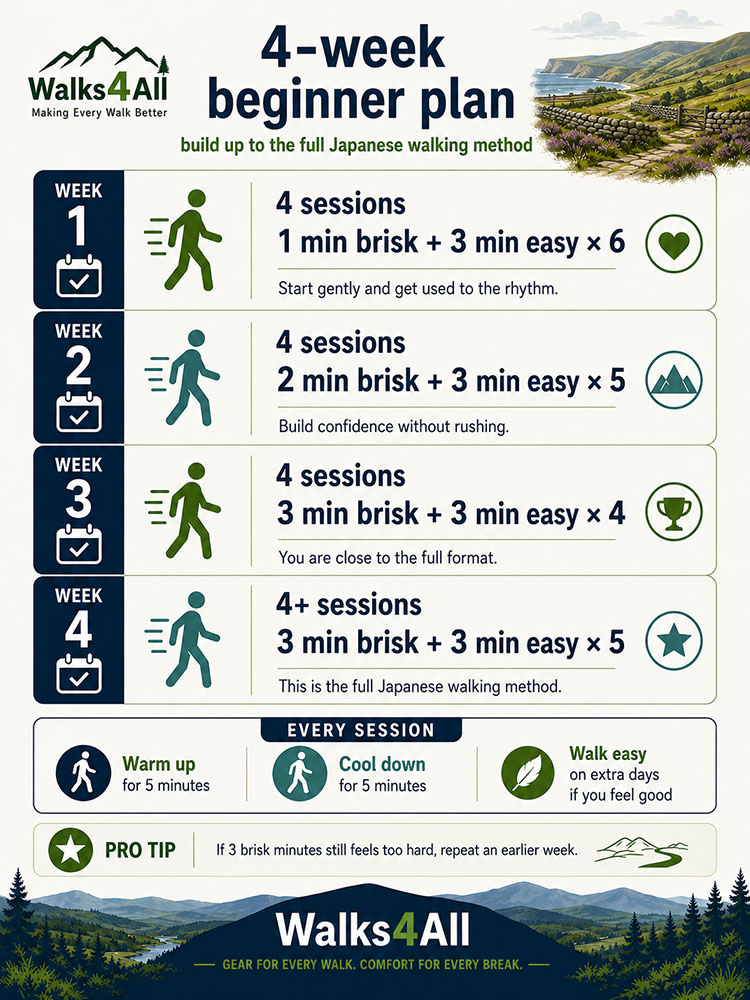
Beginners can gradually build towards the full Japanese walking method by extending the brisk blocks over four weeks rather than starting at full intensity.
If three minutes of brisk walking feels like a lot right now, ease in. Keep the easy blocks as long as you need, and grow the hard blocks slowly.
| Week | Brisk block | Easy block | Sets, days |
| Week 1 | 1 minute | 3 minutes | 5 sets, 3 days |
| Week 2 | 1.5 minutes | 3 minutes | 5 sets, 3-4 days |
| Week 3 | 2 minutes | 3 minutes | 5 sets, 4 days |
| Week 4 | 3 minutes | 3 minutes | 5 sets, 4 days |
Indoors or out? A treadmill or walking pad works well and makes timing easy; increase the speed or incline for the brisk blocks. Outdoors, plan an out-and-back route so you do not finish three brisk minutes from home. Once the full three-and-three feels comfortable, progress by adding a fifth or sixth session or by making a slight incline.
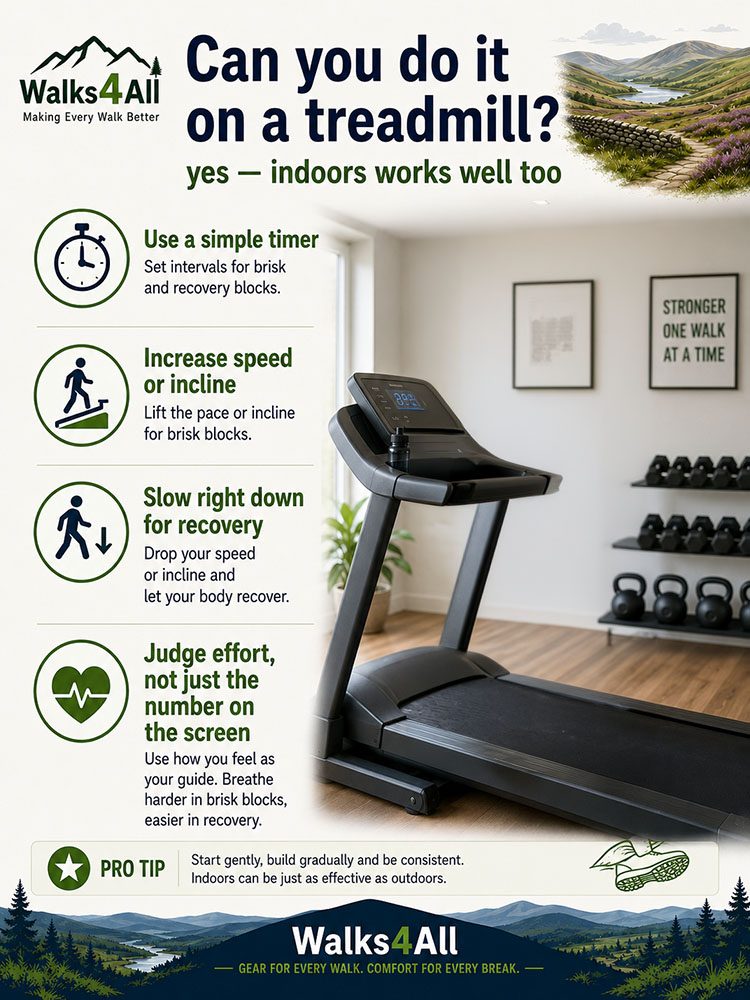
A treadmill or walking pad can work well for Japanese walking: increase speed or incline for brisk blocks, then slow down for recovery.
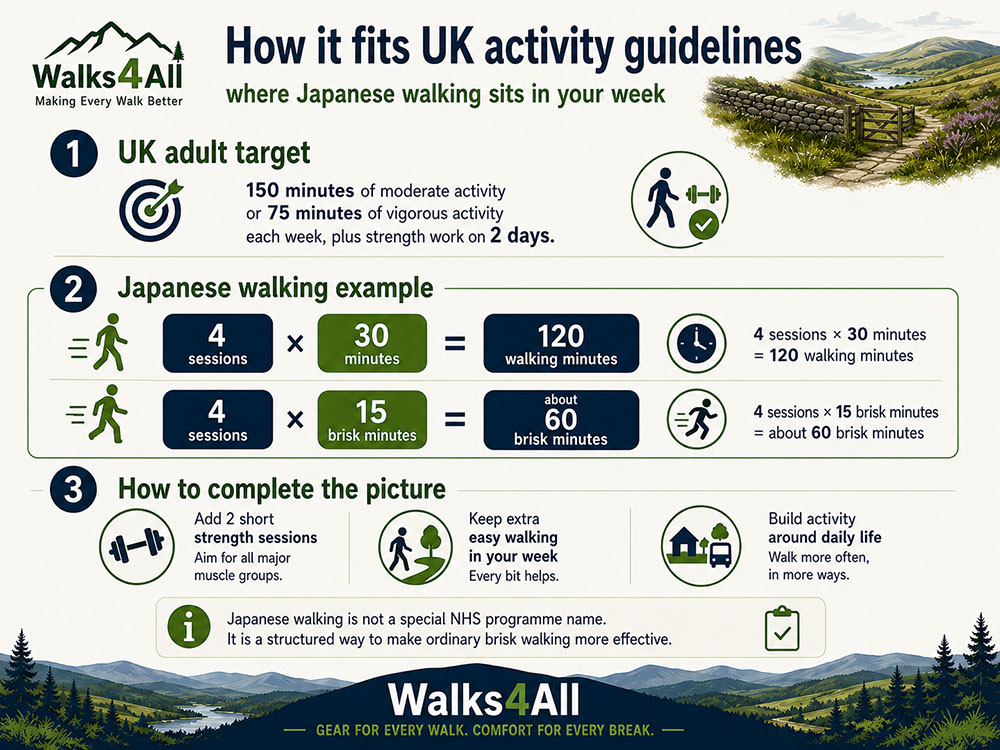
Four Japanese walking sessions can meaningfully contribute to UK weekly activity targets, especially when paired with two short strength sessions.
The NHS recommends 150 minutes of moderate activity or 75 minutes of vigorous activity a week, plus strength training on two days. Four thirty-minute interval sessions fit neatly within that, with the brisk blocks counting towards the vigorous end. There is no NHS-specific endorsement of Japanese walking as a branded method, and there does not need to be: it is simply a structured way to make ordinary brisk walking, which the NHS already champions, do more for you in less time. Add two short strength sessions, and you have covered the guidelines in full.[5]
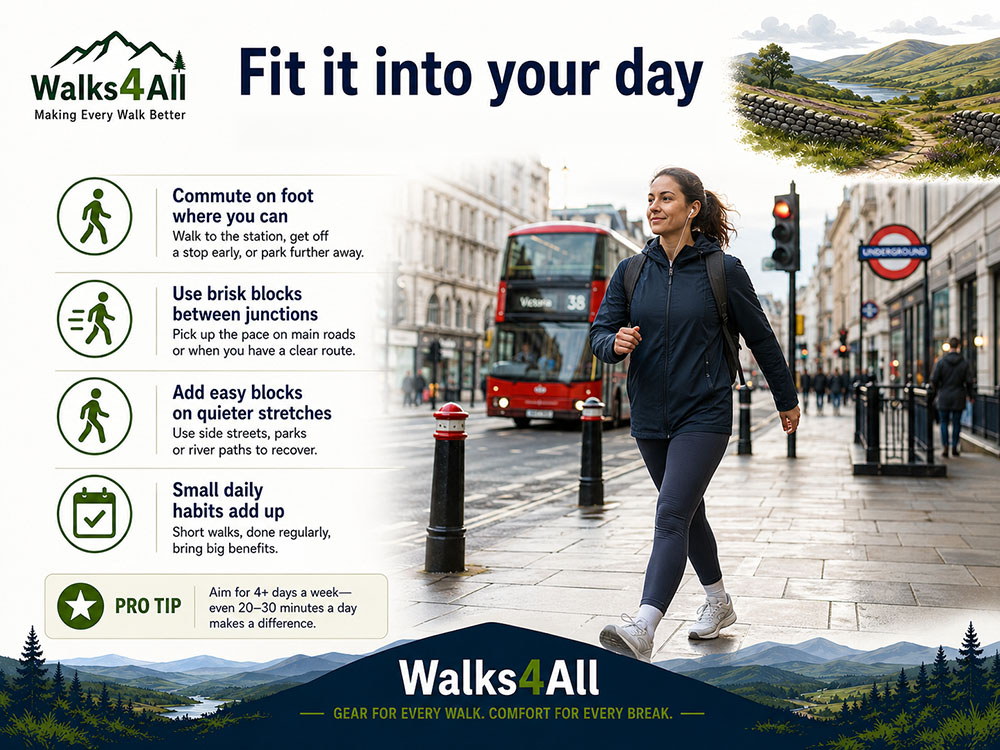
Japanese walking can be fitted into everyday life by using brisk blocks on clear stretches and easy blocks on quieter routes or during recovery sections.
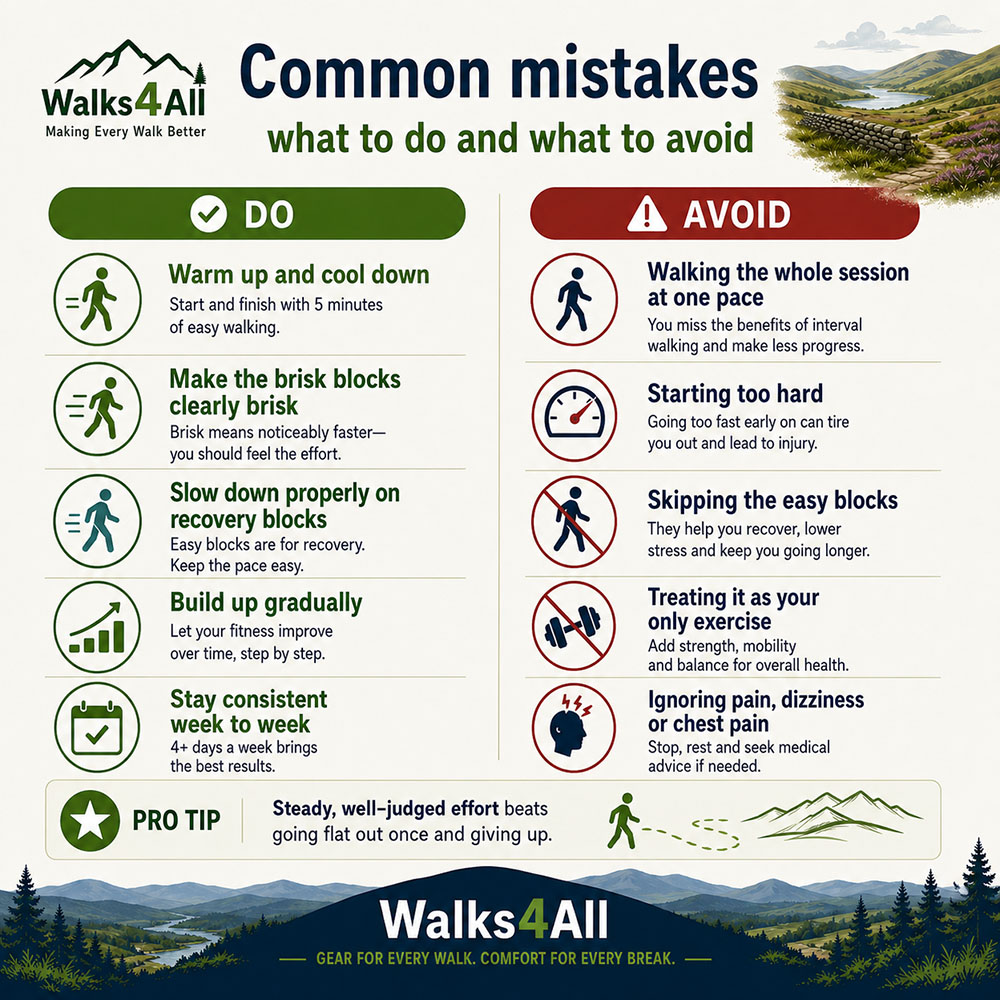
Most Japanese walking mistakes stem from flattening the intervals: push clearly on brisk blocks, slow down on recovery blocks and build up steadily.
Japanese walking is one of the better-evidenced fitness trends. For older, busy, or less fit people, and for anyone managing blood pressure or blood sugar, it is a genuinely good use of thirty minutes: more fitness, more leg strength, and better numbers than a steady stroll, all at low cost and low impact.
It is not magic, not a weight-loss cure, and not clearly 'better than 10,000 steps'. Do it four days a week, keep your daily step count up, add a little strength training, and you have a rounded, sustainable plan.
Not exactly. It delivers more fitness per minute, whereas 10,000 steps burn more total calories. The 10,000 figure was a marketing slogan, and benefits plateau earlier, so doing both is ideal.[4]
A little, mainly by improving fitness and trimming fat, but weight loss depends far more on diet. No exercise specifically targets belly fat.[3]
Yes. Adjust the speed or incline on the treadmill or walking pad for the brisk blocks, and slow down for recovery. Judge effort rather than the treadmill's number.
Generally, yes, and it is low-impact. Build up gradually, and check with your GP first if you have heart, lung, blood pressure, joint, or balance problems.
It is a gentle, walking-paced form of interval training that avoids jumping and the associated risk of injury, which is why it suits people who would never do sprint intervals.
July 2026
We take evidence seriously at Walks4all. If you'd like to better understand how walking studies are designed, how results should be interpreted, and what scientific terms mean, explore our guides on the following: