By using this website, you agree to our use of cookies (needed to provide our website’s features) and our Terms of Use.
By: Andrew Forrest - September 2026
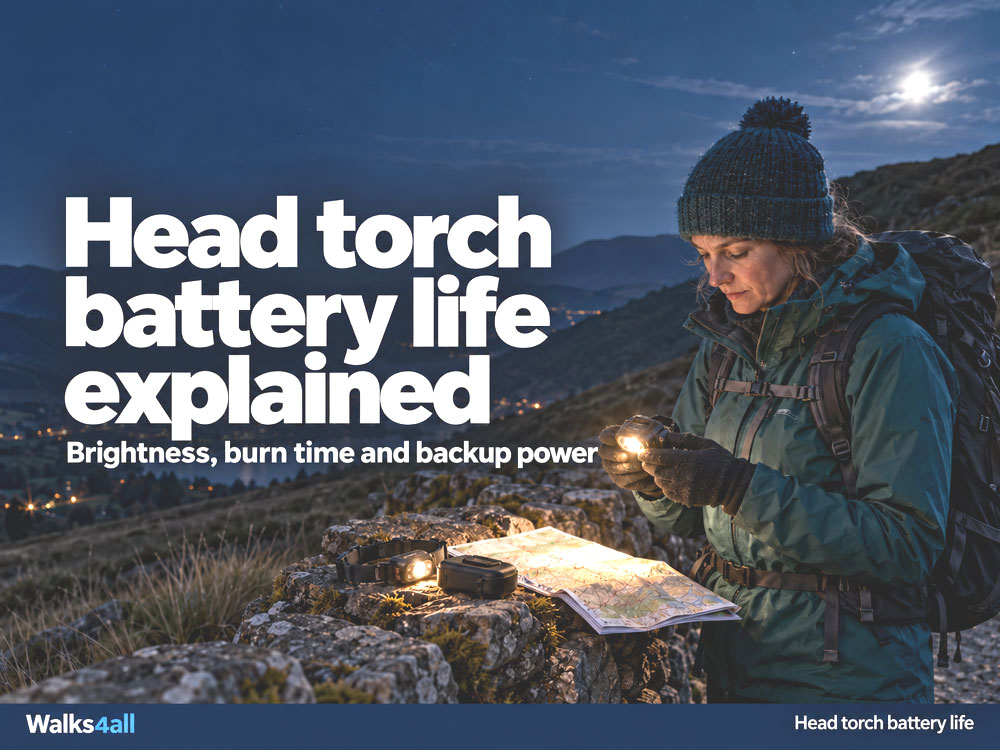
A head torch's claimed burn time is not a promise of constant brightness. Learn how to compare modes, allow for cold and delays, and plan a spare light.
This page contains affiliate links. As an Amazon Associate, we earn from qualifying Amazon purchases at no additional cost to you. We may also earn commissions from other retailers, again at no additional cost to you.
A head torch may last only a short time on its brightest setting but many hours on a dimmer one. Burn time, also called runtime, is how long it stays on during a test; it doesn't guarantee steady brightness. The FL 1 standard sets out common tests for torches and head torches. Its battery-life test measures the time until light output falls to one-tenth (10%) of the level measured shortly after switching on. Check the time for your chosen setting, allow for delays, and carry a separate backup light on remote routes.[1] [2] [3]
A product might advertise 625 lumens and 100 hours. These figures are not from the same setting. For its ACTIK CORE head torch, Petzl lists 625 lumens for two hours on MAX POWER, its highest regular setting; 100 lumens for seven hours on STANDARD, its medium setting; and seven lumens for 100 hours on its lowest setting. These figures use Petzl's CORE rechargeable battery pack. They are manufacturer test figures, not a promise of fixed brightness throughout every minute.[5]
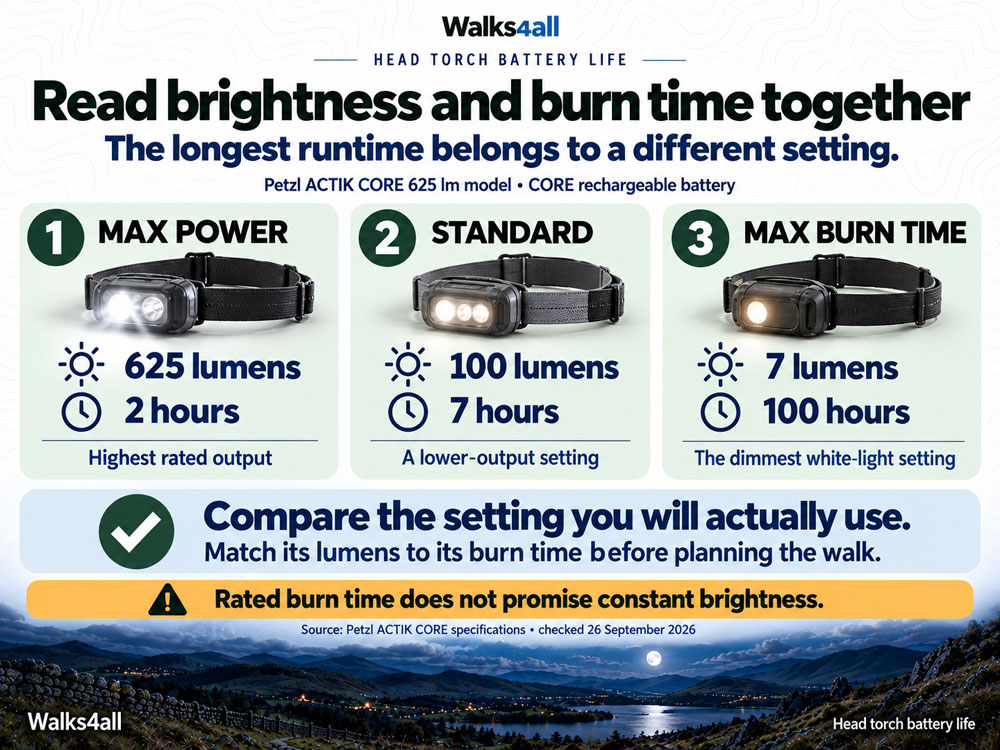
For the Petzl ACTIK CORE 625 lm model with the CORE battery, compare the brightness and rated burn time in the same mode. Constant brightness is not guaranteed.
FL 1 is the code for the Flashlight Basic Performance Standard. Its full label, ANSI/PLATO FL 1, names the American National Standards Institute (ANSI) and the Portable Lights American Trade Organisation (PLATO). In the test described by Petzl, runtime starts 30 seconds after switching on and ends when the light output falls to 10% of the measured level. This refers to remaining light output, not remaining battery charge.[1] [2] [6] Whilst these are American standards, they are widely used by Petzl and others in the UK.
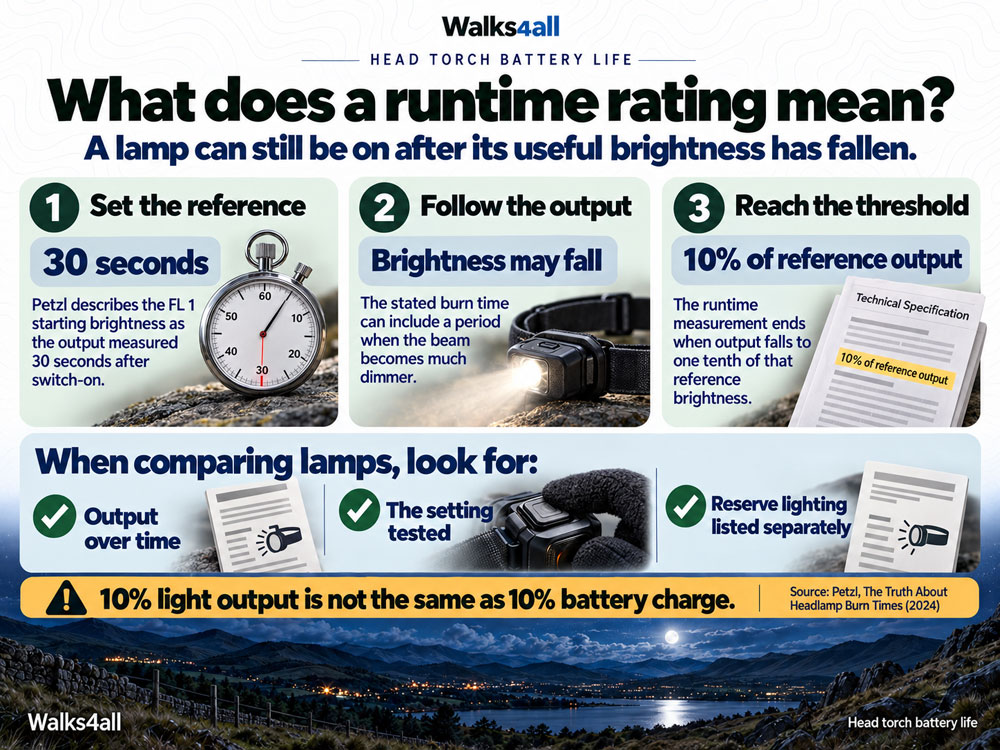
A runtime rating can include dimming. This explains Petzl’s published FL 1 method; it is not an output curve or a test of a particular lamp.
For rough ground, look for a graph showing how light output changes over time, often called an output curve. Check whether the manufacturer states how much light the torch maintains and for how long. Some torches also have reserve lighting: a dim light that remains when the battery is nearly empty. Petzl lists this extra reserve period separately for the ACTIK CORE.[1] [5]
Boost is a short burst used to pick out a distant marker. High is a named setting, but the torch may automatically reduce its brightness as it warms up or its battery drains. Standard or medium is often the more useful setting for planning a walk. Reserve lighting may help you move slowly, but it is not a substitute for a working main beam on difficult terrain. Check your own torch's specifications rather than assuming every brand uses the same names.[1] [5]
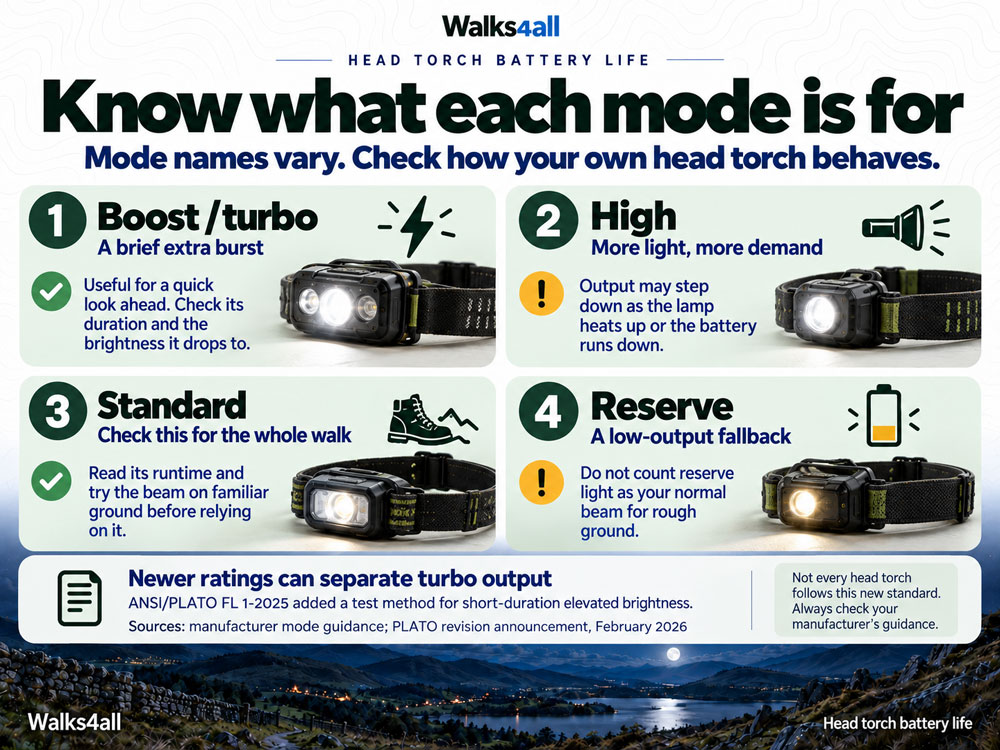
Mode names and behaviour vary. Check the instructions and output information for your own lamp.
The 2025 revision of the FL 1 standard introduced a specific test for the brief extra brightness marketed as turbo or boost. For brands that use the revised method, this can make a brief-brightness claim clearer. It still does not turn that setting into an all-night light.[2]
Suppose a planned walk takes 90 minutes out and 90 minutes back. Add an hour for a slower return, a missed junction or a stop: you now need roughly four hours of useful light. A torch rated for seven hours at the setting you expect to use gives a margin on paper, but the figure may be measured at a much lower output. Test your own lamp on easy ground and carry a separate charged light.
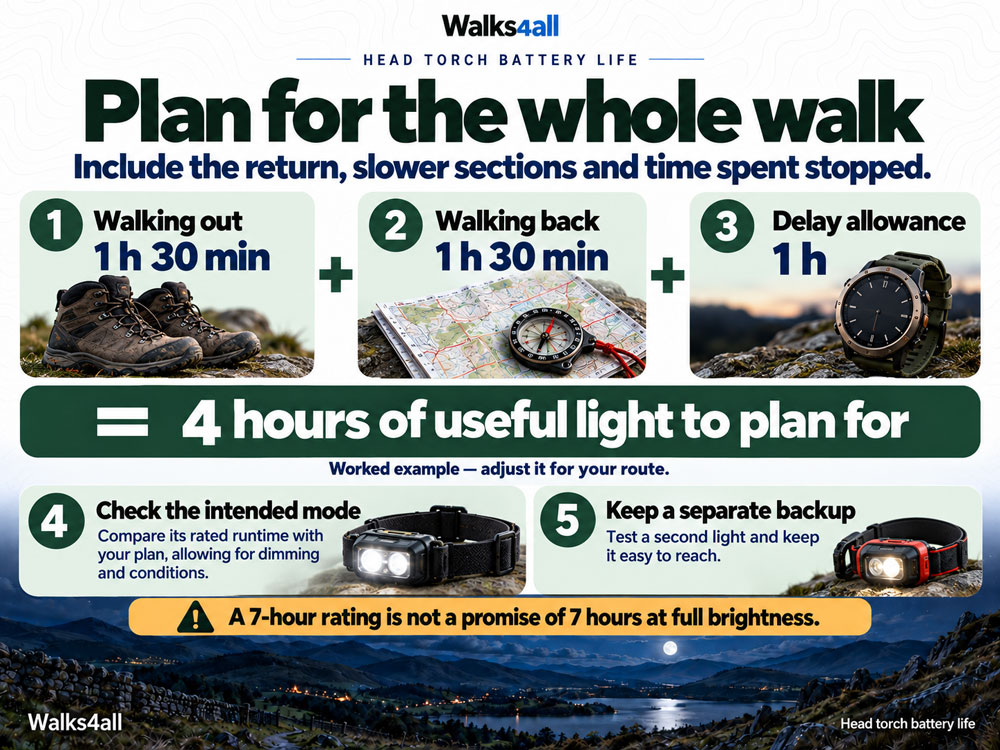
Worked planning example: 1½ hours out + 1½ hours back + 1 hour for delays = 4 hours. Choose a larger allowance when the route or conditions require it.
Base your battery plan on your route. For longer or colder walks, or those with more challenging navigation or rougher ground, allow extra time and spare capacity. Our best head torches guide helps compare the lamps; our UK power-bank guide covers portable battery packs for recharging devices on longer trips. A power bank cannot instantly replace a failed light partway down a descent unless you can run the light directly from it.
The ACTIK CORE has a hybrid design that accepts either a rechargeable battery pack or replaceable batteries. With its rechargeable CORE pack, Petzl lists a maximum of 625 lumens for two hours and 100 lumens for seven hours. With three AAA batteries, the small cylindrical cells often used in remote controls, the maximum is 450 lumens for two hours, and STANDARD is listed at 100 lumens for ten hours. Both the maximum light output and the stated time on STANDARD vary with the battery type.[5]
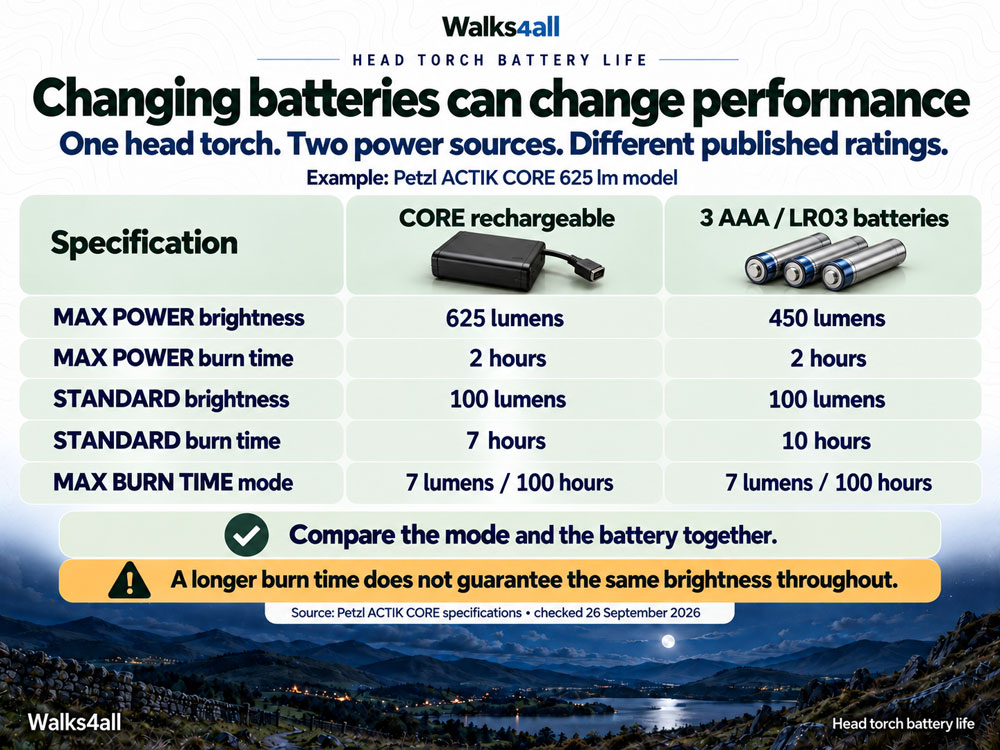
The Petzl ACTIK CORE 625 lm model has different maximum output and standard-mode runtime with CORE and AAA power. Rated runtime does not guarantee constant brightness.
Cold can also reduce the battery's useful life. Petzl and others note that both standard batteries and its CORE rechargeable pack are sensitive to temperatures below freezing.
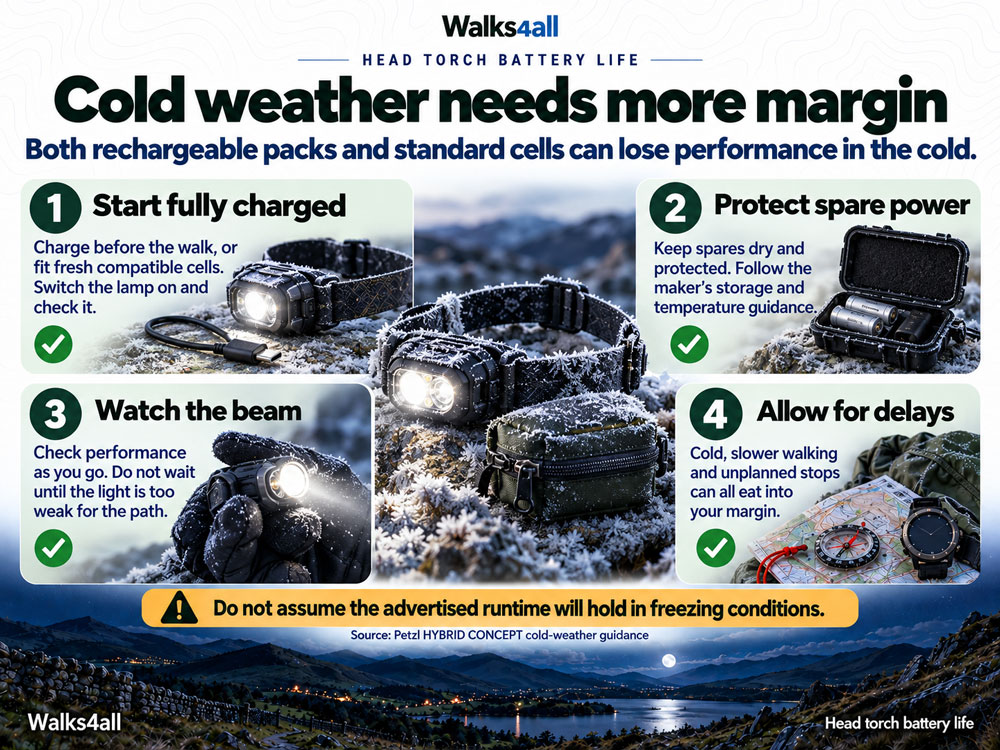
Cold can reduce battery performance. The effect varies with battery type, temperature and condition; avoid treating a laboratory runtime as a deadline.
If the weather is cold, start with a fully charged battery, protect spare power from damp, and check the lamp before leaving. Do not treat a laboratory runtime as a deadline you can walk up to.[4]
Cold can shorten battery life, while wet weather makes it especially important to keep battery and charging covers properly closed. Keep spare batteries dry and check your torch's IP rating (ingress protection) which describes its tested protection against dust and water ingress. Our guide to head torch IP ratings helps you choose protection suited to your walks. An IP rating does not tell you how well the battery performs in the cold.
For safe night walking, carry a separate, ready-to-use head torch in your backpack in case the main lamp fails. A power bank requires compatible equipment and time to recharge; whether the lamp can run safely while charging depends on the model.[3]
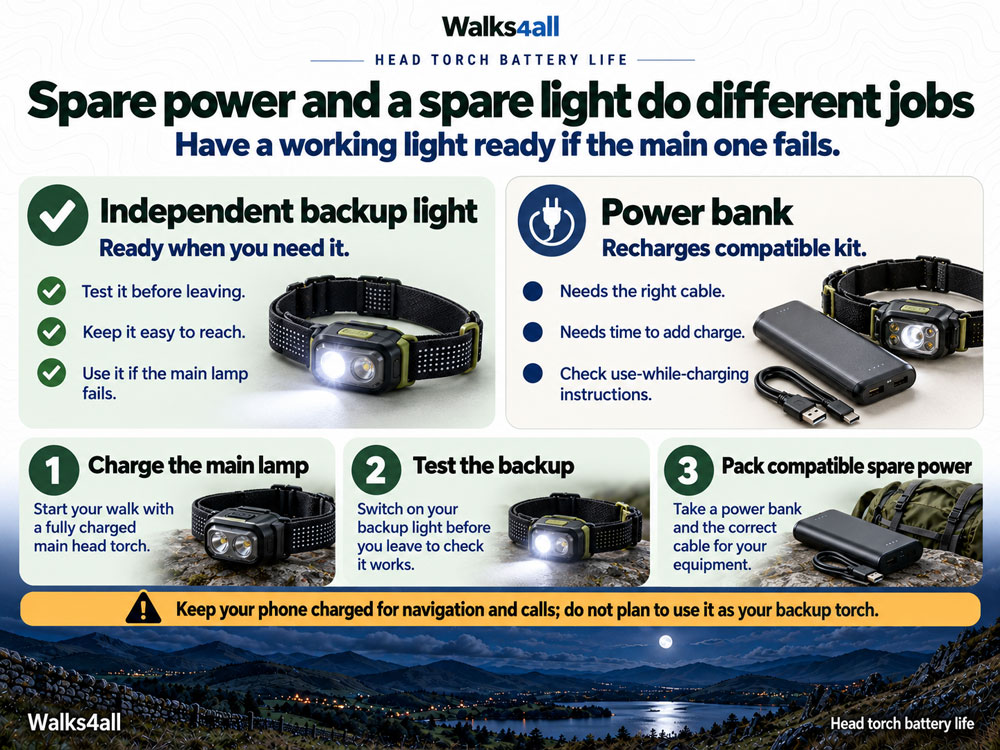
Carry an independent working light. A power bank can recharge compatible devices, but charging takes time, and whether you can use it while charging depends on the model.
Check the lighting along the whole route, including the return, before you leave, and allow realistic time for delays.
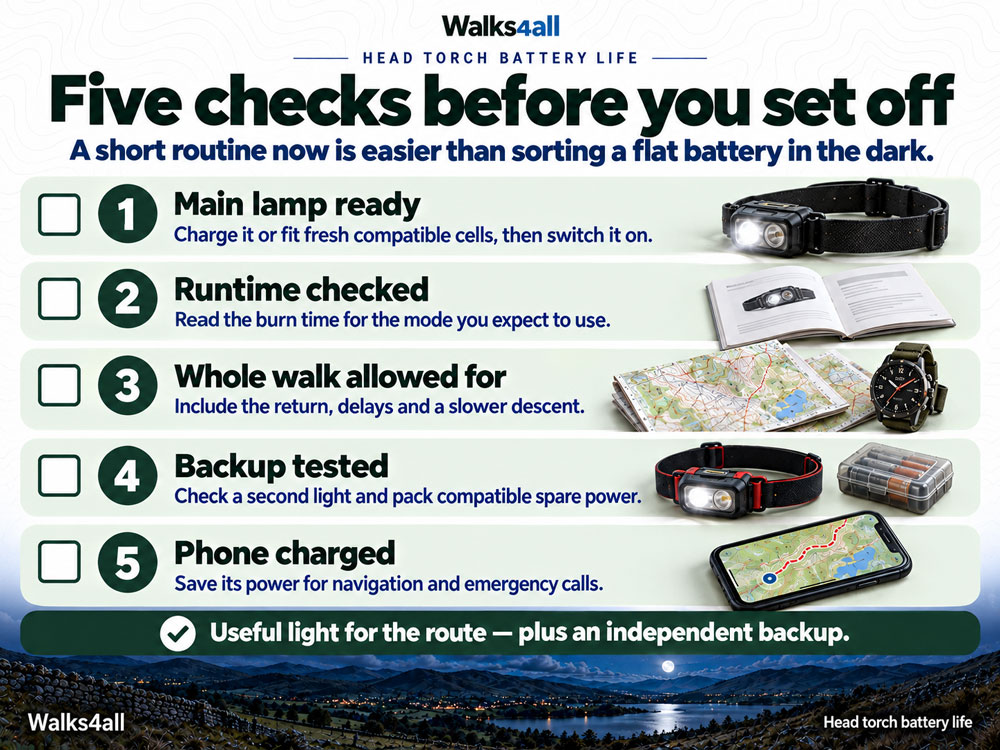
Before a night walk, test the main lamp and the backup, check the intended mode’s runtime, allow for the whole route and delays, and charge your phone.
Treat a runtime claim as a starting point for comparison. What matters is whether the lamp still shows you the path when you need it, on a setting you can comfortably walk on. Learn its controls on a familiar route, allow a generous margin, and carry a separate working light.
No. Check the setting and how brightness changes during the test. In the FL 1 torch-testing method described by Petzl, burn time continues until light output falls to one-tenth (10%) of its initial level.[1]
Neither is automatically better. Rechargeable packs are convenient; replaceable batteries can be swapped quickly. Torches that accept either type may have different brightness and runtime figures for each type.[5]
Only if the model can run safely while charging and has sufficient power. A power bank takes time to recharge a lamp, so carry a separate working light in case the main one fails.[3]
It can. Petzl says its CORE pack and standard batteries are sensitive to temperatures below freezing. Allow extra margin in cold weather and check the instructions for your battery.[4]
September 2026