By using this website, you agree to our use of cookies (needed to provide our website’s features) and our Terms of Use.
By: Andrew Forrest - September 2026
What do IPX4, IP67 and IP68 mean on a head torch? Read the dust and water ratings, choose for UK rain, and understand what a test rating cannot guarantee.
This page contains affiliate links. As an Amazon Associate, we earn from qualifying Amazon purchases at no additional cost to you. We may also earn commissions from other retailers, again at no additional cost to you.
An IP rating describes how a head torch's casing was tested for resistance to dust and water ingress. IP stands for ingress protection; ingress simply means something getting in. In IPX4, X means no dust rating is stated, and 4 indicates splash protection. IP67 indicates dust-tight protection plus a temporary immersion test, in which the torch is held under fresh water. IP68 combines dust-tight protection with a longer or deeper underwater test set by the manufacturer. Check the stated depth and time. An undamaged IPX4 head torch can suit many UK walks in the rain; for persistent soaking and long wet nights in the hills, choose a higher-rated model.[1] [2]
The International Electrotechnical Commission (IEC) sets the test rules and publishes the international standard IEC 60529. In an IP code, the first digit indicates protection against solid objects and dust; the second indicates protection against water ingress. A 6 in the first position means dust-tight: no dust enters during the test. A 5 allows limited dust ingress, but not enough to interfere with safe operation. If the first position is X, no solids rating is specified.[1] [2]
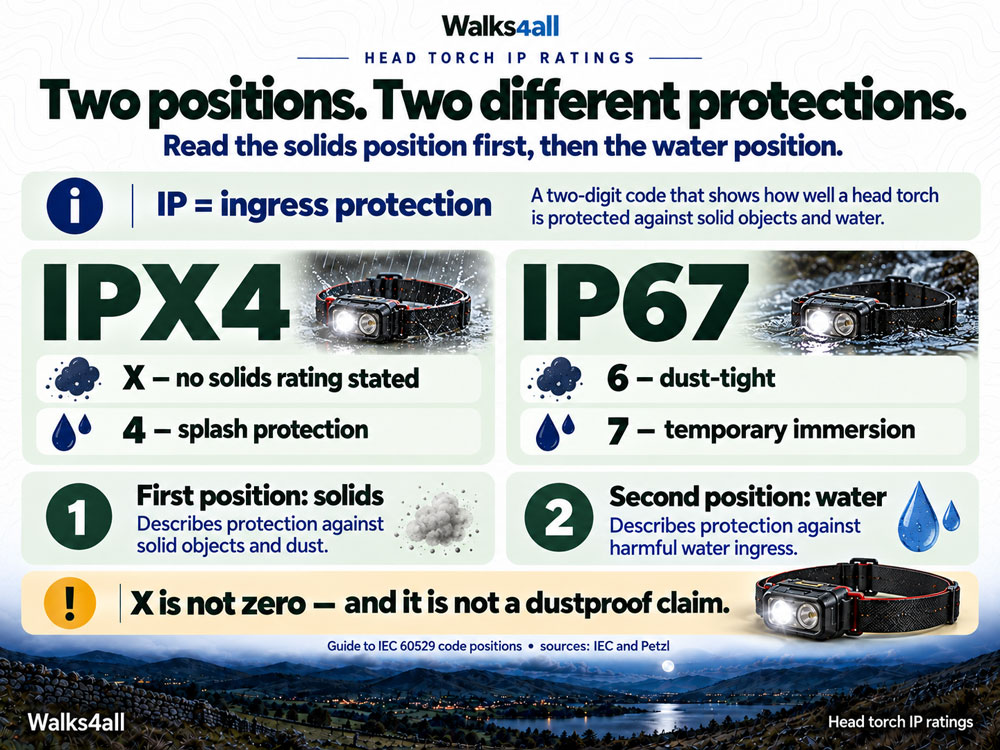
Read each position separately. In IPX4, X leaves the solids protection unspecified while 4 indicates splash protection.
For water, 4 covers splashing or spraying. For a head torch, 7 covers temporary immersion to a depth of one metre for 30 minutes; 8 covers a longer or deeper underwater test, with depth and duration specified by the manufacturer. These are the test categories. Follow your head torch's manual, including instructions for the charging socket and its cover.[2]
Compare the dust and water parts separately. The following codes describe the test conditions, with IP68 limits set for the specific product.[1] [2]
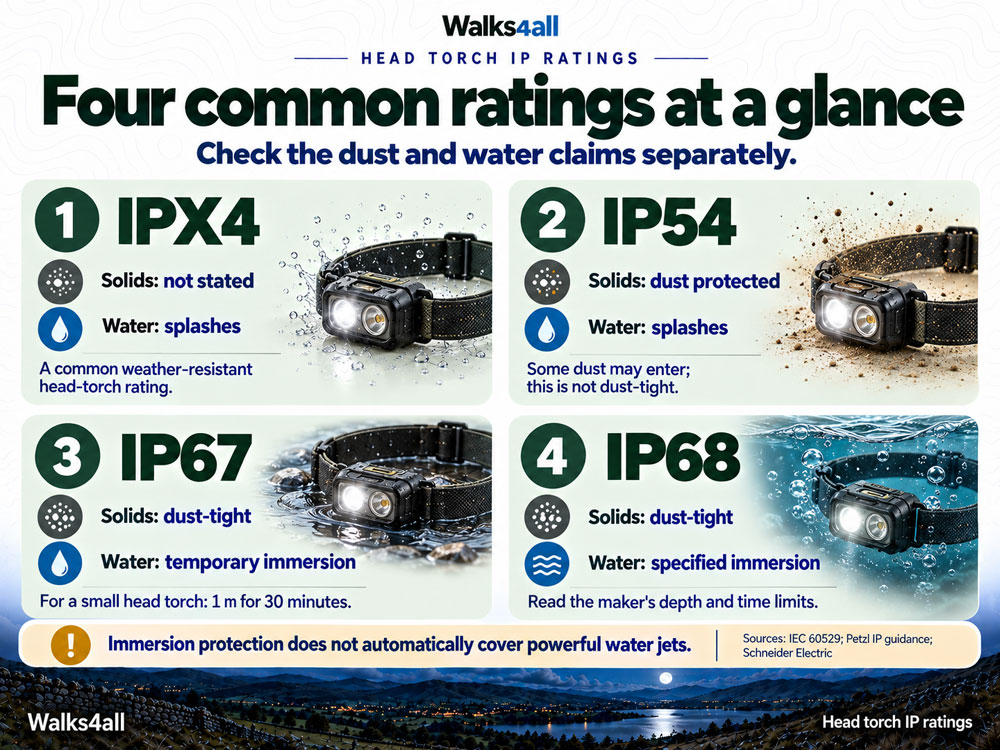
These codes describe various test conditions. Immersion ratings do not automatically provide protection against powerful water jets.
| Rating | Solids | Water | What it tells you |
| IPX4 | No stated solids rating | Water splashes | A common rain-ready head torch rating |
| IP54 | Dust protected, not dust-tight | Water splashes | Protection against some dust plus routine splashing |
| IP67 | Dust-tight | Underwater at 1 metre for 30 minutes | Extra reassurance in very wet use |
| IP68 | Dust-tight | Underwater depth and time set by the maker | Check exact depth and time on the model |
Petzl's current ACTIK CORE is rated IPX4, whereas Black Diamond lists the Storm 500-R as IP67. These examples show that two useful walking lamps can have different protection ratings. Neither rating indicates beam quality or battery life.[3] [4]
For a local footpath in showers, IPX4 is a reasonable starting point if the lamp is intact and used as instructed. Petzl describes IPX4 as suitable for most conditions in rain, snow or damp. If you are regularly out for hours in driving rain, cross wet ground, or need a light for harsher conditions, consider IP67 models. The extra seal may help, but it does not excuse leaving the charging cover open.[2]
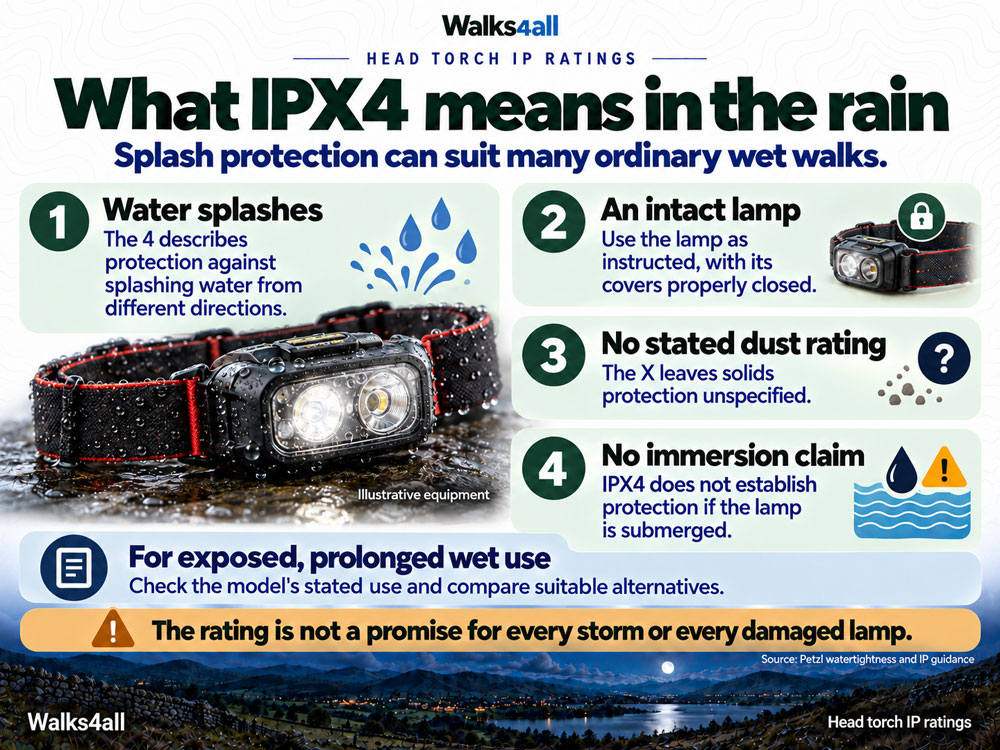
Petzl describes IPX4 as suitable for most headlamp use in rain, snow or damp conditions. Inspect your lamp and follow its instructions.
IP68 may be useful if the torch could go underwater, but the code alone cannot tell you whether a particular model suits your needs. Check the manufacturer's tested depth and duration.
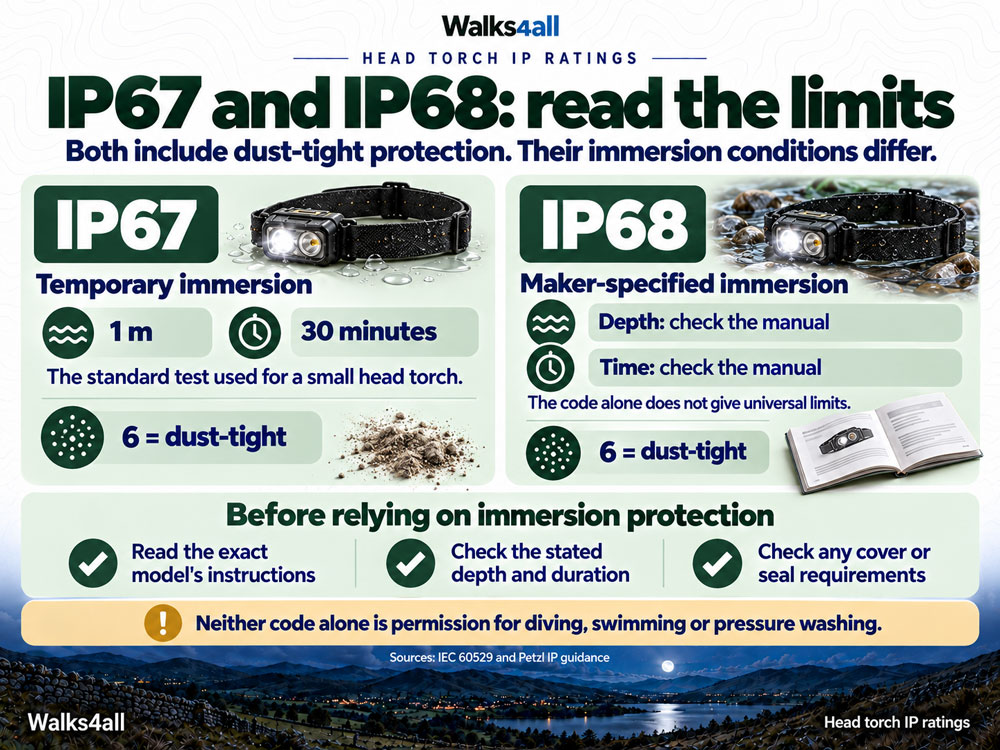
For a small head torch, IP67 requires a temporary immersion test at 1 m for 30 minutes. IP68 requires manufacturer-specified conditions; check the actual limits.
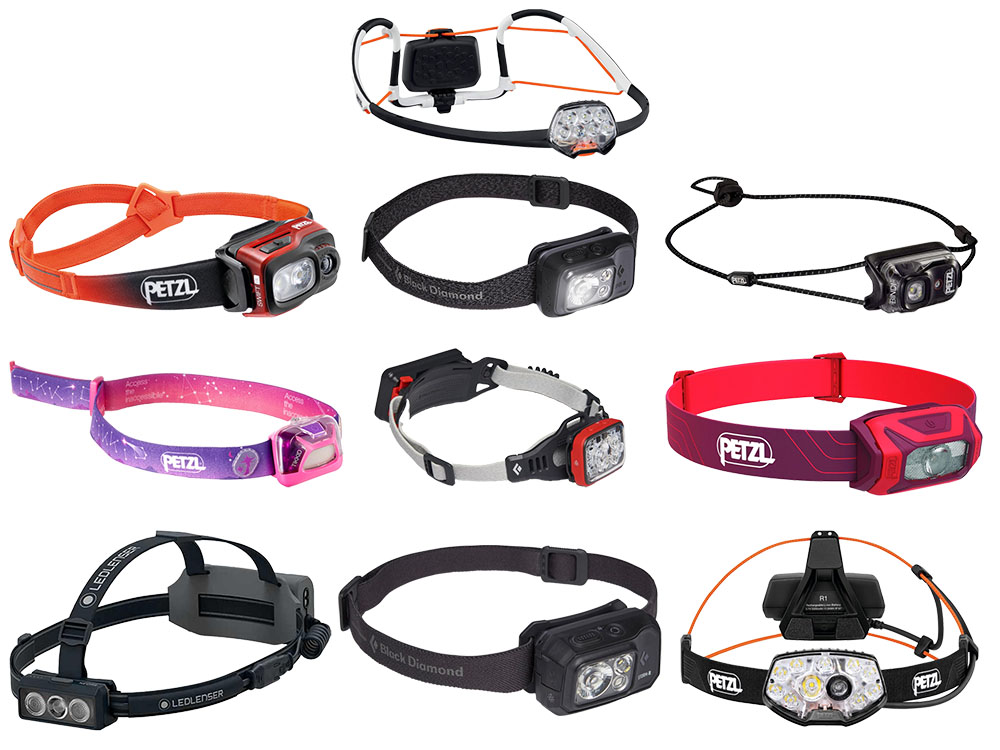
For hillwalking, choose a beam, battery life, fit and backup plan that match the route. Our best head torches for hiking guide compares those choices.
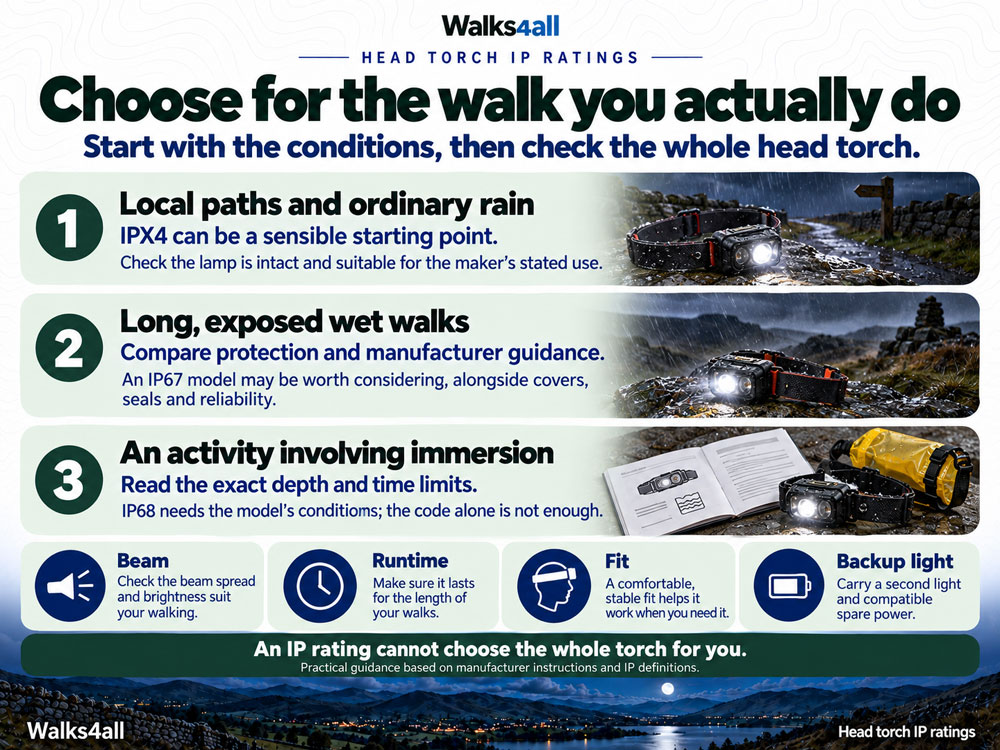
Use the conditions of the walk to guide the comparison, then check the manufacturer’s intended use, beam, runtime, fit and backup plan.
To work out how much battery life you need and allow for cold weather or delays, read how long a head torch battery lasts.
An IP rating does not indicate how well a torch withstands knocks or drops, how much light it produces, or how long its battery lasts. Tests in fresh water do not establish protection against salt water, detergents, or high-pressure cleaning. Follow the manufacturer's instructions for such exposures.
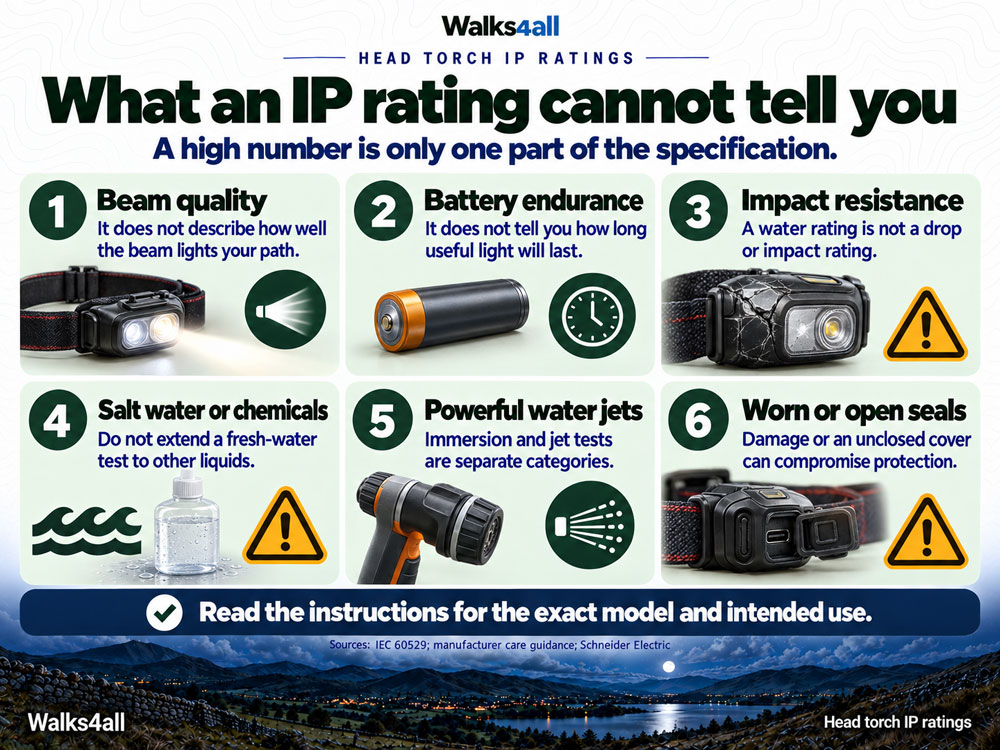
IP is one part of the specification. Check the separate claims for impact, performance and exposure beyond the stated water tests.
The rating does not mean the lamp will always remain sealed after a hard drop, a cracked casing, wear, or an improperly closed cover.
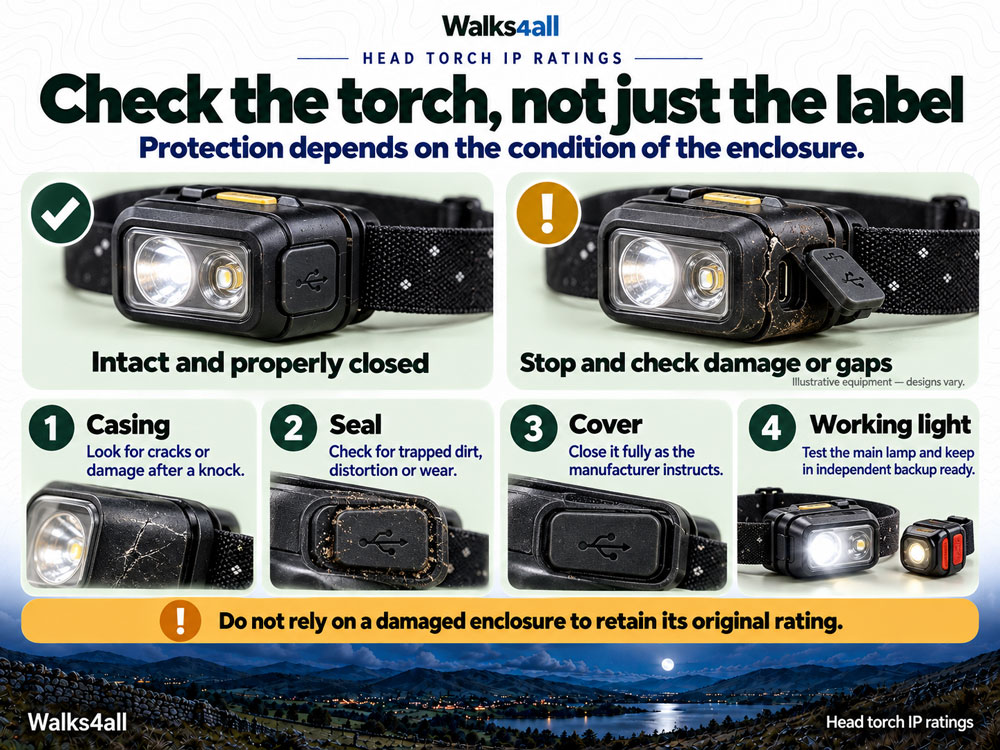
The published rating applies to the enclosure in its specified condition. Inspect the lamp you own; follow model-specific instructions.
If a lamp has been soaked, follow its instructions before opening or charging it. Check the cover and seal, wipe away dirt carefully, and allow it to dry.
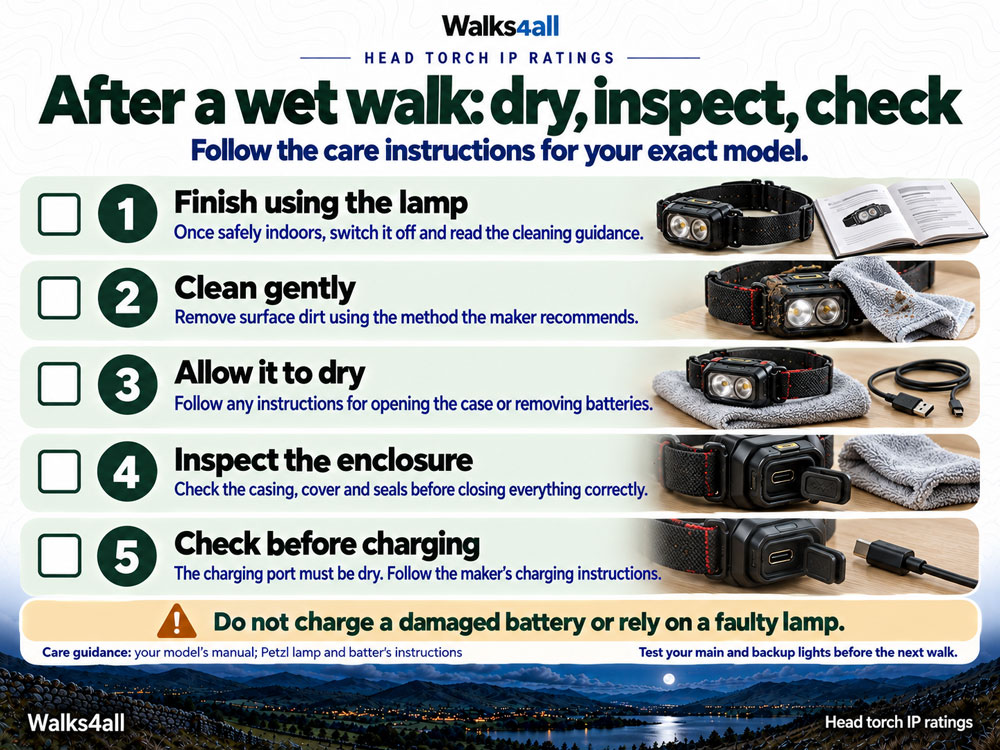
Follow the instructions for your model, including any battery-removal or drying steps. Ensure the charging port is dry before charging.
Keep spare batteries and any power bank (a portable battery pack for recharging devices) dry, either in a drybag or your rucksack. Our power-bank guide for hiking covers water resistance and charging options for longer trips.
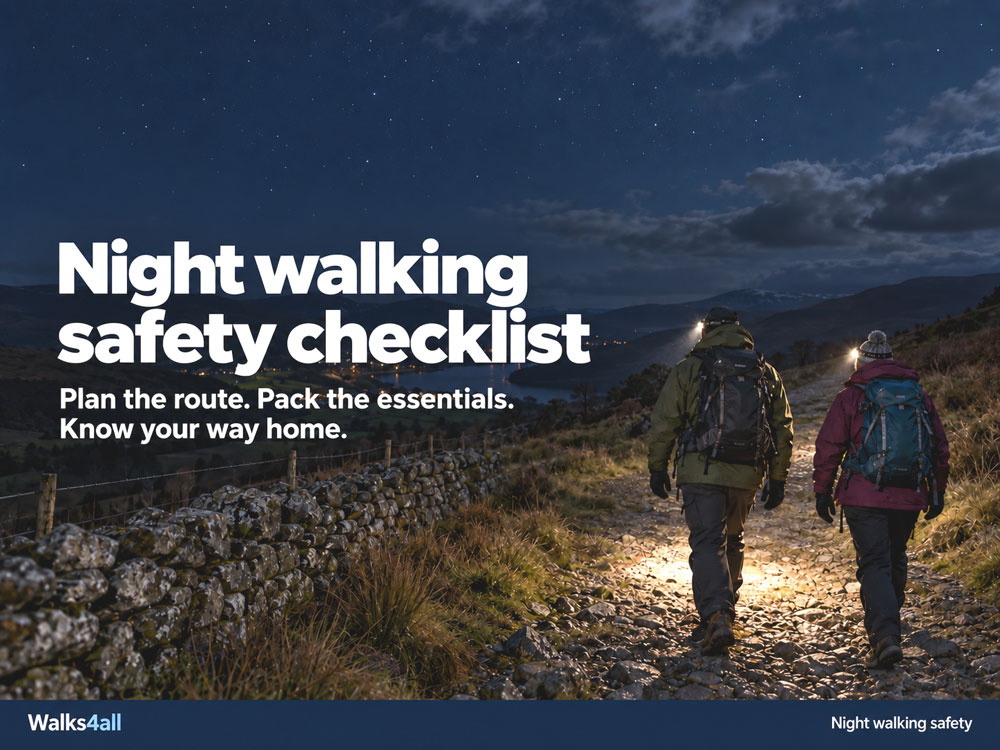
On a remote night walk, keep a second light ready even if the main torch has a high IP rating. Our night walking safety checklist covers route planning, spare lighting and the kit to take after dark.
Read both parts of the code, then consider the conditions you expect on the walk. IPX4 is a practical rating for many rain-soaked walks; IP67 adds dust-tight protection and a defined immersion test. For IP68, check the manufacturer's stated depth and duration. Inspect the torch you own and carry a backup rather than assuming a printed rating makes a damaged lamp dependable.
It is a splash protection rating, suitable for normal rain with an intact head torch. For prolonged exposure to very wet conditions, consider a higher rating and follow the product instructions.[2]
It means no solids rating is specified for that part of the code. It is neither a claim of dust-tightness nor proof that dust will enter.[1]
IP68 describes a different immersion condition, but the manufacturer specifies the depth and duration. Compare those details with the rest of the head torch, not just the last digit.[2]
Do not assume based on the final digit alone. Water-jet and immersion tests are separate categories. If jets matter for your use, check whether the manufacturer provides a separate jet rating.[2]
September 2026