By using this website, you agree to our use of cookies (needed to provide our website’s features) and our Terms of Use.
By: Andrew Forrest - September 2026
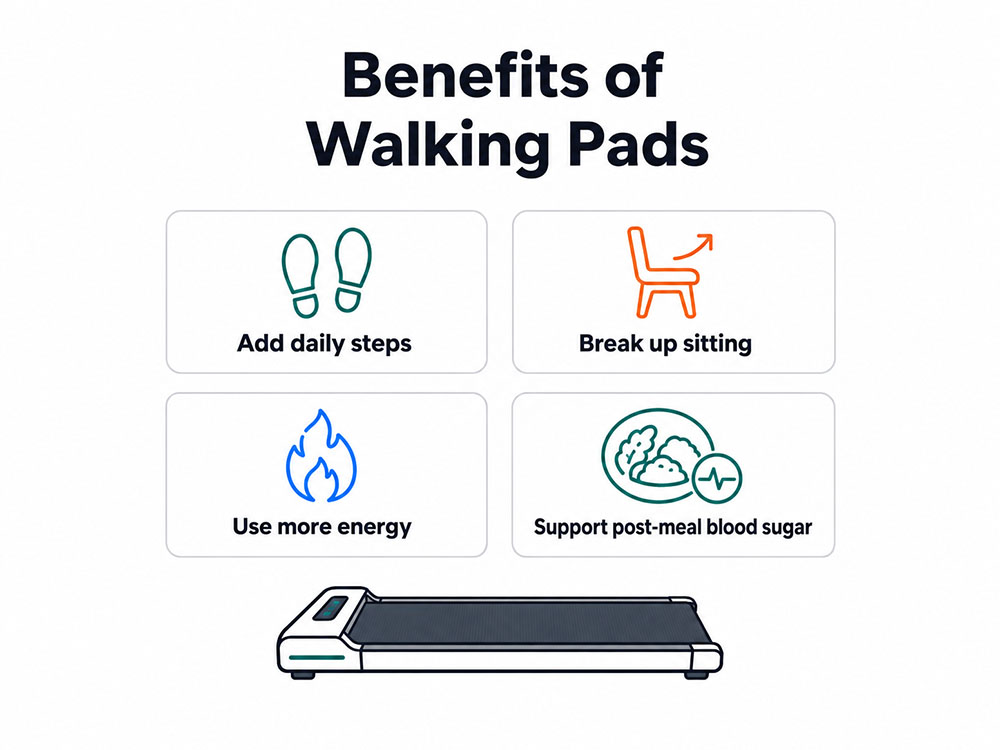
Walking pads can help you add steps and replace sitting with light activity. Here is what the evidence does and does not show about calories, blood sugar, fitness, focus, and weight loss.
This page contains affiliate links. As an Amazon Associate, we earn from qualifying Amazon purchases at no additional cost to you. We may also earn commissions from other retailers, again at no additional cost to you.
Walking pads offer a practical way to increase steps, break up extended sitting, and boost energy expenditure at home or at your desk. But do they truly enhance health, fitness, and focus, or are some claims exaggerating the evidence? We review studies on walking pads, treadmill desks, sitting breaks, and daily step goals.
We assess potential benefits for blood sugar, weight management, fitness, mood, and work performance, distinguishing walking-pad studies from broader evidence on walking and reduced sitting. We also cover suitable speeds, the time required to add 1,000 or 2,000 steps, desk and TV use, and practical considerations such as noise, setup, maintenance, and safety.
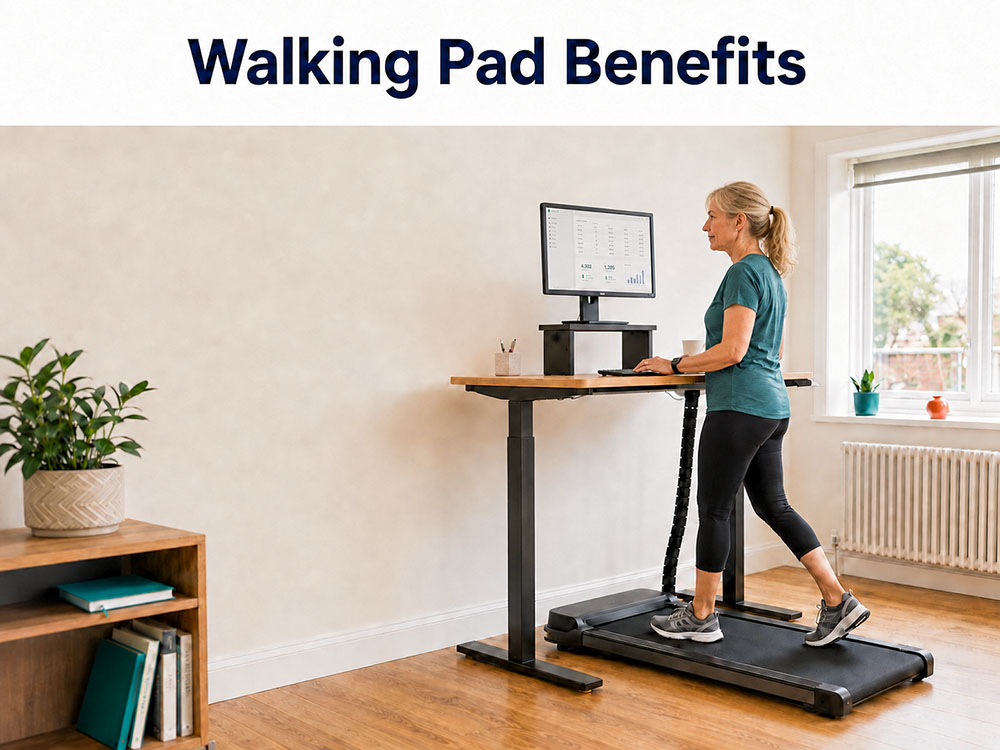
A walking pad can turn some desk time into light walking, helping to add daily steps and reduce prolonged sitting.
Health & Wellbeing Disclaimer
The information in this article is intended for general educational and wellbeing purposes. It discusses walking pads, under-desk treadmills, standing desks, sitting time, light movement, and related health and safety considerations, drawing on published research and public health guidance, primarily for generally healthy adults.
A walking pad or standing desk may not be suitable for everyone. If you have a medical condition affecting balance, circulation, joints, or mobility (such as significant musculoskeletal problems, varicose vein complications, circulatory disorders, dizziness, or reduced balance), or if prolonged standing or walking causes pain, dizziness, breathlessness, discomfort, or unsteadiness, you should consult your GP, physiotherapist, or another qualified healthcare professional before making significant changes to your work setup or daily movement patterns.
This article does not provide medical advice and should not replace professional healthcare. Individual responses to sitting, standing, and walking vary. Always adjust your workstation gradually, prioritise comfort and regular movement, follow your walking pad manufacturer's safety instructions, keep cables and step-off areas clear, and seek professional advice if you experience persistent or concerning symptoms.
In simple terms: a walking pad encourages more movement, reduces sitting time, and helps burn more energy compared to sitting at a desk. Controlled studies conducted over a single session or day show that taking short walking breaks can also improve blood sugar and insulin levels after meals. However, evidence supporting long-term weight loss, increased fitness, or disease prevention from using the machine alone is weak. The real benefit lies in making walking easier, not from any unique features of the pad.
Think of a walking pad as a stripped-back treadmill built for strolling, not sprinting. They're slim, lack bulky handrails, and are designed to slide neatly under a standing desk. While some offer a pop-up rail and a faster running mode, their main job is to keep you moving at a gentle, steady pace while you work.
Studies often call the equipment a treadmill desk, treadmill workstation or active workstation. That's the closest direct evidence, although a shared office treadmill desk isn't identical to a small home walking pad.
The useful question is not simply 'Is a walking pad good for you?' It is 'What activity does it replace or add?' Twenty minutes on a pad instead of 20 minutes in a chair is a genuine change. Twenty minutes on a pad instead of a brisk outdoor walk may be a step sideways, or even a reduction in intensity and variety.
Walking-pad claims sit at four different levels of evidence. Keeping them separate prevents a plausible benefit from being presented as a proven walking-pad effect.
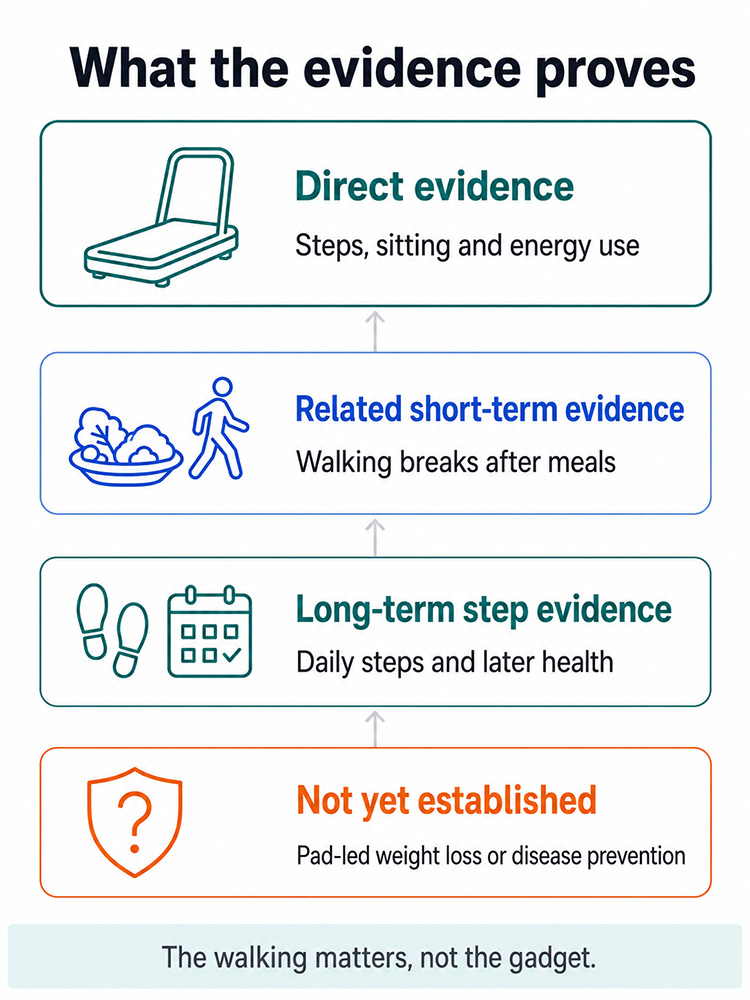
The strongest walking-pad evidence covers steps, sitting and energy use; longer-term weight loss and disease prevention remain unproven.
| Evidence level | What it includes | What it can tell us |
| Direct | Treadmill-desk laboratory studies and workplace trials | Whether walking while working changes steps, sitting, energy use or work performance |
| Transferable | Controlled studies that interrupt sitting with short walking breaks | Likely short-term effects during a similar session or day, especially after meals |
| Indirect | Long-term observational studies of daily steps | How step count is associated with later health, not whether buying a pad causes those outcomes |
| General walking evidence | Research on brisk walking, exercise or outdoor walking | Benefits that may apply only if pad walking matches the intensity, dose or setting studied |
The most comprehensive direct review we found pooled 13 treadmill-desk studies with only 351 participants. Seven were laboratory studies, and six were workplace studies. That is enough to be confident about some immediate changes, but too small and too short to settle claims about disease, body weight or long-term fitness.[1]
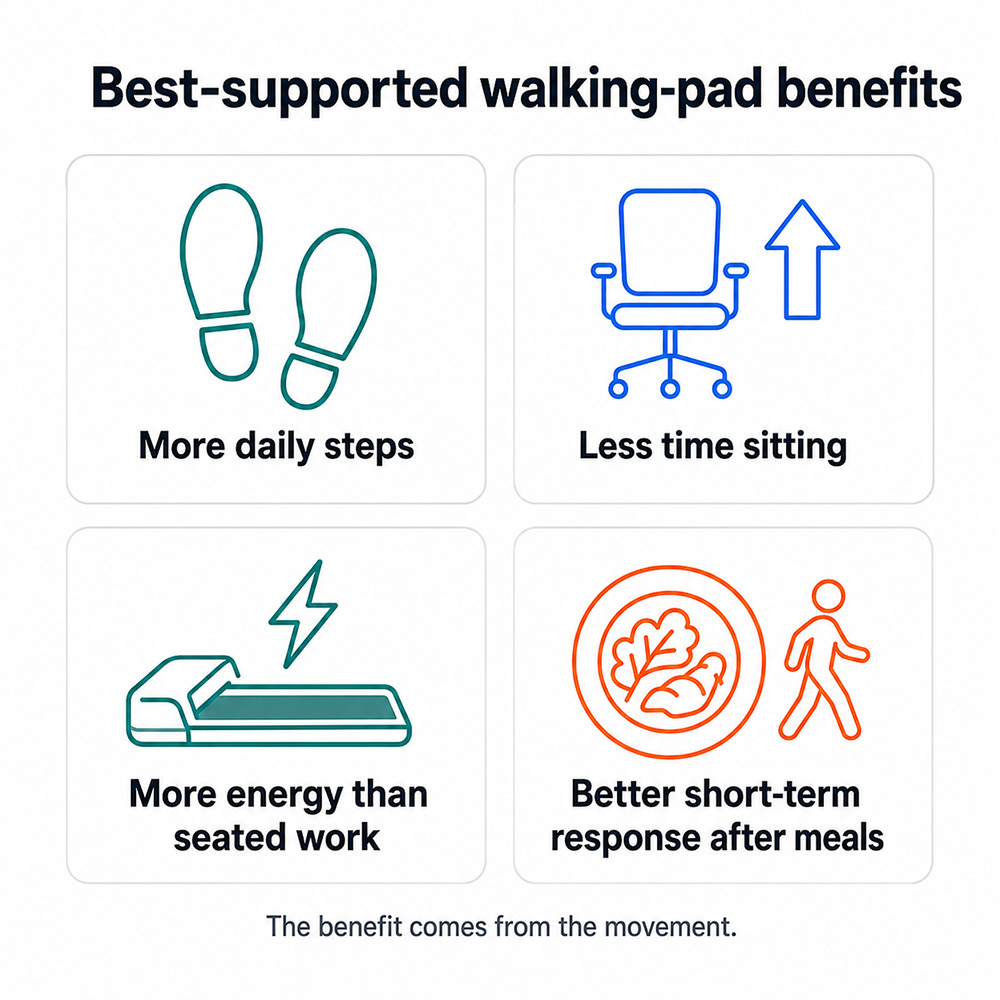
The best-supported benefits come from replacing sitting with movement, rather than from anything unique about the walking pad.
| Claim | What the evidence says | How directly it applies |
| Adds daily steps | Workplace trials show meaningful increases, although use and the ability to maintain the routine vary | Direct and reasonably supported |
| Reduces sitting | Treadmill desks can reduce sitting, particularly when paired with prompts and routines | Direct, but effects are modest and variable |
| Burns more calories | About 105 extra kcal per hour versus sitting in pooled slow treadmill-desk studies; faster sessions can burn more | Direct short-term evidence; personal figures vary |
| Improves post-meal blood sugar | Frequent short walking breaks reduce glucose and insulin responses | Good transferable short-term evidence, not long-term pad evidence |
| Improves fitness | Depends on pace, breathing and total dose; desk pace is often light | Plausible, but little direct evidence of fitness gains |
| Supports weight loss | Can help if it adds enough activity to use more energy than you consume; direct pad trials have not shown consistent loss | Supported by general exercise evidence; uncertain for pads alone |
| Helps thinking or mood | Walking may help idea generation; direct evidence that a pad improves mood or focus is limited | Partly direct for creativity; weak for mood |
| Works well while typing | Some thinking tasks are maintained, but typing speed and precise mouse work can suffer | Direct workstation evidence; task-dependent |
| Reduces early death | Higher step counts are associated with a lower risk in long-running groups of adults | Indirect and observational, not a pad treatment effect |
| Helps with joints or back pain | Often claimed, but direct walking-pad trials are inadequate | Not established for the pad itself |
This is the clearest real-world benefit. A pad lets you walk while doing something you already do for hours, like email, phone calls, online training, or watching TV. It reduces the need to set aside time, travel somewhere or depend on the weather.
In a six-month randomised workplace study of shared treadmill desks, the intervention group added an average of 1,622 steps per day compared with controls. Per work hour, they also added 1.6 minutes of light activity and reduced sedentary time by 3.6 minutes.[2]
A 13-month trial involving office workers with overweight or obesity showed that those in the treadmill group increased their weekday walking time by 18 minutes, compared to just one minute in the control group. The difference was statistically significant, exceeding what would be expected by chance, although it was smaller than researchers had anticipated.[3]
The less appealing aspect is maintaining the routine. During the six-month shared-desk program, employees were expected to use the treadmill for 45 minutes twice daily. However, attendance was only about 45 to 50 per cent of the scheduled sessions. The most common reasons were work conflicts and being out of the office. Despite this, the average daily use was approximately 43 minutes of light walking, but the strict target was unrealistic within typical work schedules.[4]
A 2023 meta-analysis combined data from 17 long-term studies involving 226,889 adults. It found that taking an additional 1,000 daily steps correlates with a 15% lower risk of death from any cause, while an extra 500 steps correlates with a 7% reduced risk of death from heart and circulatory issues.[7] These findings represent associations, not certainties, and do not guarantee that adding exactly 1,000 steps will reduce an individual's risk by precisely 15%.
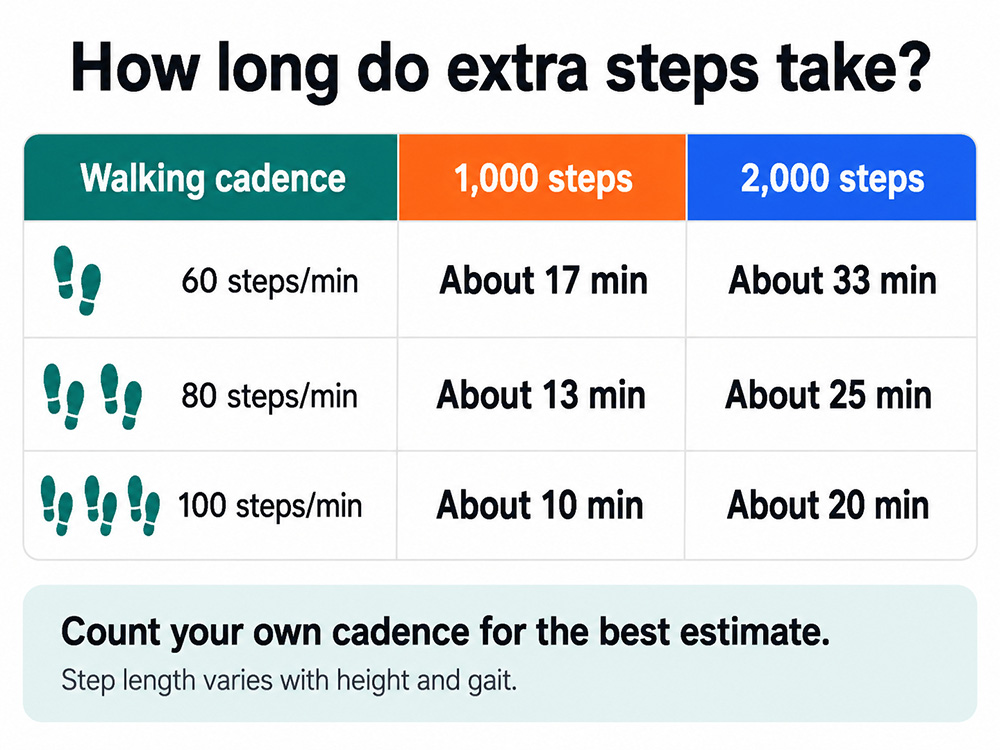
At 60 to 100 steps per minute, 1,000 extra steps take about 10 to 17 minutes, and 2,000 take about 20 to 33 minutes.
A 2025 dose-response review found that walking 7,000 steps daily, compared to 2,000 steps, was linked to a 47% reduction in all-cause mortality risk. The analysis also found lower risks for other outcomes, though the strength and certainty of evidence varied by outcome.[8]
A different UK Biobank study showed that walking more than approximately 2,200 steps daily is linked to reduced mortality and cardiovascular risk. The model suggested that about half the potential benefit occurs at 4,000 to 4,500 steps, while the lowest risk was seen around 9,000 to 10,500 steps per day.
If you spend most of your day seated, adding even a small number of steps is a significant achievement. However, it's important to recognise that a walking pad isn't a miracle device that extends life, and 10,000 steps isn't a magical goal. The mortality research considered all steps taken throughout the day, whether on a treadmill, walking the dog, or moving around the kitchen.
Walks4all takeaway: If your usual day involves little activity, aiming to add an extra 1,000 to 2,000 steps is a good initial goal. Base your progress on your current routine, increase steps gradually, and evaluate your habit over several weeks rather than on a single perfect day. Consider the mortality statistics as helpful indicators, not as precise personal risk estimates.
The pad's value extends beyond just counting steps. It can also influence daily routines by encouraging breaks from prolonged sitting. According to the 2026 UK Chief Medical Officers' guidance, adults should reduce sedentary periods and, whenever feasible, interrupt extended inactivity with at least light physical activity.[16]
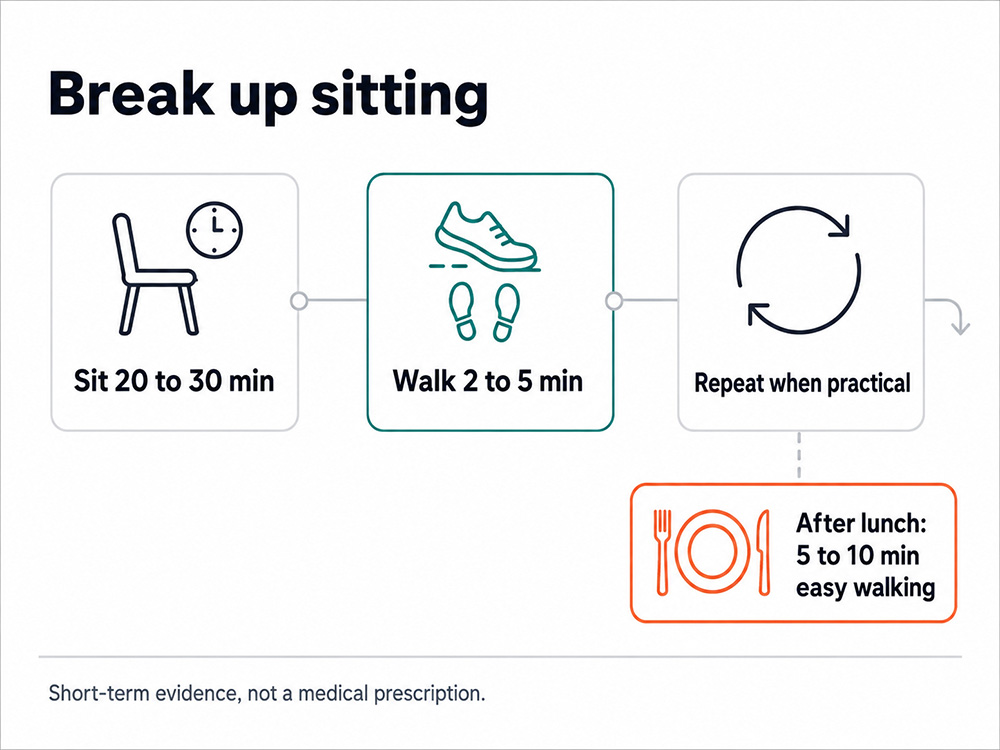
Short, frequent walking breaks can help break up prolonged sitting; the timings shown reflect short-term studies, not a medical prescription.
In the treadmill-desk review, workplace use reduced sitting by an average of 1.73 minutes per hour over a 24-hour day. The estimate was modest, and the studies varied, but it moved in the expected direction.[1]
A 2023 network meta-analysis of 23 randomised trials with 1,428 office workers found that treadmill workstations paired with prompts, like reminders or encouragement to change posture, reduce work-related sitting more than traditional desks. Equipment combined with prompts tended to perform better than equipment alone. However, the authors rated the overall certainty of the evidence as low.
That distinction matters. A pad lent against a door or a wall does nothing. A pad linked to a recurring cue, such as the first call of the day or ten minutes after lunch, is more likely to change behaviour.
Walks4all takeaway: Use the pad to substitute a specific sitting period, rather than as furniture you aim to recall. Choose one or two consistent cues and keep a chair accessible. Alternating between sitting, standing, and walking is more practical than attempting to walk all day.
This is one of the strongest arguments based on how the body responds, although most of the evidence concerns walking breaks rather than commercial pads.
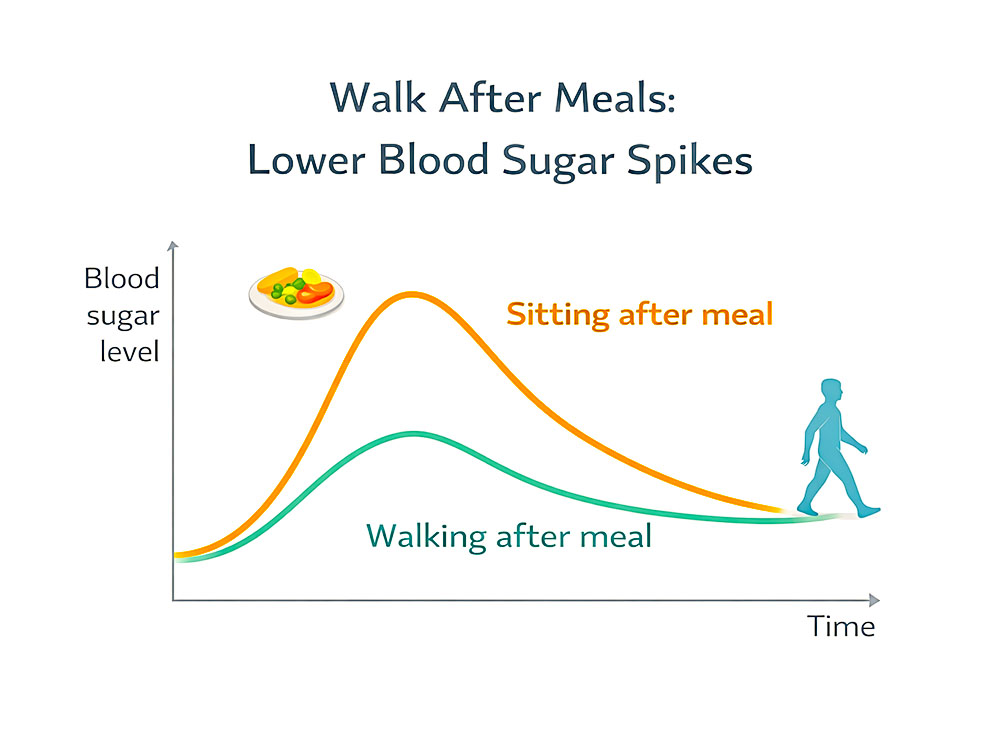
A 2026 systematic review analysed 53 studies in which participants tried various sitting and activity conditions, typically in random order. These studies focused on short-term effects during a single session or day, with 39 contributing to the overall analysis. Researchers sometimes call these acute studies. The findings showed that, compared to uninterrupted sitting, taking regular activity breaks lowered post-meal increases in glucose and insulin. Walking yielded the most significant combined effect among different break types. Breaks every 15 to 20 minutes had the strongest estimated impact, while 30-minute breaks also proved beneficial. Conversely, breaks every 45 to 60 minutes caused smaller changes, which might have been due to chance.[5]
The protocols varied. Breaks ranged from 30 seconds to 10 minutes, with a median of 2.5 minutes, and the laboratory sessions lasted only 3 to 12 hours. The review therefore supports a short-term metabolic effect, meaning a change in how the body handled the meal during the study period. It does not show that pad use prevents diabetes or replaces treatment.
An influential trial demonstrates this pattern: nineteen adults with overweight or obesity participated in five-hour sessions of either continuous sitting or alternating periods of two minutes of light or moderate walking every 20 minutes. The results showed that walking conditions led to lower post-meal glucose and insulin levels compared to sitting without breaks.[6]
A recent small-scale experiment involved the same participants testing various patterns over multiple eight-hour days. Just five minutes of light walking every 30 minutes significantly lowered the glucose response, and several walking routines also decreased daytime blood pressure.[17] Since the sample included only 11 adults, these findings should not be regarded as a universal recommendation.
Walks4all takeaway: If you sit for work, taking brief and frequent pad walks is more effective for breaking up sitting than delaying movement until the end of the day. A practical goal is to walk easily for 2 to 5 minutes every 20 to 30 minutes when possible, along with 5 to 10 minutes after lunch. This timing is based on short laboratory studies, rather than established long-term guidelines.
Walking consumes more energy than sitting. Laboratory studies on slow treadmill-desk walking indicate that energy expenditure increases by approximately 105 kcal per hour compared to sitting.[1] This figure is based on office-work conditions, not a maximum limit. Walking faster during activities like watching television or listening to a podcast would generally burn more total energy, assuming the pace remains safe and within the treadmill's capabilities. Additionally, the 2024 Compendium of Physical Activities confirms that energy demand rises with increased treadmill-walking speed.[19]
The figure of 105 averages across specific studies and may not be precise for every individual or device. Energy expenditure varies with body size, speed, gradient, gait, hand support, and duration. Consumer wearables and displays can also be inaccurate. An older lab study of obese office workers found an average difference of 119 kcal per hour compared to sitting, showing how results can vary by sample and testing method.[18]
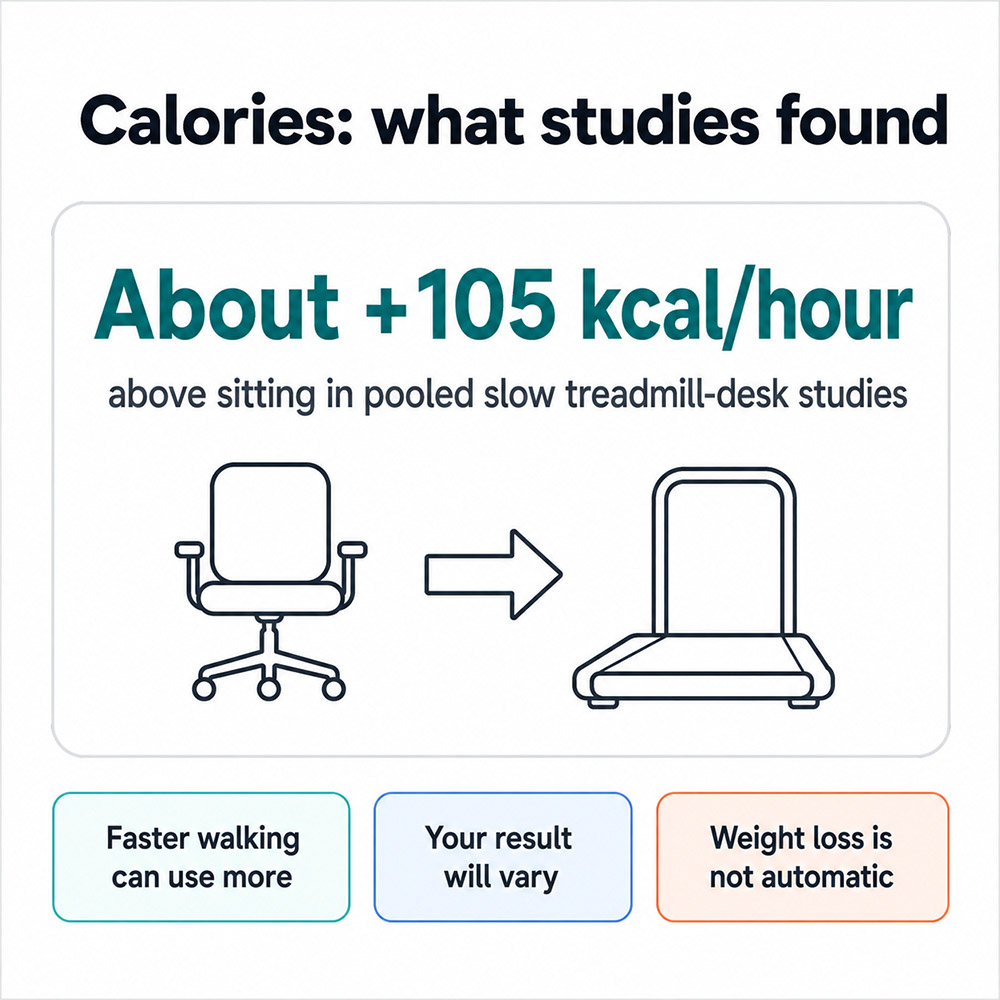
Slow treadmill-desk walking used about 105 kcal per hour more than sitting on average, but faster walking and individual results vary.
Increasing energy expenditure doesn't guarantee weight loss, but it can help. A 2024 study combined data from 116 trials involving nearly 7,000 adults with overweight or obesity who were assigned to exercise or control groups. Supervised aerobic exercise resulted in modest decreases in weight, waist circumference, and body fat. These improvements tended to increase with more weekly exercise, and exceeding 150 minutes of moderate-intensity exercise per week might be necessary for significant health benefits. This reflects general exercise research, not specific to walking-pad use.[20]
Direct evidence for walking pads is limited. Studies on treadmill desks in the review showed no significant impact on BMI or body-fat percentage,[1] and a 13-month trial found no notable differences between groups in BMI or waist size.[3] This does not mean walking cannot aid weight loss, but it suggests that simply providing a desk treadmill at typical usage levels does not consistently lead to weight loss on its own.
Body weight reflects the balance between energy intake and expenditure over time, and people may compensate without realising it. The updated UK guidance also notes that the amount of physical activity needed for weight loss cannot be neatly specified because food intake and energy expenditure interact.[16]
Walks4all takeaway: A walking pad can assist with weight loss by encouraging consistent movement, helping you burn more energy than you consume over time. An hour of comfortable walking while watching TV might contribute more than a few slow minutes at a desk. Don't rely solely on the display for calorie counts; instead, monitor your weight trend over several weeks and consider your overall diet, sleep, and strength training.
It can, but only if the walking is sufficiently demanding and repeated frequently. Very slow walking while typing is normally considered light activity. It may increase energy use and interrupt sitting without providing the same training stimulus as a brisk walk.
Moderate intensity means your breathing and heart rate rise, but you can still talk, though not sing comfortably. The 2026 UK guidelines recommend at least 150 minutes of moderate activity, or 75 minutes of vigorous activity, each week, plus muscle-strengthening activity on at least two days. They also recommend reducing sitting time.[16]
This gives a walking pad two possible roles:
Direct research has not established that ordinary desk walking improves cardiorespiratory fitness. It has shown short-term increases in heart rate, oxygen use and energy expenditure, which are necessary ingredients but not the same as demonstrating a meaningful change in fitness over months.[1] [11]
Walks4all takeaway: Keep the jobs separate. Use slow pad walking to break up desk time, then include purposeful brisk walking or other aerobic activity for fitness. Add strength work twice a week. If you can type normally without noticing your breathing, do not assume the session is moderate exercise.
This section applies specifically to walking while working at a desk. It is not a reason to avoid a walking-pad session while watching television, listening to music or exercising without a keyboard.
Walking and working can often go together, but not all tasks benefit equally. A systematic review of active workstations showed that treadmill desks boost movement and energy use but may impair fine hand control, making tasks like precise typing, mouse pointing, and keyboard-mouse combinations more challenging.[11]
A 2024 experiment involving 44 healthy adults found that several tests of attention, memory and thinking improved or remained unchanged at active workstations, while typing speed fell without more errors. Because sitting was always tested on the first day and overall scores improved after day one, practice and familiarisation may explain part of the result.[12]
A 12-month field study observed increased overall physical activity and no decline in work performance after employees adopted treadmill workstations. Some analyses showed improvements in self- and supervisor-rated performance, but since this was a small, non-blinded workplace intervention, it shouldn't be viewed as conclusive evidence that a treadmill pad enhances productivity for everyone.[15]
In a separate experiment, researchers randomly assigned 75 adults to either sit or walk at 1.5 mph (approximately 2.4 km/h). The walking group performed worse across all typing assessments and on some tests related to learning and attention.[21] This does not establish that 2.4 km/h is a definitive cutoff point. Instead, it shows why a comfortable walking pace can still be too fast for tasks that require extensive keyboard use.
The practical pattern is straightforward: walking pairs more naturally with activities like calls, webinars, reading, voice notes, or casual planning rather than with complex spreadsheets, design tasks, or quick mouse movements. The optimal pace is the slowest speed that lets you maintain a natural walking rhythm and perform the task accurately.
Certain accessories can make working at a standing desk while walking easier by preventing monitor shake, as outlined in our guide to standing desk accessories.
These are Walks4all starting ranges, not medical rules or laboratory thresholds.
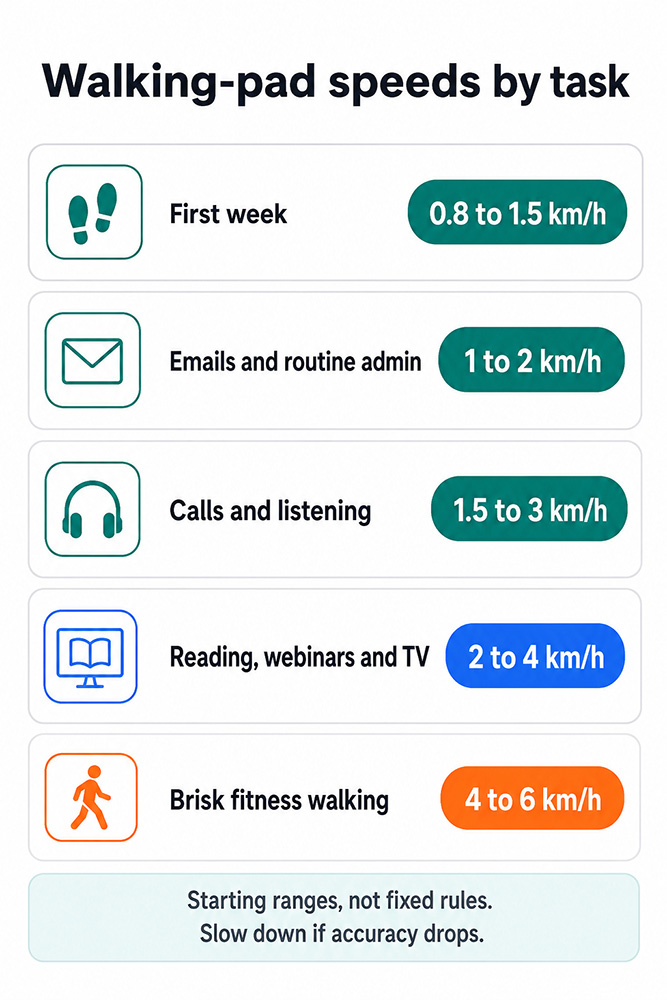
Start slowly and match the walking-pad speed to the task; reduce the pace or step off if accuracy or posture deteriorates.
They match the practical guide in our best walking pads UK article, and the research finding that typing can deteriorate even at about 2.4 km/h.[21] Start at the bottom of the range, stay within the manufacturer's limit and adjust for your own balance, gait and accuracy.
| Task | Suggested starting speed | Why |
| First week or getting used to the pad | 0.8 to 1.5 km/h | Learn the belt movement before adding work |
| Emails and routine admin | 1 to 2 km/h | Slower speed usually protects typing and mouse accuracy |
| Calls and listening meetings | 1.5 to 3 km/h | Less precise keyboard work allows a slightly quicker pace |
| Reading, webinars and television | 2 to 4 km/h | No typing may make a more natural walking pace possible |
| Brisk fitness walking without desk work | 4 to 6 km/h | A dedicated session can be faster if safe and comfortable |
If you notice a drop in accuracy, tension in your shoulders, or find yourself reaching for the desk, take a break or pause.
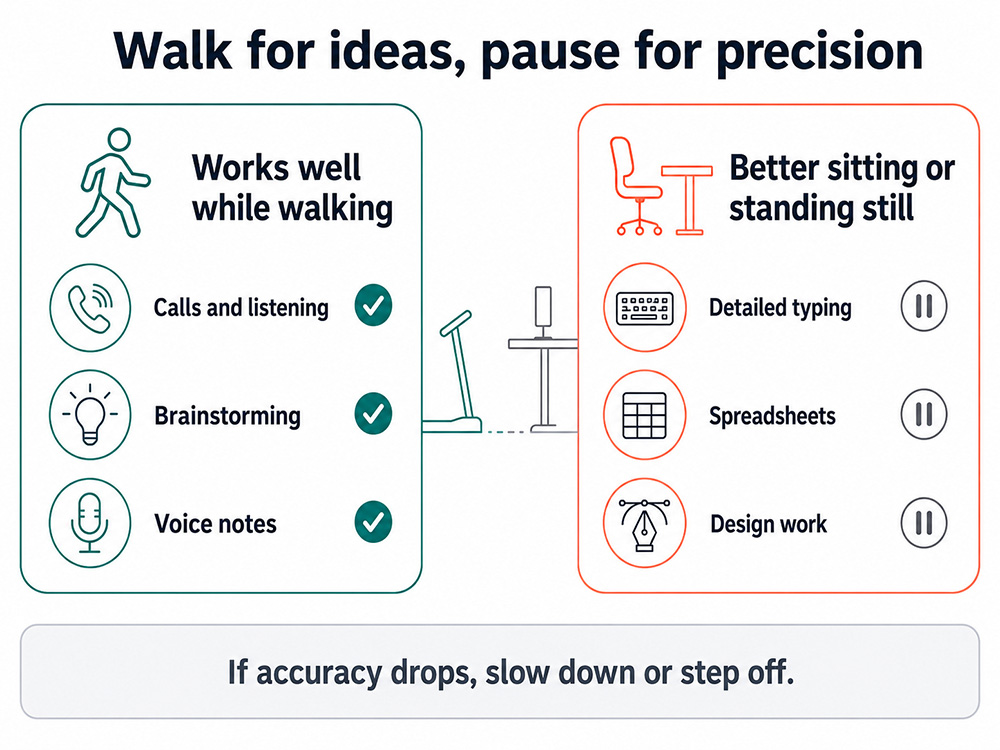
Walking can suit listening and idea generation, while precision tasks are often easier seated or standing still.
For tasks that demand intense focus and a single correct response, remaining seated or standing still could be more effective. The Walks4all standing desk benefits guide explains how to alternate between three different positions.
Walks4all takeaway: Match your activity to the task at hand. Use walking for calls, listening, reading, and initial thinking. Slow down for emails, and sit or stand for detailed typing, calculations, design work, and key video meetings. When watching TV, you can usually walk faster since no keyboard or mouse demands your attention.
The mental case is more nuanced than 'walking pads improve focus'. A set of four experiments found that walking boosted divergent thinking, the type used to generate many possible ideas. In the first experiment, 81 per cent of participants improved on the divergent-thinking task while walking on a treadmill. Walking helped far fewer people on a convergent task with one correct answer.[13]
The experiments also separated movement from setting. Indoor treadmill walking improved creative idea generation, while outdoor walking produced the strongest novel analogies in one comparison. So at least part of the creativity effect came from walking itself, and part could come from the outdoor environment.[13]
This is not evidence that pad walking treats anxiety or depression. Reports of improved energy, mood or focus among treadmill-desk users are interesting, but much of that literature is qualitative, self-reported or short-term. It is safer to say that some people feel better when they move, and that walking may suit brainstorming better than precision work.
Walks4all takeaway: Use a walking pad to generate ideas, not to find a single exact answer. Trying a ten-minute walk before tasks like writing, planning, or solving problems can be a helpful experiment. If you're frequently feeling low or anxious movement can help, but it shouldn't replace proper care.
Level walking involves muscular effort, but the experience differs outdoors. Outside, you get daylight, natural scenery, fresh air, social interactions, route navigation, pace changes, and small balance challenges from uneven surfaces. A flat treadmill in a spare room can't replicate these outdoor exposures.
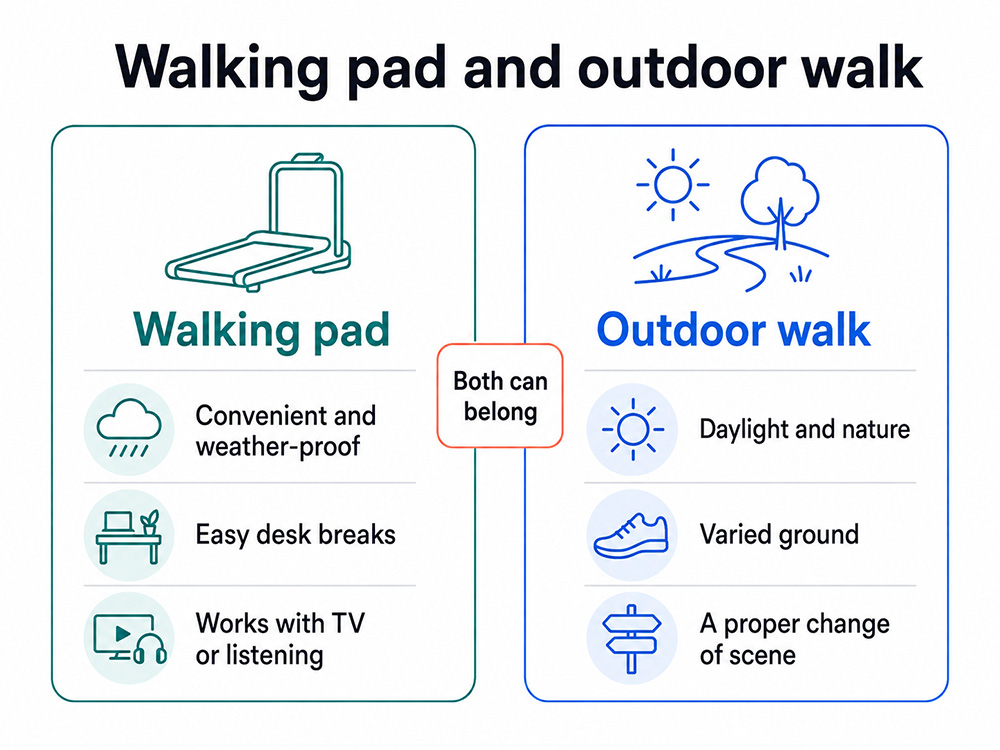
A walking pad is convenient for desk breaks and indoor sessions, while outdoor walks add daylight, nature and varied terrain.
A systematic review examined 11 trials involving 833 adults and compared activity in natural outdoor environments with indoor activity. Results showed that outdoor activity increased feelings of revitalisation, positive engagement, and energy, while reducing tension, confusion, anger, and depression. However, due to heterogeneity among the studies, their generally low quality, and their short-term nature, the review could not determine whether outdoor activity provides long-term advantages.[14]
In short, it's not an 'either/or' situation. Indoor walking absolutely gets the creative juices flowing, but it won't replicate the mood-boosting benefits of getting out into green space. Physical movement sparks the brain, but nature provides the soul-soothing backdrop.
Walks4all takeaway: Think 'pad and outdoors', not 'pad or outdoors'. Use the pad for convenience, poor weather and desk breaks. Keep outdoor walks for daylight, variety, nature and a proper change of scene.
Articles and product pages often move from 'walking is healthy' to 'this walking pad delivers every walking benefit'. The following claims need more care.
| Claim | Better wording |
| 'A walking pad prevents heart disease or early death' | More daily steps are linked to a lower risk. No trial shows that buying or using a pad prevents these outcomes. |
| 'It melts fat or guarantees weight loss' | It increases energy expenditure compared with sitting. Long-term weight change is variable and was not significant in pooled workplace evidence. |
| 'It fixes back or joint pain' | Some people prefer gentle movement to prolonged sitting, but direct evidence that a walking pad treats pain is inadequate. |
| 'It improves posture' | Alternating positions may feel better than holding a single posture. Poor desk height or reaching while walking can create new strain. |
| 'It replaces the gym' | It's a great tool for light daily movement, but an hour of slow desk-walking doesn't replace the need to lift heavy weights, raise your heart rate, or challenge your balance. |
| 'It cancels a sedentary lifestyle' | Steps help across different sitting levels, but lower sedentary time still appears favourable. Move more and sit less rather than trying to offset one with the other. |
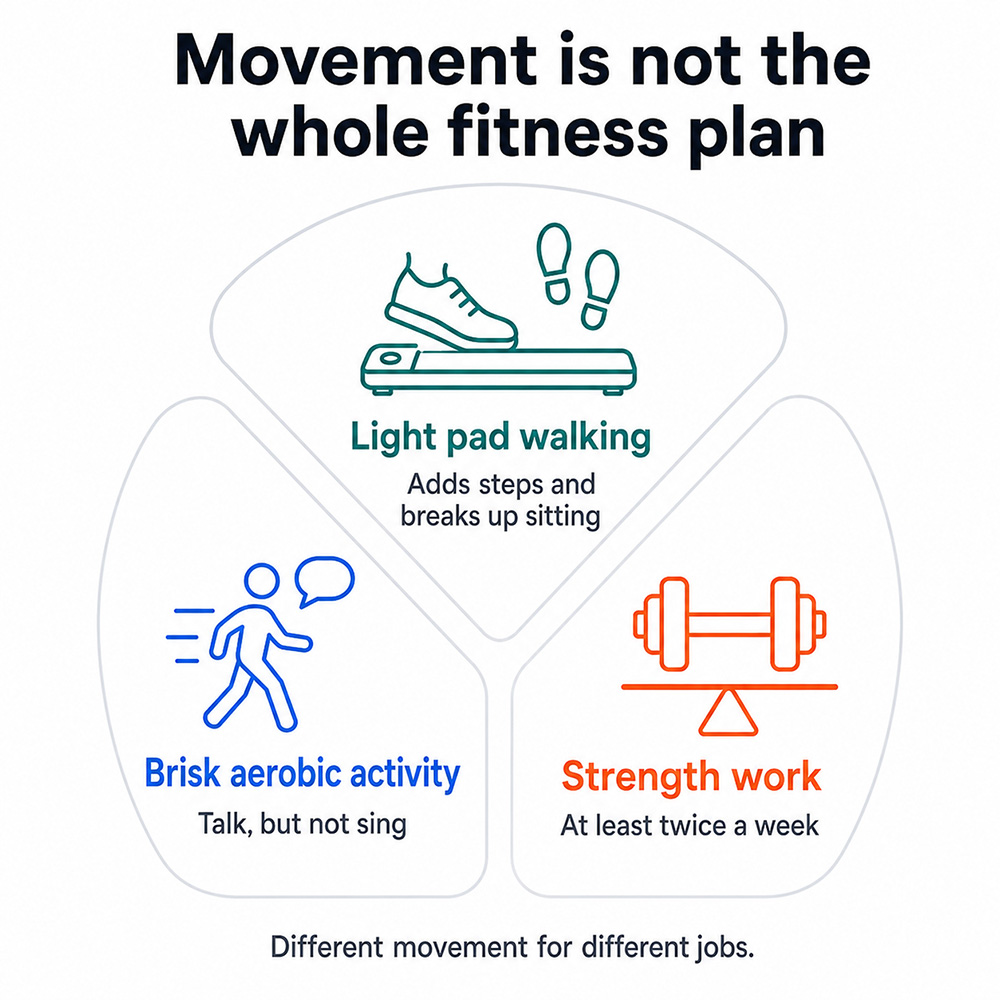
Slow walking-pad sessions can add movement, but a balanced fitness plan also includes brisk aerobic activity and regular strength training.
The options below complement one another. The strongest routine is usually a mix: sit for detailed tasks, stand for short breaks, walk gently during compatible work, go outside when practical, and include dedicated strength work.
| Option | Best for | Main limitation |
| Walking pad at desk | Adding steps, light movement and short sitting breaks while doing compatible tasks | Typing or mouse accuracy may suffer; usually low intensity; no outdoor exposure |
| Standing desk | Changing posture and reducing chair time with minimal task disruption | Standing still uses little extra energy compared with walking |
| Brisk outdoor walk | Moderate activity, change of scene, daylight, nature and varied movement | Requires a separate time slot, a safe route and suitable conditions |
| Strength and balance training | Muscle, bone, function and falls resilience | Not delivered by ordinary pad walking |
No research-backed universal walking-pad duration exists. The optimal duration depends on your current activity, symptoms, work and goals. Large targets can also backfire if they make the habit awkward.
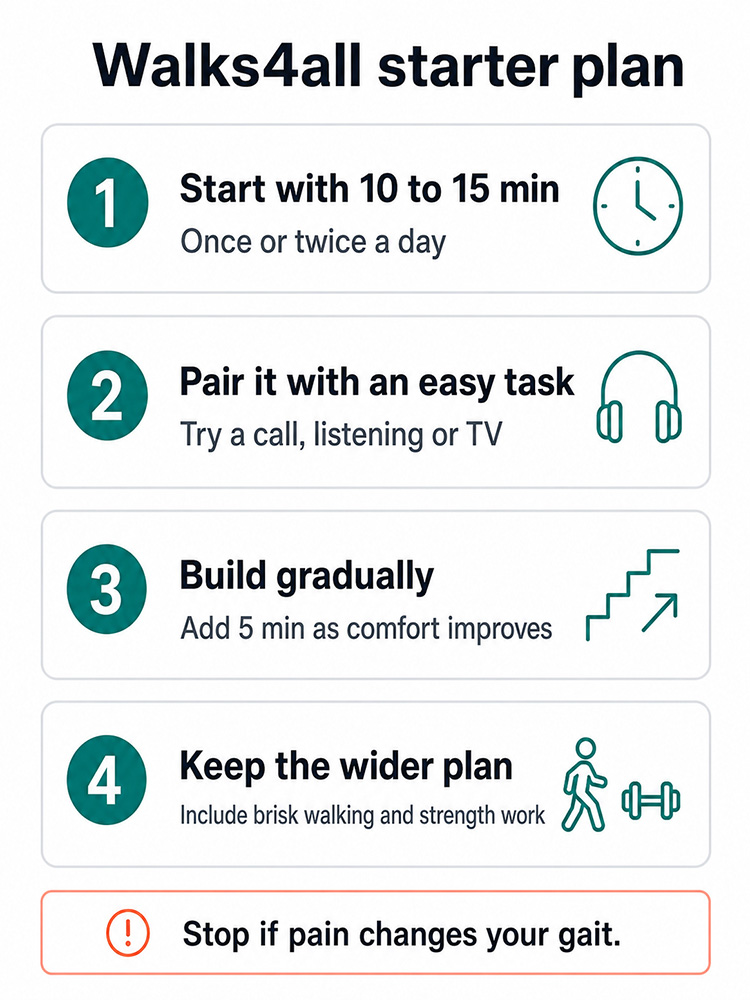
A gradual walking-pad plan makes the habit easier to sustain while keeping brisk activity and strength work in the wider routine.
A practical starting plan is:
You do not have to walk continuously. In fact, sitting-break evidence favours repeated short bouts for the blood sugar response after meals, while workplace research shows that long, rigid desk sessions can be difficult to sustain.[4] [5]
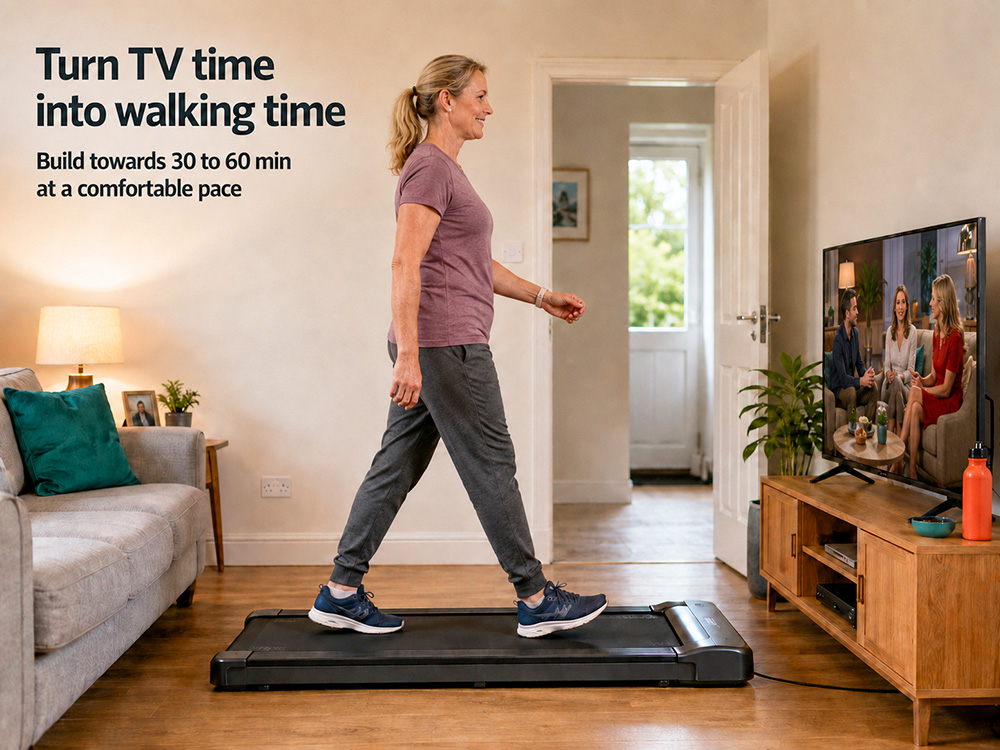
Build gradually towards a 30 to 60-minute walking-pad session while watching television, using a comfortable pace.
Using a standing desk is only one option. If you can walk safely and comfortably, a 30- to 60-minute pad session while watching television can provide a substantial block of movement without the typing and mouse-control issues of a treadmill desk. Build up gradually, and use a pace that suits the session.
Cadence is the number of steps you take per minute. It varies with belt speed, height, step length and gait. Instead of relying on a generic estimate, count your steps for two minutes at your normal pad pace, divide by two, then use the table below.
| Walking cadence | Time for 1,000 steps | Time for 2,000 steps |
| 60 steps/min | About 17 minutes | About 33 minutes |
| 80 steps/min | About 13 minutes | About 25 minutes |
| 100 steps/min | About 10 minutes | About 20 minutes |
These are simple arithmetic examples, not recommended speeds. A wrist-worn tracker may miss steps if your hands remain on a keyboard or desk. When comparing your own weeks, use the same device and placement, and focus on the trend rather than false precision. For a more personal estimate based on your height, pace and other details, use the Walks4all walking calculator.
Distance is simpler when you know the belt speed.
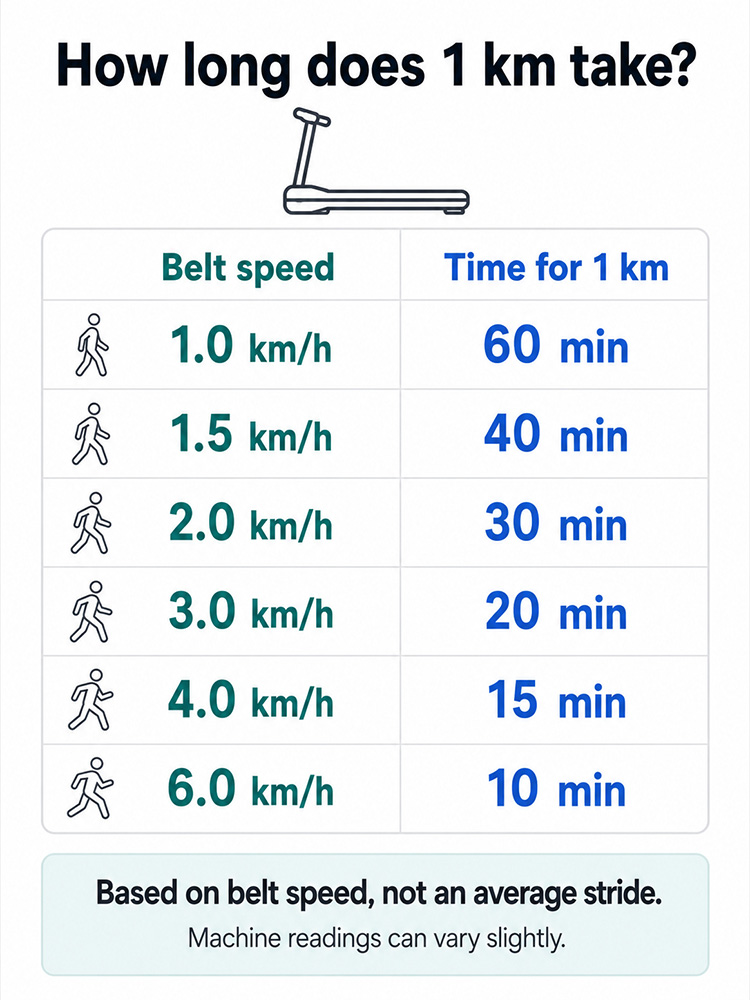
One kilometre takes about 60 minutes at 1 km/h, 20 minutes at 3 km/h and 10 minutes at 6 km/h; machine readings can vary slightly.
The table below uses speed alone, so it doesn't require an 'average-height' person. Height and step length affect how many steps you take over 1 kilometre, but not the time needed to cover 1 kilometre at a genuine 3 km/h. Allow for small differences in machine calibration and the time the belt takes to speed up or slow down.
| Belt speed | Time for 1 km | Typical use |
| 1.0 km/h | 60 minutes | Very slow familiarisation |
| 1.5 km/h | 40 minutes | Slow desk walking |
| 2.0 km/h | 30 minutes | Routine desk tasks for some users |
| 2.5 km/h | 24 minutes | Calls or listening for some users |
| 3.0 km/h | 20 minutes | Purposeful easy walking |
| 4.0 km/h | 15 minutes | Dedicated walking, reading or television |
| 5.0 km/h | 12 minutes | Brisk walking for many adults |
| 6.0 km/h | 10 minutes | Fast walking; check the pad's limit |
The table is based on distance arithmetic, not a guarantee that every speed suits every person or machine. The Walks4all walking calculator provides a more detailed estimate of steps, distance, time and calories. The Walks4all calorie calculator offers a deeper dive into calories and weight loss.
| Moment | Pad plan | Why |
| Start of work | 10 minutes easy walking while planning the day | Attaches the habit to a reliable cue |
| Morning | 2 to 5 minutes after each 20 to 30 minutes sitting, where practical | Breaks up prolonged sitting |
| After lunch | 5 to 10 minutes easy walking | Fits the evidence on activity after eating |
| Calls or training | Walk at the slowest comfortable pace | Little need for precise typing or mouse control |
| Detailed work | Sit or stand; park the belt | Protects accuracy and ergonomics |
| Later in the day | Brisk outdoor walk or focused pad session | Adds intensity, daylight or both |
Walks4all takeaway: The useful habit is not 'walk all day'. It is 'choose the right movement for the right job'. Even two or three repeatable sessions can add a meaningful number of steps without turning work into an endurance test.
While the health and productivity benefits are well supported, a walking pad remains a mechanical device in a home office. Weighing these practical factors will help you decide whether it suits your space and routine.
Walks4all takeaway: The best walking pad is one you can use comfortably in your workspace. Measure the available floor space and the usable belt area, check the weight limit, follow the maintenance instructions, and test the noise level before an important call. Be prepared to mute your microphone while walking if your colleagues can hear the pad.
Compact treadmills remove some of the features people rely on at the gym. A short deck, no fixed handrails and divided attention can increase the risk of a misstep. Set up the space before chasing a step target.
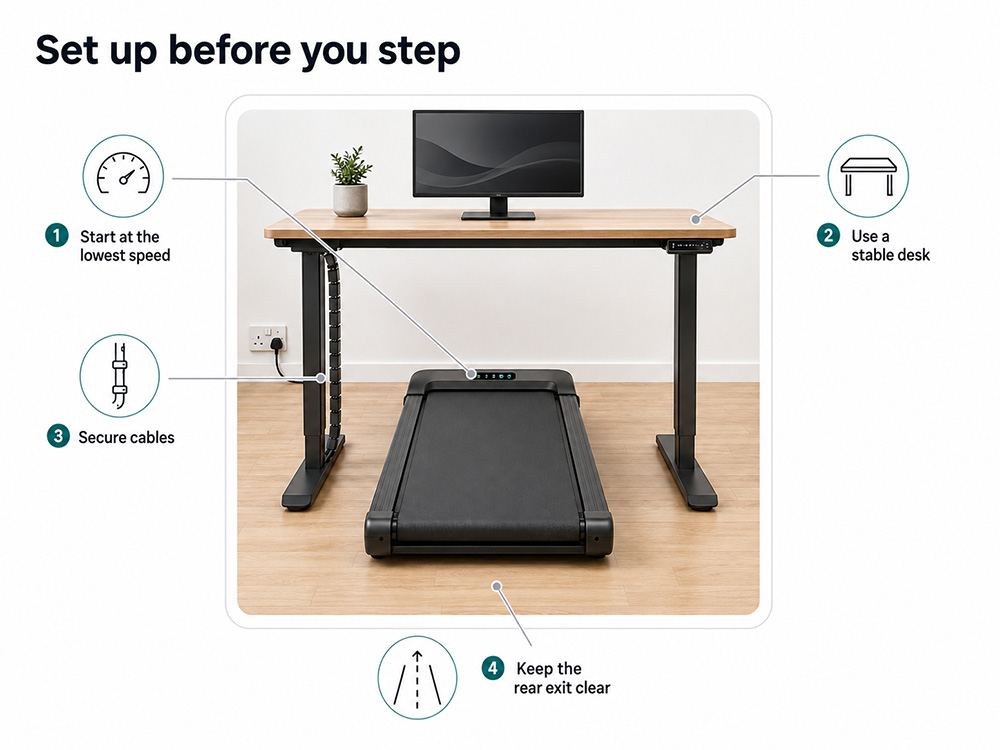
Set up the walking pad before use: choose the lowest speed, secure cables, use a stable desk and keep the rear exit clear.
For a practical workstation guide, see How to set up a walking pad with a standing desk. If you are comparing models, consult the Walks4all guide to the best walking pads in the UK.
A pad may be less suitable for people with significant balance problems, recurrent falls, severe visual impairment, foot numbness, or conditions that make unsupervised treadmill use unsafe. Some may be better served by a stable treadmill with full handrails, supervised exercise, or a different form of activity.
Walking pads excel at providing opportunities to walk in spaces where people might otherwise remain seated. Studies on treadmill desks indicate increased energy expenditure and a slight decrease in sedentary behaviour, while workplace trials demonstrate that accumulating additional steps is feasible. Additionally, short-term walking-break studies reveal benefits such as improved blood sugar and insulin responses following meals during the same day or session.
The best approach depends on the setting. Slow desk walking can add steps during calls and routine work. A separate 30- to 60-minute session in front of the television can be quicker and more purposeful, as you are not trying to type. If the pace raises your breathing enough, that dedicated session may also contribute to moderate-intensity activity.
The evidence does not justify treating the pad as a cure-all. Weight loss depends on sufficient extra activity over time and on overall energy balance. Fitness depends on intensity, work performance depends on the task, and the major mortality findings come from observational studies of total daily steps rather than from walking-pad trials.
The most useful approach is simple: start from your baseline, replace a few sitting periods, add longer sessions if they fit your day, keep some brisk walking and strength training, and still get outside when you can.
Walks4all takeaway: Use the pad in a way that adds meaningful movement to your daily life. This could be ten minutes after lunch, slow walking during calls, or an hour while watching TV. Gradually incorporate it, maintain a suitable pace for each activity, and ensure indoor steps don't replace outdoor walks or the strength exercises your body needs.
Yes, if the goal is to take more steps, replace some sitting and increase energy expenditure. Direct studies support those outcomes. Evidence is weaker for long-term weight loss, fitness and disease prevention from the pad itself.
It can provide a similar level of walking at a matched speed, but it does not replicate daylight, nature, fresh air, varied terrain or a change of scene. Indoor walking can still support movement and creative thinking. Ideally, use both.
There is no universally evidence-based duration. Start with 10 to 15 minutes once or twice a day and build gradually. For sitting breaks, short bouts every 20 to 30 minutes align with short laboratory studies, but they are not a proven long-term prescription. If you are comfortable and not working at a desk, a longer television or listening session can also be practical.
Yes, but 10,000 steps is not a magic threshold. People starting low can gain meaningful activity by adding 1,000 to 2,000 steps. Track your baseline and build towards a total you can sustain.
Yes, it can help if it adds enough activity to burn more energy than you consume over time. General exercise trials show modest weight and fat loss, especially with larger weekly amounts. Direct workplace walking-pad trials have not shown consistent changes in body mass index (BMI) or body fat, so the pad is a useful tool, not a guarantee.
It counts as physical activity. It counts towards the moderate-intensity guideline only if the pace raises your breathing and heart rate enough that you can talk but not sing comfortably. A slow typing pace is usually light activity.
There is no single best number. Start very slowly and use the lowest speed that gives you a natural gait without compromising accuracy or posture. Many people need to stop walking for detailed typing and mouse work.
Standing changes posture and reduces chair time, but walking increases muscle activity and energy use. In short meal-response studies, walking breaks produced larger effects than standing.
Cognition is often maintained at active workstations, but typing and mouse performance can decline. Walking may help with calls and brainstorming, while precision work is usually better done seated or standing still.
No. Higher step totals are associated with lower risk, even among people who sit a lot, but that does not prove that steps cancel out the effects of prolonged sitting. The better aim is to move more and break up periods of sitting.
September 2026
We take evidence seriously at Walks4all. If you'd like to better understand how walking studies are designed, how results should be interpreted, and what scientific terms mean, explore our guides on the following: