The 9 walking mistakes after 50, and what the studies say to do instead
By: Andrew Forrest - November 2026
Nine common walking mistakes after 50, from stretching first to watching your feet, with practical fixes backed by research and UK guidance.
Table of contents
This page contains affiliate links. As an Amazon Associate, we earn from qualifying Amazon purchases at no additional cost to you. We may also earn commissions from other retailers, again at no additional cost to you.
Many walking mistakes after 50 stem from beliefs we picked up years ago and never questioned: that a short walk isn't worth the effort, that you should stretch before setting off, or that the safest place to look is at your feet. Some do no harm, but others can increase the risk of a fall, leave you sore, or put you off walking altogether.
We carefully reviewed more than 140 studies and guidelines to help make sense of the evidence. The first finding is encouraging: for most people, the biggest benefit still comes from walking more, especially if you're not very active now. The second is that how you walk has a lot to do with staying comfortable, staying on your feet, and keeping going for years. Here are nine common mistakes and what research suggests doing instead. Some advice is backed by large trials and reviews; other guidance rests on thinner evidence. Under "The catch" in each section, we explain which is which and where the limits are.
Health & Wellness Disclaimer
This article is for general information only and does not constitute medical advice, diagnosis or treatment. Speak to your GP or another qualified healthcare professional before making major changes to your activity routine, particularly if you have a medical condition, are pregnant, are returning after illness or injury, or develop chest pain, severe breathlessness, dizziness or unusual pain.
Quick answer
Nine common walking mistakes after 50 include dismissing short walks, moving too slowly, stretching before you start, watching your feet, rushing, holding your arms rigid, wearing the wrong shoes, looking at your phone while walking, and treating walking as enough on its own. The fixes are simple: walk more, including ten minutes after meals; pick up the pace for part of most walks; start easy; look a few steps ahead; take your time; wear grippy, fastened shoes; stop before using your phone; and add strength and balance exercises twice a week.
Video: The 9 walking mistakes after 50, and what the studies say to do instead
Five walking myths to put to rest
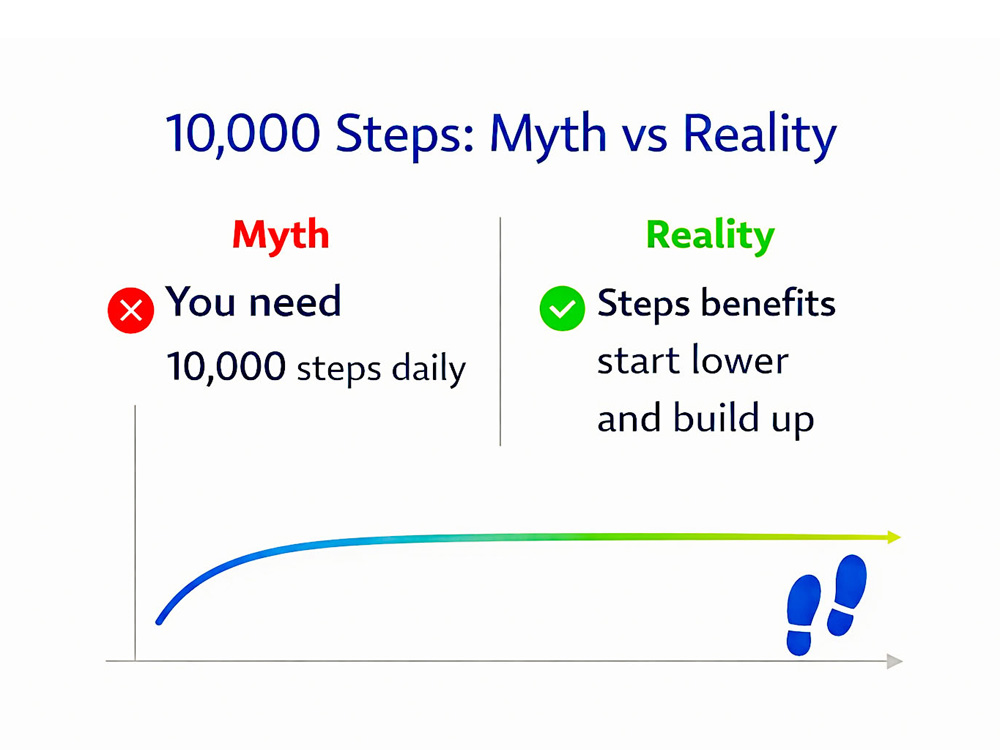
- "You need 10,000 steps a day." The authors of a large analysis in The Lancet Public Health say the figure isn't evidence-based and originated as a marketing campaign in Japan. In that analysis, the benefit for people aged 60 and over levelled off at about 6,000 to 8,000 steps, and older or frailer walkers gained far fewer.[1] [2]
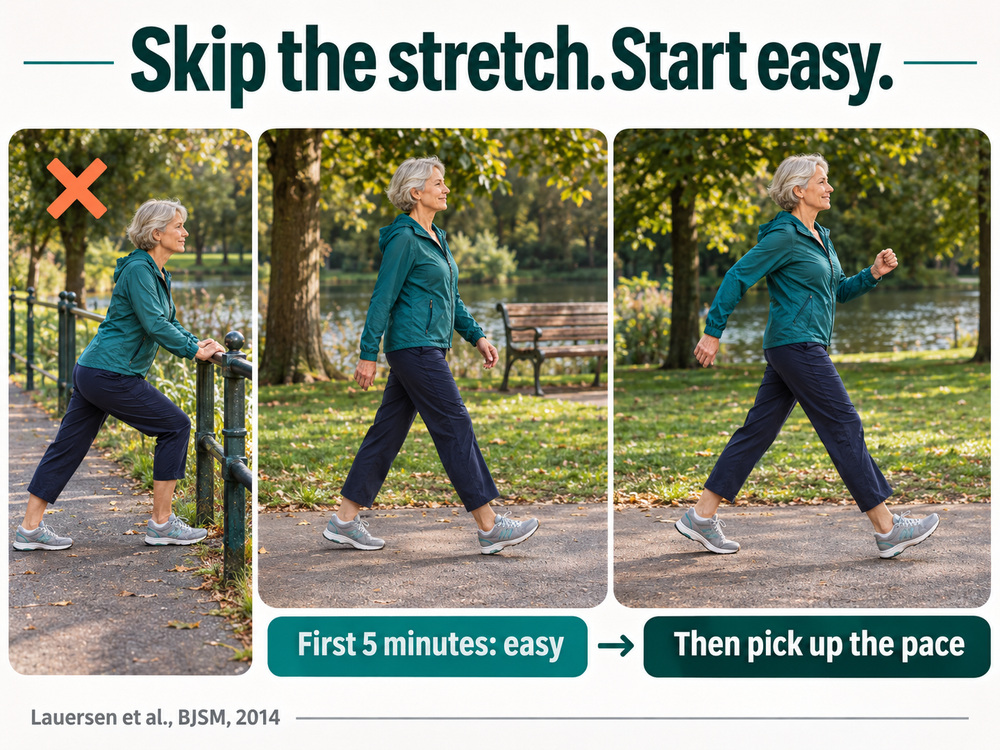
- "Stretch before a walk to avoid injury." Across 25 trials, most of which involved young, active people, stretching did not affect injury rates[3], whereas warming up through movement improved performance[4]. For walkers, that means starting with an easy first five minutes.
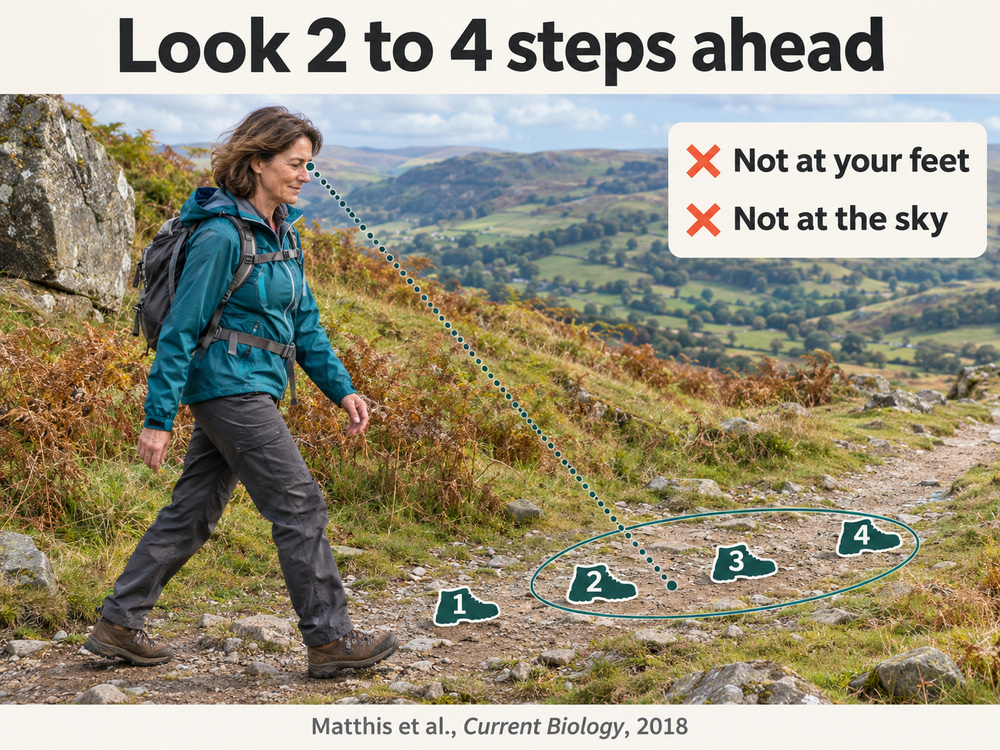
- "Never look down." Walkers wearing eye trackers looked two to four steps ahead[5], whereas older adults instructed to watch each tricky patch of footing until their foot landed made fewer stepping errors[6].
- "Walking wears out your knees." For knee osteoarthritis, exercise can ease pain. Walking programmes are as effective as thigh exercises, and walking more each day was not associated with more knee replacements.[7] [8] [9]
- "After 50, you lose 1 to 2 per cent of your muscle every year." The best estimates suggest it's closer to 0.5 per cent a year from mid-life, rising faster after 75. Strength declines faster than muscle size, but strength training can rebuild it.[10] [11]
The UK weekly target, in brief
- Move more: UK guidelines recommend aiming for "at least 150 minutes of moderate intensity per week (increased breathing, able to talk) or at least 75 minutes of vigorous intensity per week (breathing fast, difficulty talking), or a combination of both". A brisk walk that still lets you talk counts as moderate activity.[12]
- Strength: "build strength on at least 2 days a week".[12]
- Balance: "take part in balance activities 2 days a week to reduce the risk of frailty and falls"[12].
- Start from where you are: "any activity is better than none, and more is better still". If you're doing very little now, gradually build up from your current level.[12] [13]
The nine mistakes at a glance
| The mistake |
What the research suggests instead |
Walks4all takeaway |
| 1. Thinking a short walk isn't worth the bother, and sitting for the rest of the day |
The biggest benefits come from adding those first steps. Even lower step counts matter after age 75, weekly totals matter more than the pattern, and a 10-minute walk after meals helps regulate blood sugar. |
Every walk counts. A ten-minute walk after a meal is one of the best walks of the day. |
| 2. Strolling every step |
On most walks, spend part of the time walking briskly, at a pace where you can talk but not sing, or about 100 steps a minute. Long-term studies find that brisk walkers do better, and interval walking builds strength and fitness. |
On most walks, walk briskly for part of the way, where you can talk but not sing. |
| 3. Stretching before you set off, or setting off at full pace |
Stretching beforehand hasn't been shown to prevent injury. Starting easily and building up gradually are what a warm-up is for. |
Skip the stretches. Walk the first five minutes at an easy pace, then pick up the pace. |
| 4. Watching your feet, or staring at the horizon |
Look a few steps ahead, and keep an eye on each tricky patch of ground until your foot lands. Varifocals can blur kerbs and steps. |
Look a few steps ahead, not at your feet or the sky. |
| 5. Rushing and shuffling |
Trips and slips cause most falls, often when people are hurrying. Outdoors, most falls happen on pavements and kerbs, and even fit, active walkers fall. |
Give yourself time, lift your feet, and take kerbs and poor lighting slowly. |
| 6. Arms pinned or hands in pockets |
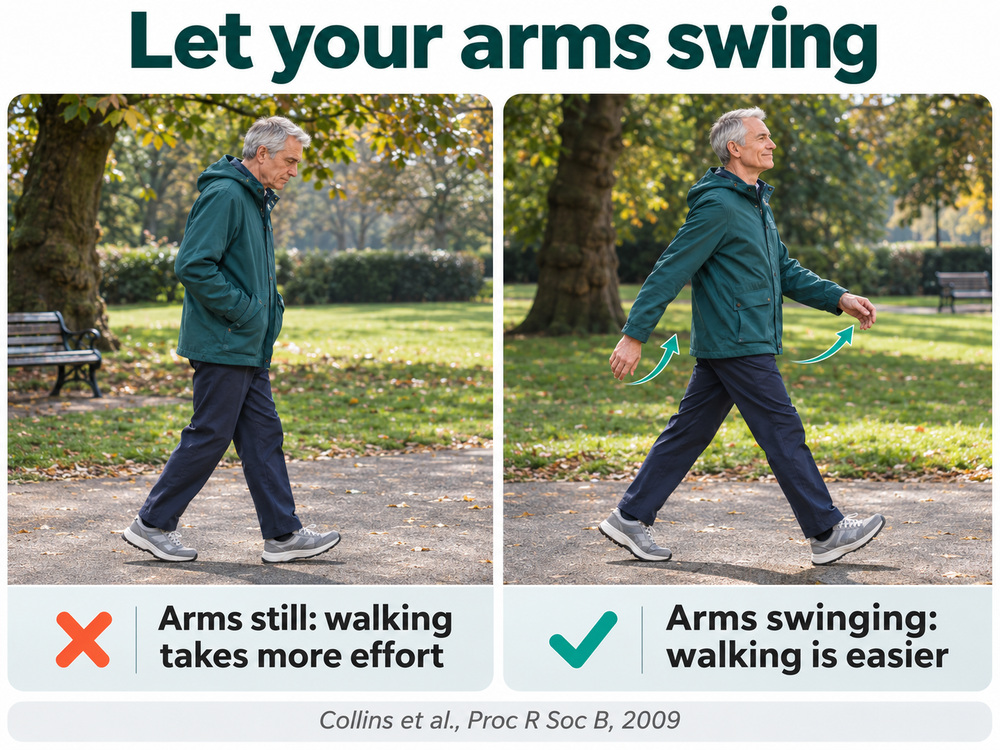
A natural arm swing makes walking easier and may help you recover from a trip, while walking faster restores the swing. |
Let your arms swing. Poles add support and make for a more effective workout. |
| 7. The wrong shoes, worn shoes, or socks indoors |
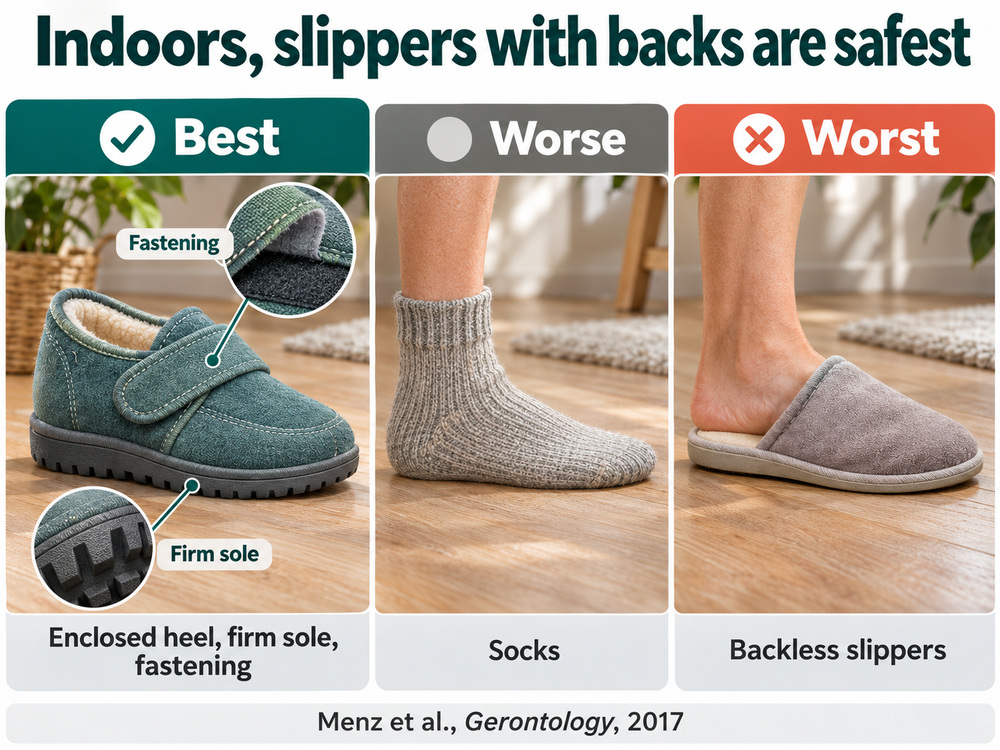
Trainers pose the lowest fall risk, while bare feet or socks pose the highest. Backless slippers are worst for balance, and firm, grippy soles are recommended. |
Grippy, low-heeled shoes that fasten, and slippers with backs. |
| 8. Eyes on your phone |
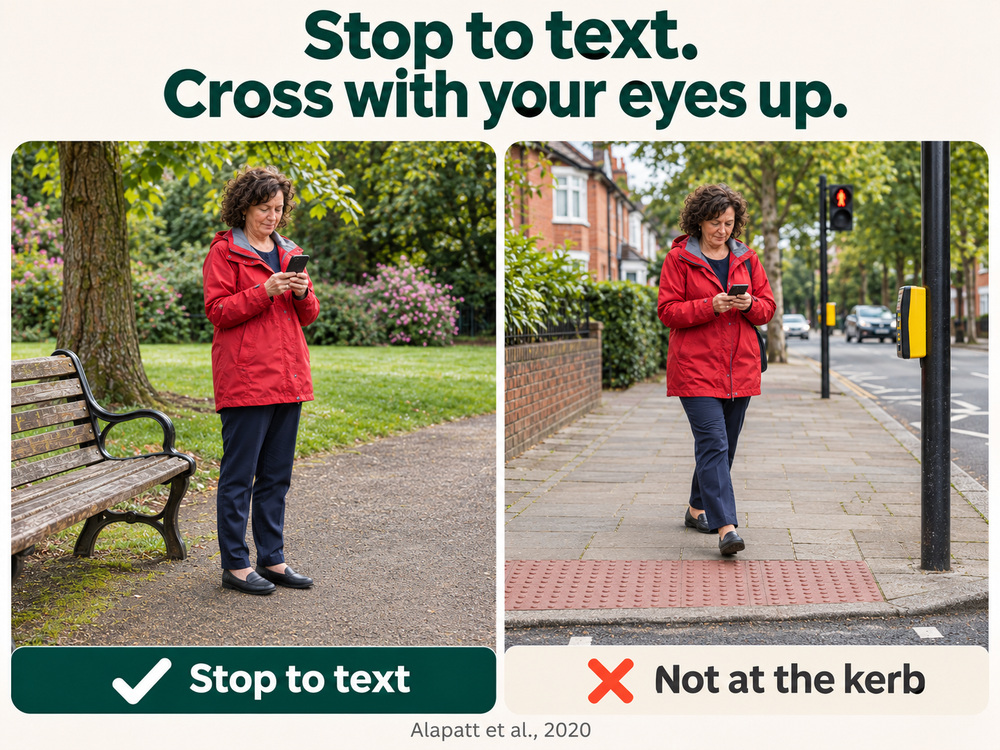
Texting slows people over 50 to below the walking speed assumed when timing many road crossings, while phone calls distract older pedestrians at crossings. |
Stop to text or read, and finish calls before you cross the road. |
| 9. Treating walking as the whole job |
Strength, balance, and a little impact help protect muscle and bone and prevent falls; walking itself is good for the knees. |
Twice a week, add strength and balance. Keep walking. |
Mistake 1: Thinking a short walk isn't worth the bother
The short answer: a short walk is worth it. If you're doing very little now, those first extra steps offer the greatest benefit, and a ten-minute walk after a meal is one of the most useful walks you can take.
Many of us follow an unspoken rule: a walk only counts if it's long or brings the step counter up to 10,000. A ten-minute loop around the block hardly seems worth putting on your shoes for. And once the "proper" walk is over, no one thinks twice about spending the afternoon in an armchair.
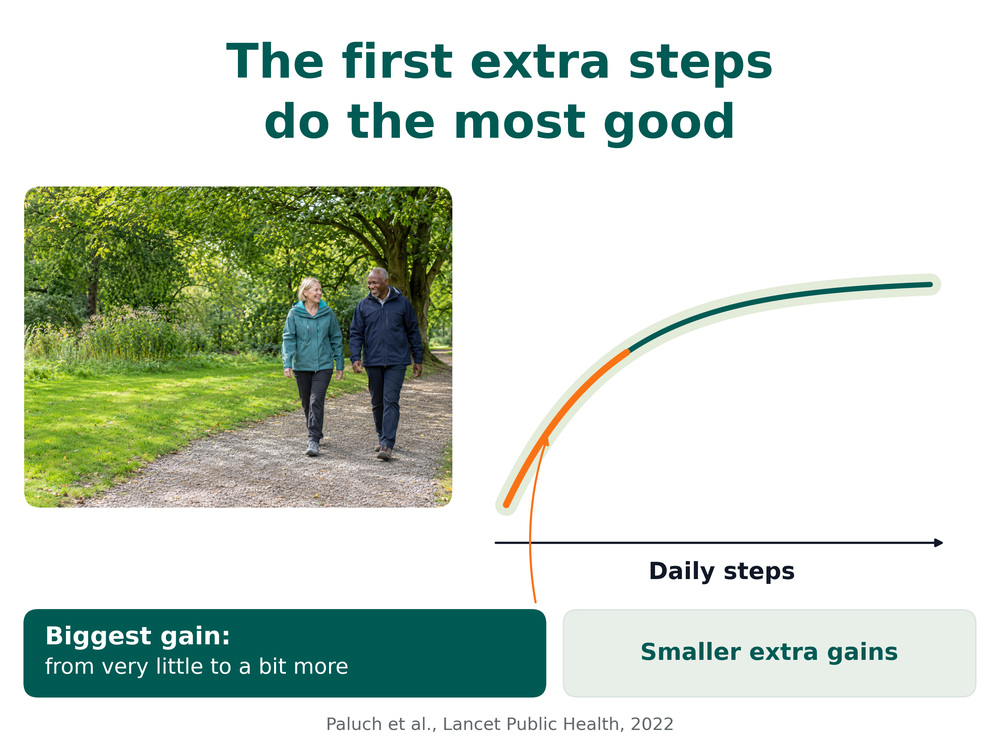
Across 15 studies involving 47,471 adults, the greatest risk reduction came from moving out of the least active group. Taking more steps also helped, but moving into either of the higher groups made a smaller difference than the initial increase in activity.
The research suggests otherwise, and the details are encouraging. When scientists pooled data from 15 groups of adults, totalling 47,471 people, and followed them for about seven years, those in the second-lowest quarter, who took about 5,800 steps a day, had a 40 per cent lower risk of dying than those in the lowest quarter, who took about 3,550.[1] The two more active quarters did even better, with risks about 45 and 53 per cent lower, respectively, but the gains were smaller than the jump from the lowest to the second-lowest quarter. For people aged 60 and over, the benefit levelled off at around 6,000 to 8,000 steps a day.
Other large analyses show the same pattern. Across eight groups totalling 36,383 people, with an average age of 63, moving from the least active quarter to the next was linked to about half the risk of dying; light activity counted on its own, too.[14] Another pooled analysis of 12 groups and 111,309 people found a lower risk of dying with as few as about 2,600 steps a day, with the risk falling further up to about 8,800.[15] Researchers have also modelled the effect of five extra minutes a day of brisk activity for the least active fifth of adults: around 6 per cent fewer deaths.[16]
And the 10,000-step figure was never evidence-based. The authors of the step analysis in The Lancet Public Health say it originated as a marketing campaign in Japan.[1] Our guide to 10,000 steps a day tells the full story.
Older and frailer walkers can set the bar even lower. A Japanese study of 8,664 adults, with a median age of 74, found that the number of daily steps linked to a lower risk of death was about 1,800 for people over 75 and 2,600 for frail people, compared with about 4,100 for those under 75.[2] It's never too late to start: adults who became active in their 40s to early 60s after years of little activityhad death rates nearly a slow as those who had been active throughout their lives.[17] The UK guidelines for older adults put it this way: "even light activity brings some health benefits compared to being sedentary".[13]
You don't have to walk every day for it to count. Among 13,547 women with an average age of 72, reaching 4,000 steps on just one or two days a week was linked to a 26 per cent lower risk of dying; reaching that total on three or more days was linked to a 40 per cent lower risk. Once researchers accounted for total steps, the pattern itself made no difference.[18] In US adults, reaching 8,000 steps on one or two days a week was nearly as beneficial as doing so three to seven days a week, while in British groups, weekend-only activity matched activity spread throughout the week.[19] [20] [21] A long walk at the weekend is far better than none.
Timing helps: walk after meals
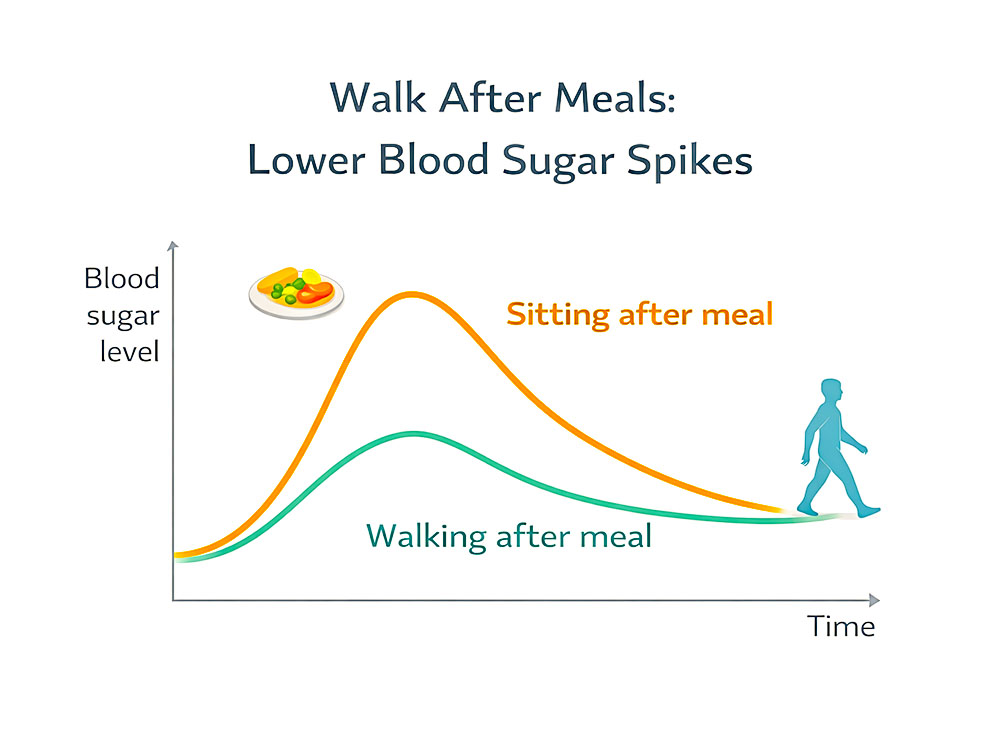
Timing is one of the easiest things to change. In a study of 41 adults with type 2 diabetes, averaging 60 years old, ten-minute walks after each main meal lowered post-meal blood sugar ny about 12 per cent more than a single 30-minute daily walk, and about 22 per cent more after the evening meal.[22] Among inactive people over 60, three 15-minute walks after meals controlled blood sugar throughout the day as well as one 45-minute walk, and performed better after dinner.[23]
It's also worth breaking up long periods of sitting. Across 53 studies, short activity breaks lowered blood sugar and insulin after meals. Walking breaks were most effective, with the largest effects observed when breaks were taken about every 20 minutes.[24] Walking breaks also provided greater benefits than standing breaks.[25] [26]
If most of your steps come in short bursts, try linking a few together. Among adults taking 8,000 steps a day or fewer, those who walked some of their steps in stretches of at least ten minutes had a lower risk than those who spread every step across very short bursts.[27] Aim for a mix of short walks throughout the day and at least one longer walk.
The catch
The step studies are observational, so they show who fared better but can't explain why. People who are unwell tend to walk less, so illness itself accounts for part of the difference. The meal and sitting studies tracked blood sugar over hours or weeks; whether these findings affect long-term disease is a separate question. We also don't want to replace one magic number with another: one large analysis found that benefits levelled off at 6,000 to 8,000 steps for people aged 60 and over. That's not a target you fail by missing.
What to do instead
- Not doing much right now? Try adding one short walk each day, even just ten minutes. Taking that first step matters most.
- When you can, take a ten-minute walk after your main meals, especially dinner. Our guide to the 10-minute walk after meals explains why.
- If you sit for long periods, get up and take a short walk every 20 minutes or so. Work at a desk? Our guides to walking pads and standing desks explore ways to spend less time sitting.
- Focus on the week, not the day. A long weekend walk counts.
- If numbers help, use our walking calculator to convert steps into minutes and miles.
Walks4all takeaway: Every walk matters. If you're not very active now, those first extra steps can do the most good, and a ten-minute walk after a meal is one of the best walks of the day.
Mistake 2: Strolling every step
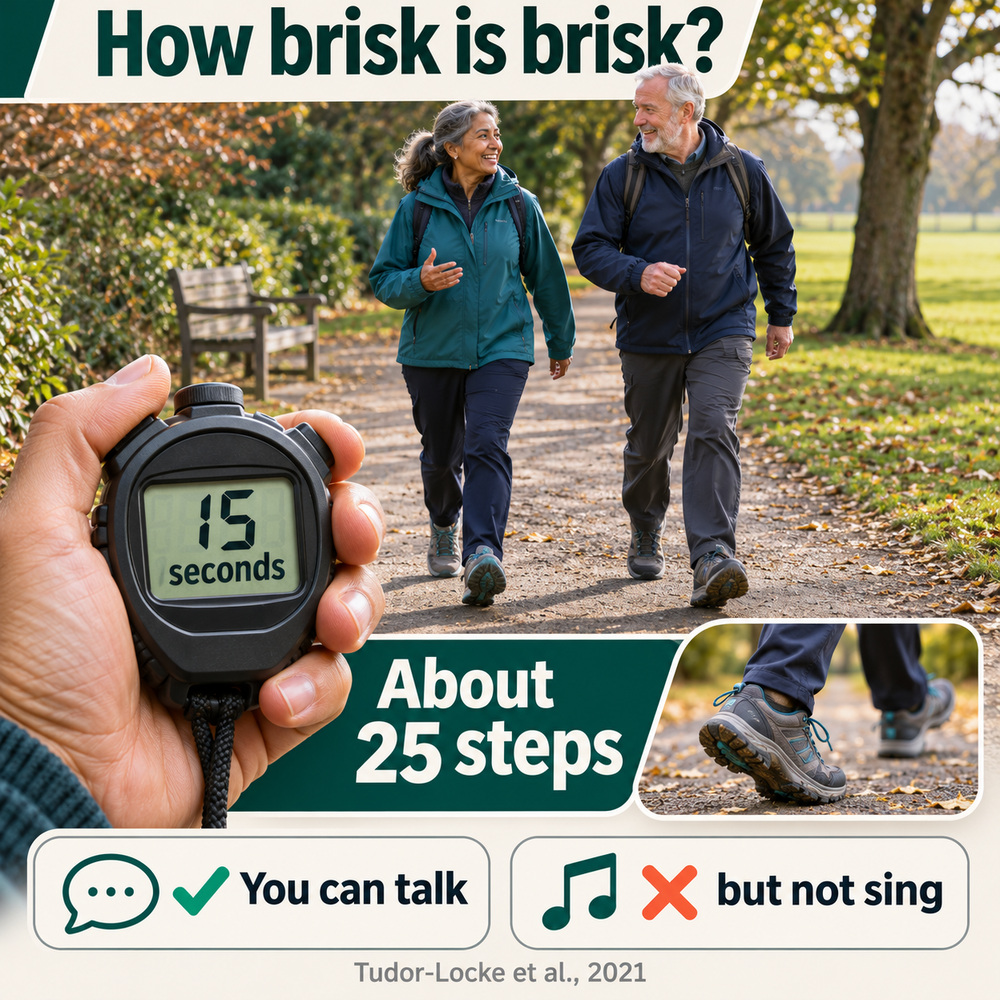
The short answer: keep your easy walks, but make part of most walks brisk, at a pace where you can talk but not sing. For most people, that's about 100 steps a minute, or roughly 25 steps every 15 seconds.
Distance can seem like the only thing that matters, so many of us keep every walk at the same comfortable amble. An amble is pleasant and far better than sitting. But studies keep finding additional benefits to picking up the pace, and it takes no extra time.
For adults aged 61 to 85, about 100 steps per minute is counted as moderate, brisk walking, roughly 25 steps in 15 seconds.
Brisk walking has a measurable pace. Researchers studying 98 adults aged 61 to 85 found that about 100 steps per minute marked the start of moderate intensity, the same threshold seen in younger adults.[28] Based on each person's heart rate and perceived effort, moderate intensity began at about 105 steps per minute.[29] To check your pace, count your steps for 15 seconds on a flat stretch. About 25 steps puts you in that range. The figure varies widely from person to person, so use it as a guide and let your breathing have the final say: you should be able to talk, but not sing.
Long-term studies favour a brisk pace. Across 50,225 walkers in 11 British cohorts, an average walking pace was linked to a 20 per cent lower risk of death than a slow pace, while a brisk pace was linked to a 24 per cent lower risk. The association was clearest among people over 50.[30] In about 65,000 UK Biobank adults wearing trackers, the lowest death rate among the combinations studied was seen in those taking 7,500 to 10,000 steps a day, some at about 100 steps a minute. Among people taking fewer than 5,000 steps, brisk walking was linked to a risk reduction similar to that associated with taking many more steps at a slower pace.[31] Peak pace also predicted a lower risk after accounting for total steps.[1]
Even very short bursts count. Among people who did no formal exercise, three daily bursts of one to two minutes of vigorous everyday activity, such as walking quickly up a hill or climbing a flight of stairs, were linked to a 38 to 40 per cent lower mortality rate.[32]
Try three minutes faster, three minutes easier
One effective way to build pace is with intervals, a method known as Japanese walking. In a five-month Japanese trial involving 246 people with an average age of 63, doing at least five rounds of three minutes fast and three minutes easy, four days a week, increased thigh strength by 13 per cent and walking fitness by 9 per cent, more than steady walking, and further lowered blood pressure.[33] People stick with it, too: over 22 months, average adherence among 696 people was 70 per cent.[34] Our guide to Japanese walking explains the full method.
The catch
Hard effort briefly increases the risk of a heart attack: about six-fold overall, and more than a hundred-fold among people who exercised less than once a week, compared with about two-fold among those who exercised five or more times a week.[35] For most people, a brisk walk is less strenuous than that. UK guidelines say the risk of serious problems from physical activity is very low when the effort matches your current activity level and health.[13] The risk in that study was highest among people who rarely exercised, so the advice is to start easy and gradually increase your pace over several weeks. Talk to your GP before starting if you have chest pain, a heart condition or another long-term condition, or if exercise makes you feel unwell.
Pace studies also face a chicken-and-egg problem. The British study measured pace through self-rating, and slower walkers may already be unwell. So walking speed may partly reflect health, rather than simply cause it.[36] One study of older women found no clear link between pace and risk of death after accounting for total steps.[37] In the Japanese trial, only about half of the interval group met their target. Our October 2026 walking health update covers the latest research on pace.
What to do instead
- Use the talk test: brisk means you can talk, but not sing.
- For a numerical check, count your steps for 15 seconds on a flat stretch. About 25 steps is brisk.
- Try going three minutes faster or easier, five times in a row, a few days a week.
- Once brisk walking feels comfortable, try walking up a hill or the stairs when you can. Even a minute or two of harder effort counts.
- Build your pace gradually over several weeks, rather than all at once. Brisk walking isn't suitable for everyone, and walking more slowly still counts.
Walks4all takeaway: On most walks, try walking briskly for part of the way, at a pace where you can talk but not sing, or about 100 steps a minute. Alternate three minutes at this faster pace with three minutes at an easier pace to get started.
Mistake 3: Stretching before you set off, or setting off at full pace
The short answer: you don't need to stretch before walking. Trials, most of them involving young, active people, haven't shown that stretching prevents injury. Instead, start with five minutes at an easy pace, then slowly increase the pace. Gradually increase the length and pace of your walks over several weeks.
School PE lessons taught a generation to stretch before and after exercise, holding each stretch until it felt tight. Others skip the warm-up altogether and stride out the front door at full pace. The evidence suggests both approaches miss the point.
Across 25 trials, most involving young, active people, stretching had no effect on injuries. For walkers, the first five minutes at an easy pace serve as a warm-up.
Across 25 trials involving 26,610 people, stretching had no effect on injuries, while strength training reduced them to less than a third.[3] Long stretches can also temporarily reduce muscle power. A review found that static stretching lowered performance immediately afterwards by an average of 3.7 per cent, mainly when stretches lasted 60 seconds or longer.[38] Across 104 studies, strength fell by about 5.4 per cent after static stretching, with the smallest effects from holds of 45 seconds or less, regardless of age.[39] Five minutes of calf stretching briefly made standing balance less steady in 25 people over 65, although it did not affect their walking.[40]
An active warm-up is a different matter. Across 32 studies, warming up through movement improved performance in 79 per cent of measures.[4] Evidence that warming up prevents injury leans slightly in its favour and comes from sport.[41] For a walker, no special moves are needed: the first five minutes of the walk at an easy pace do the job.
Afterwards, stretching is optional. Stretching before or after exercise changes next-day soreness by about one point on a 100-point scale[42], and there is no strong evidence that it improves walking[43]. Strength training improves range of motion just as much as stretching[44].
Build up over weeks, not just over a walk
The UK guidelines advise older adults to build up "gradually from current levels".[13] This applies over several weeks as well as during a single walk. Your thighs may feel sore for a day or two after your first long walk with lots of downhill sections, but they're usually much less sore the next time as your muscles adapt.[45] So, after your first big hill walk, the next one is likely to leave you far less sore.
The catch
Short stretches are harmless. Three 30-second thigh stretches did not reduce leg strength in older women[46], so if you enjoy stretching or a physiotherapist has prescribed a stretch for a specific problem, keep doing it. Most stretching research has involved young, athletic people, and no study has tested a gentle five-minute warm-up for older walkers.
What to do instead
- Walk the first five minutes at an easy pace, then pick up the pace.
- If you like how it feels, ease off during the last few minutes.
- Enjoy stretching? Keep the holds short: long holds of a minute or more briefly weaken the muscles.
- Gradually add a little more each week, either a few extra minutes or one more brisk stretch of the route.
- Your thighs may feel sore after your first long downhill walk, but the next one should leave you feeling less sore. Our walk selector maps every Walks4all route, making it easy to choose your next step up.
Walks4all takeaway: Skip the stretches. Start with an easy five-minute walk, then pick up the pace and add a little more each week.
Mistake 4: Watching your feet, or staring at the horizon
The short answer: look two to four steps ahead, about a second and a half in front of you. On rough ground, kerbs, and steps, lower your gaze and focus on each tricky foothold until your foot lands, then look ahead again.
As the years go by, many of us start watching our feet because we're afraid of tripping. Others grew up hearing the opposite advice: keep your head up, look towards the horizon, and never look down. But steady walkers do neither.
Outdoors, walkers wearing eye trackers focused on the ground two to four steps, or about a second and a half, ahead.
When researchers fitted healthy adults with eye trackers and had them walk outdoors, the walkers looked at the ground two to four steps ahead, about 1.5 seconds in front of them. On rough ground, almost all their gaze stayed on the path, and their steps grew shorter and slower. Even on a flat trail, about half their gaze remained within four leg lengths.[5] That's the pattern worth copying: keep your eyes on the path just ahead, moving and scanning.
As people age, they tend to look down more. A review of 53 eye-tracking studies found that older adults fixate more often and for longer on the ground just ahead, while spending less time scanning farther along their route.[47] Worry lowers their gaze even further. Among 44 adults with an average age of 75, those at higher risk of falling, and lower-risk adults who were made anxious, looked only one or two steps ahead and made more stepping errors farther along.[48] Being told to focus on how they were moving had the same effect and slowed them down.[49]
A second finding is particularly important for people at higher risk of falling. Older adults at high risk of falls looked away from a stepping spot before their foot landed and stepped less accurately.[50] In a small trial involving 16 older adults, asking them to keep looking at each stepping spot until their heel touched down reduced stepping errors.[6] So the rule has two parts: look ahead, and when the footing is tricky, keep watching it until your foot is down.
Attention matters, too. When 112 older adults were asked to focus on their destination, they spent less time looking at the ground and walked more steadily.[51] A review of 18 studies found that outward-looking cues generally putperformed body-focused cues for older adults, although the advantage was less clear for walking.[52] Stepping can also be practised. In a year-long trial involving 264 people over 65, a programme combining stepping to targets with general exercise reduced the fall rate by about 65 per cent: 11.6 per cent fell, compared with 33.0 per cent in the comparison group.[53]
Varifocals and the kerb
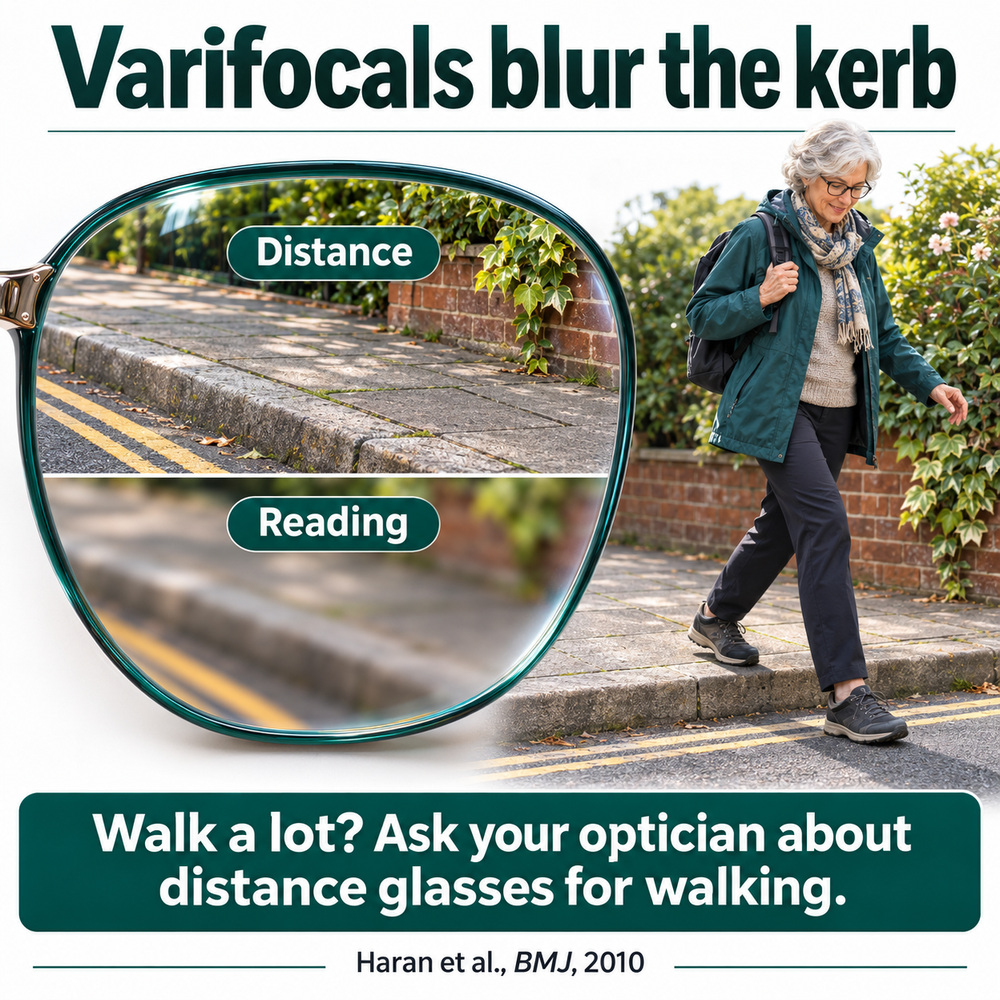
Bifocals and varifocals place the reading portion of the lens at the bottom, where you look to check the ground just ahead. In a study of 156 people aged 63 to 90, multifocal glasses impaired depth perception and the ability to detect edges such as kerbs. Followed for a year, multifocal wearers were more than twice as likely to fall, and more likely to fall from a trip outdoors.[54] In a separate study, toe clearance varied more from step to step when people stepped while wearing multifocals.[55]
With varifocals, the ground just ahead is visible through the reading portion of the lens. For people who went out regularly, wearing distance glasses while walking reduced falls by about 40 per cent.
The better news came when people swapped glasses. In a trial of 606 multifocal wearers with an average age of 80, single-vision distance glasses for walking reduced falls by about 40 per cent among those who regularly went out.[56] In a small study, varifocals with a weaker reading addition were as safe as distance glasses on stairs.[57]
What about posture?
Stand tall if it feels good, but don't expect it to change how you walk. In 99 adults aged 60 to 88, six months of supervised back exercises three times a week reduced the upper-back curve by 3 degrees, but did affect walking speed or the ability to get up and walk.[58] A review of 24 studies found that exercise modestly improved a stooped upper back, with no clear effect on falls.[59] Among 1,100 adults in the Framingham study, a more rounded upper back was not associated with slower walking or weaker grip[60]. However, in people aged 77 and over, it was linked to more falls[61], and women with greater rounding experienced a larger decline in lung function over 16 years[62].
Forward head posture is moderately associated with neck pain, but this finding comes only from snapshot studies, which cannot show which came first.[63] The alarming figures often cited for how much a forward head increases the load on the neck come from a single short paper estimating forces as the head tilts[64], so we do not repeat them. Focus your attention on where you are going rather than how you are holding yourself.
The catch
The gaze studies are small and mostly conducted in laboratories or on test paths. The stepping trial measured stepping errors, not falls, and the stepping programme combined stepping practice with general exercise, so the stepping component cannot be separated out. The glasses trial's overall result was not significant: the benefit was confined to people who went out regularly, and outdoor falls increased among those who rarely went out.
What to do instead
- Look a few steps ahead along the path and keep your eyes moving.
- On rough ground, kerbs, or steps, look down at where you're placing your foot and keep watching until it lands.
- Take it slow on rough ground; steady walkers know to.
- Keep your focus on where you're headed; overthinking each step slows you down and turns your gaze inward.
- Spend a lot of time walking outdoors in varifocals? Ask your optician about distance-only glasses for walking or a weaker reading addition. Rarely go out? Check with your optician before changing your glasses: in the glasses trial, outdoor falls increased in that group.
Walks4all takeaway: Look a few steps ahead, not down at your feet or up at the sky. On tricky ground, watch where each foot lands. If you walk a lot in varifocals, ask your optician about distance-only glasses for walking.
Mistake 5: Rushing and shuffling
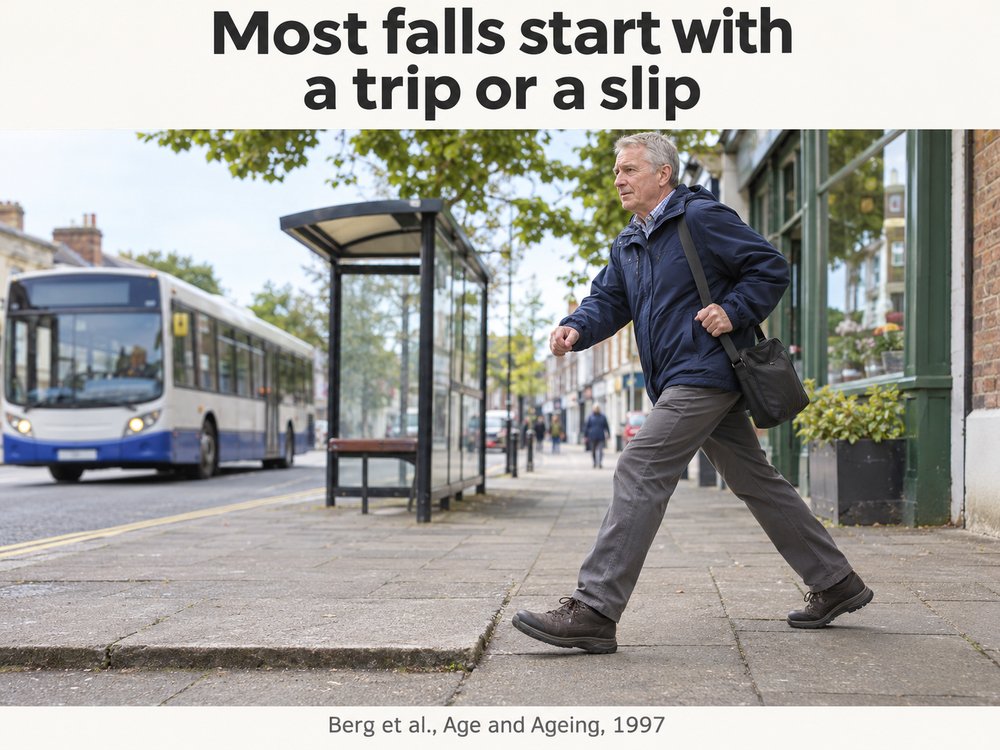
The short answer: among independent older adults, most falls start with a trip or slip, often when they're hurrying. Outdoor falls usually occur on pavements, kerbs, and streets. Give yourself time, lift your feet, take kerbs carefully, and slow down as the light fades.
Picture a fall, and most of us imagine the same scene: a frail person indoors, a loose rug, a dark landing. But studies paint a broader picture: outdoor falls often affect active, healthy people.
In a year-long study of 96 independent older adults, trips and slips accounted for 59 per cent of falls, and hurrying was the most common reason participants gave for falling.
In a year-long study of 96 independent older adults, trips and slips accounted for 59 per cent of falls. Most falls occurred while walking, and fallers most often cited hurrying as the reason.[65] Among 125 women over 65, trips caused 33 per cent of falls and slips caused 22 per cent. Forward falls, which most often injure the wrist, were associated with trips and hurrying.[66]
Outdoors, the surroundings cause most falls. A study of 2,193 people aged 45 and over found that 73 per cent of outdoor falls were caused by environmental factors, such as uneven surfaces or tripping and slipping on objects. These falls usually occured on pavements, kerbs and streets, and walking was the most common activity at the time.[67] In a study following 765 older adults in Boston, those who fell outdoors tended to be younger, male, active and healthy.[68]
Then there is shuffling. Average toe clearance does not decrease with age, but it becomes more variable from step to step in older people, and even more so in those who fall.[69] Even an occasional low step can catch on a raised paving slab.
Poor lighting can affect your walking sooner than you might expect. In near-darkness on a treadmill, people around 50 walked as unsteadily as people in their 70s, while younger adults were unaffected.[70] To help drivers see walkers, wear fluorescent clothing during the day and reflective material at night.[71]
The catch
Active people spend more time walking outdoors, so their higher number of outdoor falls partly reflects their greater exposure. Fall studies rely on people's memories of their falls. Toe clearance measured in a laboratory did not predict everyday trips beyond a person's fall history[72]. No trial has shown that coaching people to lift their feet prevents falls on its own, and one study found that dim light alone did not unsettle 24 older walkers[73]. The strength and balance exercises described in mistake 9 are the ones to prevent falls.
What to do instead
- Leave a few minutes to spare, so you never need to rush for the bus or the crossing.
- Lift your feet and step carefully on uneven ground, especially when you're tired near the end of a walk.
- Take kerbs deliberately, and look at them until your foot is down.
- Watch out for wet leaves, moss, and ice. Our guide to safe walking explains grips and footwear.
- At dusk, bring a torch and wear bright or reflective clothing. For more tips, see our night walking safety checklist, and compare toches in our head torch guide.
Walks4all takeaway: Give yourself time, lift your feet, and take kerbs and poorly lit areas slowly. Even fit walkers can trip.
After a fall
- Call 999 if you or someone else has fallen and may have injured their head, neck, back or hip, or is unable to get up.[74]
- Get help from NHS 111 after a fall that leaves you in pain, injured, or unwell.[74]
- Tell your GP if you've had a fall, even if you weren't hurt, or if you're concerned about your balance.[74]
- The NICE falls guideline applies to everyone aged 65 and over, as well as to people aged 50 to 64 who are at higher risk, for example, because they have a long-term condition such as arthritis, diabetes, dementia or Parkinson's, or have had a stroke.[75]
- NICE recommends a comprehensive falls assessment for people in these groups who have fallen in the past year and are living with frailty, have been injured and needed treatment, have lost consciousness, were unable to get up without help, or have fallen two or more times.[75]
- If walking or balance is affected, NICE recommends a falls-prevention exercise programme to improve balance, coordination, strength, and power. Ask your GP if there's one near you.[75]
Mistake 6: Arms pinned to your sides, or hands in your pockets
The short answer: let your arms swing. A natural arm swing makes walking easier. Walking a little faster brings it back, and poles add support and a more intense workout.
With your hands in your pockets on a cold morning, a bag in each hand, or your arms held stiffly at your sides, it may feel as if they do nothing. Yet your arms are part of the walking machine, swinging in sync with the opposite leg.
Holding the arms still increased energy expenditure by about 12 per cent above standing in a laboratory study.
In a laboratory study, keeping the arms raised increased energy use by about 12 per cent compared with standing[76], while a review concluded that arm swing most likely reduces the energy required for walking[77]. Arm swing also tends to decrease with age: among 60 adults aged 30 to 77, it diminished with age but increased again when people walked faster[78].
Swinging your arms may also help you recover from a trip. In a laboratory study of 16 older adults, those who kept their arms moving were able to turn their bodies and take a longer recovery step.[79] A small laboratory study also found that a larger arm swing made walking steadier from side to side.[80]
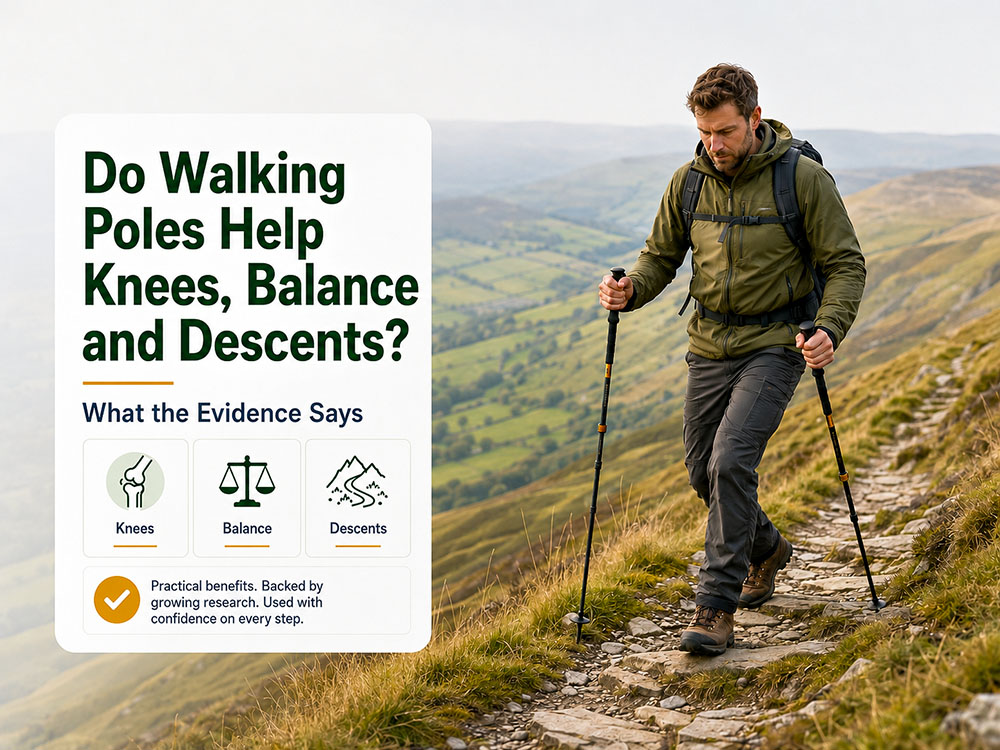
Poles take the idea a step further. Nordic walking with poles raised increases calorie burn by about 20 per cent at the same speed, without feeling any harder[81]. Across 22 trials in older adults, Nordic walking produced modest improvements in weight, waist, blood pressure and fitness[82]. Our guides cover whether walking poles help knees and balance, how to use them on hills, descents and flat paths, and how to compare pairs.
One thing worth knowing
In small studies, people in the early stages of Parkinson's disease swung one arm much less than the other[83], while symptom-free carriers of a Parkinson's gene variant showed more uneven arm swing[84]. A sore shoulder or a heavy bag is a much more common cause of uneven swing. Still, if one arm has recently started swinging less than the other, it's worth mentioning to your GP.
The catch
In another laboratory study, older adults used their arms less to stop a trip and more to break their fall[85]. In one trial, Nordic walking was no better than ordinary walking for most outcomes among older adults[86], and no data are available on falls involving poles[87]. The arm-swing studies are small and were conducted in laboratories, not on country lanes.
What to do instead
- Keep your hands out of your pockets; wear gloves instead.
- Wear a rucksack to keep both arms free to swing.
- Pick up your pace for a minute and feel the swing return.
- For a more challenging workout or extra support on downhill stretches, try using walking poles and learn how to use them.
- Use a stick or frame, or have a stiff shoulder? Keep using whatever helps you stay steady. A free swing can help, but it isn't required; a physiotherapist can advise you on the rest.
- Tell your GP if one of your arms has recently started swinging less than the other one.
Walks4all takeaway: Let your arms swing. Walking a little faster brings the swing back, and poles add support and make for a more effective workout.
Mistake 7: The wrong shoes, worn-out shoes, or socks and backless slippers indoors
The short answer: choose comfortable, grippy shoes with low heels and secure fastenings; wear slippers with backs at home, and avoid ordinary socks on hard or slippery floors. Replace walking shoes when they show signs of wear, and use any mileage or yearly guideline as a reminder to check them.
Shoes are easy to take for granted. We use the pair by the door until the sole wears out, and at home we shuffle around in socks or old backless slippers. Studies suggest slippers deserve just as much thought as walking boots.
A study of women aged 65 to 83 found that balance and walking were best in enclosed slippers with firm soles and a fastening, worse in socks, and worst in backless slippers.
When researchers compared 327 older adults who had fallen with 327 who had not, athletic and canvas shoes were linked to the lowest risk, whereas going barefoot or wearing socks was associated with about 11 times the risk, although the estimate was highly uncertain.[88] Among 176 retirement-village residents, those who fell indoors were much more likely to be barefoot or wearing socks at home.[89] Slippers were also tested. In 30 women aged 65 to 83, balance and walking were best in enclosed slippers with firm soles and a fastening, poorer in socks, and worst in backless slippers.[90] A systematic review recommended that older people wear low heels and firm, slip-resistant soles, both indoors and outdoors.[91]
Feet need as much care as shoes. In 305 older people with painful feet, a podiatry package combining insoles, footwear advice and a voucher, foot and ankle exercises, and education reduced falls by 36 per cent.[92] Weak toes and bunions were linked to falls.[93] If your knees ache, stable, supportive shoes eased walking pain more than flat, flexible shoes in 164 people with knee osteoarthritis, and caused fewer side effects.[94] Our guide to why foot health matters more as you age covers what to check.
Beyond that, comfort is a sensible guide. Choosing shoes based on arch type did not reduce injuries[95], and specific cushioning or stability features have not been shown to prevent them[96]. Therefore, choosing the most comfortable shoe is a sensible option[97]. In winter, slip-on grips reduce injurious outdoor falls on snow and ice[98].
When to replace walking shoes
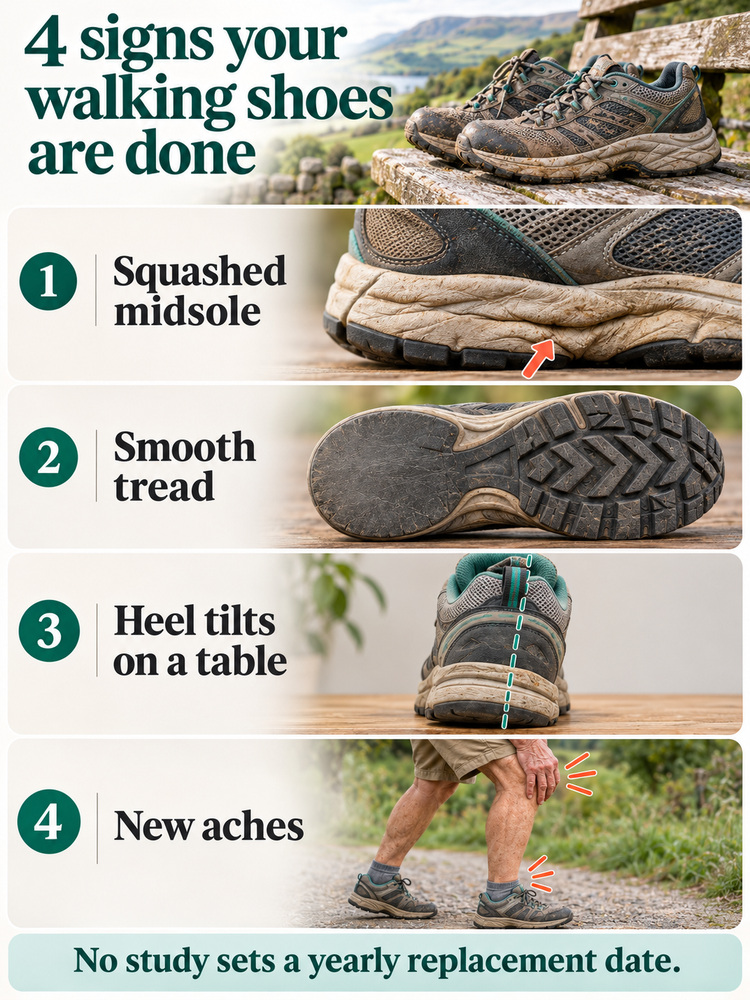
You'll often hear that walking shoes should be replaced every year or after a set number of miles. Brooks, for example, recommends replacing running shoes after 300 to 500 miles (about 480 to 800 kilometres), or every three to six months, depending on how much you run; it doesn't give a separate figure for walking shoes.[99] No study establishes a replacement interval for walking shoes. Shoe midsoles do stiffen with use[100], so mileage is best treated as a reminder to check your shoes, not a deadline. Look for a creased or squashed midsole, smooth tread, a heel that tilts when the shoe is placed on a table, or aches that weren't there before.
No study recommends replacing walking shoes every year. Check them every few months instead. A compressed midsole, a worn-smooth tread, a tilting heel, or new aches are signs it's time for a new pair.
The catch
The podiatry trial tested several interventions together in people with foot pain, so it's not possible to isolate the extent to which the shoes contributed to the results. The sock and slipper studies were small, with wide margins of uncertainty. Thin, flexible shoes are not always worse, either: among 65 people over 65, gradually introducing minimal shoes over a year improved balance scores, though fall rates did not differ.[101]
What to do instead
- Choose comfortable shoes with a firm, grippy sole, a low heel, and laces or straps. Our guide to lacing walking shoes and boots can help you achieve a snug fit.
- At home, wear slippers with backs and fastenings, and avoid wearing regular socks on hard or slippery floors.
- If your feet hurt, consider seeing a podiatrist: one trial found that a package of insoles, footwear advice, and foot exercises reduced falls.
- Every few months, check your shoes for a compressed or creased midsole, worn-smooth tread, or a tilted heel.
- In winter, wear slip-on grips on snow and ice. Our guide compares microspikes and ice grippers.
Walks4all takeaway: Choose comfortable, grippy, low-heeled shoes that fasten, or slippers with backs. Avoid wearing ordinary socks on hard or slippery floors.
Mistake 8: Walking with your eyes on your phone
The short answer: stop texting or reading, finish calls before you cross a road, and keep your phone charged in your pocket for emergencies. Texting slows people over 50 below the walking speed many road crossings are timed for.
Phones are now part of nearly every walk, and the temptation to reply to a message while walking is hard to resist. After 50, that habit may be a little riskier than it once was.
While texting, people in their 50s and those over 60 walked more slowly than the pace allowed by many timed road crossings.
When 308 adults walked while texting, everyone slowed down, especially those over 50. People in their 50s averaged 1.07 metres per second while texting, while those over 60 averaged 1.00, both below the 1.2 metres per second many pedestrian crossings are timed for.[102] Across 22 studies, texting and reading slowed walking, but phone calls did not affect walking speed.[103] Calls pose a different risk. In a virtual street-crossing study, older adults talking on the phone were less likely to finish crossing in time, while listening to music made no difference.[104]
The injury figures point the same way. In a study of younger pedestrians and riders, those using a phone in the minute before a road injury had three times the odds of being hurt[105]. Reading or texting made walkers slower, more wayward and head-down[106], and phone-related pedestrian injuries in US emergency departments rose faster than pedestrian injuries overall[107]. And looking away from your footing too soon is what made older adults step less accurately in the gaze studies in mistake 4[6] [50].
The catch
A charged phone is one of the most useful safety items to carry, especially when walking alone or in the hills. The advice is to stop before using it, not to leave it at home. Most injury studies focus on young people, and the evidence on headphones comes from a series of case reports without a comparison group.[108] In a simulator study, music did not affect older adults' road crossing.
What to do instead
- Move to the side before stopping to read or send a message.
- End your call before you get to the kerb, then cross with your eyes up.
- Keep your phone charged and close at hand for emergencies. Bring a small power bank for long days out.
- Keep your music low enough to hear traffic while walking near the road.
- Hiking alone or heading into the hills? Find safety tips on planning your trip and what to pack.
Walks4all takeaway: Stop if you need to text or read, and finish calls before crossing a road. Keep your phone charged and in your pocket for emergencies.
Mistake 9: Treating walking as the whole job
The short answer: walking is the foundation, but it's not the whole job. At least two days a week, add strength and balance exercises, along with a little impact if your bones allow. And keep walking: the evidence shows it's good for your knees.
Two beliefs pull in opposite directions here. One holds that walking covers everything, so nothing else is needed. The other warns that walking wears out your knees, so you should take it easy. The studies challenge both.
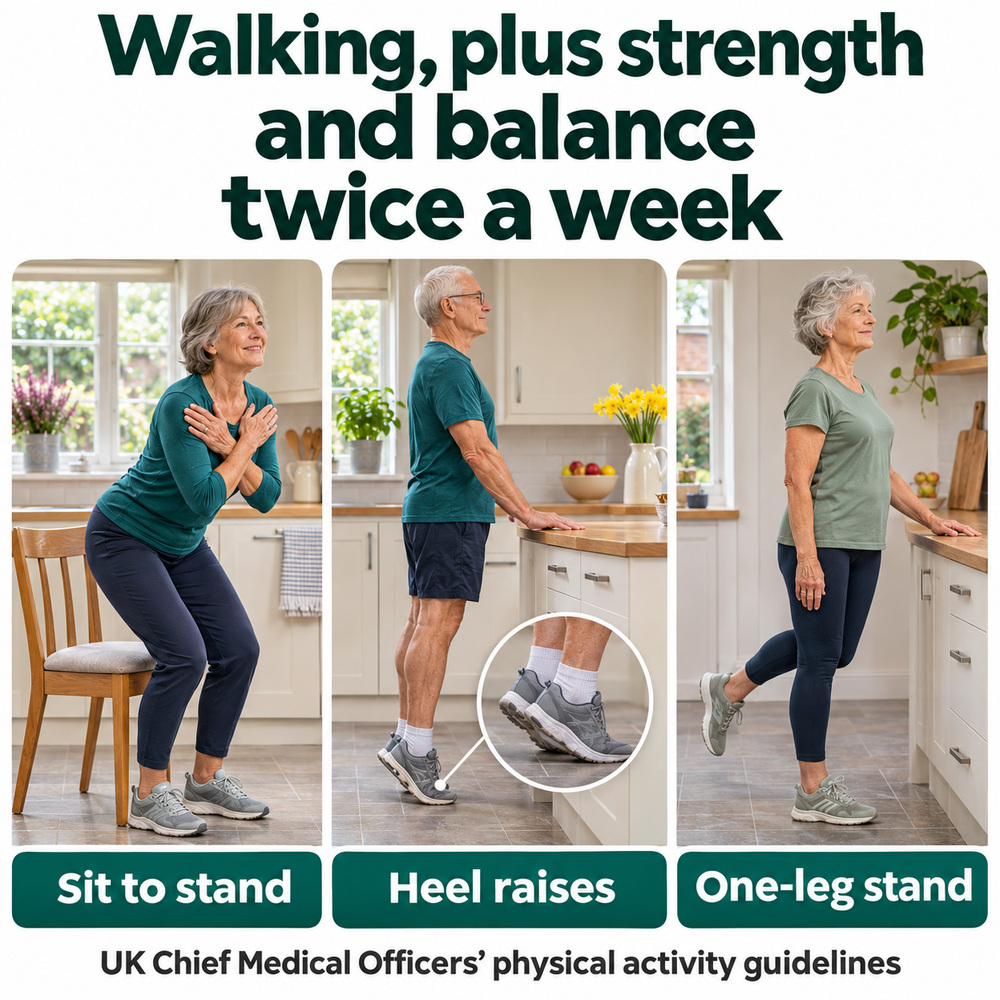
UK guidelines recommend that older adults do strength-building activities at least twice a week and balance activities twice a week. Chair sit-to-stands, heel raises and standing on one leg at the kitchen worktop are simple ways to get started.
Strength
Across 121 trials involving 6,700 older people, progressive strength training led to substantial strength gains, made it easier to rise from a chair, and slightly improved walking speed.[11] Among healthy older adults, the greatest strength gains came from doing two sessions a week, with two to three sets of seven to nine repetitions.[109] Muscle-strengthening activity was associated with a 10 to 17 per cent lower risk of death, with the lowest risk linked to about 30 to 60 minutes a week.[110] Strength training is especially important because strength declines faster than muscle size as we age.[10] UK guidelines advise older adults to "build strength on at least 2 days a week".[12]
Balance
Across 108 trials involving 23,407 people, exercise reduced falls by about 23 per cent. Balance and functional exercises were most effective, while the benefits of walking-only programmes remained uncertain.[111] Doing at least three hours of balance exercises a week reduced falls by about 42 per cent.[112] Fall-prevention exercise reduced falls causing injury by about a third and falls causing fractures by about 60 per cent.[113] Balance training improved all balance measures in healthy adults over 65, with the best results from about three sessions a week.[114] The UK guidelines ask older adults to "take part in balance activities 2 days a week to reduce the chance of frailty and falls".[12]
Bones, and a little impact
Walking is linked to fewer hip fractures. Among 61,200 women, those who walked at least four hours a week had 41 per cent fewer hip fractures than those who walked for less than an hour.[115] Among 35,996 men aged 50 and over, walking for the same amount of time was associated with 43 per cent fewer hip fractures, while a brisk pace was associated with 47 per cent fewer than a leisurely pace.[116]
Bone density presents a more mixed picture. Older trials found little effect of walking on spinal bone density in women around and after menopause, with benefits at the hip only in programmes lasting longer than six months.[117] A 2026 analysis of 124 trials in middle-aged and older adults found small gains in hip and spinal bone density from brisk walking or jogging for about two to three hours a week. However, it rated the evidence mostly as low certainty and found no clear effect of brisk walking on fractures.[118] The osteoporosis guideline, based on 50 trials, recommends strength and impact exercises rather than walking[119], and the UK consensus agrees: bone-loading exercise, along with strength, balance and posture work.[120]
A little impact can help. In older men in Loughborough, doing up to 50 single-leg hops a day for a year increased hip bone density in the hopping leg, while the other leg lost bone.[121] In women with low bone mass, eight months of supervised strength and impact training increased spine bone density by 2.9 per cent, compared with a 1.2 per cent decrease in the comparison group.[122]
Knees
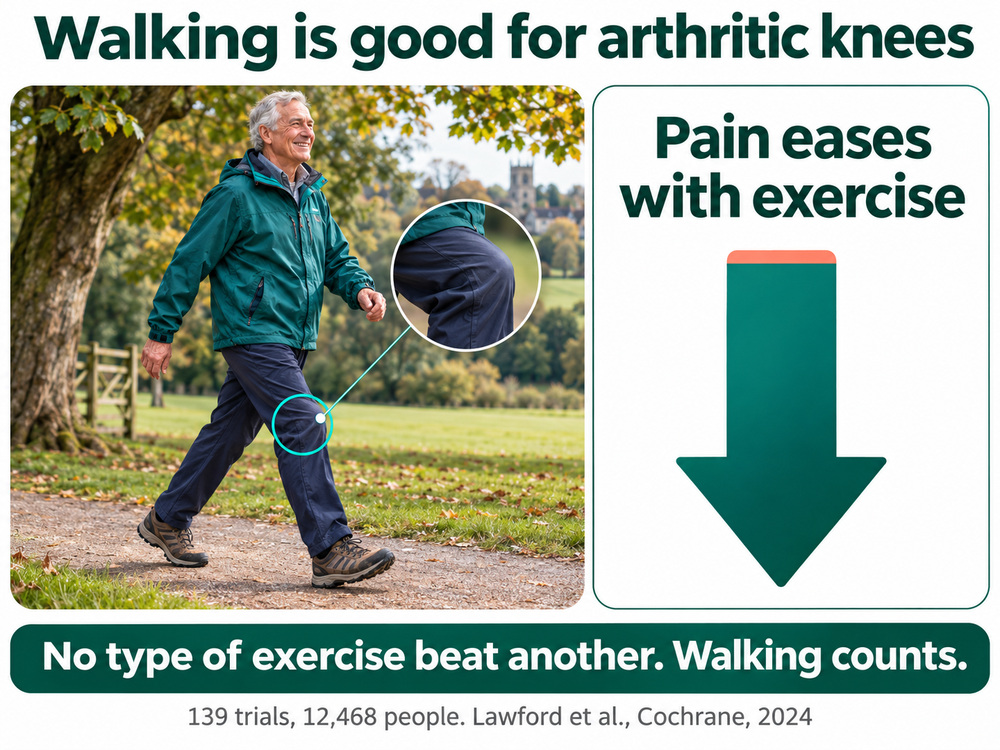
The news here is better than most people expect. Across 139 trials involving 12,468 people with knee osteoarthritis, exercise reduced pain by about 13 points on a 100-point scale compared with usual care, and no one type of exercise was better than another.[7] Walking programmes eased knee pain at least as much as home-based thigh exercises.[8] Among people over 50 with knee osteoarthritis, walking for exercise was linked to a lower risk of developing frequent knee pain[123], while more daily walking was not linked to a higher risk of knee replacement.[9]
Across 139 trials involving 12,468 people with knee osteoarthritis, exercise reduced pain, but no type of exercise was more effective than another.
Knee-loading exercise did not damage cartilage on MRI scans.[124] Recreational runners had lower rates of hip and knee osteoarthritis than non-runners: 3.5 per cent compared with 10.2 per cent[125]. Choosing to run was not associated with worse knees among people over 50 who already had osteoarthritis[126]. Strength training was linked to about 20 per cent lower odds of frequent knee pain.[127] NICE recommends exercise for everyone with osteoarthritis, noting that it may cause some pain at first but benefits the joints.[128]
The catch
The link between strength training and a longer life is based on observational evidence, and the balance-training review measured balance scores rather than falls. Impact exercise is not suitable for everyone. Three men in the hopping study dropped out because of discomfort. The impact programme for women was closely supervised, while a brisk walking programme in women with fragile bones produced a small gain in bone density but increased falls.[129] Anyone with osteoporosis or a previous fracture should seek advice before adding impact exercise. The knee review rated the evidence as low to moderate in certainty. When results were pooled as an odds ratio, the difference in running was not statistically significant, and people with healthier knees may be more likely to choose running.
What to do instead
- Strength training twice a week: chair sit-to-stands, step-ups onto the bottom stair, wall press-ups, heel raises, or resistance-band exercises.
- Work on your balance at least twice a week: stand on one leg at the kitchen worktop, walk heel to toe along the hall, or join a local tai chi or strength-and-balance class.
- Add a little impact, if your bones allow: try heel drops, small hops in place, or a hill or two on your walks.
- Keep walking with sore knees, and check the box below to find out when to seek advice.
Walks4all takeaway: Add strength and balance exercises twice a week, with a little impact if your bones allow. And keep walking: it's good for your knees.
Knees already aching?
- For knee osteoarthritis, NICE advises that exercise may be painful at first, but it benefits the joints. Begin with shorter walks on flatter ground and gradually build up over several weeks.[128]
- Wearing supportive, stable shoes can help[94], as can strengthening the thighs and hips[7] [127].
- Get advice from NHS 111 straight away if your knee is very painful, you cannot move it or put weight on it, it is badly swollen or has changed shape, or it locks, gives way or clicks painfully. Also get advice if you have a very high temperature, or feel hot, cold or shivery, or notice redness or heat around the knee.[130]
- See a GP if your knee pain hasn't improved after a few weeks.[130]
Things you may have heard about walking and getting older
A few beliefs about ageing accompany common walking mistakes and shape what people expect from their walks. Here's what studies say about five of the most common beliefs.
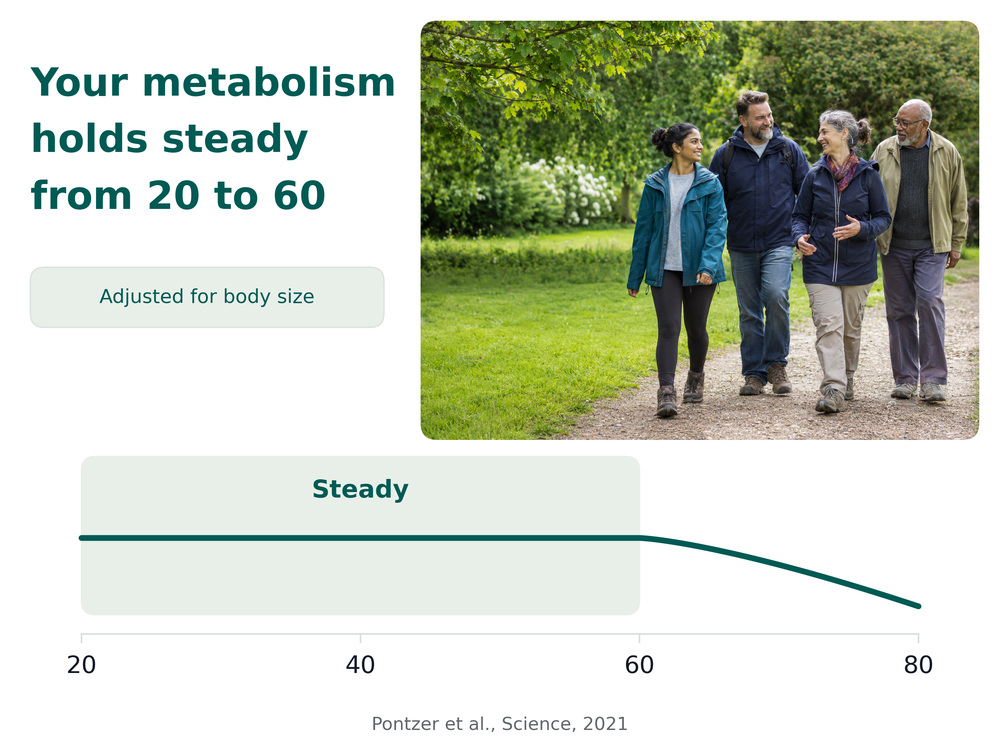
Less than you might think, and later. An international team pooled measurements from 6,421 people, aged from eight days to 95 years, using doubly labelled water, a method that measures how much energy the body burns over several days of ordinary living. After adjusting for body size and composition, daily energy use remained flat from 20 to 60, then declined by around 0.7 per cent a year.[131] An independent group placed the turning point closer to 52[132], so think of it as a broad decade, not a specific birthday.
After adjusting for body size, daily energy use remained stable from ages 20 to 60 among 6,421 people, then declined by about 0.7 per cent per year.
Three caveats: the study compared different people at different ages, rather than following the same people over time. The figures were adjusted for body composition, so they do not guarantee that your total will stay the same if you lose muscle. Energy use may also have declined across generations.[133] In midlife, muscle and movement change most: among more than 96,000 UK Biobank adults, each decade of age was associated with about 7.5 per cent less overall activity.[134]
"After 50 you lose 1 to 2 per cent of your muscle every year"
The best estimates suggest that muscle loss averages about 0.5 per cent a year from mid-life, or four to five per cent a decade, and accelerates after 75. Strength declines faster than muscle size, so stairs may start to feel harder before you can see a change on the tape measure.[10] Another commonly cited figure, 3 to 8 per cent a decade from age 30, has an unclear source, and the "from 30" claim is not well supported. The good news, as noted in mistake 9, is that strength training helps older people regain strength.[11]
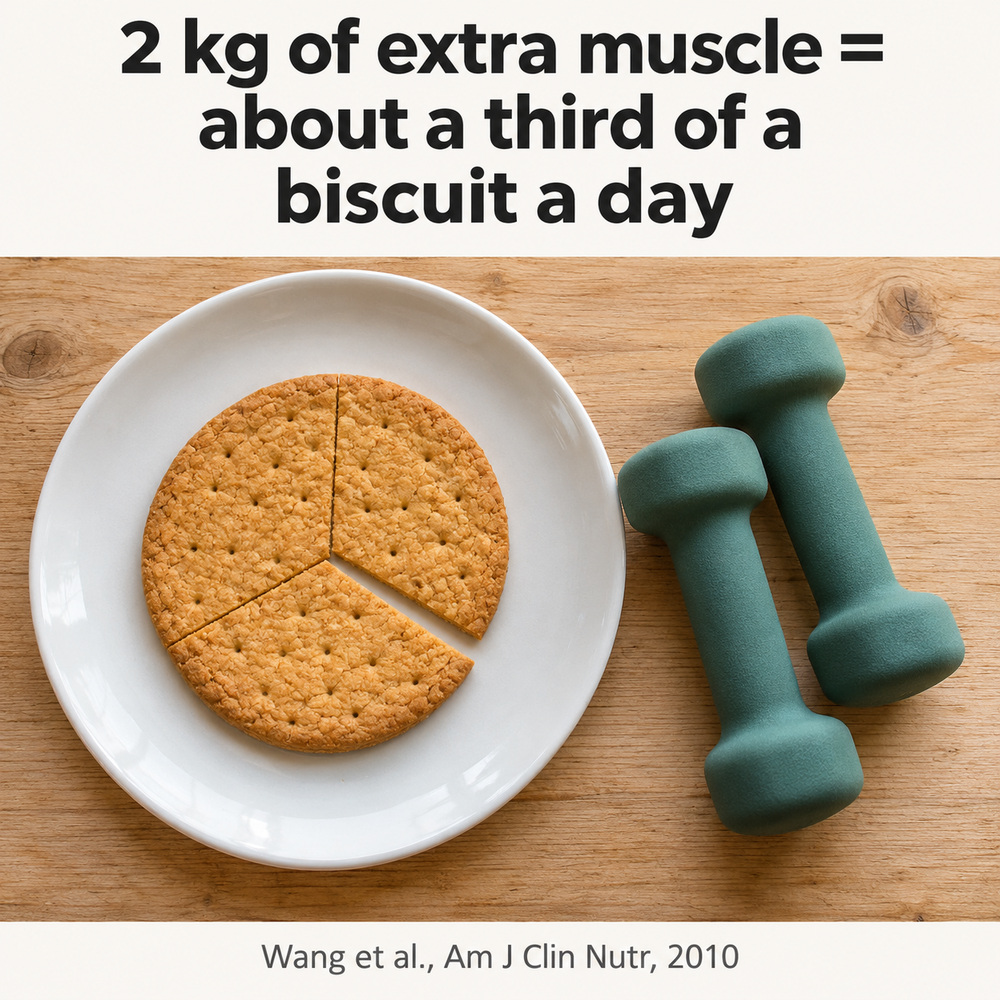
At rest, each kilogram of muscle burns about 13 kcal per day.[135] Two extra kilograms of muscle amount to roughly a third of a digestive biscuit per day. Muscle matters for strength, balance, and getting up off the floor, not as a furnace.
At rest, one kilogram of muscle burns about 13 kcal a day, meaning two kilograms burns roughly the equivalent of a third of a digestive biscuit.
"You need a drink after every walk"
Not after a 10- to 20-minute walk or a ten-minute stroll after a meal. For exercise lasting under about an hour in cool conditions or at an easy pace, drinking to thirst is enough[136]. Fluid guidance aims to prevent losing more than 2 per cent of body weight and to replace any shortfall afterwards, not to encourage habitual drinking[137].
Long or warm walks are the exception. Older people feel less thirsty after exercising in warm weather or when going without water[138] [139], and from about age 40, the body becomes less effective at shedding heat[140]. So, on long or warm walks, carry water and drink before you feel thirsty. Low fluid intake is common among older people, though estimates vary widely[141], so drink regularly throughout the day. Our guide to hydration for walkers has more advice on staying hydrated during longer walks.
"Take one or two rest days a week from walking"
The UK guidelines state that "any activity is better than none, and more is better still".[12] Walking has one of the lowest injury rates of any activity: about 1.4 per cent over 30 days in one national survey[142]. Walking more did not increase walkers' injury risk[143]. Rest days make sense after hard training or when something hurts.
The bigger picture
Some studies in this guide have limitations, which we have noted. Taken together, however, the evidence points in a clear direction. Studies on step counts and pace, trials of strength and balance training, and reviews of knee pain all reach a similar conclusion: people who stay active tend to do better, and each new study strengthens that picture. The UK Chief Medical Officers put it well in their physical activity guidelines: "If physical activity were a drug, we would refer to it as a miracle cure".[13] Walking is not a cure-all or a substitute for medical care, but it is one of the easiest ways to add more activity to an ordinary day.
It's never too late to start. Adults who became active in their 40s to early 60s after years of little activity had nearly the same lower death rate as people who had been active throughout their lives.[17] Walking also has one of the lowest injury rates of any activity.[142] Whatever your age or how much you walk now, each of these nine changes is small enough to try on your next walk.
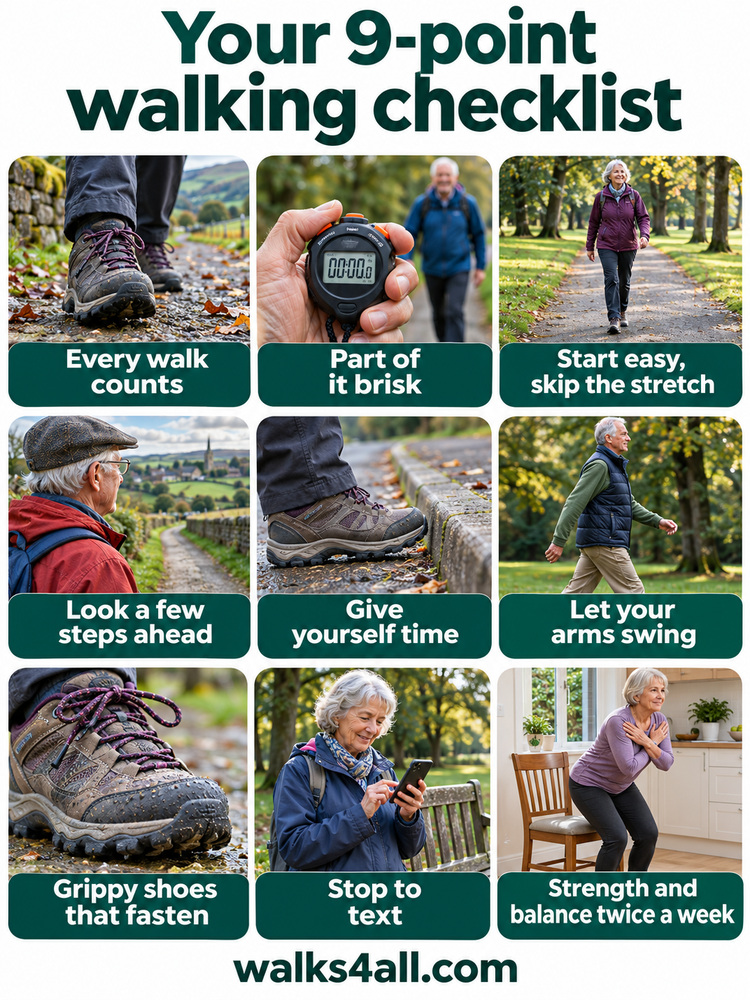
Your nine-point walking checklist
Print this, or save it to your phone.
Find all nine Walks4all takeaways from this guide in one place. Print them or save them to your phone.
- Every walk makes a difference. If you're not very active now, those first extra steps can help the most. When you can, take a ten-minute walk after a meal.
- On most walks, spend part of the time walking briskly, at about 100 steps per minute, fast enough to talk but not sing. Alternate three minutes at this pace with three minutes at an easier pace.
- Skip the stretches. Start with an easy five-minute walk, then pick up the pace and increase it a little each week.
- Look a few steps ahead, not at your feet or up at the sky. On tricky ground, watch where each foot lands. If you walk a lot in varifocals, ask your optician about distance-only glasses for walking.
- Give yourself time, lift your feet, and move slowly over kerbs and in poor light.
- Let your arms swing. Walking a little faster brings the swing back. Poles add support and make the workout more effective.
- Wear comfortable, grippy, low-heeled shoes that fasten, and wear slippers with backs indoors. Avoid ordinary socks on hard or slippery floors.
- Stop to text or read, and finish calls before crossing a road. Keep your phone charged and in your pocket for emergencies.
- Twice a week, add strength and balance work, plus a little impact if your bones allow. Keep walking: it is good for your knees.
Frequently Asked Questions (FAQs) on walking after 50
Where should you look when you walk?
Look about two to four steps ahead, roughly a second and a half in front of you, and keep your eyes moving.[5] On rough ground, kerbs, and steps, watch each tricky foothold until your foot lands.[6] Older walkers who looked only one or two steps ahead made more stepping errors further along[48], as did those who looked away from a foothold too soon[50].
Should you stretch before walking?
You don't need to. In 25 trials, most involving young, active people, stretching before exercise did not prevent injuries, and holding stretches for a long time can briefly weaken your muscles. Instead, walk at an easy pace for the first five minutes, then pick up the pace.[3] [39] Short stretches did not weaken older women's legs, so if you enjoy stretching, carry on.[46]
How many steps a day should a 60-year-old walk?
There is no official UK step target. One large pooled analysis found that, for people aged 60 and over, the benefits levelled off at around 6,000 to 8,000 steps a day. The greatest gain came from moving out of the least active group, whose average was about 3,550 steps. For people over 75, around 1,800 steps a day was linked to a lower risk of dying.[1] [2] So, 10,000 steps is fine if you enjoy it, but it's not a target you have to reach.
Do steps around the house count?
Yes. Light activity was associated with a lower risk of death on its own. UK guidelines state that even light activity offers some health benefits compared with sitting.[13] [14] Taking a short walk to break up long periods of sitting can also help regulate blood sugar after meals.[24]
What is a good walking pace for a 60-year-old?
Walk briskly enough to talk, but not sing. For adults aged 61 to 85, about 100 steps per minute, or roughly 25 steps in 15 seconds, is considered moderate, or brisk, walking. This varies from person to person, so let the talk test decide.[28] [29]
Should I walk every day or take rest days?
Daily walking meets UK guidelines, which state that any activity is better than none, and that more is better still.[12] Walking has one of the lowest injury rates of any activity, and walking more did not increase walkers' risk of injury. Rest days make sense after hard training or when something hurts.[142] [143]
Is walking enough exercise after 50?
Walking is a good foundation, but it isn't enough on its own. UK guidelines recommend that adults aim for at least 150 minutes of moderate activity each week, along with strength exercises at least twice a week and balance activities twice a week to reduce the risk of frailty and falls. In fall-prevention trials, balance and functional exercises were most effective, whereas the results for walking-only programmes were uncertain.[12] [111]
Should I keep walking if my knee hurts?
With knee osteoarthritis, usually yes: exercise, including walking, usually helps ease knee pain, and walking more was not linked to an increased risk of knee replacement. NICE advises that exercise may cause some pain at first but is beneficial for the joints. Contact NHS 111 straight away if your knee is very painful, will not move or bear your weight, is badly swollen or has changed shape, locks or gives way, or is red and hot and you have a very high temperature. See a GP if your knee pain doesn't improve within a few weeks.[7] [9] [128] [130]
What are the best shoes and slippers to prevent falls?
One study found the lowest fall risk with athletic and canvas shoes, and the highest when people were barefoot or wearing socks.[88] A review recommended low heels and firm, slip-resistant soles.[91] For indoor wear, enclosed slippers with a firm sole and a fastening provided the best balance and walking support, whereas backless slippers provided the least.[90]
Is there an alternative to varifocals for walking?
Yes: single-vision distance glasses reserved for walking. In a trial involving 606 varifocal and bifocal wearers, using distance glasses for walking reduced falls by about 40 per cent among those who regularly went out, but increased outdoor falls among those who rarely went out. Ask your optician whether they would suit you.[56]
How we put this guide together
The guide draws on the Walks4all evidence database, which contains more than 7,500 papers on walking and health. We have read every study cited, either at abstract or full-text level, for this guide or one of our books. As we go, we explain the size and type of each study, because a trial that changes what people do carries more weight than a survey that finds a link. Where the evidence is limited or points the other way, we cover it under "The catch", alongside the good news. Every study is listed below with a link so you can read it for yourself. Our guides to understanding health research and the limitations of walking studies explain how to assess a study for yourself.
November 2026
Related reading:
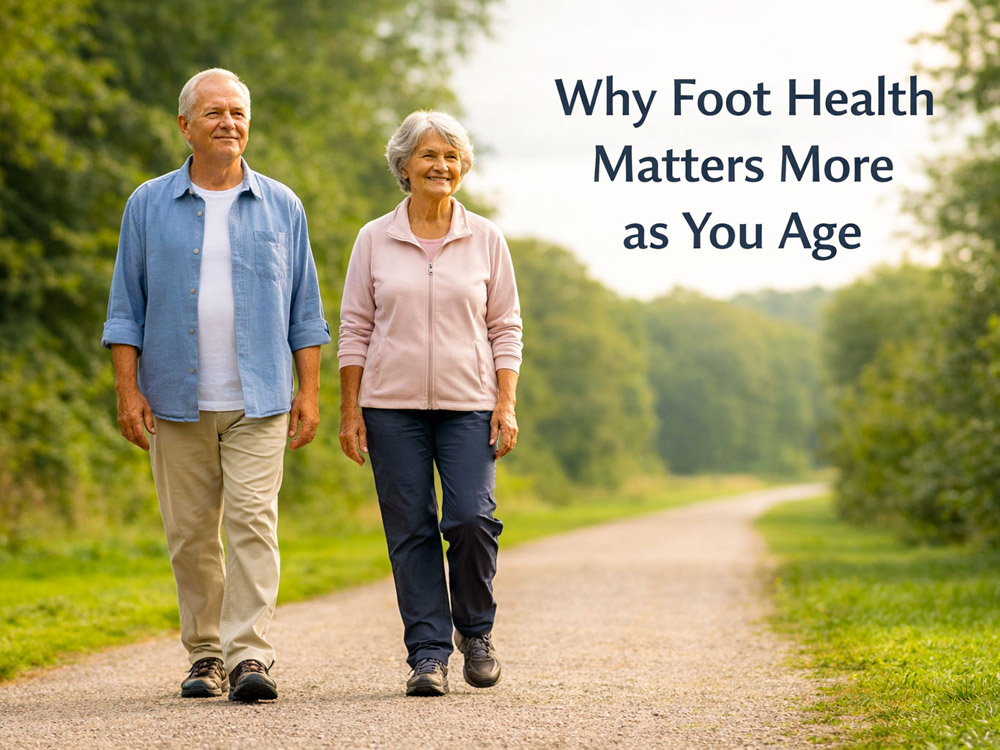 Article: Why foot health matters more as you age: Mobility, balance, fall prevention and staying independent for life
Your feet support every step you take. As we age, subtle changes in foot strength, structure, circulation, and sensation can quietly ripple outward, affecting balance, confidence, walking speed, joint health, and long‑term independence.
Published January 2026
Want to 'go deeper'?
We take evidence seriously at Walks4all. If you'd like to better understand how walking studies are designed, how results
should be interpreted, and what scientific terms mean, explore our guides on the following:
References
- Paluch AE, Bajpai S, Bassett DR, et al. Daily steps and all-cause mortality: a meta-analysis of 15 international cohorts. The Lancet Public Health. 2022;7(3):e219-e228.
What the review shows: The biggest drop in death risk came with the first step up from the least active; for over-60s, benefit levelled at 6,000 to 8,000 steps.
- Shimoda T, Tomida K, Nakajima C, et al. Dose-Response Relationships of Daily Steps with Disability Incidence and All-Cause Mortality Stratified by Age and Physical Frailty. Journal of the American Medical Directors Association. 2025;26(1):105356.
What the study shows: Over-75s and frail people gained from far fewer daily steps than younger, fitter people.
- Lauersen JB, Bertelsen DM, Andersen LB. The effectiveness of exercise interventions to prevent sports injuries: a systematic review and meta-analysis of randomised controlled trials. British Journal of Sports Medicine. 2014;48(11):871-877.
What the review shows: Stretching did not reduce sports injuries, while strength training cut them to under a third.
- Fradkin AJ, Zazryn T, Smoliga JM. Effects of Warming-up on Physical Performance: A Systematic Review With Meta-analysis. The Journal of Strength and Conditioning Research. 2010;24(1):140-148.
What the review shows: An active warm-up improved performance in 79 per cent of the measures.
- Matthis JS, Yates JL, Hayhoe M. Gaze and the Control of Foot Placement When Walking in Natural Terrain. Current Biology. 2018;28(8):1224-1233.e5.
What the study shows: Walkers look at the ground about two to four steps, or 1.5 seconds, ahead, and almost constantly on rough ground.
- Young WR, Hollands MA. Can telling older adults where to look reduce falls? Evidence for a causal link between inappropriate visual sampling and suboptimal stepping performance. Experimental Brain Research. 2010;204(1):103-113.
What the study shows: Telling older adults to keep looking at each stepping spot until the heel landed cut stepping errors.
- Lawford BJ, Hall M, Hinman RS, et al. Exercise for osteoarthritis of the knee. Cochrane Database of Systematic Reviews. 2024;(12):CD004376.
What the review shows: Exercise eased knee osteoarthritis pain by about 13 points out of 100, with no type of exercise better than another.
- Roddy E, et al. Aerobic walking or strengthening exercise for osteoarthritis of the knee? A systematic review. Annals of the Rheumatic Diseases. 2005;64(4):544-548.
What the review shows: Walking programmes eased knee osteoarthritis pain at least as well as home thigh exercises.
- Master H, Thoma LM, Neogi T, et al. Daily walking and the risk of knee replacement over 5 years among adults with advanced knee osteoarthritis in the United States. Archives of Physical Medicine and Rehabilitation. 2021;102(10):1888-1894.
What the study shows: More daily walking was not linked with more knee replacements.
- Mitchell WK, Williams J, Atherton P, et al. Sarcopenia, dynapenia, and the impact of advancing age on human skeletal muscle size and strength; a quantitative review. Frontiers in Physiology. 2012;3:260.
What the review shows: Muscle mass falls about 0.5 per cent a year from mid-life, faster later, and strength falls faster than size.
- Liu Cj, Latham NK. Progressive resistance strength training for improving physical function in older adults. Cochrane Database of Systematic Reviews. 2009;(3):CD002759.
What the review shows: Progressive strength training brought large strength gains in older people and made getting up from a chair easier.
- UK Chief Medical Officers. Physical activity for adults and older adults: 19 and over (text of the infographic). GOV.UK, updated 16 July 2026.
What the guidance shows: Any activity is better than none; strength on two days and balance on two days a week for older adults.
- UK Chief Medical Officers. UK Chief Medical Officers' Physical Activity Guidelines. Department of Health and Social Care, 2019 (page updated 10 July 2026).
What the guidance shows: Some physical activity is better than none, even light activity; build up gradually from current levels.
- Ekelund U, Tarp J, Steene-Johannessen J, et al. Dose-response associations between accelerometry measured physical activity and sedentary time and all cause mortality: systematic review and harmonised meta-analysis. BMJ. 2019;366:l4570.
What the review shows: Any movement, including light activity, was linked with lower mortality, with the steepest gain at the low end.
- Stens NA, Bakker EA, Mañas A, et al. Relationship of Daily Step Counts to All-Cause Mortality and Cardiovascular Events. Journal of the American College of Cardiology. 2023;82(15):1483-1494.
What the review shows: Lower mortality began from about 2,600 steps a day, with the risk falling further to about 8,800.
- Ekelund U, Tarp J, Ding D, et al. Deaths potentially averted by small changes in physical activity and sedentary time: an individual participant data meta-analysis of prospective cohort studies. The Lancet. 2026;407(10526):339-349.
What the study shows: Five more minutes a day of brisk activity in the least active fifth was modelled to prevent about 6 per cent of deaths.
- Saint-Maurice PF, Coughlan D, Kelly SP, et al. Association of leisure-time physical activity across the adult life course with all-cause and cause-specific mortality. JAMA Network Open. 2019;2(3):e190355.
What the study shows: People who became active in mid-life had nearly the same lower death rate as those active throughout.
- Hamaya R, Evenson KR, Lieberman DE, et al. Association between frequency of meeting daily step thresholds and all-cause mortality and cardiovascular disease in older women. British Journal of Sports Medicine. 2025;59(24):1726-1733.
What the study shows: 4,000 steps on just one or two days a week went with lower mortality in older women; total steps drove the effect.
- Inoue K, Tsugawa Y, Mayeda ER, et al. Association of Daily Step Patterns With Mortality in US Adults. Jama Network Open. 2023;6(3):e235174.
What the study shows: 8,000 steps on just one or two days a week went with nearly as much lower mortality as on three to seven days.
- O'Donovan G, Lee IM, Hamer M, Stamatakis E. Association of "weekend warrior" and other leisure time physical activity patterns with risks for all-cause, cardiovascular disease, and cancer mortality. JAMA Internal Medicine. 2017;177(3):335-342.
What the study shows: In British surveys, activity packed into one or two sessions carried much the same lower risk as activity spread out.
- Khurshid S, Al-Alusi MA, Churchill TA, et al. Accelerometer-derived "weekend warrior" physical activity and incident cardiovascular disease. JAMA. 2023;330(3):247-252.
What the study shows: Activity packed into one or two days carried much the same lower heart and stroke risk as activity spread out.
- Reynolds AN, Mann JI, Williams S, et al. Advice to walk after meals is more effective for lowering postprandial glycaemia in type 2 diabetes mellitus than advice that does not specify timing: a randomised crossover study. Diabetologia. 2016;59(12):2572-2578.
What the study shows: Ten minutes of walking after each meal lowered post-meal blood sugar more than one 30-minute walk a day.
- DiPietro L, Gribok AV, Stevens M, et al. Three 15-min Bouts of Moderate Postmeal Walking Significantly Improves 24-h Glycemic Control in Older People at Risk for Impaired Glucose Tolerance. Diabetes Care. 2013;36(10):3262-3268.
What the study shows: Three 15-minute walks after meals controlled 24-hour blood sugar as well as one 45-minute walk in people over 60.
- Gale JT, Martin H, Haszard JJ, et al. The Acute Effects of Interrupting Prolonged Sitting With Regular Activity Breaks on Postprandial Glucose and Insulin in Adults: A Systematic Review and Meta-Analysis. Obesity Reviews. 2026;27(11):e70152.
What the review shows: Walking breaks about every 20 minutes gave the largest drop in post-meal blood sugar and insulin.
- Gong J, Tan L, Wang Y, et al. Effects of short-bout accumulated exercise on postprandial metabolism in adults: A systematic review and meta-analysis. Complementary Therapies in Medicine. 2026;101:103416.
What the review shows: Short walking bouts lowered post-meal blood sugar; standing alone did not.
- Buffey AJ, Herring MP, Langley CK, et al. The acute effects of interrupting prolonged sitting time in adults with standing and light-intensity walking on biomarkers of cardiometabolic health in adults: a systematic review and meta-analysis. Sports Medicine. 2022;52(8):1765-1787.
What the review shows: Walking breaks lowered post-meal glucose and insulin more than standing breaks.
- del Pozo Cruz B, Ahmadi M, Sabag A, et al. Step accumulation patterns and risk for cardiovascular events and mortality among suboptimally active adults. Annals of Internal Medicine. 2025;178(12):1718-1727.
What the study shows: In adults taking 8,000 steps a day or fewer, some walking in longer stretches was linked with lower risk than very short bursts.
- Tudor-Locke CE, Mora-González J, Ducharme SW, et al. Walking cadence (steps/min) and intensity in 61-85-year-old adults: the CADENCE-Adults study. International Journal of Behavioral Nutrition and Physical Activity. 2021;18(1):129.
What the study shows: About 100 steps a minute marked moderate intensity in people aged 61 to 85.
- McAvoy CR, Miller TA, Aguiar EJ, et al. Cadence (steps/min) and relative intensity in 61 to 85-year-olds: the CADENCE-Adults study. International Journal of Behavioral Nutrition and Physical Activity. 2023;20(1):141.
What the study shows: Judged by heart rate and effort, moderate intensity began at about 105 steps a minute in people aged 61 to 85.
- Stamatakis E, Kelly P, Strain T, et al. Self-rated walking pace and all-cause, cardiovascular disease and cancer mortality: individual participant pooled analysis of 50 225 walkers from 11 population British cohorts. British Journal of Sports Medicine. 2018;52(12):761-768.
What the study shows: Average and brisk walkers had 20 and 24 per cent lower mortality than slow walkers in British cohorts.
- Wei L, Ahmadi MN, Koemel NA, et al. Combinations of stepping intensity and daily step counts against all-cause and cardiovascular disease mortality: insights from a device-based prospective study. British Journal of Sports Medicine. 2026;60(18):1401-1408.
What the study shows: Lowest risk at 7,500 to 10,000 steps with some at about 100 steps a minute; brisk steps help most when total steps are low.
- Stamatakis E, Ahmadi MN, Gill JMR, et al. Association of wearable device-measured vigorous intermittent lifestyle physical activity with mortality. Nature Medicine. 2022;28(12):2521-2529.
What the study shows: Three daily 1 to 2 minute bursts of vigorous everyday activity were linked with a 38 to 40 per cent lower death rate in non-exercisers.
- Nemoto Ki, Genno H, Masuki S, et al. Effects of High-Intensity Interval Walking Training on Physical Fitness and Blood Pressure in Middle-Aged and Older People. Mayo Clinic Proceedings. 2007;82(7):803-811.
What the study shows: Interval walking raised thigh strength by 13 per cent and walking fitness by 9 per cent, more than steady walking.
- Masuki S, Mori M, Tabara Y, et al. The factors affecting adherence to a long-term interval walking training program in middle-aged and older people. Journal of Applied Physiology. 2015;118(5):595-603.
What the study shows: Middle-aged and older people kept up interval walking 70 per cent of the time over 22 months.
- Mittleman MA, Maclure M, Tofler GH, et al. Triggering of acute myocardial infarction by heavy physical exertion: protection against triggering by regular exertion. New England Journal of Medicine. 1993;329(23):1677-1683.
What the study shows: Heavy exertion briefly raised heart attack risk, far more in people who rarely exercised.
- Studenski S, Perera S, Patel K, et al. Gait speed and survival in older adults. JAMA. 2011;305(1):50-58.
What the study shows: Each 0.1 metres a second faster usual walking speed went with about 12 per cent lower mortality.
- Lee IM, Shiroma EJ, Kamada M, et al. Association of step volume and intensity with all-cause mortality in older women. JAMA Internal Medicine. 2019;179(8):1105-1112.
What the study shows: About 4,400 steps a day went with a 41 per cent lower death rate than about 2,700 in older women.
- Behm DG, Blazevich AJ, Kay AD, et al. Acute effects of muscle stretching on physical performance, range of motion, and injury incidence in healthy active individuals: a systematic review. Applied Physiology Nutrition and Metabolism. 2016;41(1):1-11.
What the review shows: Static stretching briefly reduced performance, mostly with long holds, and had no clear effect on injury.
- Simic L, Šarabon N, Marković G. Does pre-exercise static stretching inhibit maximal muscular performance? A meta-analytical review. Scandinavian Journal of Medicine and Science in Sports. 2013;23(2):131-148.
What the review shows: Static stretching reduced strength by about 5.4 per cent, least with holds of 45 seconds or less, at any age.
- Han MJ, Yuk GC, Hwangbo G, et al. Acute Effects of 5 Min of Plantar Flexor Static Stretching on Balance and Gait in the Elderly. Journal of Physical Therapy Science. 2014;26(1):131-133.
What the study shows: Five minutes of calf stretching briefly unsettled standing balance in over-65s, with walking unaffected.
- Fradkin AJ, Gabbe BJ, Cameron PA. Does warming up prevent injury in sport? The evidence from randomised controlled trials. Journal of Science and Medicine in Sport. 2006;9(3):214-220.
What the review shows: The evidence that warming up prevents injury leans mildly in favour but is limited and from sport.
- Herbert RD, de Noronha M, Kamper SJ. Stretching to prevent or reduce muscle soreness after exercise. Cochrane Database of Systematic Reviews. 2011;(7):CD004577.
What the review shows: Stretching before or after exercise made about a one-point difference to soreness on a 100-point scale.
- Vialleron T, Delafontaine A, Ditcharles S, et al. Effects of stretching exercises on human gait: a systematic review and meta-analysis. F1000Research. 2020;9:984.
What the review shows: No strong evidence that stretching improves walking.
- Afonso J, Ramirez-Campillo R, Moscão J, et al. Strength training versus stretching for improving range of motion: a systematic review and meta-analysis. Healthcare (Basel). 2021;9(4):427.
What the review shows: Strength training improved range of movement as much as stretching.
- Proske U, Morgan DL. Muscle damage from eccentric exercise: mechanism, mechanical signs, adaptation and clinical applications. Journal of Physiology. 2001;537(2):333-345.
What the review shows: Downhill-type muscle work causes next-day soreness, and much less the next time.
- Gonçalves R, Gurjão ALD, Jambassi Filho JC, et al. The acute effects of static stretching on peak force, peak rate of force development and muscle activity during single- and multiple-joint actions in older women. Journal of Sports Sciences. 2013;31(7):690-698.
What the study shows: Three 30-second thigh stretches did not reduce leg force in older women.
- Cotton K, Selioutski L. Gaze behavior during walking in older adults: A systematic review of eye-tracking research. Gait & Posture. 2026;131:110641.
What the review shows: With age, people fix their eyes more on the ground just ahead and scan less of the route.
- Ellmers TJ, Cocks AJ, Young WR. Evidence of a Link Between Fall-Related Anxiety and High-Risk Patterns of Visual Search in Older Adults During Adaptive Locomotion. The Journals of Gerontology Series A. 2020;75(5):961-967.
What the study shows: Higher-risk and anxious older walkers looked only one or two steps ahead and made more stepping errors.
- Ellmers TJ, Cocks AJ, Kal EC, et al. Conscious Movement Processing, Fall-Related Anxiety, and the Visuomotor Control of Locomotion in Older Adults. The Journals of Gerontology Series B. 2020;75(9):1911-1920.
What the study shows: Thinking about how you move pulled older walkers' gaze in to the next step or two and slowed them down.
- Chapman GJ, Hollands MA. Evidence that older adult fallers prioritise the planning of future stepping actions over the accurate execution of ongoing steps during complex locomotor tasks. Gait & Posture. 2007;26(1):59-67.
What the study shows: Older adults at high fall risk looked away from stepping targets too early and stepped less accurately.
- Mak TCT, Wong TWL, Leung MCY, et al. External focus strategy improves visuomotor control of gait in older adults. Psychological Research. 2025;89(3):95.
What the study shows: Focusing on the destination reduced older adults' time looking at the ground and steadied their walking.
- Chen T, Mak TCT, Ng SSM, et al. Attentional Focus Strategies to Improve Motor Performance in Older Adults: A Systematic Review. International Journal of Environmental Research and Public Health. 2023;20(5):4047.
What the review shows: Outward-looking cues usually beat body-focused cues for movement in older adults, less clearly for walking.
- Yamada M, Higuchi T, Nishiguchi S, et al. Multitarget Stepping Program in Combination with a Standardized Multicomponent Exercise Program Can Prevent Falls in Community-Dwelling Older Adults: A Randomized, Controlled Trial. Journal of the American Geriatrics Society. 2013;61(10):1669-1675.
What the study shows: Stepping-to-targets practice plus exercise cut the fall rate by about 65 per cent over a year.
- Lord SR, Dayhew J, Howland A. Multifocal Glasses Impair Edge-Contrast Sensitivity and Depth Perception and Increase the Risk of Falls in Older People. Journal of the American Geriatrics Society. 2002;50(11):1760-1766.
What the study shows: Multifocal wearers were more than twice as likely to fall, and more likely to trip and fall outdoors.
- Johnson L, Buckley JG, Scally A, et al. Multifocal Spectacles Increase Variability in Toe Clearance and Risk of Tripping in the Elderly. Investigative Ophthalmology & Visual Science. 2007;48(4):1466-1471.
What the study shows: Toe clearance varied more from step to step when older people stepped up in multifocals.
- Haran MJ, Cameron ID, Ivers R, et al. Effect on falls of providing single lens distance vision glasses to multifocal glasses wearers: VISIBLE randomised controlled trial. BMJ. 2010;340:c2265.
What the study shows: Distance-only glasses for walking cut falls by about 40 per cent in multifocal wearers who regularly went out, but raised outdoor falls in those who rarely did.
- Elliott DB, Hotchkiss J, Scally A, et al. Intermediate addition multifocals provide safe stair ambulation with adequate 'short-term' reading. Ophthalmic and Physiological Optics. 2016;36(1):60-68.
What the study shows: Varifocals with a weaker reading addition were as safe on stairs as distance glasses.
- Katzman WB, Vittinghoff E, Lin F, et al. Targeted spine strengthening exercise and posture training program to reduce hyperkyphosis in older adults: results from the study of hyperkyphosis, exercise, and function (SHEAF) randomized controlled trial. Osteoporosis International. 2017;28(10):2831-2841.
What the study shows: Six months of back exercise improved the upper-back curve by 3 degrees, with no change in walking function.
- Ponzano M, Tibert N, Bansal S, et al. Exercise for improving age-related hyperkyphosis: a systematic review and meta-analysis with GRADE assessment. Archives of Osteoporosis. 2021;16(1):140.
What the review shows: Exercise improved a stooped upper back modestly, with no clear effect on falls.
- Lorbergs AL, Murabito JM, Jarraya M, et al. Thoracic Kyphosis and Physical Function: The Framingham Study. Journal of the American Geriatrics Society. 2017;65(10):2257-2264.
What the study shows: A more rounded upper back was not linked with slower walking or weaker grip.
- Koelé MC, Willems HC, Swart KMA, et al. The association between hyperkyphosis and fall incidence among community-dwelling older adults. Osteoporosis International. 2022;33(2):403-411.
What the study shows: A stooped upper back was linked with more falls in people aged 77 and over, not in younger participants.
- Lorbergs AL, O'Connor GT, Zhou Y, et al. Severity of Kyphosis and Decline in Lung Function: The Framingham Study. The Journals of Gerontology Series A. 2017;72(5):689-694.
What the study shows: Women with more upper-back rounding lost more lung function over 16 years.
- Mahmoud NF, Hassan KA, Abdelmajeed SF, et al. The Relationship Between Forward Head Posture and Neck Pain: a Systematic Review and Meta-Analysis. Current Reviews in Musculoskeletal Medicine. 2019;12(4):562-577.
What the review shows: Forward head posture was moderately linked with neck pain in adults, in snapshot studies.
- Hansraj KK. Assessment of stresses in the cervical spine caused by posture and position of the head. Surgical Technology International. 2014;25:277-279.
What the study shows: The origin of the widely shared neck-load figures: an estimate of forces as the head tilts, not a study of walkers.
- Berg WP, Alessio HM, Mills EM. Circumstances and consequences of falls in independent community-dwelling older adults. Age and Ageing. 1997;26(4):261-268.
What the study shows: Trips and slips caused 59 per cent of falls, most while walking, and hurrying was the commonest reason given.
- Crenshaw JR, Bernhardt KA, Achenbach SJ, et al. The circumstances, orientations, and impact locations of falls in community-dwelling older women. Archives of Gerontology and Geriatrics. 2017;73:240-247.
What the study shows: Trips caused 33 per cent and slips 22 per cent of falls in older women; forward falls came with trips and hurrying.
- Li W, Keegan THM, Sternfeld B, et al. Outdoor Falls Among Middle-Aged and Older Adults: A Neglected Public Health Problem. American Journal of Public Health. 2006;96(7):1192-1200.
What the study shows: 73 per cent of outdoor falls were caused by the surroundings, mostly on pavements, kerbs and streets.
- Kelsey JL, Berry SD, Procter-Gray E, et al. Indoor and Outdoor Falls in Older Adults Are Different: The Maintenance of Balance, Independent Living, Intellect, and Zest in the Elderly of Boston Study. Journal of the American Geriatrics Society. 2010;58(11):2135-2141.
What the study shows: Older people who fell outdoors tended to be younger, male, active and healthy.
- Barrett R, Mills P, Begg RK. A systematic review of the effect of ageing and falls history on minimum foot clearance characteristics during level walking. Gait & Posture. 2010;32(4):429-435.
What the review shows: Toe clearance varies more from step to step in older people and in fallers, though the average does not drop.
- Naaman T, Hayek R, Gutman I, et al. Young, but not in the dark - The influence of reduced lighting on gait stability in middle-aged adults. Plos One. 2023;18(5):e0280535.
What the study shows: In near-darkness, the walking of people around 50 became as unsteady as that of 70-year-olds.
- Kwan I, Mapstone J. Interventions for increasing pedestrian and cyclist visibility for the prevention of death and injuries. Cochrane Database of Systematic Reviews. 2006;(4):CD003438.
What the review shows: Fluorescent materials help drivers see pedestrians by day, and reflective materials at night.
- Avalos MA, Rosenblatt NJ. Can minimum toe clearance predict community-based trips by older adults? Gait & Posture. 2024;107:189-193.
What the study shows: Lab-measured toe clearance did not predict everyday trips beyond a person's fall history.
- Helbostad JL, Vereijken B, Hesseberg K, et al. Altered vision destabilizes gait in older persons. Gait & Posture. 2009;30(2):233-238.
What the study shows: Dim light alone did not unsettle older walkers in a small lab study.
- NHS. Falls. NHS website, page last reviewed 6 March 2025.
What the guidance shows: Call 999 after a fall if someone may have injured the head, back, neck or hip, or cannot get up; get help from NHS 111 if they may be in pain, injured or unwell; see a GP after a fall or with worries about balance or mobility.
- National Institute for Health and Care Excellence. Falls: assessment and prevention in older people and in people 50 and over at higher risk (NG249). 2025.
What the guidance shows: A comprehensive falls assessment for people who have fallen in the past year and meet set criteria, and a falls prevention exercise programme for those whose walking or balance is affected.
- Collins SH, Adamczyk PG, Kuo AD. Dynamic arm swinging in human walking. Proceedings of the Royal Society B. 2009;276(1673):3679-3688.
What the study shows: Holding the arms still increased the energy used above standing by about 12 per cent.
- Meyns P, Bruijn SM, Duysens J. The how and why of arm swing during human walking. Gait & Posture. 2013;38(4):555-562.
What the review shows: Arm swing is mostly passive and most likely reduces the energy walking uses.
- Mirelman A, Bernad-Elazari H, Nobel T, et al. Effects of Aging on Arm Swing during Gait: The Role of Gait Speed and Dual Tasking. Plos One. 2015;10(8):e0136043.
What the study shows: Arm swing shrinks with age and grows again with faster walking.
- Bruijn SM, Sloot LH, Kingma I, et al. Contribution of arm movements to balance recovery after tripping in older adults. Journal of Biomechanics. 2022;133:110981.
What the study shows: In older adults tripped in a lab, moving arms helped them take a longer recovery step.
- Punt M, Bruijn SM, Wittink HM, et al. Effect of arm swing strategy on local dynamic stability of human gait. Gait & Posture. 2015;41(2):504-509.
What the study shows: A bigger arm swing made walking steadier from side to side in ten young men.
- Church TS, Earnest CP, Morss GM. Field testing of physiological responses associated with Nordic walking. Research Quarterly for Exercise and Sport. 2002;73(3):296-300.
What the study shows: Walking with poles raised calorie burn by about 20 per cent at the same speed without feeling harder.
- Liu J, Kim JH. The effects of Nordic walking on the cardiovascular risk factors in older adults: a systematic review and meta-analysis. Archives of Gerontology and Geriatrics. 2025;129:105663.
What the review shows: Nordic walking brought modest gains in weight, waist, blood pressure and fitness in older adults.
- Lewek MD, Poole RD, Halawa OI, et al. Arm swing magnitude and asymmetry during gait in the early stages of Parkinson's disease. Gait & Posture. 2010;31(2):256-260.
What the study shows: People in the early stages of Parkinson's disease swung one arm much less than the other.
- Mirelman A, Bernad-Elazari H, Thaler A, et al. Arm swing as a potential new prodromal marker of Parkinson's disease. Movement Disorders. 2016;31(10):1527-1534.
What the study shows: Symptom-free carriers of a Parkinson's gene variant showed more lopsided arm swing.
- Roos PE, McGuigan MP, Kerwin DG, et al. The role of arm movement in early trip recovery in younger and older adults. Gait & Posture. 2008;27(2):352-356.
What the study shows: Older adults' arms did little to stop a trip and were used more to protect against the fall.
- Gomeñuka NA, Oliveira HB, Silva ES, et al. Effects of Nordic walking training on quality of life, balance and functional mobility in elderly: a randomized clinical trial. PLoS One. 2019;14(1):e0211472.
What the study shows: Nordic walking helped balance and mobility in older adults but was no better than ordinary walking for most outcomes.
- Rodrigues IB, Ponzano M, Butt DA, et al. The Effects of Walking or Nordic Walking in Adults 50 Years and Older at Elevated Risk of Fractures: A Systematic Review and Meta-Analysis. Journal of Aging and Physical Activity. 2021;29(5):886-899.
What the review shows: Nordic walking may improve getting up and walking in over-50s with fragile bones; there are no falls data.
- Koepsell TD, Wolf ME, Büchner DM, et al. Footwear Style and Risk of Falls in Older Adults. Journal of the American Geriatrics Society. 2004;52(9):1495-1501.
What the study shows: Trainers carried the lowest fall risk; bare feet or socks a far higher one.
- Menz HB, Morris ME, Lord SR. Footwear Characteristics and Risk of Indoor and Outdoor Falls in Older People. Gerontology. 2006;52(3):174-180.
What the study shows: Older people who fell indoors were far more likely to go barefoot or in socks at home.
- Menz HB, Auhl M, Munteanu SE. Effects of Indoor Footwear on Balance and Gait Patterns in Community-Dwelling Older Women. Gerontology. 2017;63(2):129-136.
What the study shows: Balance and walking were best in enclosed firm slippers, worse in socks and worst in backless slippers.
- Menant JC, Steele JR, Menz HB, Munro BJ, Lord SR. Optimizing footwear for older people at risk of falls. Journal of Rehabilitation Research and Development. 2008;45(8):1167-1181.
What the review shows: Low heels and firm, slip-resistant soles indoors and out; bare feet, socks and high heels raise fall risk.
- Spink MJ, Menz HB, Fotoohabadi M, et al. Effectiveness of a multifaceted podiatry intervention to prevent falls in community dwelling older people with disabling foot pain: randomised controlled trial. BMJ. 2011;342:d3411.
What the study shows: A podiatry package for people with painful feet cut falls by 36 per cent.
- Mickle KJ, Munro BJ, Lord SR, et al. ISB Clinical Biomechanics Award 2009: toe weakness and deformity increase the risk of falls in older people. Clinical Biomechanics. 2009;24(10):787-791.
What the study shows: Weak toes and bunions were linked with falls in older people.
- Paterson KL, Bennell KL, Campbell PK, et al. The Effect of Flat Flexible Versus Stable Supportive Shoes on Knee Osteoarthritis Symptoms. Annals of Internal Medicine. 2021;174(4):462-471.
What the study shows: Stable supportive shoes eased knee osteoarthritis pain on walking more than flat flexible shoes, with fewer side effects.
- Knapik JJ, Trone DW, Tchandja J, Jones BH. Injury-reduction effectiveness of prescribing running shoes on the basis of foot arch height: summary of military investigations. Journal of Orthopaedic & Sports Physical Therapy. 2014;44(10):805-812.
What the study shows: Shoes chosen by arch type did not reduce injuries in about 7,200 recruits.
- Relph N, Greaves H, Armstrong R, et al. Running shoes for preventing lower limb running injuries in adults. Cochrane Database of Systematic Reviews. 2022;(8):CD013368.
What the review shows: No good evidence that particular cushioning or stability features prevent injuries.
- Nigg BM, Baltich J, Hoerzer S, Enders H. Running shoes and running injuries: mythbusting and a proposal for two new paradigms: 'preferred movement path' and 'comfort filter'. British Journal of Sports Medicine. 2015;49(20):1290-1294.
What the review shows: Choosing the most comfortable shoe is a reasonable guide.
- McKiernan FE. A simple gait-stabilizing device reduces outdoor falls and nonserious injurious falls in fall-prone older people during the winter. Journal of the American Geriatrics Society. 2005;53(6):943-947.
What the study shows: Slip-on shoe grips reduced injurious outdoor falls on snow and ice.
- Brooks Running. When to replace your running shoes. Brooks Running blog, 29 July 2020.
What the guidance shows: As a general rule, replace running shoes after 300 to 500 miles (three to six months, depending on how much you run); no separate figure is given for walking shoes.
- Chambon N, Sevrez V, Ly QH, et al. Aging of running shoes and its effect on mechanical and biomechanical variables: implications for runners. Journal of Sports Sciences. 2014;32(11):1013-1022.
What the study shows: Shoe midsoles stiffened and absorbed less shock with use, with a small effect on movement.
- Futrell E, Chevan J. Effects of Long-Term Minimal Footwear Use on Fall-Risk and Fall Incidence in Older Adults. Gerontology. 2026;72(4):245-257.
What the study shows: Minimal shoes introduced gradually improved older adults' balance scores, with no difference in falls.
- Alapatt LJ, Peel NM, Reid N, et al. The Effect of Age on Gait Speed When Texting. International Journal of Environmental Research and Public Health. 2020;17(2):599.
What the study shows: While texting, people in their 50s and over 60 walked below 1.2 metres a second, the walking speed many road crossings are timed for.
- Zhang X, Li Q, Gao P, et al. The effect of mobile phone task and age on gait: A systematic review and meta-analysis. Frontiers in Physiology. 2023;14:1163655.
What the review shows: Texting and reading slowed walking; calls did not change walking speed.
- Neider MB, Gaspar JG, McCarley JS, et al. Walking and talking: Dual-task effects on street crossing behavior in older adults. Psychology and Aging. 2011;26(2):260-268.
What the study shows: Older adults on a phone call were less likely to finish a virtual road crossing in time; music made no difference.
- Ren JT, Xue C, Yin X, et al. Road Injuries Associated With Cellular Phone Use While Walking or Riding a Bicycle or an Electric Bicycle: A Case-Crossover Study. American Journal of Epidemiology. 2021;190(1):37-43.
What the study shows: Phone use in the minute before was linked with three times the odds of a road injury in younger pedestrians and riders.
- Schabrun SM, van den Hoorn W, Moorcroft A, et al. Texting and Walking: Strategies for Postural Control and Implications for Safety. Plos One. 2014;9(1):e84312.
What the study shows: Reading or texting slowed walking, increased drift and held the head bent forward.
- Nasar JL, Troyer D. Pedestrian injuries due to mobile phone use in public places. Accident Analysis & Prevention. 2013;57:91-95.
What the data shows: Phone-related pedestrian injuries in US emergency departments rose faster than pedestrian injuries overall.
- Lichenstein R, Smith DC, Ambrose JL, et al. Headphone use and pedestrian injury and death in the United States: 2004-2011. Injury Prevention. 2012;18(5):287-290.
What the data shows: Pedestrians wearing headphones were struck by vehicles and trains, sometimes after a warning had sounded.
- Borde R, Hortobágyi T, Granacher U. Dose-Response Relationships of Resistance Training in Healthy Old Adults: A Systematic Review and Meta-Analysis. Sports Medicine. 2015;45(12):1693-1720.
What the review shows: Two strength sessions a week of two to three sets of seven to nine repetitions gave the biggest gains in older adults.
- Momma H, Kawakami R, Honda T, et al. Muscle-strengthening activities are associated with lower risk and mortality in major non-communicable diseases: a systematic review and meta-analysis of cohort studies. British Journal of Sports Medicine. 2022;56(13):755-763.
What the review shows: Muscle-strengthening activity was linked with 10 to 17 per cent lower mortality, lowest at about 30 to 60 minutes a week.
- Sherrington C, Fairhall NJ, Wallbank GK, et al. Exercise for preventing falls in older people living in the community. Cochrane Database of Systematic Reviews. 2019;(1):CD012424.
What the review shows: Exercise cut falls by about 23 per cent; balance work did best; walking alone was uncertain.
- Sherrington C, Fairhall N, Kwok W, et al. Evidence on physical activity and falls prevention for people aged 65+ years: systematic review to inform the WHO guidelines on physical activity and sedentary behaviour. International Journal of Behavioral Nutrition and Physical Activity. 2020;17:144.
What the review shows: Three or more hours a week of balance work cut falls by about 42 per cent.
- El-Khoury F, Cassou B, Charles MA, Dargent-Molina P. The effect of fall prevention exercise programmes on fall induced injuries in community dwelling older adults: systematic review and meta-analysis of randomised controlled trials. BMJ. 2013;347:f6234.
What the review shows: Fall-prevention exercise cut injurious falls by about a third and fracture-causing falls by about 60 per cent.
- Lesinski M, Hortobágyi T, Muehlbauer T, et al. Effects of Balance Training on Balance Performance in Healthy Older Adults: A Systematic Review and Meta-analysis. Sports Medicine. 2015;45(12):1721-1738.
What the review shows: Balance training improved balance in healthy over-65s, best at about three sessions a week.
- Feskanich D, Willett W, Colditz G. Walking and Leisure-Time Activity and Risk of Hip Fracture in Postmenopausal Women. Jama. 2002;288(18):2300.
What the study shows: Walking at least four hours a week went with 41 per cent fewer hip fractures in women.
- Feskanich D, Flint A, Willett WC. Physical Activity and Inactivity and Risk of Hip Fractures in Men. American Journal of Public Health. 2014;104(4):e75-e81.
What the study shows: In men over 50, walking at least four hours a week went with 43 per cent fewer hip fractures, and a brisk pace with 47 per cent fewer.
- Ma D, Wu L, He Z. Effects of walking on the preservation of bone mineral density in perimenopausal and postmenopausal women. Menopause the Journal of the North American Menopause Society. 2013;20(11):1216-1226.
What the review shows: Walking alone had no measurable effect on spine bone density in women around and after the menopause.
- Lu C, Li L, Zhang L, et al. Effect of exercise on bone health in middle aged and older adults: hierarchical network meta-analysis of randomised trials. BMJ. 2026;394:e100561.
What the review shows: Across 124 trials in middle-aged and older adults, brisk walking or jogging gave small gains in hip and spine bone density, rated mostly low certainty, with no clear effect of brisk walking on fractures.
- Bae S, Lee S, Park H, et al. Position Statement: Exercise Guidelines for Osteoporosis Management and Fall Prevention in Osteoporosis Patients. Journal of Bone Metabolism. 2023;30(2):149-165.
What the guidance shows: For osteoporosis, strength and impact training maximised bone strength and reduced falls; walking is not among the recommended modes.
- Brooke-Wavell K, Skelton DA, Barker KL, et al. Strong, steady and straight: UK consensus statement on physical activity and exercise for osteoporosis. British Journal of Sports Medicine. 2022;56(15):837-846.
What the guidance shows: Recommends bone-loading exercise plus strength, balance and posture work.
- Allison SJ, Folland JP, Rennie WJ, et al. High impact exercise increased femoral neck bone mineral density in older men: A randomised unilateral intervention. Bone. 2013;53(2):321-328.
What the study shows: Up to 50 hops a day for a year raised hip bone density in older men's hopping leg.
- Watson SL, Weeks BK, Weis LJ, et al. High-Intensity Resistance and Impact Training Improves Bone Mineral Density and Physical Function in Postmenopausal Women With Osteopenia and Osteoporosis: The LIFTMOR Randomized Controlled Trial. Journal of Bone and Mineral Research. 2018;33(2):211-220.
What the study shows: Eight months of supervised strength and impact training raised spine bone density in women with low bone mass.
- Lo GH, Vinod S, Richard MJ, et al. Association between walking for exercise and symptomatic and structural progression in individuals with knee osteoarthritis: data from the Osteoarthritis Initiative cohort. Arthritis & Rheumatology. 2022;74(10):1660-1667.
What the study shows: Walking for exercise was linked with less new frequent knee pain in people over 50 with knee osteoarthritis.
- Bricca A, Juhl CB, Steultjens MPM, et al. Impact of exercise on articular cartilage in people at risk of, or with established, knee osteoarthritis: a systematic review of randomised controlled trials. British Journal of Sports Medicine. 2019;53(15):940-947.
What the review shows: Knee-loading exercise did not harm cartilage on MRI in people at risk of, or with, knee osteoarthritis.
- Alentorn-Geli E, Samuelsson K, Musahl V, et al. The Association of Recreational and Competitive Running With Hip and Knee Osteoarthritis: A Systematic Review and Meta-analysis. Journal of Orthopaedic and Sports Physical Therapy. 2017;47(6):373-390.
What the review shows: Recreational runners had less hip and knee osteoarthritis than non-runners or competitive runners.
- Lo GH, Musa SM, Driban JB, et al. Running does not increase symptoms or structural progression in people with knee osteoarthritis: data from the osteoarthritis initiative. Clinical Rheumatology. 2018;37(9):2497-2504.
What the study shows: Running by choice was not linked with worse knees in people over 50 with knee osteoarthritis.
- Lo GH, McAlindon TE, Kriska AM, et al. Strength Training Is Associated With Less Knee Osteoarthritis: Data From the Osteoarthritis Initiative. Arthritis & Rheumatology. 2024;76(3):377-383.
What the study shows: Strength training at any age was linked with about 20 per cent lower odds of frequent knee pain and knee osteoarthritis.
- National Institute for Health and Care Excellence. Osteoarthritis in over 16s: diagnosis and management (NG226). 2022.
What the guidance shows: Offer exercise to everyone with osteoarthritis; it may hurt a little at first but helps the joints.
- Ebrahim SBJ, Thompson PW, Baskaran V, et al. Randomized placebo-controlled trial of brisk walking in the prevention of postmenopausal osteoporosis. Age and Ageing. 1997;26(4):253-260.
What the study shows: Brisk walking brought a small gain in bone density but more falls in women with fragile bones.
- NHS. Knee pain. NHS website, page last reviewed 21 December 2023.
What the guidance shows: Get advice from NHS 111 now for a very painful, immovable, badly swollen or misshapen knee, one that locks or gives way, or a red, hot knee with a high temperature; see a GP if pain does not improve within a few weeks.
- Pontzer H, Yamada Y, Sagayama H, et al. Daily energy expenditure through the human life course. Science. 2021;373(6556):808-812.
What the study shows: Size-adjusted daily energy use is stable from 20 to 60 and declines after 60.
- Speakman JR, Westerterp KR. Associations between energy demands, physical activity, and body composition in adult humans between 18 and 96 y of age. American Journal of Clinical Nutrition. 2010;92(4):826-834.
What the study shows: Size-adjusted energy use began to fall at around 52 in an independent dataset.
- Speakman JR, de Jong JMA, Sinha S, et al. Total daily energy expenditure has declined over the past three decades due to declining basal expenditure, not reduced activity expenditure. Nature Metabolism. 2023;5(4):579-588.
What the study shows: Size-adjusted daily energy use appears to have drifted down across the generations.
- Doherty A, Jackson D, Hammerla N, et al. Large Scale Population Assessment of Physical Activity Using Wrist Worn Accelerometers: The UK Biobank Study. Plos One. 2017;12(2):e0169649.
What the data shows: Each decade of age went with about 7.5 per cent less overall activity in UK Biobank.
- Wang Z, Ying Z, Bosy-Westphal A, et al. Specific metabolic rates of major organs and tissues across adulthood: evaluation by mechanistic model of resting energy expenditure. American Journal of Clinical Nutrition. 2010;92(6):1369-1377.
What the study shows: At rest a kilogram of muscle burns about 13 kcal a day.
- Kenefick RW. Drinking Strategies: Planned Drinking Versus Drinking to Thirst. Sports Medicine. 2018;48(Suppl 1):31-37.
What the review shows: Drinking to thirst is enough for exercise of under about an hour, in cool conditions or at an easy pace.
- Sawka MN, Burke LM, Eichner ER, et al. Exercise and Fluid Replacement. Medicine & Science in Sports & Exercise. 2007;39(2):377-390.
What the guidance shows: Drinking during exercise aims to avoid losing more than 2 per cent of body weight; afterwards, replace any deficit.
- Kenney WL, Chiu P. Influence of age on thirst and fluid intake. Medicine & Science in Sports & Exercise. 2001;33(9):1524-1532.
What the review shows: Older adults feel less thirsty and drink less after going without water or exercising in the warm.
- Phillips PA, Bretherton M, Risvanis J, et al. Effects of drinking on thirst and vasopressin in dehydrated elderly men. Ajp Regulatory Integrative and Comparative Physiology. 1993;264(5):R877-R881.
What the study shows: After a day without water, older men felt less thirsty than younger men.
- Larose J, Boulay P, Sigal RJ, et al. Age-Related Decrements in Heat Dissipation during Physical Activity Occur as Early as the Age of 40. Plos One. 2013;8(12):e83148.
What the study shows: From about 40, men stored more body heat and sweated less during exercise in the heat.
- Parkinson E, Hooper L, Fynn J, et al. Low-intake dehydration prevalence in non-hospitalised older adults: systematic review and meta-analysis. Clinical Nutrition. 2023;42(8):1510-1520.
What the review shows: Low fluid intake is common in older people, but estimates vary very widely.
- Powell KE, Heath GW, Kresnow MJ, Sacks JJ, Branche CM. Injury rates from walking, gardening, weightlifting, outdoor bicycling, and aerobics. Medicine & Science in Sports & Exercise. 1998;30(8):1246-1249.
What the data shows: About 1.4 per cent of walkers reported an injury over 30 days, among the lowest of any activity.
- Colbert LH, Hootman JM, Macera CA. Physical activity-related injuries in walkers and runners in the Aerobics Center Longitudinal Study. Clinical Journal of Sport Medicine. 2000;10(4):259-263.
What the study shows: Walkers were less likely to be injured than runners, and walking more did not raise injury risk.